The Habit Formation Protocol
Every other protocol on this site fails without this one. Habit science is the behavioral layer underneath sleep windows, training plans, and fasting schedules — and its toolbox is small, concrete, and surprisingly well-studied.
What the evidence supports
- Implementation intentions ("when X, then Y") reliably double follow-through on planned behaviors in meta-analyses.
- Habit strength predicts real-world behavior better than intention or motivation.
- Environment and cue design outperform willpower in the long run — the "friction" literature is consistent.
What remains uncertain
- The popular "21/66 days to form a habit" figures come from small studies — treat them as ranges, not laws.
- Most research is on simpler behaviors than multi-part health protocols; the transfer is plausible, not proven.
Evidence last reviewed: August 13, 2026. Conclusions may change as new research is published.
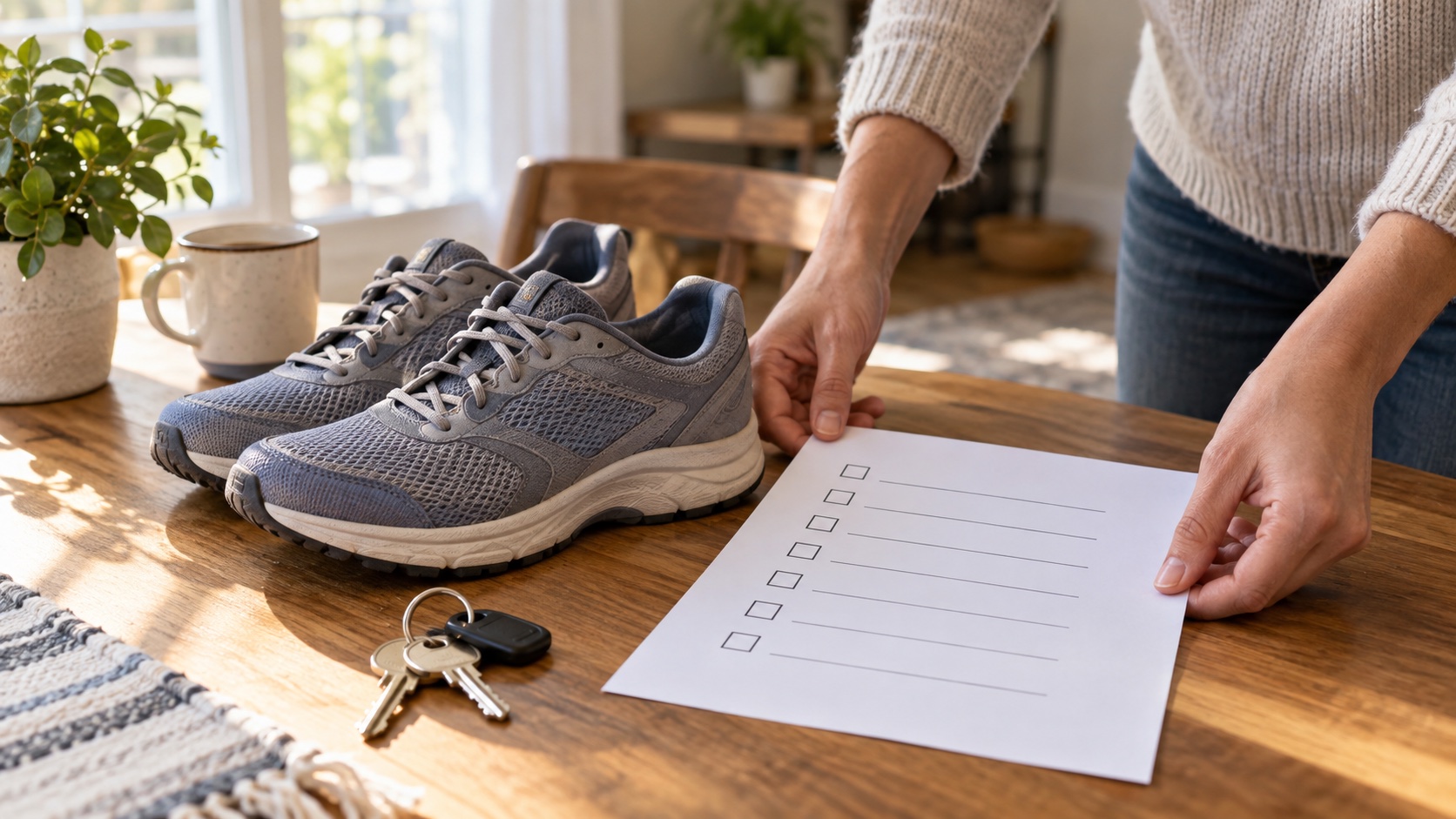
The Five Tools
- 📝 Implementation intentions — the highest-leverage tool: decide when and where in advance. "After I brush my teeth, I do 10 air squats" beats "I'll exercise more" every time, in every meta-analysis.
- 🏗️ Habit stacking — anchor the new behavior to an existing one: "After [current habit], I [new habit]." Stacking works because the cue is already automatic.
- 2. The 2-day rule — never miss twice. One missed session is noise; two is the start of a pattern. The rule exists to protect the streak's psychology, not perfectionism.
- 🏠 Environment design — add friction to bad defaults (phone in another room), remove it from good ones (walking shoes by the door). The literature's consistent verdict: environment beats willpower.
- 🪞 Identity framing — "I'm someone who trains" outperforms "I want to train." Behavior follows the story you're already telling.
Product picks are generic categories, not brands. We may earn a commission on Amazon or iHerb purchases at no cost to you — this never changes our evidence conclusions. Full disclosure
Comfortable walking shoes
May improve comfort and consistency for walking-based activity.
⚠️ Footwear cannot correct every pain problem; persistent foot, knee, or hip pain warrants appropriate evaluation.
Check price on Amazon →Installing a Protocol: The Recipe
- Pick ONE protocol — not three. One new protocol per month; everything else stays on maintenance.
- Shrink it to 2 minutes — the first week is the smallest possible version. A 2-minute version done daily beats an ideal version abandoned.
- Anchor it — attach it to an existing daily event with an implementation intention.
- Track the streak — a visible checkmark chain; the chain's own psychology does the enforcement.
- Review weekly — Sunday, 5 minutes: what fired, what didn't, one adjustment to the cue or the friction.
The Protocol × Anchor Map
| Protocol | Natural anchor (the cue) | 2-minute starter version |
|---|---|---|
| 🛏️ Sleep | Sunset / last meal | Set tomorrow's alarm at the same time |
| 🧘 Meditation | Morning coffee | Three slow breaths before the first sip |
| 🏋️ Resistance training | Existing calendar block | Five air squats when you log on for work |
| 🚴 Cardio | Post-lunch | Ten-minute walk after lunch |
| 📉 Weight loss | Grocery run | One protein item per shopping trip |
| ⏱️ Fasting | Dinner ends | Close the kitchen after dinner, no exception |
| 💓 Blood pressure | Morning bathroom | Cuff on the counter, one reading |
| 🩺 Quarterly audit | Calendar equinox/solstice | Book the lab order today |
⚖️ The honest caveat
Habit research is behavioral psychology, not cardiology: most trials are on simpler behaviors (exercise attendance, medication adherence, flossing) than multi-part protocols. The tools transfer well, but the site's own evidence tiers apply — this page is a synthesis of replicated findings, not a trial of this exact stack.
The Series Map
Seven parts — this page is the system; the six that follow are the deep dives into each working tool. Every other protocol on this site assumes these mechanics; install this series first if you're starting fresh.
| Part | Page | What you'll get |
|---|---|---|
| 1 | This page | The five tools and the install recipe — the system in one pass |
| 2 | Implementation Intentions & Stacking | The two strongest tools: when-X-then-Y plans and anchor habits |
| 3 | The 2-Day Rule & Streaks | Never miss twice — streak psychology and the minimum-viable day |
| 4 | Environment Design | Friction and defaults — make good easy, bad hard |
| 5 | Identity & Rebuilding | The relapse protocol and the self-label that predicts behavior |
| 6 | Review Systems | The weekly five minutes and the quarterly reset |
| 7 | Social Accountability | Commitment devices and the right kind of partner |
The Rest of This Series
Deeper pages in this series — one per situation, in no particular order. Read them when the situation arrives; none of them replace the plan above.
- 🔗 The Digital Environment: Notifications, Feeds & Attention Defaults — An audit of the attention defaults built into your phone: notifications, feeds, and interruption architecture.
- 🔗 Habit Change With a Partner or Household — Why household habits converge, how autonomy support beats policing, and how to run shared habits as two-week experiments instead of judgments.
- 🔗 Behavior Change During Travel, Holidays & Busy Seasons — The final tool in the habit series: a continuity floor, pre-commitments, and a re-entry plan that keep behavior change alive through travel, holidays.
Where the Evidence Lives
Habit science lives at the junction of behavioral psychology and the site's own pillars — this series operationalizes both:
- 🎨 What habits build over years — the Hobbies & Habits topic owns the long-view: habits as daily purpose, not just discipline.
- 😌 The downshift pattern — the Downshift Habit topic owns the Blue-Zones ritual habit — the daily small pause this series can install.
- 👥 The social layer — the Building Your Tribe topic owns why social norms shape behavior; Part 7 turns that into accountability.
- 🧭 Every protocol needs this page — each of the site's other protocols (sleep, fasting, training) assumes the install mechanics here.
- 🩺 The quarterly check — the Quarterly Self-Audit is the review system at the biomarker level; Part 6 links the two.
Troubleshooting the First Two Weeks
- 🚩 The new habit died by day four — the cue was vague or the habit too big. Shrink it to the 2-minute version and re-anchor it to an existing habit (Part 2's stacking fix).
- 🚩 Two habits installed, both failing — you installed two at once. One at a time; the second waits until the first runs without decision-making.
- 🚩 Motivation vanished on day ten — normal, and irrelevant: the environment should be doing the work by now. If it still depends on motivation, Part 4's friction audit is the fix.
- 🚩 Doing it but resenting every minute — the habit is too big or the wrong habit. Shrink it back to the 2-minute version for a week; if the resentment stays, the habit — not your discipline — is the problem, and Part 6's review exists to retire it cleanly.
- 🚩 Missed three days and feel like quitting — the all-or-nothing trap. The 2-day rule (Part 3) and the identity frame (Part 5) exist precisely for this moment.
If You Only Do Three Things
- 📝 Write one when-X-then-Y plan — the single most evidence-backed tool in this whole series, on paper, today (Part 2).
- 🏠 Make one environment change — one thing moved, one thing removed, so the good choice is the easy choice (Part 4).
- 📅 Never miss twice — the 2-day rule is the entire resilience system in four words (Part 3).
The Five Tools in One Day
A sample day with all five tools running, for a person installing the morning walk:
| When | What happens | Tool at work |
|---|---|---|
| 6:30 | Alarm; shoes beside the bed, water glass full | Environment (friction removed) |
| 6:35 | "After my first glass of water, I put on the shoes" | Implementation intention + stacking |
| 6:45 | 10-minute walk — the 2-minute version escalated | Minimum-viable day floor |
| 7:00 | Calendar gets an X while coffee brews | Streak tracking |
| Sunday | Five-minute review: what worked, one fix | Review system |
The tools aren't a checklist of virtues — they're a stack of defaults that run the day when motivation doesn't show up. Install them in that order and the habit installs itself.
Questions, Answered Briefly
- ❓ How long does a habit take to form? — The often-quoted 66 days is an average from one study (Lally et al., 2010); the honest range is weeks to months, and the feeling of automaticity — not the calendar — is the real marker.
- ❓ Do habit-tracking apps help? — Tracking helps by making progress visible (Part 3's calendar does the same with zero apps), but apps add a dependency. Paper works.
- ❓ Which habit should I install first? — The one that makes the others easier: sleep. The Sleep Protocol's wake anchor is the single highest-leverage install on this site.
- ❓ Can I ever stop tracking it? — Yes — that's the point. When the habit runs on autopilot, drop the tracker and keep the review (Part 6).
This Page in One Workflow
- 1. Pick one — one habit, the one that compounds (usually sleep or movement).
- 2. Shrink it — cut it to the 2-minute version that feels almost silly.
- 3. Anchor it — after an existing habit, same time and place (Part 2).
- 4. Engineer it — one environment change that makes it easier (Part 4).
- 5. Track and review — calendar X, weekly review, quarterly reset (Parts 3 & 6).
The Habit Install Checklist
- One habit chosen — the one that compounds
- 2-minute version written down
- Anchor habit named (existing habit it attaches to)
- One environment change made — friction removed
- Calendar X system started (paper or digital)
- The 2-day rule rehearsed: miss once = noise, miss twice = pattern
- The why is written next to the habit — identity statement, not just goal ("I'm a person who walks daily")
- Weekly 5-minute review booked (Part 6)
- Quarterly reset date set — keep, adjust, or drop
- No second habit started until the first runs without decision-making
- Anchor checked: the habit attaches to something that already happens daily, in the same place
- Misses handled by the 2-day rule — shame stays out of the loop
The Bottom Line
- Implementation intentions are the strongest tool — decide when and where, in advance.
- Anchor to what's already automatic — stacking beats starting.
- One protocol per month, shrunk to 2 minutes, never miss twice — that's the whole system.
- Environment beats willpower — design the friction, then relax.
Go Deeper: The Habit Formation Protocol
These five companion pages turn the topic into smaller, testable practices.
- 🔗 The habit loop, mechanized
- 🔗 Why willpower fails
- 🔗 The one-habit-at-a-time rule
- 🔗 Habit vs identity
- 🔗 The 66-day question
Related Topics
- Gollwitzer & Sheeran, "Implementation intentions and goal achievement: a meta-analysis of effects and processes," Advances in Experimental Social Psychology (2006)
- Gardner, Lally & Wardle, "Making health habitual: the psychology of habit-formation," British Journal of General Practice (2012)
- Lally et al., "How are habits formed: modelling habit formation in the real world," European Journal of Social Psychology (2010)
- Wood & Neal, "Healthy through habit: interventions for initiating and maintaining health behavior change," Behavioral Science & Policy (2016)