Meditation Environments: Beaches, Nature & Dark Rooms
Every tradition has a preferred room — but the instruction underneath all of them is the same: sit still, watch one thing, return when you wander. This page walks the six environments people actually use, with the honest framing up front: the setting is support, not requirement.
What the evidence supports
- Green-space exposure is linked to lower stress markers and better mood across meta-analyses — the strongest environment evidence here.
- Stable contexts stabilize behavior: consistent cues and locations are a well-replicated support for habit adherence.
- The dim, low-stimulus retreat room is the format this page operationalizes, consistent with attention-restoration reasoning.
What remains uncertain
- Blue-space research is emerging, mostly observational — promising associations, but causality and dose are unsettled.
- No head-to-head trials establish that one meditation environment produces better outcomes than another.
- Which setting suits which person is untested; the ranking below is practical, not an efficacy verdict.
Evidence last reviewed: August 13, 2026. Conclusions may change as new research is published.
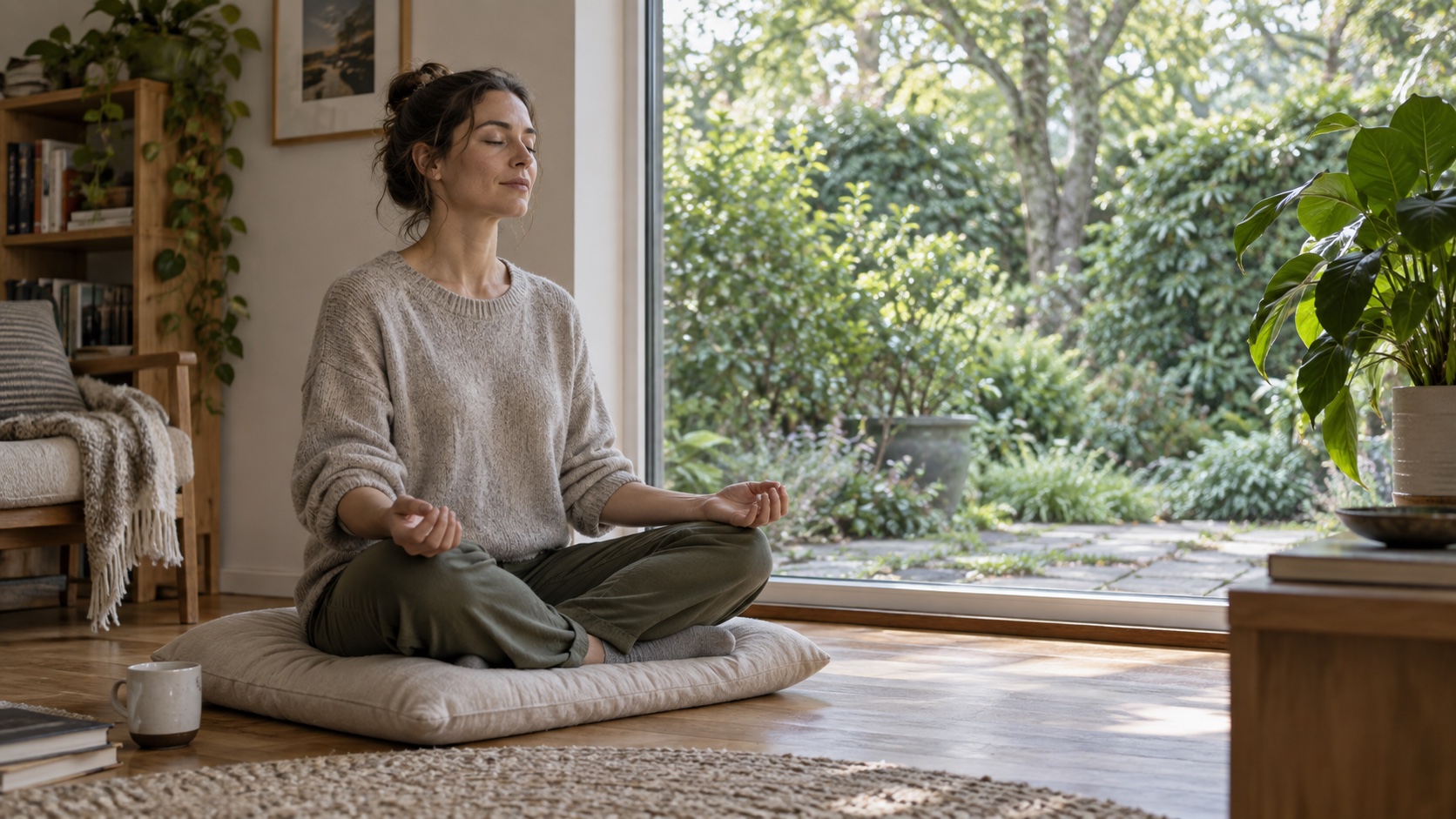
Support, Not Requirement
A bench by the ocean and a parked car both contain enough conditions to meditate. What the environment changes is the flavor of attention — and how likely you are to show up.
- 🧘 The core truth — the noticing-and-returning loop from Part 2 runs identically on a cushion, a rock, or a train seat — no setting is required.
- 🎨 Flavor, not mechanics — water gives a wide horizon, a forest gives layered sound, a dark room gives almost nothing — and "nothing" is itself a flavor. Settings change the object of attention, not the practice.
- 📈 Where environment actually matters — adherence. A fixed spot quietly removes the daily "where today?" decision — and removing small decisions is among the best-documented habit levers.
- 🧭 The honest read — choose for comfort and show-up odds, not imagined potency. If a setting becomes the excuse, the setting is the problem.
The Ranked Menu
Six environments, ranked by how reliably they get used — adherence first, romance second.
| Environment | What it gives | How to use it | Watch out for |
|---|---|---|---|
| 🏠 The home corner | A fixed cue — same cushion, wall, and time; the show-up decision is pre-made | Claim a corner facing one wall, light the candle to start, sit there daily | Don't let the corner get repurposed; a "good enough" corner beats a perfect room you never reach |
| 🌑 The dark quiet room | Minimal visual load; the traditional retreat format; attention sinks inward | Lights off or dimmed, curtains drawn, spine upright, 10–20 min | Dark plus lying down equals sleep; keep the spine upright and the sit anchored away from bedtime |
| 🌲 Park or forest | Layered natural sound and green; the strongest environment evidence in this territory | Bench sit 10 min, slow walk 5, sit again somewhere new; city parks count | Playgrounds, wind, and cold — see the seasonal plan below |
| 🌊 Beach or shoreline | A wide horizon and rhythmic sound; blue-space research is emerging, mostly observational | Eyes open at the horizon, waves as the anchor, or a slow barefoot walk | Sun, wind, and season — a weekly treat, not the daily default |
| 🚆 Commuter or office | Noise — free practice material; the environment you're already in | Normal seat, soften the gaze, use the rattle and announcements as the anchor, 5–10 min | Dozing on warm trains; keep the spine upright and a time cap on |
| 🏢 Workplace micro-sit | Two minutes anywhere; the only format that survives a full workday | Stairwell, car, or empty meeting room; phone face-down; three breaths in, one minute on the breath | Interruptions — and treating it as the main practice when it is only maintenance |
Product picks are generic categories, not brands. We may earn a commission on Amazon or iHerb purchases at no cost to you — this never changes our evidence conclusions. Full disclosure
Blackout shades or curtains
May reduce unwanted bedroom light and make a dark sleep setting easier to maintain.
⚠️ None expected from the product itself; install securely and preserve a safe route to exits.
Check price on Amazon →Beaches and Water: The Blue-Space Evidence
- 🌊 What blue space means — any visible water: ocean, lake, river, fountain. Systematic reviews find mostly favorable, mostly observational associations with well-being that persist after adjusting for exercise and income — but most studies are cross-sectional, so direction and dose remain open questions. Promising
- 👀 How to sit by water — eyes open at the horizon; a wide view naturally invites open monitoring. Let the wave rhythm carry the anchor when the breath feels thin; return when it doesn't.
- 🦶 The walking option — slow barefoot walking at the waterline is Part 5's informal walking meditation wearing a better view; cold sand keeps you honest about pace.
- ⚖️ The vacation trap — the beach is a treat, and treats don't build daily habits. Use water weekly or monthly; the home corner stays the daily default.
Forests and Parks: The Green-Space Session
- 🌲 The shinrin-yoku findings — Japanese field studies measured lower cortisol, pulse, and blood pressure after forest walks versus city walks. Effects are real and short-term; samples were small and "forest" often meant rural Japan. Moderate
- 🏞️ City parks count — greenspace meta-analyses link residential greenness with small health advantages; for sitting practice the bar is low — trees, birds, some distance from traffic. You do not need wilderness.
- 🪑 The bench-to-bench format — sit 10 minutes, walk slowly 5, sit again somewhere new. The walk between is practice, not a break — same skill, different anchor.
- 👂 What to notice — layered sound: wind, birds, leaves, distant traffic. Practice switching between one layer and the whole; the switching is the meditation.
- 🌡️ The season problem — outdoor sits die in winter unless the plan exists in advance: parks and water in fair months, the home corner in the cold ones, one outdoor sit a month when weather allows.
Dark Quiet Rooms: The Classic
The dim retreat hall is the format this whole series borrows from — and its logic is simple: vision is attention's biggest landlord.
- 🌑 Why darkness — remove the visual stream and the attentional load drops — less to track, less to resist, more bandwidth for the one thing you came to watch.
- 🕯️ The traditional setting — retreat halls everywhere use the same recipe: one dim room, fixed schedule, minimal stimuli, the same seat daily. It is load reduction, not decoration.
- 😴 The trap — darkness plus a reclined spine equals sleep, and a "meditation" that is always a nap stops being either. Sit upright; if dark sits end in dozing, move them earlier in the day.
| Retreat hall | Home version |
|---|---|
| 🕯️ A room with one purpose — practice, nothing else | A corner that keeps its purpose during sit time |
| 🌑 Total visual quiet — dim or no light | Curtains drawn, lights off, one candle as the only visual anchor |
| 🧘 Communal silence — others practicing beside you | Household rule: the corner is off-limits during the sit |
| ⏰ A fixed daily schedule | Same time daily, on the 2-day rule from the habit series |
The Home Corner: Building a Fixed Spot
- 🏠 Why a corner — the strongest environment effect in this territory isn't green or blue; it's stability. A fixed spot turns the sit into a habit instead of a daily decision.
- 🧱 The build — a cushion or chair, facing the same wall, at the same time. The wall matters: it closes the "what's happening over there" channel open sightlines keep feeding.
- 🕯️ The one-candle cue — lighting the candle starts the session. The cue does the remembering, so motivation doesn't have to; blowing it out ends it.
- 🏋️ The workout rule — the corner is for practice, not doom-scrolling or work calls. Protect its single meaning; a corner that means two things means neither.
- 🔗 The friction science — why fixed spots work is the habit series' territory: the Environment Design topic owns the friction-reduction mechanics. This page supplies the cushion; that page supplies the wiring.
Reusable earplugs
May reduce intermittent environmental noise at bedtime.
⚠️ Improper use can irritate the ear canal; users who need to hear alarms or caregiving cues should choose cautiously.
Check price on Amazon →Noisy and Public Environments: The Commuter Practice
The train and the open office hand you a stream of sound. The reframe: noise is not an enemy — it is content.
- 🚆 The reframe — sound is a ready-made object of attention, and attention on a moving target is exactly the skill being trained. Announcements, the rattle, the seatmate's call — all free material.
- 👂 The technique — sit normally, eyes open or softly closed, anchor on the breath, then widen to include the noise. When a sound grabs you, notice the grabbing — the noticing is the practice.
- 🎧 Earplugs are allowed — if the volume is genuinely unpleasant, use them; the skill-building version lets the sound in, but an unpleasant sit stops happening.
- ⏱️ The dose — 5 to 10 minutes, capped by the stop announcement. The commute sit is a supplement to the daily sit, never its replacement.
The Workplace Two-Minute Version
Two minutes, three breaths to settle, then attention on the breath. The bar is low on purpose: the format must survive a calendar full of meetings.
- 🪜 The stairwell — nobody schedules the stairwell. One flight down, two minutes on the landing, one flight back — the walk down is the settle.
- 🚗 The car — before leaving the lot or after arriving: a locked car is a one-person room. Park, sit, three breaths, two minutes, then the day resumes.
- 🚪 The empty meeting room — borrow one, don't book it. Door closed, phone face-down, a note on the door if colleagues interrupt.
- ⚖️ The guardrail — micro-sits are maintenance, not the main event. The home sit is the practice; the two-minute version is the field kit. If micro-sits are all that's left, the tricks page owns that conversation.
Where the Evidence Lives
This page is the where-to layer — the science behind each claim lives in the pillars, and this series references rather than repeats it:
- 🧘 The meditation science — the stress pillar's Meditation & Mindfulness topic owns what practice does to stress and attention; this page only asks where to do it.
- 🌬️ The breath as a portable anchor — the Breathwork topic owns the physiology of slow breathing and the long exhale; every environment here uses it as the default anchor.
- 🧪 The stress physiology — the Cortisol topic owns the stress-response mechanics that nature exposure is proposed to quiet.
- 🪜 Micro-recovery — the Downshift Habit topic owns brief, frequent recovery; the workplace micro-sit is that idea seated.
- 😴 Darkness and sleep — the Sleep Science of Repair topic owns why dark nights matter for restoration; the dark room is that principle in practice form.
What to Do When It Goes Wrong
Outdoor and shared settings fail in predictable ways. Five scenarios and the response that works:
- 🚩 The wind turns the sit into an endurance event — turn your back to it, hood up, or move to the lee side of a building or dune. A wind sit becomes a hearing sit — the gusts are the anchor. If wind is the whole experience, relocate: one relocated sit beats one skipped.
- 🚩 Cold hands are ending sits early — layers beat willpower: insulated mat, gloves, hat, warm drink first. Cold shortens sessions faster than boredom does; below your comfort threshold, move indoors — the home corner is always open.
- 🚩 Sitting with closed eyes outdoors feels conspicuous — people notice you far less than it feels; a still person on a park bench reads as "enjoying the sun." If being watched is the objection, sit with eyes softly open — the self-consciousness itself is practice material.
- 🚩 Distractions — the phone, the lawnmower, the neighbor — the phone goes on airplane mode before the sit starts; that is the whole defense. For the rest, treat interruptions as objects of attention: notice the itch to react and return to the anchor — the itch is a meditation object like any other.
- 🚩 Seasonal collapse — outdoor practice died with the first frost — name the indoor default (home corner or dark room) before the season turns, and keep one outdoor sit a month when weather allows. A practice with a seasonal plan survives winter; one without it usually doesn't.
Questions, Answered Briefly
- ❓ Which environment is best? — The one you return to. The evidence can't rank them; your attendance can. Home corner daily, park or water weekly, micro-sits for the workday.
- ❓ Do I need silence? — No. Silence is one flavor; noise is another — and for training attention, the noisy one may be the more demanding classroom. The commute practice above is built exactly for it.
- ❓ Is a dark room better than a bright one? — Not better — different. Darkness reduces visual load; some find that settling, others find it sleepy. Try both; keep whichever you actually sit in.
- ❓ Can I meditate lying on the beach? — You can, and you'll often fall asleep — which is rest, not practice. Sitting upright keeps the session a session; lying down is a nap in a meditation costume.
🪑 The room is seasoning
The cushion is the practice; the room is the seasoning. Pick the corner you'll actually sit in, defend it, and let beaches and forests stay treats, not requirements.
The Bottom Line
- Environment changes flavor and adherence — not the core skill — the loop runs anywhere.
- Home corner is the daily default; park and water are weekly treats; micro-sits are maintenance.
- Noise is an object of attention, not an enemy.
- If the setting becomes the excuse, the setting is the problem — a bad-environment sit still counts.
This Page in One Workflow
- Pick the daily spot — home corner, dark room, or office micro-sit — and write down where it is.
- Build the cue — candle, cushion placement, same wall. The cue starts the sit.
- Schedule two outdoor sessions this week — park or water — as treats, not requirements.
- One commute or workday micro-sit per day — stairwell, car, or borrowed meeting room.
- Judge by attendance at week's end — the setting you actually used most is your primary environment. Keep it.
The Daily Checklist
- Home corner intact — cushion in place, same wall, cue ready
- One sit done, indoors or out, and the environment logged in one word
- Phone on airplane mode before the sit starts
- One workplace or commute micro-sit attempted
- Outdoor conditions noted — wind, cold, sun — and tomorrow's setting adjusted
- The setting didn't become the excuse — a bad-environment sit still counts
The Weekly Checklist
- Two outdoor sessions attempted — park or water
- Home corner decluttered and re-reserved for practice
- Seasonal plan checked — the indoor default is named for the coming month
- One new environment tried — anything from the menu not yet visited
- Week reviewed honestly: which setting got the most sits? Keep it
Go Deeper: Meditation Environments
These five companion pages turn the topic into smaller, testable practices.
- 🔗 The environment evidence
- 🔗 The nature option
- 🔗 The dark-room retreat
- 🔗 The public-space practice
- 🔗 Building the home corner
Related Topics
- White, M.P. et al., "Blue space, health and well-being: a narrative overview and synthesis of potential benefits," Environmental Research (2020)
- Gascon, M. et al., "Outdoor blue spaces, human health and well-being: a systematic review of quantitative studies," International Journal of Hygiene and Environmental Health (2017)
- Park, B.J. et al., "The physiological effects of Shinrin-yoku (taking in the forest atmosphere or forest bathing): evidence from field experiments in 24 forests across Japan," Environmental Health and Preventive Medicine (2010)
- Twohig-Bennett, C. & Jones, A., "The health benefits of the great outdoors: a systematic review and meta-analysis of greenspace exposure and health outcomes," Environmental Research (2018)
- Ohly, H. et al., "Attention Restoration Theory: a systematic review of the attention restoration potential of exposure to natural environments," Journal of Toxicology and Environmental Health, Part B (2016)