Audit Shortcuts: Making It Painless
The first five parts of this series told you what to measure and what the numbers mean. This part answers the question the other five quietly ignore: how do you get yourself to actually do the audit, four times a year, without it becoming a production? The answer is not more motivation. It is less friction — thirteen ranked shortcuts, each one removing a small piece of the cost, until the whole audit fits inside thirty minutes.
What the evidence supports
- Implementation-intention plans ("I will do X at time T in place P") reliably increase follow-through on health behaviors in meta-analyses.
- Reminders tied to one specific action at one specific moment improve appointment attendance and screening uptake.
- Social support and doing the task with others consistently improve exercise and self-monitoring adherence.
- Pre-staging and batching — reducing setup friction — is a recurring theme across habit-formation research.
What remains uncertain
- Which single shortcut matters most — studies rarely test these devices head-to-head or in combination.
- How much the shortcuts change long-term health outcomes rather than just completion rates.
- Whether calendar anchoring works as well for self-initiated audits as for externally scheduled appointments.
Evidence last reviewed: August 13, 2026. Conclusions may change as new research is published.
The Point of This Page
The audit is not hard. What is hard is everything around the audit — the scheduling, the staging, the ordering, the follow-through. Four times a year, those small costs stack up against a Sunday morning that has better offers.
Every shortcut below does the same thing: it lowers the cost of the audit instead of raising your enthusiasm for it. Enthusiasm is weather. Cost is architecture, and architecture is reliable.
The Core Stack: Shortcuts 1–7
The ladder is ordered by how much of the thirty-minute audit each shortcut carries. The first seven are the core stack — with them in place, the audit nearly runs itself.
- 📅 Calendar anchoring — the first Sunday of the quarter — What to do: the moment you finish this page, create a recurring calendar event for the first Sunday of January, April, July, and October — with a time, a location, and a link back to this page. Why it works: a fixed date beats a floating intention. Implementation-intention research finds that "when and where" plans roughly double follow-through versus "I'll do it sometime" — and a recurring event is a plan you set once, forever.
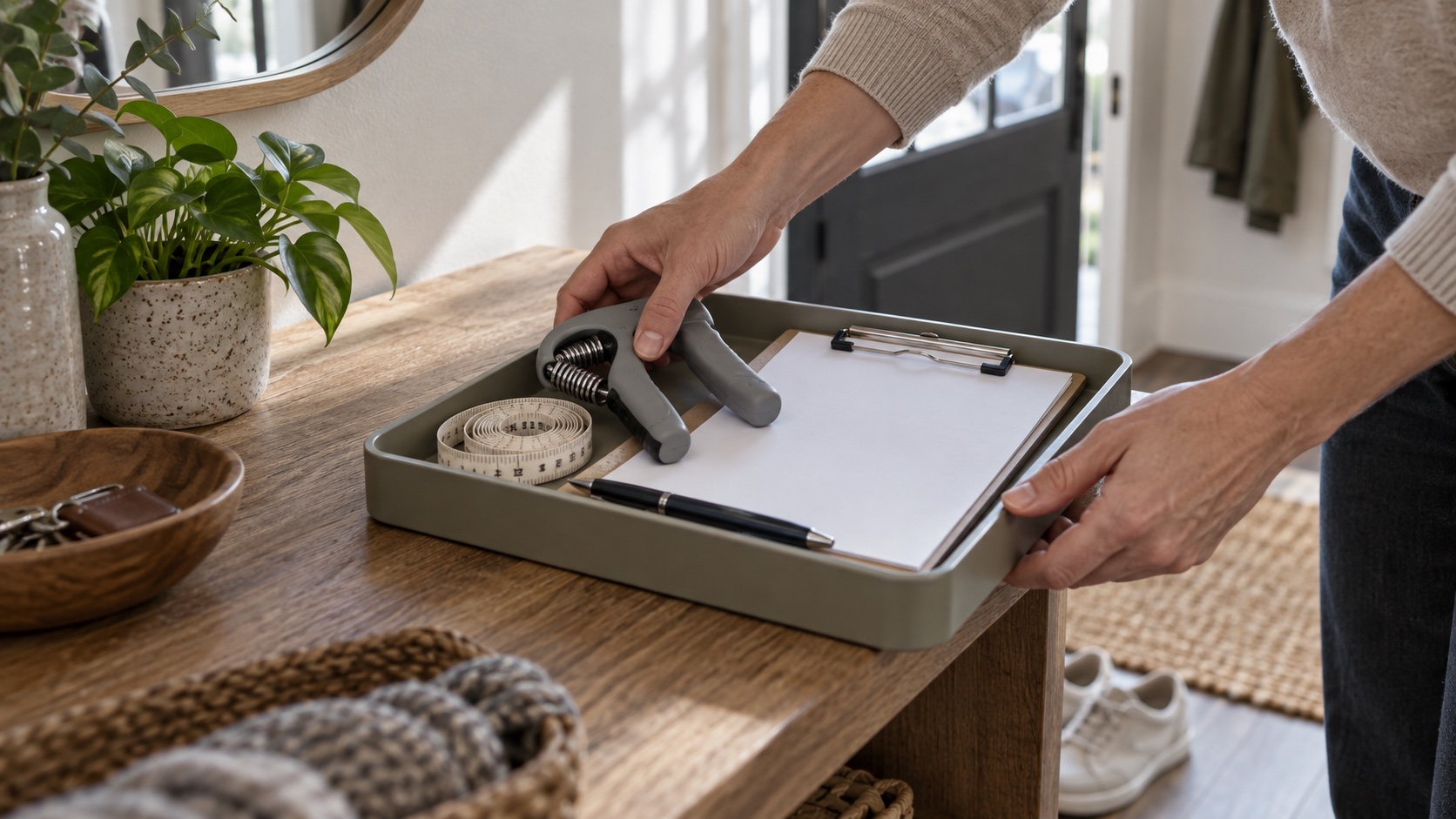
- 🎒 The thirty-minute kit — What to do: stage everything in one drawer — blood pressure cuff, tape measure, dynamometer, printed sheet, pen. It lives assembled and is never disassembled. Why it works: every item you have to hunt for is a decision point, and Sunday morning is the worst place to ask for decisions. Pre-staged equipment removes friction at exactly the moment the audit is most likely to die.
- 🧾 Batch lab ordering — What to do: one request to your clinician, one visit to the lab, every marker — ApoB, HbA1c, fasting glucose, the lipid panel — drawn in a single sitting. Why it works: three lab visits are three separate obstacles; one standing order is one stop. Batching also time-matches every number, which is what makes the quarter-to-quarter comparison valid.
- 🔔 The phone reminder stack — What to do: three timed nudges, set when you book the anchor. Ten days out: order the labs. Two days out: pack the kit and print the sheet. The morning of: do the audit. Why it works: reminders land hardest when each one cues a single concrete action at a single moment — three small tasks survive far better than one big vague "don't forget."
- 🖊️ The pre-filled sheet — What to do: before you measure anything, copy last quarter's numbers into the new sheet's "last quarter" column. Why it works: the hardest line on any sheet is the first one. A sheet that arrives half-filled turns the audit from a blank-page chore into a comparison — and the comparison is the entire point of auditing.
- 🌅 The same-morning rule — What to do: labs in the morning, fasted; home measures the same morning; everything done by lunch. Why it works: fasting labs demand the morning anyway, so pairing them with the home measures kills the "I'll do it this weekend" drift. Same-day, same-conditions measures also strip circadian and fed-state noise out of the comparison.
- 🧑🤝🧑 The partner audit — What to do: do it with someone — spouse, friend, training partner. Swap measurements, compare sheets over coffee. Why it works: honest answer — a second person in the room roughly doubles the chance the audit happens, because nobody wants to be the one who cancels. Social accountability is one of the most reliable adherence effects in the behavior literature.
Product picks are generic categories, not brands. We may earn a commission on Amazon or iHerb purchases at no cost to you — this never changes our evidence conclusions. Full disclosure
Flexible body-measurement tape
Can help track waist circumference when a person and clinician choose to monitor it.
⚠️ Can encourage unhelpful body checking for some people; a measurement is a risk marker, not a diagnosis or a worth score.
Check price on Amazon →The Fine-Tuners: Shortcuts 8–13
The second tier makes the series last — they protect the trend once the habit exists.
- 🧭 The one-action rule — What to do: every audit ends with exactly one behavior change, written on the sheet. Why it works: an audit that produces five resolutions produces none — the list gets carried home and forgotten. One committed change per quarter is four per year, and four compounding changes a year is what moves the trend lines you are measuring.
- 🏥 One lab, forever — What to do: same lab, same draw conditions, same time of day, every quarter. Why it works: between-lab and day-to-day variation can swamp the small shifts you are hunting. Consistency is what converts a series of snapshots into an actual trend you can trust.
- 🖐️ The five-marker minimal audit — What to do: when life is chaos, shrink the audit to five numbers — blood pressure, ApoB, HbA1c, waist, grip. Why it works: a minimal audit still catches the markers where metabolic risk concentrates, and it takes twenty minutes. A skipped audit catches nothing. Done beats perfect.
- 📮 The result slot — What to do: book a fifteen-minute calendar slot three days after the draw to open the results and write the comparison. Why it works: unopened results are the audit's most common silent death — the lab visit happened, the insight never did. A slot makes "read and compare" as real as the draw itself.
- 🗓️ Stack it on an existing anchor — What to do: piggyback the audit on a quarterly ritual you already keep — seasonal house maintenance, the equinox, a quarterly review at work. Why it works: new habits attach to old ones far more easily than they stand alone. Borrowing an existing anchor's momentum is free, and a borrowed anchor never gets forgotten.
- ⏭️ Skip a quarter, honestly — What to do: traveling, post-surgery, or sick? Skip — write "skipped: travel" on the sheet and resume at the next anchor. Why it works: an honest gap leaves a visible hole in the trend, and the trend survives it. What kills the series is not the gap — it is the quiet, guilty abandonment that follows a missed quarter.
| Shortcut | What to do | Why it works | Effect |
|---|---|---|---|
| 📅 Calendar anchoring | Recurring event, first Sunday of each quarter | Fixed dates beat floating intentions | Strong |
| 🎒 The thirty-minute kit | One drawer, fully staged, never unpacked | Removes decision points at low-motivation moments | Strong |
| 🧾 Batch lab ordering | One request, one visit, all markers | One obstacle instead of three; time-matched numbers | Strong |
| 🔔 Reminder stack | Three nudges: order, pack, do | One concrete action per reminder | Good |
| 🖊️ Pre-filled sheet | Copy last quarter's numbers in first | Turns a blank page into a comparison | Strong |
| 🌅 Same-morning rule | Labs and home measures, done by lunch | Kills rescheduling drift; matched conditions | Good |
| 🧑🤝🧑 Partner audit | Measure with someone, compare over coffee | Hard to cancel on a friend | Good |
| 🧭 One-action rule | One behavior change, written and dated | Five resolutions produce zero changes | Moderate |
| 🏥 One lab, forever | Same lab, time, conditions every quarter | Converts snapshots into a trend | Good |
| 🖐️ Five-marker minimal | BP, ApoB, HbA1c, waist, grip — twenty minutes | Done beats perfect; catches the risk concentrators | Strong |
| 📮 The result slot | Fifteen-minute slot to open and compare results | Unopened results are the silent killer | Moderate |
| 🗓️ Stack on an anchor | Piggyback on a quarterly ritual you keep | New habits attach to old anchors | Moderate |
| ⏭️ Skip a quarter, honestly | Write the reason, resume at the next anchor | Visible gaps survive; silent abandonment doesn't | Moderate |
The thirteen shortcuts at a glance — effect ratings reflect how much adherence research stands behind the mechanism.
What the Shortcuts Actually Buy You
The honest way to read the stack: none of it raises motivation. It removes minutes — of setup, of travel, of decision. The chart below is the point, in one picture: the same audit, the same numbers, at four different time costs depending on what you staged in advance.
Hand-grip dynamometer
Can track grip-strength performance over time when measured consistently.
⚠️ Readings can be affected by pain, arthritis, technique, and device variation; a result is not a diagnosis.
Check price on Amazon →The Thirty-Minute Audit, Start to Finish
With the core stack in place, the audit morning has six stops. The order matters less than the fact that it ends.
Skipping a Quarter, Honestly
The skip rule deserves its own section because it is the shortcut people most resist taking. Missing a quarter because you were traveling, recovering from surgery, or sick is not a failure of the system — it is an event the system was designed to absorb.
- 📝 The honest skip — write the reason on the sheet: "skipped: travel." The gap becomes a visible, labeled hole in the trend instead of a mystery.
- 🗓️ The resume rule — you do not owe the trend a catch-up audit. Resume at the next anchor, with the pre-filled sheet picking up where the last completed quarter left off.
- 🚫 What actually ends the series — not the gap. The quiet abandonment: one skipped quarter becomes "I'll restart when things calm down," and the anchor goes silent forever. A written skip is the vaccine against that.
- 🏥 The exception — a health scare, a new symptom, or a concerning number is not a skip situation. That is when the audit — or a clinician visit — moves to the top of the week, not the next quarter.
Common Pitfalls and How to Overcome Them
The audit fails in six predictable ways, and each failure has a countermove already built into the shortcuts above.
| Pitfall | Why it happens | The countermove |
|---|---|---|
| Audit perfectionism | "If I can't do the full twelve-marker audit, I won't do one at all" — the perfect becomes the enemy of the done | The five-marker minimal audit. Twenty minutes of five numbers beats a skipped quarter, every time. |
| Lab anxiety avoidance | Fear of the needle or of the number turns into "I'll book the draw next month" | The same-morning rule plus a partner audit. Fear shrinks when the appointment is calendared, batched, and shared. |
| Collecting without comparing | Numbers get recorded but never placed next to last quarter's | The pre-filled sheet. The comparison is the audit; a sheet that arrives pre-filled makes missing it nearly impossible. |
| The endless-spreadsheet trap | Each quarter brings a new, better tracking system; the data ends up in five incompatible files | One sheet, one format, forever. "Better" is the enemy of "continues." |
| Skipping when busy | Busy quarters get skipped quietly, and one quiet skip becomes the new normal | The five-marker floor plus the honest skip rule. A written skip preserves the series; a silent one ends it. |
| Data hoarding without action | A decade of numbers, zero behavior changes — the audit becomes an archive, not an instrument | The one-action rule. Every audit ends with exactly one change, written and dated. |
Six failure modes and their built-in countermoves.
Where the Evidence Lives
The Metabolic pillar owns the lab science: what ApoB and HbA1c actually mean, why a fasted draw matters for glucose, and how a seated blood pressure reading should look. The Biomarker Testing guide carries the marker-by-marker detail and the Blood Pressure topic owns the cuff protocol. This page borrows the numbers; the pillar explains them.
- 🧪 The markers and their thresholds — Blood Markers is the ApoB, HbA1c, and glucose reference for this series.
- 📏 The measurement technique — Body Metrics covers waist, grip, and balance so the numbers mean what they claim to.
- 😴 The wearable data — Sleep & Recovery handles regularity and resting heart rate.
- 📋 The sheet itself — Tracking Sheets documents the four-column log this page keeps mentioning.
- 🩺 The series spine — The Quarterly Self-Audit lead ties the six parts together.
What to Do When It Goes Wrong
Even a friction-proof system meets friction. Five scenarios that actually happen, with the response that works:
- 🚩 The anchor Sunday arrived and you did nothing — do not reschedule to "sometime." Move it to the next Sunday morning and arm the reminder stack now. A late audit is still a data point; a rescheduled-forever audit is not.
- 🚩 The lab results came back and you haven't opened them — this is what the result slot is for. Open, compare, write one action. Unread results decay into an unread archive faster than you'd believe.
- 🚩 Three quarters of data look noisy — noise usually comes from changed conditions, not changed biology: a different lab, a different draw time, a cuff on the wrong arm. Stabilize conditions with "one lab, forever" and the same-morning rule for two quarters before reading any trend.
- 🚩 The kit is dead — flat batteries, lost tape — restock the moment the audit ends, not before the next one begins. The kit's whole job is to never be missing a part when Sunday arrives.
- 🚩 You are avoiding the audit because a number is probably bad — the number is already true; the audit only reveals it. Book the draw and bring the partner. A bad number found in March is a problem you can act on by June; an unmeasured one is just a problem.
Questions, Answered Briefly
- ❓ Do I really need to do this every quarter? — No. Quarterly is the cadence that catches trends before they harden into diagnoses, but the five-marker minimal audit is the floor, and honest skips are part of the design. Two audits a year beats zero audits forever.
- ❓ Is the first Sunday of the quarter magic? — No. Any fixed recurring date works — the magic is in the fixity. Pick a day you can defend four times a year and set it to repeat.
- ❓ If I could only keep one shortcut, which should it be? — Calendar anchoring. Without a date, nothing else on this page fires. With a date, the rest of the stack tends to build itself out of necessity.
- ❓ I skipped two quarters — is the series ruined? — No. The trend now has a visible gap, and a visible gap is honest data. Resume at the next anchor with the pre-filled sheet; the past is still there to compare against.
⏰ The thirty-minute truth
Motivation decides whether you do the first audit. Architecture decides whether you do the fortieth. Everything on this page is architecture: lower the cost of the audit until skipping it takes more effort than doing it.
The Bottom Line
- Anchor it or lose it — first Sunday of the quarter, set once, repeats forever.
- Stage everything — kit, labs, sheet. Friction is the real enemy, not motivation.
- The audit is a comparison, not a collection — pre-filled sheet in, one action out.
- A minimal audit beats a skipped one — five markers and honest gaps are part of the design.
This Page in One Workflow
- Anchor — set the recurring calendar event for the first Sunday of each quarter, and arm the reminder stack.
- Order — batch lab request sent ten days out, one visit, all markers.
- Stage — kit drawer packed, sheet pre-filled with last quarter's numbers.
- Execute — fasted labs and home measures the same morning, done by lunch.
- Compare & act — one action written and dated, sheet filed, next anchor already on the calendar.
The Daily Checklist
On the audit day, seven items cover the whole morning:
- Kit on the table the night before — cuff, tape, dynamometer, sheet, pen
- Morning draw done, fasted, at the usual lab
- Home measures done the same morning, same order as last quarter
- Numbers entered into the pre-filled sheet — nothing reformatted, nothing rebuilt
- Comparison written: this quarter vs last, one line per marker
- One action chosen and written at the bottom of the sheet
- Sheet photographed and filed with the previous ones
The Weekly Checklist
In the weeks around the anchor, six items keep the stack armed:
- Anchor date verified on the calendar — first Sunday of the quarter
- Batch lab request sent, or the standing order confirmed
- Kit drawer checked — batteries, tape, blank sheet printed
- Partner or accountability text confirmed for the morning
- Last quarter's sheet pulled and the new one pre-filled
- If life is chaos: switch to the five-marker minimal audit — never a silent skip
Go Deeper: Audit Shortcuts
These five companion pages turn the topic into smaller, testable practices.
- 🔗 The batch-it rule
- 🔗 The at-home kit question
- 🔗 The calendar automation
- 🔗 The minimum-viable audit
- 🔗 The spouse/pairing effect
Related Topics
- Gollwitzer & Sheeran, "Implementation intentions and goal achievement: A meta-analysis of effects and processes," Advances in Experimental Social Psychology (2006)
- Milkman et al., "Using implementation intentions prompts to enhance influenza vaccination rates," PNAS (2011)
- Rogers & Milkman, "Reminders through association," Psychological Science (2016)
- Carron, Hausenblas & Mack, "Social influence and exercise: A meta-analysis," Journal of Sport & Exercise Psychology (1996)
- Wood & Neal, "A new look at habits and the habit-goal interface," Psychological Review (2007)