Conversation Across Generations
The intergenerational conversation is the rare cognitive activity that pays both directions at once: the elder gets purpose, novelty, and a genuine five-system workout; the child gets a language-rich exchange and a model of what aging looks like from the inside. This page walks the longevity data behind the exchange, the one structured program that tested it, and the dose-response that separates benefit from burden.
What the evidence supports
- In the Berlin Aging Study, older adults who provided grandparental care or helped others in their network lived longer, with part of the benefit running through better health years later (Hilbrand et al., 2017).
- In the Women's Healthy Ageing Project, grandmothers caring for grandchildren about one day per week had better late-life cognition than those caring none or five-plus days (Burn & Szoeke, 2015).
- Experience Corps, a structured tutoring program, improved executive function and physical activity in older volunteers — and reading outcomes in the children tutored.
What remains uncertain
- Selection: healthier grandparents take on caregiving in the first place, so the longevity link cannot be read as "babysitting adds years."
- The inverted-U matters — full-time custodial care and heavy spousal caregiving associate with strain and worse health (Schulz & Beach, 1999); the tipping point is personal.
- No study separates the conversation itself from the purpose, movement, and social role that come with it.
Evidence last reviewed: August 15, 2026. Conclusions may change as new research is published.
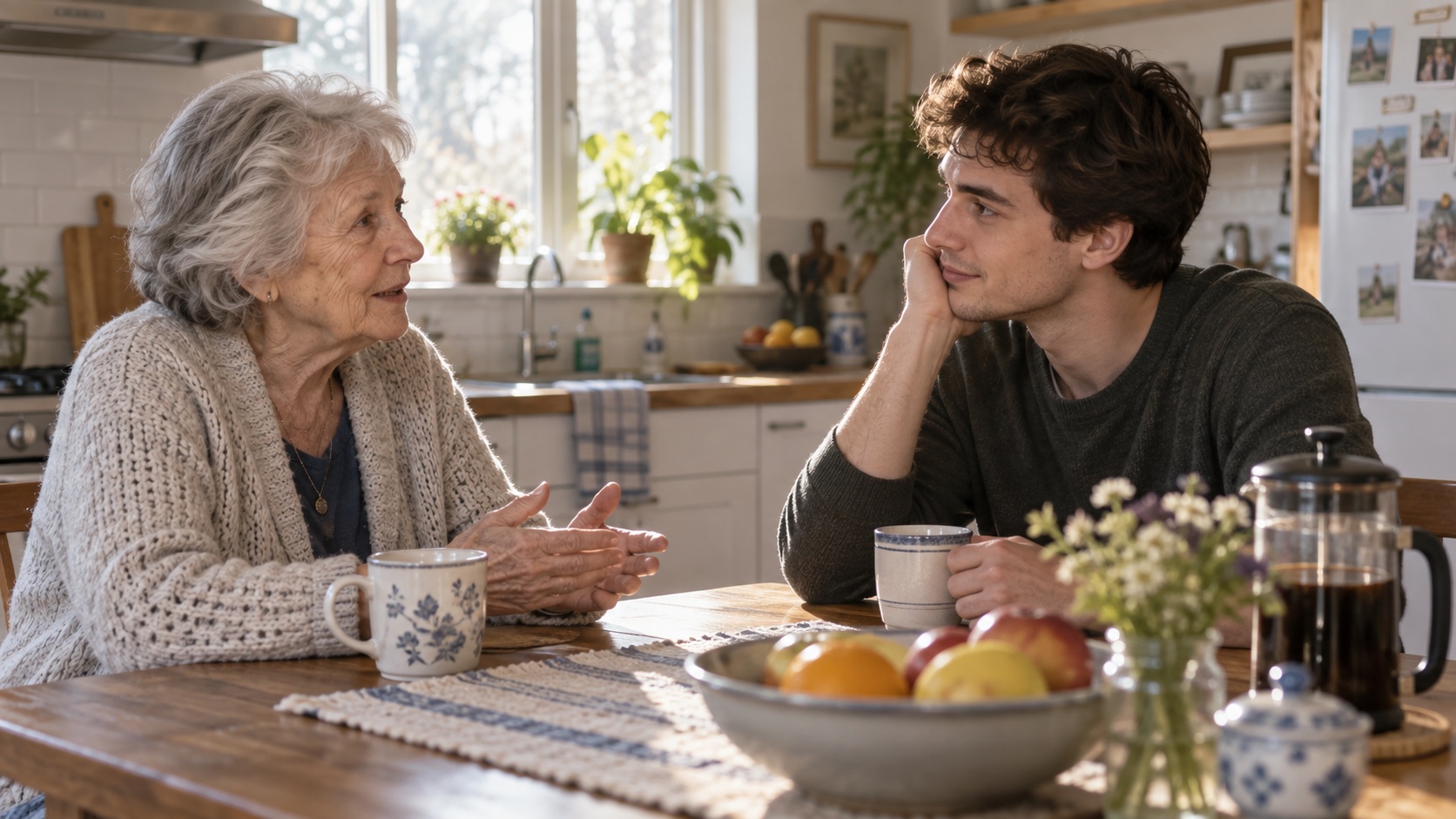
The Berlin Grandparent Finding
The foundational study is the Berlin Aging Study: 516 older adults in Berlin, interviewed at baseline in 1990–1993 at a mean age of 85, then followed for up to two decades (Hilbrand et al., Social Science & Medicine, 2017). Two behaviors stood out for longevity: providing grandparental care, and helping others in one's social network — errands, support, companionship. Both were associated with lower mortality over the follow-up, and the analyses suggested part of the effect ran through better self-reported health years later, consistent with the idea that helping is not just a marker of being well but a contributor to staying well. The authors were careful about the obvious confound — people in poor health do not volunteer for childcare — and their models adjusted for prior health and sociodemographics, but selection can never be fully removed in an observational cohort. The honest summary: caregiving associates with survival, plausibly through purpose and activity, and the association survives adjustment.
The Dose-Response Curve
The sharpest caution in this literature is the shape of the curve. In the Women's Healthy Ageing Project, grandmothers who provided care for grandchildren about one day per week performed better on late-life cognitive testing than grandmothers who provided none — and better than those providing five or more days per week (Burn & Szoeke, Maturitas, 2015). The same inverted-U appears in the European SHARE data, where providing grandchild care associated with better verbal fluency in grandparents (Arpino & Bordone, 2014). One day of care looks like engagement; seven days looks like a second job with no recovery.
The dose lesson generalizes: intergenerational contact is like most hormetic inputs on this site — beneficial at a moderate dose, corrosive at an extreme one. The same dataset that shows the benefit of ordinary grandparenting also describes the exception: custodial grandparents and full-time caregivers carry the health costs of sustained strain, a pattern documented most famously for spousal caregivers (Schulz & Beach, JAMA, 1999).
Experience Corps: The Structured Version
The closest thing to a controlled test of the exchange is Experience Corps, a program that placed older adults in public elementary schools as tutors and mentors for about 15 hours per week. The findings ran both ways. The children in participating schools improved in reading outcomes and classroom behavior (Rebok et al., 2004). The volunteers — studied specifically among women at elevated risk for cognitive decline — showed improvements in executive function and increases in physical activity relative to controls (Carlson et al., The Gerontologist, 2008). The honest scope note: participants were self-selected, the cognitive effects were modest and not uniform across measures, and the program bundled conversation with purpose, structure, and movement — which is exactly the point, and exactly why no single ingredient can be isolated. The purpose-through-service topic owns the volunteering side of the evidence; this page keeps the conversational frame.
What Actually Flows Between Generations
The exchange is asymmetric in its best way — each side receives what the other has in surplus:
- 👶 The child receives a patient, language-rich interlocutor with no place to be — questions answered slowly, stories told properly, and a working model of what an old life actually looks like, which is a form of education schools do not sell.
- 👵 The elder receives novelty (children ask what adults have stopped asking), generativity — the Eriksonian sense of mattering to the next generation — and a social role that is not optional, which is the difference between being present and being needed.
- 🧠 Both receive the workout. Cross-generational conversation loads the full system hardest precisely because the other mind is least predictable — different vocabulary, different references, different pacing. That unpredictability is the training stimulus.
- 🪞 And both receive a mirror. The child sees a future with texture; the elder sees their past through fresh eyes. The storytelling that results is depth talk in its most natural form — the substantive-conversation data applies at every age.
Making It Real
- 📅 Aim for the sweet spot, not the job. One day a week of real involvement beats seven days of resentful logistics — the inverted-U is the design constraint.
- 🏫 Prefer structured roles. Tutoring, mentoring, reading programs — roles with boundaries protect the dose and multiply the benefit (the Experience Corps model).
- ❓ Ask, rather than instruct. The five-question upgrade works upward in age as well as down; the elder asked about their life talks longer and deeper than the elder told to tell a story.
- 👂 Mind the ears. Cross-generational talk lives or dies on hearing — the hearing-loss loop is the number-one silent barrier to the exchange.
- 🔄 Frame it as reciprocity. "You are not the one who gives and the child the one who receives" is not politeness — it is the mechanism. Both directions of the exchange are documented, and believing it keeps the exchange alive.
⚠️ The same curve that rewards one day punishes seven
Full-time caregiving — custodial grandparenting, care for a disabled spouse — is associated with elevated mortality and worse health in its own literature (Schulz & Beach, JAMA, 1999). Watch for the signs of tipping: chronic resentment, sleep loss, your own appointments slipping. Respite, boundaries, and formal support are not failures of love; they are what let the exchange stay mutual. If caregiving strain is affecting your health, that is a conversation for a clinician, not a pep talk.
Who Else Benefits
The intergenerational benefit is not confined to bloodlines. The Berlin finding included helping people outside the family — the neighbor, the friend, the community group — with the same survival association (Hilbrand et al., 2017). Mentoring programs, community organizations, and the simple practice of talking to people twenty years older or younger than you capture the mechanism without the custody obligations. If your family geometry does not include grandchildren, the exchange is still available — it lives in every conversation where the two of you are strangers to each other's decade.
| Role | What the evidence says | Read |
|---|---|---|
| 👵 Non-custodial grandparent care (~1 day/week) | Lower mortality in the Berlin Aging Study; best late-life cognition in the WISE cohort | Benefit |
| 🎓 Structured tutoring (Experience Corps) | Executive-function and activity gains in older volunteers; reading gains in children | Benefit |
| 🤝 Helping others in your network | Associated with longevity beyond family lines (Hilbrand et al., 2017) | Benefit |
| 🛋️ No intergenerational contact | Missing the exchange — and the cognitive novelty it supplies | Missing out |
| 👶 Full-time custodial care | Strain and health costs in caregiver research — the cautionary arm of the curve | Caution |
The Bottom Line
- The exchange pays both directions — longevity and better health for helping elders, language and modeling for children, and a full cognitive workout for both.
- Dose decides the direction — about one day a week of grandparenting associated with the best cognition; five-plus days flips the association negative.
- Structure protects the benefit — bounded roles like tutoring (Experience Corps) delivered measurable gains in executive function and children's reading, without the custody burden.
- The exchange does not require bloodlines — helping anyone outside your age cohort captures the mechanism; guard the dose, mind the hearing, and keep it mutual.
Related Topics
- Hilbrand et al., "A prospective study of associations among helping, health, and longevity," Social Science & Medicine (2017)
- Burn & Szoeke, "Grandparenting predicts late-life cognition: Results from the Women's Healthy Ageing Project," Maturitas (2015)
- Arpino & Bordone, "Does grandparenting pay off? The effect of child care on grandparents' cognitive functioning," Journal of Marriage and Family (2014)
- Carlson et al., "Exploring the effects of an 'everyday' activity program on executive function and memory in older adults: Experience Corps," The Gerontologist (2008)
- Rebok et al., "Short-term impact of Experience Corps participation on children and schools," Journal of Urban Health (2004)
- Schulz & Beach, "Caregiving as a risk factor for mortality: The caregiver health effects study," JAMA (1999)