Sauna & the Brain
The brain is where the sauna story gets both its most exciting headline and its most fragile footing. One Finnish analysis reported that men who bathed four to seven times a week developed dementia at roughly a third the rate of once-weekly bathers — and a separate Finnish cohort found no such association at all. This page walks the finding, the failed replication, and the heat-shock-protein biology that sits between them, so you can tell the promising mechanism from the unproven claim. The cardiovascular half of the story lives on the heart page; here, the cortex.
What the evidence supports
- In the Kuopio cohort, 4–7 sauna sessions weekly were associated with hazard ratios near 0.66 for dementia and 0.65 for Alzheimer's disease over about 20 years of follow-up.
- Heat reliably activates heat shock proteins — the cell's protein-repair machinery — and misfolded-protein accumulation is a core feature of neurodegenerative disease.
- A sauna session's cooling rebound supports the body-temperature drop that deep sleep depends on, giving heat a plausible indirect route to brain health.
What remains uncertain
- The dementia finding's confidence intervals were wide, and a separate Finnish cohort analysis (Knekt et al., 2020) found no protective association.
- Human data on sauna and brain-specific biomarkers are thin; the mechanism story rests mostly on cell and animal work.
- No trial has tested whether adding sauna changes dementia risk — the epidemiology is all we have, and it disagrees with itself.
Evidence last reviewed: August 15, 2026. Conclusions may change as new research is published.
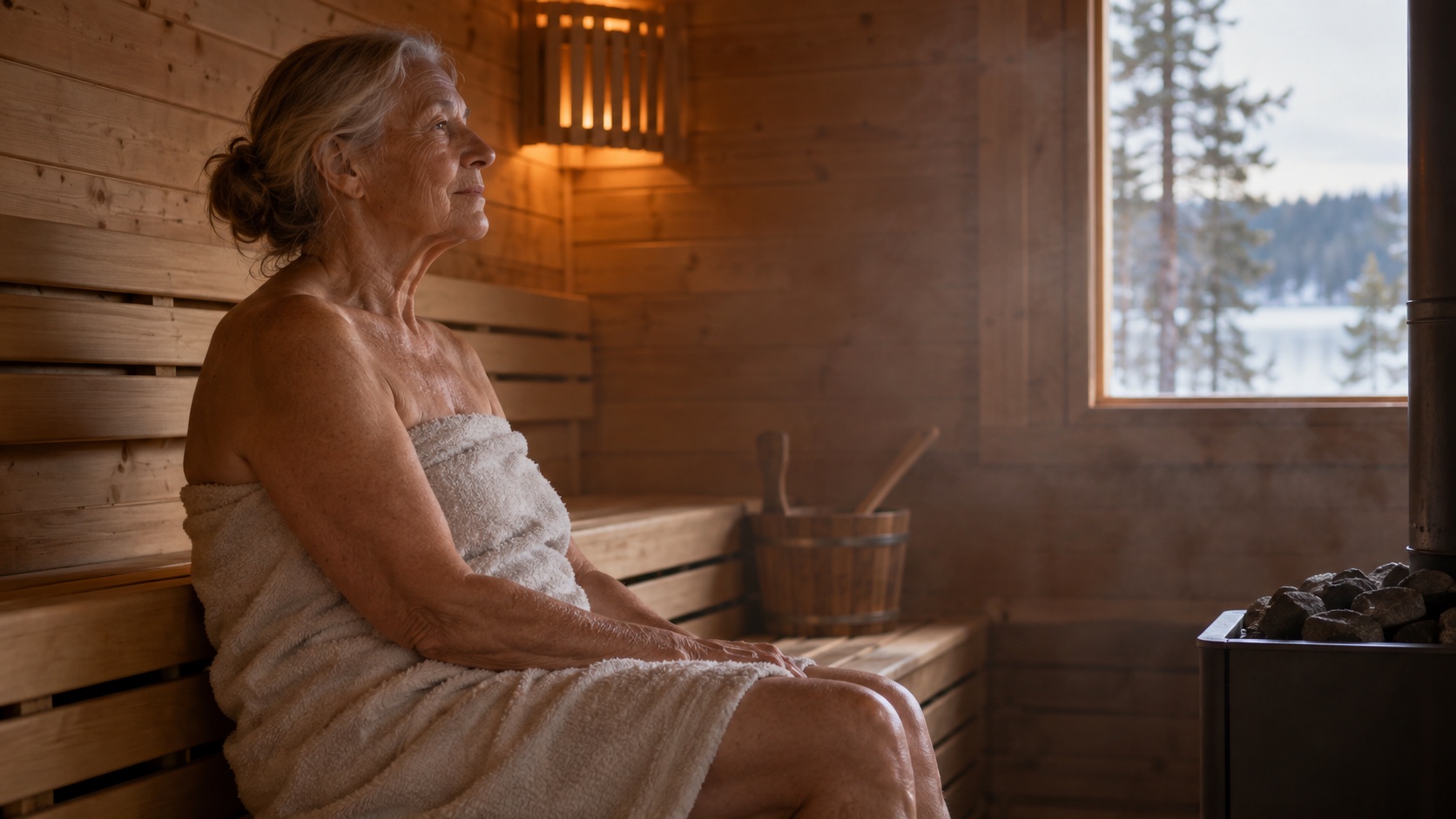
The Dementia Finding, in Full
The 2017 analysis came out of the same Kuopio cohort the first page in this series dissects (Laukkanen et al., Age and Ageing, 2017). Among 2,315 men followed for about two decades, the hazard ratio for dementia was 0.79 for 2–3 weekly sessions and 0.66 for 4–7 sessions, versus once weekly; for Alzheimer's disease specifically, the frequent-bathers' ratio was 0.65. Read with the full honesty the numbers demand: the confidence intervals were wide — in the fully adjusted analysis they approached and in some specifications crossed 1.0 — and dementia cases in the cohort numbered in the low hundreds, not thousands. The direction is interesting, the shape is graded, and the precision is poor. That combination makes it a hypothesis worth testing, not a fact worth building a routine around.
The Replication That Failed
Science gets honest when a second dataset gets a look. In 2020, researchers analyzed the Finnish Mini-Finland cohort — a different population, similar culture, similar follow-up length — and found no association between sauna bathing and dementia risk (Knekt et al., Preventive Medicine Reports, 2020). A null result does not erase the Kuopio finding; the two datasets differ in era, region, and measurement. But it does downgrade the claim. Where the cardiovascular association has been replicated across several outcomes and cohorts, the brain association has one supportive analysis, one null analysis, and no trials. The honest label is "an open question with a plausible mechanism," not "sauna protects the brain." That mechanism is worth understanding anyway, because it is the most interesting biology in this whole topic.
Heat Shock Proteins: The Cellular Repair Crew
Heat shock proteins (HSPs) are the cell's folding-and-repair staff. When temperature rises, cells upregulate them quickly — HSP70 in particular — and the proteins then go to work: grabbing misfolded or damaged proteins, refolding what can be saved, and tagging the rest for disposal (Patrick & Johnson, Experimental Gerontology, 2021). Why does that matter for the brain? Because the defining pathology of Alzheimer's and Parkinson's is accumulated misfolded protein — amyloid-beta tangles, tau aggregates, alpha-synuclein clumps. In cell and animal models, HSP70 and its relatives demonstrably suppress tau aggregation, reduce amyloid toxicity, and help neurons survive otherwise lethal stress. The leap the human data must still make: does a 15-minute sauna session raise brain-relevant HSPs enough, often enough, to matter over decades? Small human studies show circulating HSP70 rising after heat exposure, but circulating levels are a long way from neuron-level protection. This is the cleanest mechanism in the sauna literature — and the least clinically tested.
🔬 Mechanism is not outcome
A plausible mechanism plus an observational hint is how every promising longevity story starts — including many that ended nowhere. The heat-shock biology is real, elegant, and worth following; it is not yet evidence that sauna use changes dementia risk in humans. The how-the-brain-ages topic applies the same filter to every intervention in that space, and it is the right lens here too.
The Other Brain-Relevant Signals
- 🧬 BDNF — thin but real. Small acute studies report rises in brain-derived neurotrophic factor after heat exposure, a signal that supports neuronal maintenance. The studies are few, short-term, and inconsistent in size — file under "worth watching."
- ⚡ Noradrenaline and endorphins. Classic Finnish work showed sauna bathing roughly doubles circulating noradrenaline and raises beta-endorphin (Leppäluoto et al., Acta Physiologica Scandinavica, 1986) — the chemistry behind the relaxed, mildly euphoric post-sauna state many people report.
- 😌 Mood and stress. The post-session parasympathetic rebound documented on the heart page is also a mood phenomenon; survey and small-study data consistently describe improved relaxation and sleep after evening sauna. This is soft evidence, but it is consistent.
- 🩸 Inflammation. Frequent bathers showed lower C-reactive protein in the Kuopio cohort — relevant to the brain because chronic inflammation is a recognized dementia risk factor. Directionally consistent, mechanistically unproven, same as everything else on this list.
The Sleep Bridge
The most defensible brain benefit of sauna may run through sleep. Falling asleep requires a dropping core temperature, and a sauna session engineers exactly that: you heat up, then cool down hard, and the post-sauna rebound can make the temperature descent steeper than it would otherwise be. This is why the Heat & Cold Protocols recommend evening heat for sleep support, and why the Sleep pillar treats body temperature as a first-class sleep lever: whatever deep sleep does for the brain — memory consolidation, the glymphatic clearance of waste proteins — a habit that deepens it earns its brain credentials indirectly. It is a modest, believable claim that requires no leap from circulating HSP70 to neuronal survival. Note the timing discipline: a late sauna followed by a hot, slow cool-down loses the effect, which is why the protocol pages specify a cooling period before bed.
What to Make of It
| 🧪 Evidence level | What it shows | Strength |
|---|---|---|
| 🧫 Cell & animal biology | Heat shock proteins suppress tau aggregation and amyloid toxicity in models | Strong |
| 📊 Epidemiology, cohort one | KIHD: graded inverse association with dementia (HR 0.66) — wide confidence intervals | Moderate |
| 📊 Epidemiology, cohort two | Mini-Finland: no association found | Weak |
| 🩸 Human biomarker studies | Acute HSP70 and BDNF rises after heat exposure — small, short-term | Moderate |
| 🧪 Randomized trials | None testing sauna against dementia incidence | None exist |
The synthesis: if you sauna for the heart — where the parent topic's evidence is far more settled — any brain benefit is a plausible bonus, delivered honestly as such. The strongest lever on your dementia risk remains the set of factors the Cognitive Health pillar documents. The next page in this series, Sauna After Training, moves from mechanisms to mechanics: when to sauna relative to a workout, and what the heat costs in fluid.
Questions, Answered Briefly
- 🧠 Should I sauna to prevent dementia? Not as a primary strategy. The cardiovascular evidence is far stronger, one Finnish replication came back null, and no trial exists. If you sauna anyway, treat any brain benefit as an unproven bonus.
- 🔬 Do heat shock proteins actually reach the brain? Heat raises HSPs in the circulation and in many tissues, and models show the proteins protect neurons — but the step from "a hot room" to "neurons better protected for decades" has not been measured in humans.
- 📊 Which finding should I trust, Kuopio or Mini-Finland? Neither alone. The honest posture is to hold both: one supportive cohort, one null cohort, wide confidence intervals, mechanism unproven at the human endpoint. That combination reads as an open question.
- 😴 Does evening sauna really improve sleep? The cooling rebound plausibly deepens sleep onset, and the survey data are consistent — but the sleep benefit depends on a proper cool-down before bed, which is a protocol question the Heat & Cold Protocols page answers directly.
- 🥵 Does infrared sauna count for the brain? The epidemiology is built on 80–100°C Finnish saunas. Infrared devices run cooler and their long-term data are essentially absent, so no finding on this page transfers to them automatically.
The Bottom Line
- One interesting finding, one null replication — the KIHD dementia association (HR 0.66) sits beside a Finnish cohort analysis that found nothing; the brain claim is far weaker than the cardiovascular one.
- The heat-shock biology is genuine — heat stress reliably activates the protein-repair machinery that models show can suppress the misfolding at the core of neurodegeneration.
- But mechanism is not outcome — no human trial has shown sauna changes dementia risk, and the biomarker studies are small and acute.
- The sleep route is the most believable — a sauna's cooling rebound can deepen sleep onset, and sleep's brain benefits are far better established than heat's.
Related Topics
- Laukkanen T, Kunutsor SK, Kauhanen J, Laukkanen JA, "Sauna bathing is inversely associated with dementia and Alzheimer's disease in middle-aged Finnish men," Age and Ageing (2017)
- Knekt P, Järvinen R, Rissanen H, Heliövaara M, Aromaa A, "Does sauna bathing protect against dementia?" Preventive Medicine Reports (2020)
- Patrick RP, Johnson TL, "Sauna use as a lifestyle practice to extend healthspan," Experimental Gerontology (2021)
- Leppäluoto J, et al., "Endocrine effects of repeated sauna bathing," Acta Physiologica Scandinavica (1986)
- Laukkanen JA, Laukkanen T, Kunutsor SK, "Cardiovascular and other health benefits of sauna bathing: a review of the evidence," Mayo Clinic Proceedings (2018)