The mpMRI Era
For decades, an elevated PSA led to the same next step: a blind biopsy that sampled the prostate at random. Multiparametric MRI changed that sequence — now the scan comes first, and the needle follows only when and where the image says so. This page covers the trials that forced the change, how to read a PI-RADS report, and what a "clean" scan can and cannot promise you.
What the evidence supports
- mpMRI detects clinically significant prostate cancer far better than a standard template biopsy: 93% sensitivity versus 48% in the paired PROMIS study (Lancet, 2017).
- An MRI-first pathway finds more significant cancer while letting about a quarter of men skip biopsy entirely (PRECISION, NEJM, 2018).
- A negative mpMRI carries a negative predictive value of roughly 90% for significant cancer — reassuring, not conclusive.
What remains uncertain
- MRI misses on the order of one in ten significant cancers — a clean scan reduces risk substantially but does not eliminate it.
- The PI-RADS 3 "equivocal" middle zone has no settled management, and practice varies widely.
- Radiologist experience and scanner quality change accuracy in ways the trial numbers do not capture, and whether MRI-first pathways reduce prostate-cancer mortality in the long run is unproven.
Evidence last reviewed: August 15, 2026. Conclusions may change as new research is published.
The Problem With Blind Biopsies
The old standard was the transrectal ultrasound-guided biopsy: a needle passed through the rectal wall while ultrasound showed the gland's outline but not, usually, the cancer inside it. The operator took 10–12 cores on a fixed template — sampling roughly the same map in every man — in the hope of intersecting a tumor by chance. The approach had two structural flaws. First, it missed: template cores sample a tiny fraction of the gland, and cancers in the front of the prostate are routinely skipped. Second, it over-called: random cores often clipped small, indolent tumors that would never have harmed anyone, converting the overdiagnosis problem into a mechanical habit. MRI addressed both flaws at once by making the target visible before the needle fires.
What an mpMRI Actually Measures
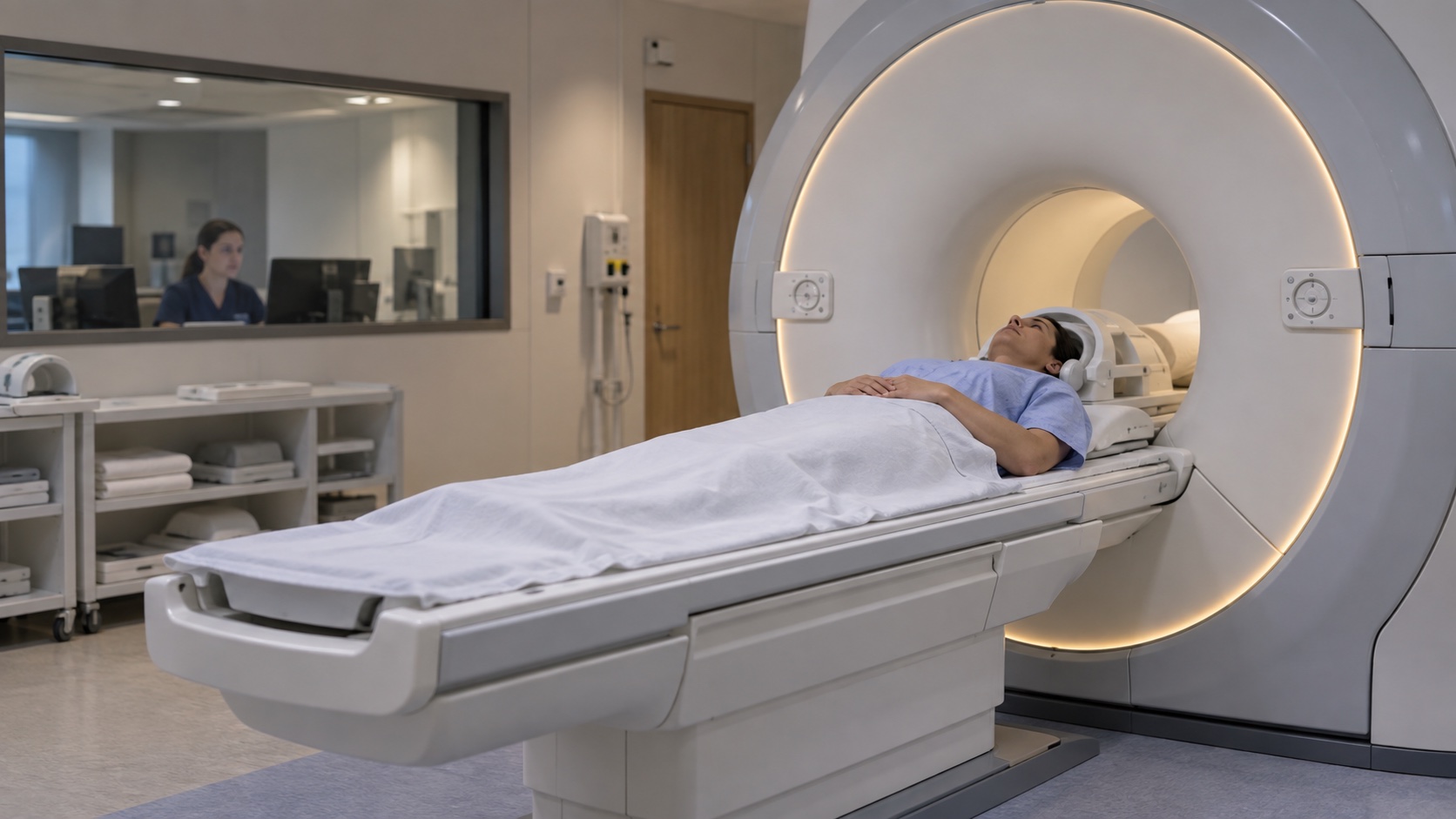
"Multiparametric" means the scan is several sequences fused into one interpretation, and each sequence sees something different. T2-weighted imaging shows anatomy — the gland's zones and any distorting mass. Diffusion-weighted imaging measures how freely water moves inside cells; tumor cells pack densely and restrict that movement, so suspicious tissue lights up on the derived ADC map. Dynamic contrast imaging tracks how blood flows through the gland — tumors tend to be leaky and fast. No radiation is involved, and the exam runs 30–45 minutes, though scanners vary. The radiologist combines the sequences into a single score. One honest caveat up front: the quality of that score depends on the radiologist, and experience varies — which is part of why guidelines push the structured scoring below rather than free-text impressions.
The Two Trials That Changed the Sequence
Two studies did the convincing. PROMIS (Lancet, 2017) compared mpMRI and template biopsy head-to-head in 576 men with elevated PSA, using a reference-standard template mapping biopsy to settle disagreements: MRI was almost twice as sensitive for clinically significant cancer — 93% versus 48% — while the standard biopsy flagged many insignificant lesions MRI ignored. PRECISION (NEJM, 2018) then tested the new sequence in practice, randomizing 500 men to either an MRI-first pathway (targeted biopsy only where the scan was suspicious) or the standard 10–12 core biopsy. The MRI arm found more significant cancer (38% versus 26% of men) while 28% of men avoided biopsy entirely. Finding more of the dangerous disease with fewer needles is the combination that ended the era of routine blind biopsy.
PI-RADS: Reading the Scan Report
Since 2019, MRI reports use a standardized five-category scale — PI-RADS v2.1 — so that "suspicious" means the same thing in every clinic (Turkbey et al., Eur Urol, 2019). The score describes how likely the lesion is to be clinically significant cancer, and each category carries a conventional next step. The two ends are clear; the middle is where judgment lives.
| Score | Meaning | Conventional next step | Read |
|---|---|---|---|
| PI-RADS 1 | Very low likelihood of significant cancer | Usually no biopsy; continue monitoring | Reassuring |
| PI-RADS 2 | Low likelihood of significant cancer | Usually no biopsy; continue monitoring | Reassuring |
| PI-RADS 3 | Equivocal — indeterminate | Judgment call: PSA density, biomarkers, and history decide | Equivocal |
| PI-RADS 4 | Likely significant cancer | Targeted biopsy of the lesion | Biopsy indicated |
| PI-RADS 5 | Very likely significant cancer | Targeted biopsy of the lesion | Biopsy indicated |
What MRI Misses
The honest limits matter as much as the wins. A negative scan misses roughly one in ten significant cancers — small lesions, certain anterior tumors, and some diffuse patterns simply do not show (meta-analytic NPV hovers near 90%; Moldovan et al., Eur Urol, 2017). That is why the phrase "clean scan" does not end the conversation: PSA trends keep running, and a rising value against a previously clean MRI is itself a finding. Two further caveats belong on the table. First, the reader matters as much as the machine: inter-reader agreement on PI-RADS scoring is imperfect, and experienced centers outperform occasional readers, so where you get scanned is part of the accuracy. Second, MRI did not end overdiagnosis; it redirected it. Imaging finds more significant disease, but it also still finds indolent lesions, which is exactly why the active surveillance pathway matters more than ever: better detection is only a win if the response is calibrated.
The Modern Sequence, Step by Step
The current pathway for a man with a concerning PSA looks roughly like roughly this: repeat the PSA to confirm the value is real; if it holds, obtain an mpMRI; and act on the PI-RADS score — usually no biopsy for 1–2, targeted biopsy for 4–5, and an individualized call for 3, often using the PSA density to decide. The PI-RADS 3 middle zone has no settled playbook — some practices biopsy it, some rescan in 6–12 months, some decide on density — and none of those choices is settled by trial data, which makes it the highest-judgment cell in the table above. Where a biopsy does happen, modern systems fuse the MRI image with live ultrasound ("fusion biopsy") so the needle samples the lesion plus a few systematic cores, rather than a blind template. Access is uneven — cost, wait times, and radiologist availability vary by region — but the sequence, not the scan, is the point: every step before the needle reduces the chance of a needle that should not have happened.
🧲 A clean scan is reassuring, not a release
A PI-RADS 1–2 MRI drops the chance of significant cancer to roughly one in ten, which is precisely why guidelines let most men skip biopsy at that point. But the remaining risk is real, and the correct response to a clean scan is scheduled follow-up — PSA on its usual rhythm, with the scan revisited if the trend turns. The MRI's job is to filter; the series' job is to watch.
Questions, Answered Briefly
- 🧭 Should I get an MRI before any biopsy? The trial evidence (PRECISION) supports image-first as the better default, and most guidelines now recommend MRI before a first biopsy for an elevated PSA — though access and coverage vary, so it is worth asking for.
- ☢️ Is an MRI radiation exposure? No. MRI uses magnetic fields and radio waves, not ionizing radiation — a meaningful difference from CT scans, which is why repeat imaging over years is tolerable.
- ❓ What does PI-RADS 4 mean for me? It means the radiologist sees a lesion likely to be significant cancer, and the conventional next step is a targeted biopsy — most, but not all, PI-RADS 4 lesions are confirmed as cancer.
- 💰 How much does it cost? It varies by system — typically from a few hundred to well over a thousand dollars, with insurance coverage improving as image-first pathways became standard. Ask your insurer before booking.
- 📅 My scan was clean. Now what? Resume the scheduled PSA rhythm, and re-engage imaging if the trend rises. The screening toolkit has the calendar logic; the velocity and density page explains what a trend means.
The Bottom Line
- The blind-biopsy era is over — mpMRI sees significant cancer nearly twice as sensitively as template sampling (93% vs 48%, PROMIS) and lets about a quarter of men skip biopsy (PRECISION).
- The score structures the decision — PI-RADS 1–2 usually means watch, 4–5 means targeted biopsy, and 3 is a genuine judgment call where density and biomarkers earn their keep.
- A clean scan is not a guarantee — roughly one in ten significant cancers hides from MRI, so follow-up stays on the schedule.
- Imaging redirected overdiagnosis rather than eliminating it — which is why calibrated responses like active surveillance matter more, not less, in the MRI era.
Related Topics
- Ahmed et al., "Diagnostic accuracy of multi-parametric MRI and TRUS biopsy in prostate cancer (PROMIS): a paired validating confirmatory study," The Lancet (2017)
- Kasivisvanathan et al., "MRI-targeted or standard biopsy for prostate-cancer diagnosis," New England Journal of Medicine (2018)
- Turkbey et al., "Prostate Imaging Reporting and Data System Version 2.1: 2019 update," European Urology (2019)
- Moldovan et al., "What is the negative predictive value of multiparametric magnetic resonance imaging in excluding prostate cancer at biopsy? A systematic review and meta-analysis," European Urology (2017)
- National Comprehensive Cancer Network, Prostate Cancer Early Detection guidelines (2024)