Order of Eating & Glucose
The same plate, eaten in a different order, produces a different glucose curve — that finding has now survived a decade of crossover trials, and it is the rare dietary intervention that costs nothing, restricts nothing, and asks only for sequencing. Protein and vegetables first, starch last: how big the effect really is, why it works, where the evidence stays thin, and how to run the experiment at your own dinner table.
What the evidence supports
- Eating protein and vegetables before carbohydrate lowers the post-meal glucose and insulin excursion — consistently, across multiple crossover trials.
- The effect appears at every meal and holds in free-living conditions, not just the lab.
- The mechanism is well understood: protein and fat slow gastric emptying, and fiber adds viscosity — glucose simply arrives more slowly.
What remains uncertain
- The trials measured hours, not years — no study has tested whether food order changes HbA1c trajectories or any hard outcome.
- Most evidence comes from type 2 diabetes and prediabetes; the absolute effect in metabolically healthy people is smaller, because their curves are already small.
- Whether the effect is mostly gastric emptying, incretin hormones, or both is still being untangled — the mechanism matters less than the consistency.
Evidence last reviewed: August 15, 2026. Conclusions may change as new research is published.
The Finding That Started It
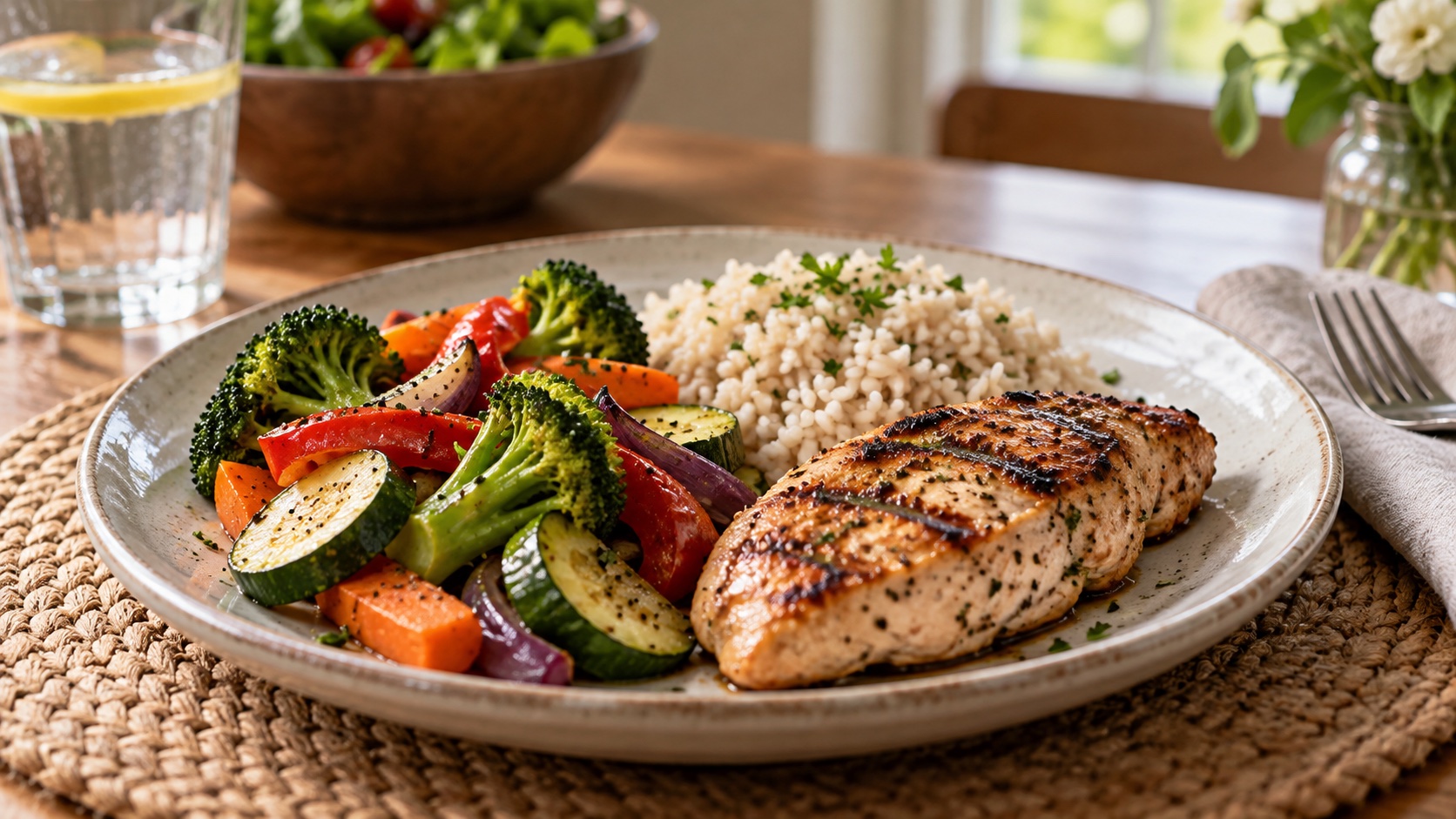
The original experiment was almost insultingly simple. Researchers gave people with type 2 diabetes the same meal twice, one week apart: chicken, vegetables, and bread. In one session the bread went first; in the other, the chicken and vegetables went first, with the bread ten minutes later. Same food, same calories, same people. When protein and vegetables came first, the post-meal glucose excursion fell by roughly a third, and insulin excursions fell too (Shukla et al., Diabetes Care, 2015). A follow-up study by the same group tested the pattern under free-living conditions for eight weeks and found the carbohydrate-last order lowered post-meal glucose across real meals, not just supervised ones (Shukla et al., BMJ Open Diabetes Research & Care, 2017).
Product picks are generic categories, not brands. We may earn a commission on Amazon or iHerb purchases at no cost to you — this never changes our evidence conclusions. Full disclosure
Low-sodium broth-based soup
A convenient volume-food option where an article explicitly teaches broth-based soup as part of a meal pattern.
⚠️ Sodium varies substantially by product; it is not a stand-alone weight-loss intervention and may not suit all dietary plans.
Check price on Amazon →Why It Works
The mechanism is plumbing more than metabolism. Starch eaten on an empty stomach digests fast: glucose floods the bloodstream within minutes, and insulin scrambles after it. Protein and fat, arriving first, occupy the stomach's exit lane — they slow gastric emptying, so the same rice dribbles into the intestine over an hour instead of ten minutes. Fiber adds its own brake, thickening the stomach contents; the fiber topic covers viscosity in detail. On top of that, protein arriving early triggers incretin hormones (GLP-1 chief among them) that prime the insulin response, so when the glucose finally arrives, the system meets it prepared rather than surprised. A protein "preload" given before a carbohydrate meal slows gastric emptying and blunts the glucose response even without any fiber at all (Ma et al., Diabetes Care, 2009) — evidence that the sequence itself, independent of what the meal contains, does real work.
The Trial Ledger
| Study | Design | Population | Finding | Read |
|---|---|---|---|---|
| Shukla et al., 2015 (Diabetes Care) | Crossover, same meal twice | Type 2 diabetes | Glucose excursion ~a third lower with protein + vegetables first | Consistent |
| Shukla et al., 2017 (BMJ Open DRC) | Free-living crossover, 8 weeks | Type 2 diabetes | Carbohydrate-last pattern lowered post-meal glucose across ordinary meals | Consistent |
| Trico et al., 2016 (Nutrition & Diabetes) | Free-living crossover | Type 2 diabetes | Sequence effect reproduced at every meal without supervision | Consistent |
| Imai et al., 2014 (J Clin Biochem Nutr) | Crossover | Type 2 diabetes | Vegetables-before-carbohydrate lowered glucose excursions | Consistent |
| Ma et al., 2009 (Diabetes Care) | Protein preload study | Type 2 diabetes | Preload slowed gastric emptying and blunted the glucose response | Mechanistic |
Notice the column that never changes: every study above enrolled people with type 2 diabetes, because that is where the excursion is large enough to move. The mechanism is general — a slower glucose arrival helps any body — but the measured effect size in a metabolically healthy person is smaller, simply because their baseline curve is already modest.
⚠️ A free lever, not a meal license
Sequencing does not erase the rice — it spreads it out. Calories, portion size, and overall meal quality still run the long game, and the trials above changed nothing about what was eaten. The other boundary line: if you take insulin or glucose-lowering medication, food order shifts the shape of your glucose curve, which can interact with dosing and timing. Reordering meals is safe to try; reordering them while on those medications is a conversation for your clinician, not a solo experiment.
The Practical Playbook
- 🥩 Protein and vegetables first, starch last. The trial gap between courses was about ten minutes — enough for the stomach to register the arrival. No need to time it to the second.
- 🥗 Start with a salad or soup course. The laziest implementation: whatever vegetables are on the table become the first course. Volume and fiber do their work before the starch lands.
- 🍮 Dessert belongs to the meal, not after it. A sweet eaten as part of a mixed meal arrives behind protein and fiber and produces a smaller excursion than the same sweet eaten alone hours later.
- 🥤 Don't drink the sugar first. The inverse of the playbook is the classic mistake: a sweet beverage on an empty stomach is a carbohydrate first course with nothing slowing it down.
- 🕰️ This is sequence, not clock timing. Food order concerns what happens within a meal; when the meal happens relative to your circadian clock is a separate lever — the meal-timing page in the Sleep pillar covers it.
One Dinner, Two Orders, Worked
The same Wednesday dinner — salmon, broccoli, and a cup of rice — served two ways to the same person. Order A: rice goes down first, because it's the fastest thing on the plate. Glucose climbs within twenty minutes, peaks tall and early, and insulin chases it the rest of the evening. Order B: salmon and broccoli first; ten minutes of conversation; then the rice, now arriving behind protein and fiber. The glucose rise is slower, the peak lower, and the area under the curve — total glucose exposure — is smaller even though every gram of food is identical. Multiply Order B by every dinner for a year and you have moved your average glucose exposure without removing a single food you enjoy. That, and not the shape of any single meal, is the point. The same logic works at a desk lunch: the wrap eaten first sends its tortilla in ahead of everything; the salad eaten first, the wrap five minutes later, delivers the same lunch on a slower conveyor. Nothing about the food changed — only the order in which it entered the queue.
Questions, Answered Briefly
- ⏱️ How long a gap between courses? The trials used roughly ten minutes. Longer gaps probably help marginally more; the point is that protein and fiber register first — not precision timing.
- 💪 Does it work for healthy people? The mechanism applies to everyone, but the measured effect is smaller when the starting curve is already modest. Healthy people get less from it — and need it less.
- 🥤 What about smoothies? Blending destroys the food structure that slows digestion, so a fruit smoothie behaves more like the "drink the sugar first" failure mode than like whole fruit — drink them as part of a mixed meal, not as a standalone first course.
- 💊 Does it replace medication? No. For people with diabetes, food order is an adjunct to treatment, not a substitute — the trials studied it alongside usual care, and medication decisions are clinician territory.
- 📈 Can I see it on a sensor? Yes — the same meal, two orders, two curves is one of the cleaner two-week CGM experiments, using the method on the sensor page: log the order before you look.
- 🥗 What if my meal is already mixed — a stew or a bowl? Sequence what you can: eat the protein pieces and vegetables first, the liquid and grain last. Mixed meals already blunt the curve somewhat, so the marginal gain is smaller — but still free.
The Bottom Line
- Sequence is real and free — protein and vegetables before starch lowers the post-meal glucose excursion by roughly a third in the original trial, with no change to what you eat.
- The mechanism is arrival speed — slower gastric emptying and an early incretin response spread the same glucose over more time.
- The evidence is short-term and diabetes-weighted — no outcome trials exist, and healthy people get a smaller absolute effect.
- Run it as a default, not a ritual — vegetables first, starch last, dessert inside the meal; the cheapest curve-flattener on the table.
Related Topics
- Shukla et al., "Food order has a significant impact on postprandial glucose and insulin excursions," Diabetes Care (2015)
- Shukla et al., "Carbohydrate-last meal pattern lowers postprandial glucose and insulin excursions in type 2 diabetes," BMJ Open Diabetes Research & Care (2017)
- Trico et al., "Manipulating the sequence of food ingestion improves glycemic control in type 2 diabetic patients under free-living conditions," Nutrition & Diabetes (2016)
- Imai et al., "Effect of eating vegetables before carbohydrates on glucose excursions in patients with type 2 diabetes," Journal of Clinical Biochemistry and Nutrition (2014)
- Ma et al., "Effects of a protein preload on gastric emptying, glycemia, and gut hormones after a carbohydrate meal in diet-controlled type 2 diabetes," Diabetes Care (2009)