The Notifications Curfew
The notification stream does not stop at sunset, but the body's tolerance for it does. This page turns the principle into a schedule: a default evening cutoff, a calls-only carve-out, and a docking time — the operational version of the before-and-after chart the parent topic draws. It also covers what the curfew studies actually measured, and what breaks curfews in practice.
What the evidence supports
- Receiving notifications in three daily batches instead of as-they-arrive improved wellbeing and reduced inattentiveness in a two-week intervention (Fitz et al., 2019).
- Batching email to three checks a day lowered self-reported stress (Kushlev & Dunn, 2015).
- Late-night smartphone use predicts next-morning depletion and lower work engagement (Lanaj et al., 2014).
What remains uncertain
- The studies measured wellbeing and self-reported stress over days to weeks — not long-term health outcomes.
- The exact cutoff hour has no direct evidence behind it; 7pm is a starting point to be tuned to your own schedule.
- How much of the benefit comes from the silence versus from the wind-down rituals that replace the phone is not separated.
Evidence last reviewed: August 15, 2026. Conclusions may change as new research is published.
Why the Evening Is the Vulnerable Window
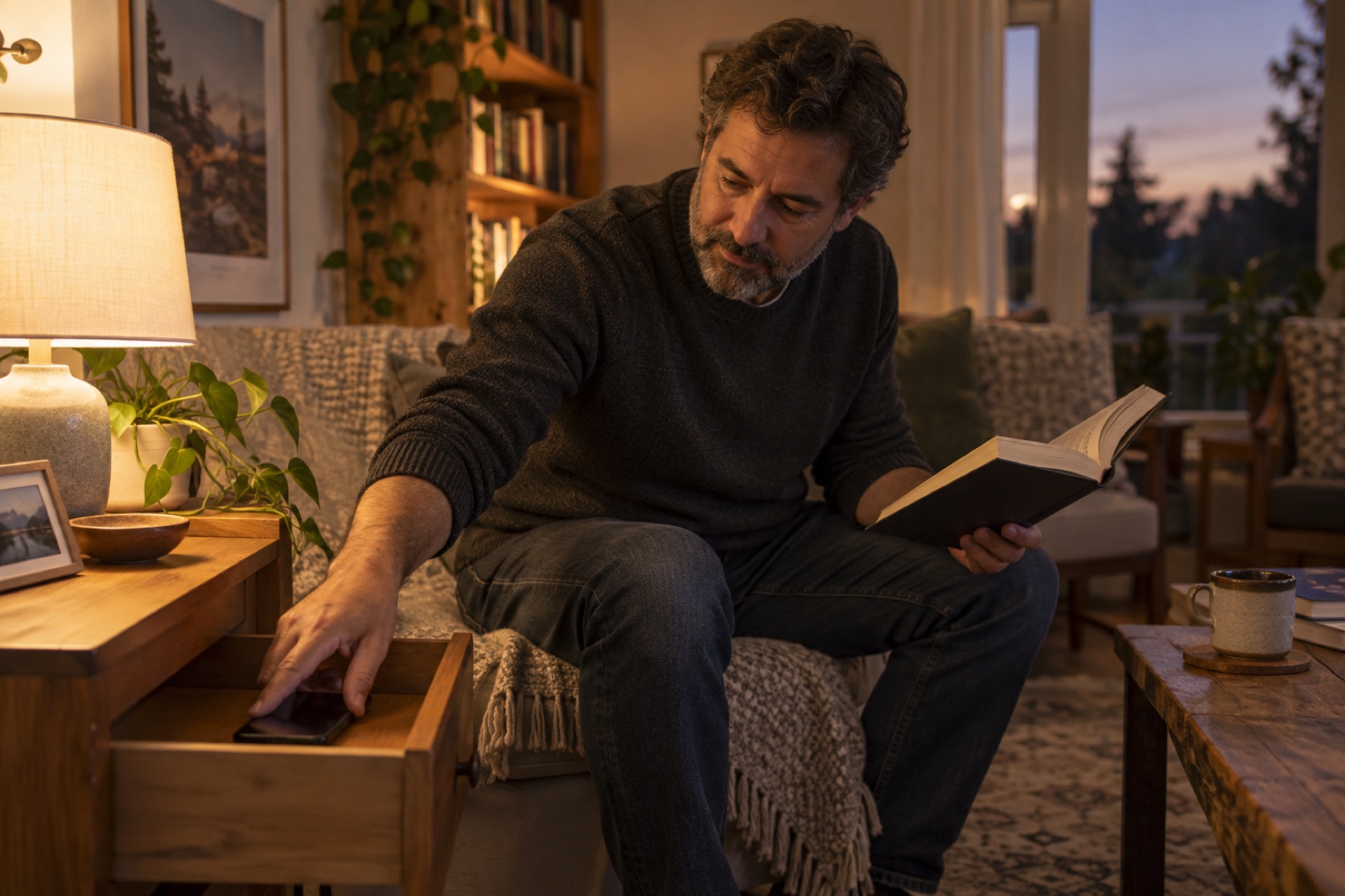
The daytime interruption tax is real, but the evening is where the same stream does its most expensive work. Two physiological events run on a schedule the phone ignores. The first is the evening cortisol descent — the hours when the stress system is supposed to ratchet down toward its overnight floor, the curve the cortisol topic maps hour by hour. A notification at 9:30pm is an arousal event landing directly on that descent, and a stream of them keeps the system idling precisely when it should be off. The second is sleep onset — the transition the bedroom rule protects by removing the device, and which the curfew protects upstream by ending the stream before the wind-down begins. The parent topic's chart — "The Interruption Stream, Tamed" — shows the same story visually: with a curfew from 7pm, the evening blocks drop to near zero instead of peaking. The schedule below is that chart, written as instructions.
Product picks are generic categories, not brands. We may earn a commission on Amazon or iHerb purchases at no cost to you — this never changes our evidence conclusions. Full disclosure
Simple alarm clock
Can support keeping a phone out of the immediate sleep environment and maintaining a consistent wake cue.
⚠️ An alarm device cannot compensate for insufficient sleep or treat insomnia; avoid relying on it to override severe sleepiness.
Check price on Amazon →The Cutoff Schedule, Defined
The curfew has three zones. The default times assume a roughly 10:30–11pm bedtime; if yours differs, shift the zones with your rhythm — the principle is the schedule, not the clock.
- ☀️ 6am–7pm — the full stream. Normal life. The daytime tax exists (the first page of this series measures it), but this zone is not the curfew's business.
- 🕖 7pm — the cutoff. Notifications off for the day. This is the line that matters: the evening interruption stream is what flattens the descent, and 7pm is the default because it leaves the two highest-value evening hours clean.
- 🌇 7–9pm — calls only. The phone still rings for people, not for platforms. Everything else waits until morning; the Downshift topic supplies the non-screen rituals that fill this window.
- 🕘 9pm — the dock. The phone plugs in outside the bedroom, merging the curfew with the bedroom rule. From here, the alarm clock owns the night.
What the Cutoff Studies Show
Nobody has run a large trial on "7pm sharp," and this page will not pretend otherwise. What exists is a small cluster of intervention studies that test the curfew's underlying logic — scheduled, batched delivery instead of a continuous stream. The clearest: 237 adults received their smartphone notifications either as they arrived or in three daily batches over two weeks; the batched group reported better wellbeing and less inattentiveness and hyperactivity (Fitz et al., 2019). A parallel line of work found that limiting email to three checks a day reduced self-reported stress compared with a continuous stream (Kushlev & Dunn, 2015). And on the evening specifically: smartphone use at night predicted next-morning depletion and lower engagement at work (Lanaj et al., 2014), while a prospective cohort found adolescents who texted after lights out were more tired a year later (Van den Bulck, 2007). The curfew is the practical translation: if batched delivery helps, then zero evening delivery helps the window that matters most.
| Time | Phone state | What stays on | What it protects |
|---|---|---|---|
| ☀️ 6am–7pm | Full stream | Everything | Normal daytime functioning |
| 🕖 7pm | Notifications off | Phone calls from contacts | The start of the evening cortisol descent |
| 🌇 7–9pm | Calls only | Calls | The wind-down window and its rituals |
| 🕘 9pm | Docked outside the bedroom | Calls only | Sleep onset and the night |
| 🌙 Overnight | Dock mode | Nothing you check voluntarily | Uninterrupted sleep cycles |
🌆 The curfew is a schedule, not a punishment
Expect the first week to feel like loss: the hand reaches, the pocket checks, the 8pm scroll itch. That is the old cue firing without its reward — the same phantom reach people report when the bedroom rule starts — and it fades within days for most. The useful reframe: the curfew is not removing your evening; it is handing the two highest-value hours of the stress cycle back to the wind-down. What you do with them is the Downshift topic's territory; the curfew's one job is to make sure the stream is not there to compete.
The Calls-Only Carve-Out
A curfew that blocks everything collapses the first time a family member calls at 8:30pm — so the carve-out is part of the design, not a loophole. Phone calls stay live through the evening; texts, feeds, and everything else wait until morning. Two honest notes. First, tell people: a short message to the handful who text you at night ("I answer calls after 7; texts wait until morning") converts surprise into expectation, and most people adapt within days. Second, know the difference between the essential and the optional stream — the same distinction the parent topic draws. A ringing phone for a real emergency is essential; a muted group chat that vibrates every ninety seconds is not. The carve-out preserves the first and starves the second, and that asymmetry is the entire intervention.
What Breaks Curfews
- 🌙 Revenge bedtime procrastination. When the day had no leisure in it, the evening phone becomes the one piece of "me time," and the curfew reads as theft. The fix is upstream — restructure the day, not the cutoff (the Sleep pillar's deep dive owns this).
- 👀 The "just checking" slip. One manual check after 7pm re-opens the stream the settings closed. Pre-decide the response: "calls only" means the screen stays dark, full stop — an implementation intention in one line.
- 🚨 The emergency rehearsal. Some people skip the curfew because of a hypothetical 9pm crisis. The carve-out answers it: the phone still rings. The fear is about missing the stream, not the call.
- 💼 Work that never ends. If 7pm silence means 11pm anxiety about the inbox, the problem is the workload, not the schedule — the curfew will surface it, which is useful information, and the honest fix is a boundary conversation, not a settings workaround.
The First Week, Night by Night
- ⚙️ Day 0 — the settings pass. Schedule Do Not Disturb for 7pm–7am with calls allowed; silence the app categories you can name (the tax page has the inventory). Ten minutes, once.
- 🌇 Nights 1–3 — expect the itch. The urge to check peaks in the first days, then declines. Note it without feeding it — it is withdrawal from a cue, not evidence that the curfew is wrong.
- 🛏️ Nights 4–7 — join it to the dock. The 9pm charging move fuses the curfew with the bedroom rule; the two hold each other up.
- 📆 Week 2 — tune the clock. If 7pm feels too early or too late against your actual rhythm, shift the zones — but keep the structure: a cutoff, a calls-only window, a dock time. The schedule is the principle.
The Bottom Line
- The evening is when the stream costs most — notifications land on the cortisol descent and sleep onset, the two transitions the stress system cannot afford to skip.
- The schedule: 7pm cutoff, calls only, 9pm dock — the operational version of the parent topic's before-and-after chart, tunable to your own rhythm.
- The batching studies support the logic — three scheduled deliveries beat a continuous stream for wellbeing and stress, and the curfew simply extends the logic to zero evening delivery.
- Expect week-one rebound, protect the carve-out, and treat slips as design bugs — the curfew settles into neutrality within days, and the calls-only exception is what makes it survivable.
Related Topics
- Fitz, Kushlev, Jagannathan, Lewis, Paliwal & Ariely, "Batching smartphone notifications can improve well-being," Computers in Human Behavior (2019)
- Kushlev & Dunn, "Checking email less frequently reduces stress," Computers in Human Behavior (2015)
- Lanaj, Johnson & Barnes, "Beginning the workday yet already depleted? Consequences of late-night smartphone use and work engagement," Organizational Behavior and Human Decision Processes (2014)
- Van den Bulck, "Adolescent use of mobile phones for calling and for sending text messages after lights out: results from a prospective cohort study with a one-year follow-up," Sleep (2007)
- Thomée, "Mobile phone use and mental health. A review of the research that takes a psychological perspective on exposure," International Journal of Environmental Research and Public Health (2018)