Adherence Tricks: Making Cardio Stick
The best cardio plan is the one still running in month six. Fitness science hands you the dose; adherence science gets you the repetition — and most cardio programs die of boredom and friction, not ignorance. This is the entertainment layer: twelve tricks, ranked by the mileage people actually get out of them.
What the evidence supports
- Temptation bundling — restricting a favorite indulgence to exercise time — increases gym attendance in randomized field studies.
- Implementation intentions ("when X happens, then I do Y") reliably improve exercise follow-through across meta-analyses.
- Social exercise and scheduled, appointment-style sessions improve attendance; cadence-matched music lowers perceived effort.
What remains uncertain
- Which single trick carries the load — techniques are mostly tested in isolation, so the ranked stack below is synthesis, not a head-to-head result.
- Long-term durability: most adherence studies run weeks to months, not years.
- The 10-minute floor specifically is a clinical consensus heuristic, not a directly tested intervention.
Evidence last reviewed: August 13, 2026. Conclusions may change as new research is published.
Why Cardio Quits
Adherence research keeps finding the same attrition pattern: people do not stop exercising because they learn it is unhealthy. They stop because time runs out, it gets boring, energy is low, or the logistics grate. Every trick below is an answer to one of these four.
Product picks are generic categories, not brands. We may earn a commission on Amazon or iHerb purchases at no cost to you — this never changes our evidence conclusions. Full disclosure
Smart band or smartwatch
Can make activity, exercise, and routine patterns easier to notice over time.
⚠️ Step, heart-rate, and sleep estimates can be inaccurate and may encourage unhelpful over-monitoring; consumer readings are not medical diagnoses.
Check price on Amazon →The Trick Stack, Ranked
Twelve tricks, ordered by how much repetition they buy for how little setup. No one runs all twelve — pick three, starting at the top.
- 🎬 Entertainment stacking — the show, the podcast, the audiobook exist only during cardio. The treadmill owns season three; the couch does not. Temptation bundling is the best-evidenced trick on this list, and the cheapest to run.
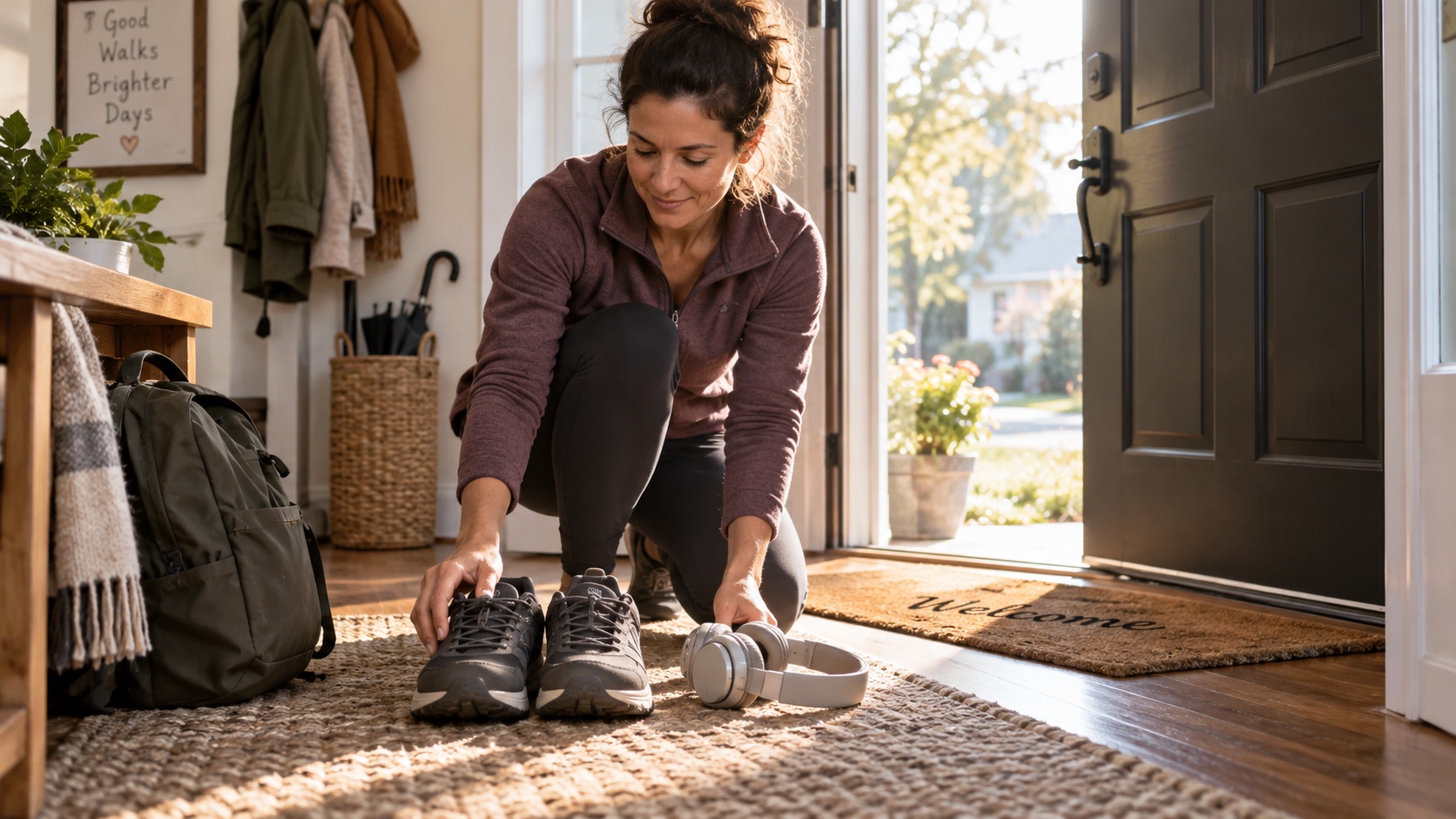
- 👟 The shoes-by-the-door default — kit staged the night before, in the path of the door. The session becomes the default and skipping requires an active decision, which is exactly the reversal friction wants.
- ⏱️ The 10-minute floor — start anyway; after ten minutes, quitting is allowed, no guilt attached. Almost nobody takes the out once the body is moving — the first ten minutes are the whole tax.
- 👥 Social cardio — the walk-and-talk with a friend, the club ride, the run group. The appointment is with a person now, not with a treadmill, and people notice when you do not show up.
- 🗺️ Route engineering — out-and-back routes cannot be shortened mid-run without walking the difference anyway; loops kill monotony. Keep one of each ready and pick by mood.
- 📅 The calendar pre-booking — sessions are appointments with yourself, blocked in the calendar and protected like any meeting. Implementation-intention research says the "when and where" is most of the battle.
- 📈 The streak chart — a visible chain of X's on the fridge or wall. The chain becomes the asset you are protecting; the only rule is never miss twice. The 2-day rule page owns the science of why that rule is the one that matters.
- 🛒 The errand pairing — commute legs on foot or bike, the long walk to the far grocery store, the meeting that becomes a walking meeting. Cardio folded into trips you were taking anyway costs zero willpower.
- 🎵 The BPM trick — playlists matched to cadence or target heart rate: ~120–140 BPM carries a brisk walk, ~150–170 a run. Cadence-matched music lowers perceived effort in controlled studies, and it converts pacing from a watch chore into a playlist.
- 🍂 The seasonal plan — every season has an indoor twin, decided in advance (the table below). Weather stops being a decision point; it becomes a routing question.
- ⏰ The uniform — same time of day, same warm-up, same first ten minutes, day after day. The ritual removes the deciding, and habits grow where decisions do not live.
- 🏆 The visible trend — the VO2 max trend line or a simple pace-per-route number, charted. Cardio becomes a game with a visible high score, and games do not need willpower.
The Trick-Effect Table
| Trick | The problem it solves | Evidence flavor | Verdict |
|---|---|---|---|
| 🎬 Entertainment stacking | Boredom | Randomized field study of gym attendance | Good |
| 👟 Shoes by the door | Friction | Environment-design research | Good |
| ⏱️ The 10-minute floor | Starting friction | Clinical consensus, untested as such | Moderate |
| 👥 Social cardio | Accountability | Self-determination theory reviews | Good |
| 🗺️ Route engineering | Monotony | Habit research, mostly indirect | Promising |
| 📅 Calendar pre-booking | Time pressure | Implementation-intention meta-analyses | Good |
| 📈 The streak chart | Consistency | Habit-formation longitudinal studies | Good |
| 🛒 Errand pairing | Time pressure | Physical-activity-intervention consensus | Good |
| 🎵 The BPM trick | Boredom, perceived effort | Music-in-exercise reviews | Good |
| 🍂 The seasonal plan | Weather, logistics | Intervention consensus | Moderate |
| ⏰ The uniform | Decision fatigue | Habit-loop research | Good |
| 🏆 The visible trend | Motivation | Self-monitoring trials | Good |
What each trick buys, and how solid the backing is. "Good" means the mechanism is well studied; it does not mean the trick works on everyone.
The Seasonal Plan
The single highest-leverage preparation is deciding, before the weather turns, what the indoor version looks like. Decide in September and January needs no decisions.
| Season | The problem | The swap |
|---|---|---|
| ☀️ Summer | Heat makes outdoor sessions miserable and raises heart rate for the same pace | Dawn or dusk slots; the pool; the gym treadmill for intervals |
| 🍂 Autumn | Race season tempts overdoing it | Protect recovery — the too-much zone lives here; keep the 2-easy-1-hard skeleton |
| ❄️ Winter | Cold, dark, ice, and treadmill dread | Treadmill, rower, or stationary bike for the interval day; warm layers and daylight hours for the walks |
| 🌱 Spring | Rebuilding after a light winter | Ramp volume ~10% per week — the ramping rule, not the full schedule, on day one |
- 🏠 The indoor rule — indoors you lose the scenery, so entertainment stacking earns double; never face a treadmill without a queue.
- 🚶 The walking exception — walking outdoors in almost any weather beats most indoor substitutes; the walking & rucking page owns the gear that makes winter walks comfortable.
Stationary bicycle
Offers an indoor, lower-impact way to accumulate aerobic activity.
⚠️ Fit, intensity, and medical context matter; chest pain, fainting, or concerning exertional symptoms require medical evaluation.
Check price on Amazon →Pick Three, Not Twelve
- 🎯 The 80/20 of tricks — one boredom trick (entertainment stacking), one friction trick (the shoes), and one people trick (social cardio) covers most of the attrition on the chart above.
- 🧪 The test window — run a trick for two weeks before judging it. Tricks work through repetition, not through logic, and nothing on this list convinces in the first session.
- 🔄 The rotation — when a trick goes stale, swap the trick, not the protocol. The protocol is the dose; the tricks are the packaging.
The First Two Weeks
The setup phase is itself a trick: what gets staged in week one runs in week six.
- Stage the gear — shoes, kit, and headphones in the door path; the route picked.
- Build the queue — one show and one podcast reserved for cardio only, from day one.
- Book the week — three sessions in the calendar, treated as appointments, not intentions.
- Draw the chart — a streak grid on the fridge, first X waiting.
- Start at the floor — week one sessions can be ten minutes; the point is the pattern, not the dose.
Three Stacks That Work
Most people do not need all twelve tricks — they need three that match the shape of their week. Three common configurations:
- 💼 The 9-to-5 stack — calendar pre-booking, errand pairing, entertainment stacking. The commute leg and the lunch walk carry the weekday volume; the show carries the weekend.
- 👨👩👧 The parent stack — the 10-minute floor, shoes-by-the-door, the streak chart. There is no reliable hour; there is a reliable ten minutes after bedtime logistics, and the chain holds the habit together.
- 🏅 The racer stack — social cardio, BPM playlists, the visible trend. The club ride provides the long session, the playlist paces the interval day, and the trend line provides the why.
The Stacking Rules
- 🧲 Pair a boredom trick with a friction trick — each covers a different failure mode; stacking two of the same kind adds complexity without coverage.
- 🌤️ One trick must be weather-proof — the seasonal plan or the indoor route. A stack that collapses in January is a summer stack.
- 🚫 Never let the tricks become the workout — the show exists to get you moving; when the session starts serving the queue instead of the reverse, rotate the trick.
Where the Evidence Lives
This page is the packaging layer — the behavioral science behind each trick lives in the habit-formation series, and this page applies it to cardio specifically:
- 🧠 Friction engineering — the Environment Design topic owns the shoes-by-the-door logic and its evidence; the cardio page points it at a shoe rack.
- 📝 The when-then plan — the Implementation Intentions topic owns the science behind calendar pre-booking and the uniform.
- 📅 The streak logic — the 2-Day Rule topic owns why "never miss twice" outperforms "never miss."
- 👥 The social layer — the Social Accountability topic owns the evidence that people show up for people.
- 🚶 The movement baseline — the Walking topic owns daily movement, and the Zone 2 Training topic owns what the sessions are for once the tricks get you out the door.
What to Do When It Goes Wrong
- 🚩 The streak broke — the 2-day rule: one miss is noise, two is a pattern. The chart is a chain, not a verdict — draw the next X today and the chain resumes.
- 🚩 The show ended and so did the runs — restock the queue before the finale, and keep two shows deep. An empty entertainment queue is a pre-planned excuse.
- 🚩 Social cardio died — the friend moved, the club folded. Replace the person within the week; the people trick has a half-life, and an orphaned habit decays fast.
- 🚩 A trick stopped working — tricks wear out; that is normal and expected. Rotate it out and keep the protocol. Quitting a stale trick is maintenance, not failure.
- 🚩 The calendar filled and the sessions vanished — shrink the session, never the frequency. A 10-minute floor kept on the calendar beats a cancelled hour, every week of the year.
Common Pitfalls and How to Overcome Them
The tricks fail in predictable ways — and each failure has a countermove already built into this page. If one of these looks familiar, the fix is the right-hand column.
| Pitfall | Why it happens | The countermove |
|---|---|---|
| The show dictates the session | The entertainment becomes the point and the workout shrinks to background | Session first: pick the workout, then the show plays during it — never the other way around |
| Gear shopping as a substitute | New shoes and trackers bought while the sessions stay unrun | Shoes by the door, zero new gear for the first 8 weeks — buying is not training |
| The 10-minute floor becomes the ceiling | The minimum-viable session becomes the every-session length | Extend by two minutes per week after the habit holds; the floor protects the streak, not the progress |
| Data hoarding over running | Routes, apps, and analytics planned for an hour; zero minutes run | Out the door in five minutes is the metric that matters — everything else is decoration |
| Social cardio becomes social coffee | The walking date turns into a sitting date | Book the activity, not the café — the walk comes first, coffee is the reward after |
| The seasonal stop | Winter kills the outdoor habit and the whole system with it | The indoor plan is pre-decided in autumn — treadmill, stairs, or the ruck loop — before the first freeze |
Questions, Answered Briefly
- ❓ Which trick should I start with? — Entertainment stacking. It is the best-evidenced, the cheapest to run, and it answers the most-cited quit reason. Add the shoes-by-the-door next; they compound.
- ❓ Are tricks a form of cheating? — No. The adaptation does not care why you showed up — the heart and mitochondria receive the session regardless of the podcast attached to it. The willpower-only approach is the one that fails.
- ❓ What if I hate the treadmill? — Then the seasonal plan's job is bigger: pick the indoor tools you merely tolerate — rower, stationary bike, swimming — and reserve the treadmill for the interval day only. Tolerated beats avoided.
- ❓ How long until cardio feels automatic? — Habit-formation studies suggest a median around ten weeks, with a wide spread — longer than most programs last, which is the point of this page. The tricks exist to bridge you to the automatic version.
🎬 The layer that decides
Doses are easy to prescribe and hard to repeat. The entertainment layer converts cardio from a willpower tax into the good part of the day — and the protocol that is still running in month six beats the perfect one that quit in week three.
The Bottom Line
- Cardio programs die of boredom and friction, not ignorance — solve those two and the dose takes care of itself.
- Entertainment stacking, the shoes-by-the-door, and social cardio carry most of the load; start there.
- The 10-minute floor beats the cancelled hour — frequency before duration, every time.
- Tricks wear out — rotate them, and never break the streak twice.
This Page in One Workflow
- Pick three — one boredom trick, one friction trick, one people trick.
- Stage — shoes, show, and playlist ready the night before; the session on the calendar.
- Show up — the 10-minute floor; quitting is allowed after ten, and almost never taken.
- Mark it — the streak chart gets its X, the visible trend gets its data point.
- Rotate — monthly review: which trick has gone stale, and what does it swap for?
The Daily Checklist
- Shoes, kit, and playlist staged the night before
- The show or podcast opened only once the session starts — never on the couch
- Session started, even if it is only the 10-minute floor
- Streak chart marked before the day ends
- One errand or commute leg done on foot
- No missed day followed by a second missed day — the only rule that is not flexible
The Weekly Checklist
- Three cardio sessions on the calendar as protected appointments
- One social session booked — walk-and-talk, club ride, or group run
- The entertainment queue checked — at least two episodes ahead
- Route varied at least once — the new loop, or the out-and-back
- Monthly review done: which trick went stale, and what it swapped for
Go Deeper: Adherence Tricks: Making Cardio Stick
These five companion pages turn the topic into smaller, testable practices.
Related Topics
- Milkman, Minson & Volpp, "Holding the Hunger Games Hostage at the Gym: An Evaluation of Temptation Bundling," Management Science (2014)
- Gollwitzer & Sheeran, "Implementation Intentions and Goal Achievement: A Meta-Analysis of Effects and Processes," Advances in Experimental Social Psychology (2006)
- Karageorghis & Priest, "Music in the Exercise Domain: A Review and Synthesis," International Review of Sport and Exercise Psychology (2012)
- Kaushal & Rhodes, "Exercise Habit Formation in New Gym Members: A Longitudinal Study," Journal of Behavioral Medicine (2015)
- Teixeira et al., "Exercise, Physical Activity, and Self-Determination Theory: A Systematic Review," International Journal of Behavioral Nutrition and Physical Activity (2012)
- Dishman, "Increasing and Maintaining Exercise and Physical Activity," Behavior Therapy (1991)