Walking: The Underrated Longevity Exercise
No gym. No technique. No recovery days. Walking is the exercise almost everyone can do every day — and the evidence for it is among the strongest in all of exercise science. Large cohort studies show clear dose-response relationships between daily steps and lower mortality. If you're building a longevity plan, this is the floor everything else stands on.
What the evidence supports
- Step-count meta-analyses show dose-response reductions in all-cause mortality up to roughly 7,000–10,000 daily steps, depending on age.
- Brisk pace adds benefit on top of step count in large cohorts.
- Short walks after meals measurably blunt post-meal glucose spikes in randomized trials.
What remains uncertain
- Step studies are observational — the healthiest people may simply walk more; causation is inferred.
- Whether 10,000 beats 7,000 steps matters is unclear; the biggest gains come from escaping the lowest step counts.
- Exactly how fast is "brisk" varies by age and fitness; the thresholds are practical approximations.
Evidence last reviewed: August 13, 2026. Conclusions may change as new research is published.
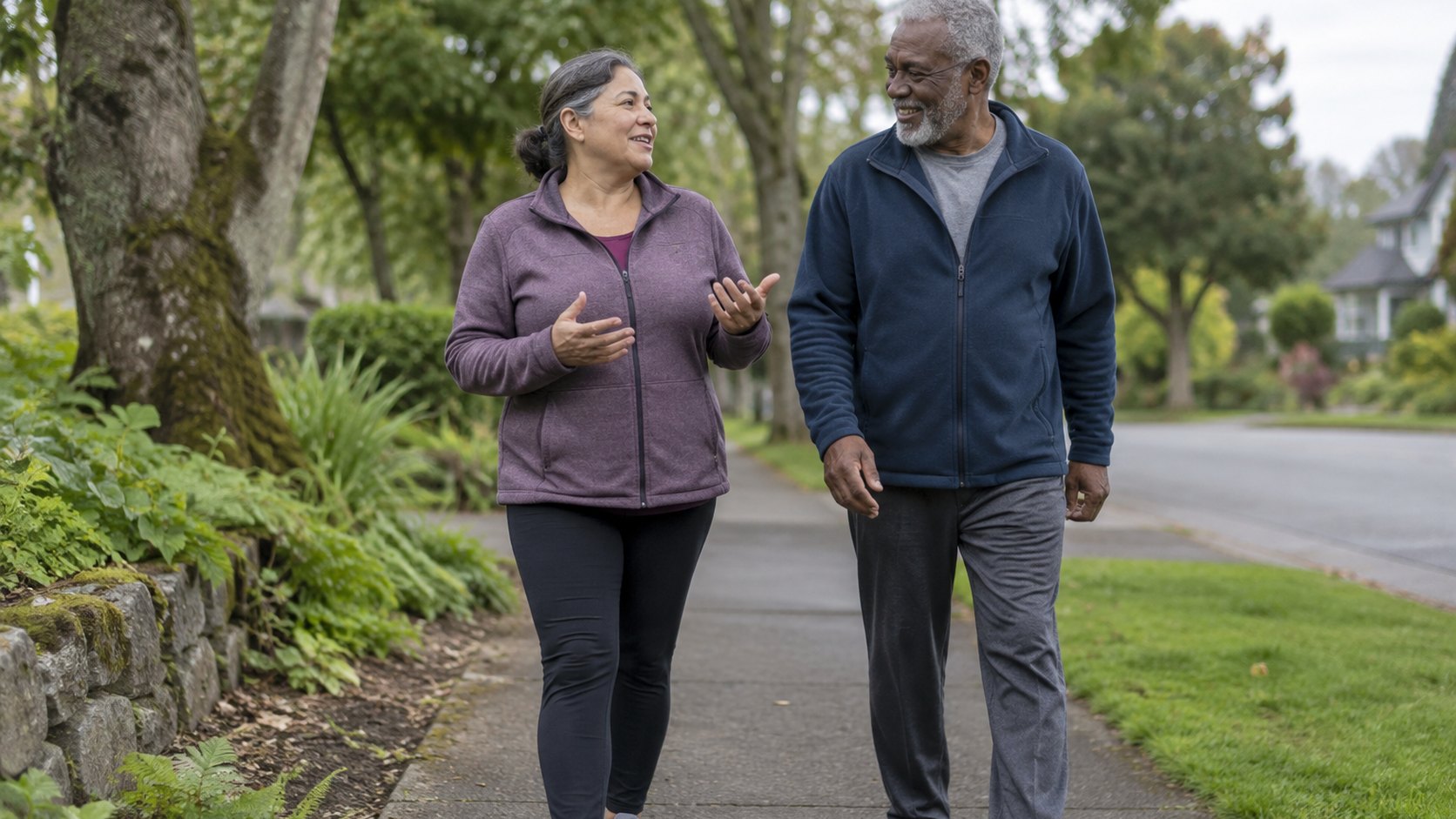
The Step-Count Evidence
The modern step-count era began with wearables, and the data have piled up fast. A 2021 meta-analysis of 15 cohorts (Paluch et al., Lancet Public Health) found a clear dose-response: mortality risk falls steadily as daily steps rise, with the benefit flattening around 6,000–8,000 steps daily for adults 60+ and 8,000–10,000 for younger adults. A separate study of older women found mortality benefit beginning at roughly 4,400 steps — well below the folk-wisdom 10,000, which originated as a marketing number for a Japanese pedometer in the 1960s, not from science.
Product picks are generic categories, not brands. We may earn a commission on Amazon or iHerb purchases at no cost to you — this never changes our evidence conclusions. Full disclosure
Smart band or smartwatch
Can make activity, exercise, and routine patterns easier to notice over time.
⚠️ Step, heart-rate, and sleep estimates can be inaccurate and may encourage unhelpful over-monitoring; consumer readings are not medical diagnoses.
Check price on Amazon →Speed Matters on Top of Steps
Counting steps is necessary but not sufficient — how you walk them adds a second layer. Analyses of UK Biobank data found that at similar step counts, people who walked at a brisk pace had lower mortality than slow walkers, and that walking faster added benefit even when total steps were modest. "Brisk" translates practically as: breathing noticeably but able to talk in sentences — for many adults, that's ~100–120 steps per minute (roughly 3–4 mph). A useful hack: count your steps for 20 seconds; multiply by three. If you're under 90, pick it up.
👟 For most untrained adults, a brisk walk IS zone 2
If running feels out of reach, a fast walk — especially with a slight incline or a loaded backpack — can hit the same aerobic training range discussed in the Zone 2 topic. Walking isn't a consolation prize; for many people it's the entire aerobic base, plus everything below.
Walking vs. Running: The Honest Comparison
Walking's biggest advantage isn't philosophical — it's practical:
| Dimension | Walking | Running |
|---|---|---|
| Injury risk | Very low — near-zero impact force | Substantially higher; overuse injuries are common |
| Accessibility | Almost everyone, almost every day | Requires baseline fitness and joint tolerance |
| Per-minute stimulus | Lower — needs more time for equal dose | Higher — more efficient if time is scarce |
| Longevity evidence | Large dose-response cohorts | Comparable or slightly stronger per unit time |
| Long-term sustainability | Excellent — decades of daily use | Variable — many people age out |
The honest synthesis: running delivers a bigger stimulus per minute, but walking delivers more total stimulus over a lifetime, because it's the modality people actually sustain. The best exercise is the one that's still happening in year twenty — and for most people, that's a walk.
Hills, Rucking, and Other Progression Levers
When your flat-ground walk stops being challenging, you have three levers before you ever need to run: pace (walk faster — the simplest), terrain (hills and stairs raise heart rate dramatically at the same speed), and load (rucking — walking with a weighted backpack). Rucking deserves special mention: a pack of 10–20% of your body weight turns a neighborhood loop into genuine zone 2 work while adding a light strength and bone-loading stimulus to the spine and legs. Start light and keep the pace conversational; the military tradition of rucking has quietly been one of the most underrated fitness tools for decades.
Comfortable walking shoes
May improve comfort and consistency for walking-based activity.
⚠️ Footwear cannot correct every pain problem; persistent foot, knee, or hip pain warrants appropriate evaluation.
Check price on Amazon →Walking and the Mind
The physical benefits get the headlines, but the mental ones may matter as much for daily adherence. Observational studies consistently associate regular walking with lower depression risk, and short-term trials show single walks improve mood and reduce anxiety — effects that are partly physiological (movement, light, rhythm) and partly situational (time outdoors, away from screens, often with company). Walking's rhythm has even been proposed as a creativity aid — a modern echo of the long tradition of philosopher-walkers, from Aristotle's peripatetics to Darwin's thinking path. For the longevity-minded, this is a two-for-one: the same habit that builds your aerobic base also builds your stress-management pillar.
Walking Supports Every Other Pillar
Part of what makes walking the highest-leverage habit in this entire site is how many pillars it touches at once:
Sleep
Daytime activity and outdoor light deepen sleep pressure and anchor your circadian rhythm — both sleep-pillar effects.
Metabolic health
Daily steps and post-meal walks improve glucose handling — the walking pill for blood sugar.
Stress
A walk is active recovery for the nervous system: movement without threat, often outdoors, often social.
Relationships
Walking is the natural social exercise — walk-and-talks with partners and friends double as connection time.
Bad Weather and Indoor Options
Rain, snow, and heat are where walking habits historically die — so plan the fallback in advance. Indoor options, ranked by how well they preserve the habit: walking at the mall or a big-box store (free, climate-controlled, social); a treadmill desk or walking pad under a standing desk (turns work hours into step hours); laps of your own home or stairwell (tedious, but five minutes of stairs is a surprisingly strong stimulus); and walking videos or marching in place during calls (last resort, still counts). The rule is the same as for outdoor walking: attach the fallback to an existing anchor — a meeting, a show, a call — so that weather changes the venue, not the habit.
The Post-Meal Walk: A Blood-Sugar Trick
One specific use of walking has unusually direct evidence: walking after eating. Muscle contraction pulls glucose from the bloodstream without needing insulin, so a 10–15 minute walk after a meal measurably blunts the post-meal glucose spike — a finding replicated in small randomized trials, particularly after carbohydrate-heavy meals and particularly for people with impaired glucose tolerance. The traditional Mediterranean habit of the post-dinner passeggiata turns out to be metabolism, not just culture. If you adopt one new walking habit, make it this one: after your largest meal, 10 minutes.
Walking as Metabolic Currency: NEAT
Step counting is also a proxy for something exercise science calls NEAT — non-exercise activity thermogenesis — the energy you burn just existing in motion: walking to the printer, pacing on phone calls, standing at your desk. NEAT varies enormously between people (up to 2,000 calories a day in extremes) and is one of the most underrated levers in weight management and metabolic health. The gym session is the visible tip; the 9,000 incidental steps are the invisible base.
Building the Habit: A Practical Ladder
| Stage | Target | How to hit it |
|---|---|---|
| Week 1–2 | Find your baseline | Wear a phone or watch for a week; record your average steps. No judgment, just data. |
| Week 3–4 | +2,000 steps/day | One 15-minute walk after lunch; park at the far end; take the stairs. |
| Month 2 | +2,000 more | Add a post-dinner 10-minute walk; walk during phone calls. |
| Month 3+ | 7–10k total, some brisk | Make one daily walk brisk (100+ steps/min); keep the rest easy. |
The psychology matters as much as the numbers: walking is the easiest exercise to make inevitable rather than effortful. Attach it to existing anchors — after lunch, during calls, commuting one stop early — and it stops being a workout you schedule and becomes a life you live in motion.
Three Walking Protocols Worth Knowing
If you want structure beyond "walk more," three protocols cover most goals:
| Protocol | Format | Best for |
|---|---|---|
| The Morning Light Walk | 10–20 min outdoors within an hour of waking, easy pace | Circadian anchoring — doubles as a sleep-pillar habit |
| The Post-Meal Loop | 10–15 min after your largest meal | Blunting glucose spikes — the metabolic walk |
| The Social Stroll | 30–45 min with a partner or friend, conversational pace | Relationships + steps — two pillars, one walk |
None of the three is a workout in the gym sense — and that's the design. They're lifestyle anchors with different payouts, and they stack: a day with the morning walk, a post-lunch loop, and an evening stroll has quietly accumulated 60–90 minutes of movement while costing no "exercise time" at all. The pooled cohorts for the best-evidenced cancer sites are in Exercise & Cancer Risk.
The Bottom Line
- Steps show a clear dose-response with mortality — with the biggest gains in the first few thousand steps. You don't need 10,000 to win.
- Pace is a second lever: brisk walking adds benefit on top of raw step counts.
- Walk after meals — 10–15 minutes measurably blunts glucose spikes.
- Build it as infrastructure, not exercise: anchor walks to meals, calls, and commutes, and let the steps accumulate themselves.
Go Deeper: Subtopics
- 🔎 Steps vs minutes — the dose-response evidence (Paluch et al. meta), and where the 10,000-step myth came from. Read it →
- 🔎 Speed matters — the "brisk" threshold, walking pace as a health marker, and the pace-stratified risk curves. Read it →
- 🔎 Rucking: walking with weight — form, load progression (start ~10% bodyweight), and why it upgrades a walk. Read it →
- 🔎 Walking as the gateway habit — from sedentary to zone 2: the on-ramp logic and month-one plan. Read it →
- 🔎 Engineering more steps — walking meetings, commute adjustments, and household tricks that add miles without "exercise time". Read it →
Related Topics
- Paluch et al., "Daily steps and all-cause mortality: a meta-analysis of 15 international cohorts," The Lancet Public Health (2022)
- Lee et al., "Association of step volume and intensity with all-cause mortality in older women," JAMA Internal Medicine (2019)
- Stamatakis et al., "Association of wearable device-measured walking pace with mortality," JAMA Internal Medicine (2022)
- DiPietro et al., "Three 15-min bouts of moderate postmeal walking significantly improves 24-h glycemic control in older people at risk for impaired glucose tolerance," Diabetes Care (2013)
- Levine, J., "Non-exercise activity thermogenesis (NEAT): environment and biology," American Journal of Physiology (2004)