Stability & Mobility: Moving Well for Life
Cardio builds your engine. Strength builds your structure. Stability and mobility build the thing that actually lets you keep using both — the ability to move without falling, reach without straining, and stand up from the floor when you're 85. It's the most skipped pillar in fitness, and the one that decides your final decade.
What the evidence supports
- Exercise programs including balance training reduce the rate of falls in community-dwelling older adults by ~23% (Cochrane meta-analysis).
- Falls are a leading cause of injury-related death and disability in adults 65+ — the stakes are well quantified.
- Balance and mobility are trainable at every age with simple, equipment-free practice.
What remains uncertain
- "Mobility" and "stability" are umbrella terms — no single program is established as optimal.
- Whether mobility work prevents injury in healthy young adults has mixed trial support.
- Static stretching's role is debated; dynamic movement practice is generally better supported than long holds.
Evidence last reviewed: August 13, 2026. Conclusions may change as new research is published.
Three Words People Confuse
Before the routines, the vocabulary — because the confusion drives a lot of useless stretching:
| Term | What it actually means | Example |
|---|---|---|
| Flexibility | Passive range of motion — how far a joint can be moved by an outside force | Pulling your leg into a stretch while lying down |
| Mobility | Active range of motion — how far you can move a joint yourself, with control | Lifting your leg to hip height and holding it there |
| Stability | Control of movement — your nervous system keeping joints aligned under load or surprise | Standing on one leg on a bus without grabbing the rail |
The longevity version of the story: stability is the one that prevents falls, and mobility is the one that lets you function. Flexibility without control (the hypermobile person who can't hold positions) doesn't protect anyone. Train control, not stretch marks.
Product picks are generic categories, not brands. We may earn a commission on Amazon or iHerb purchases at no cost to you — this never changes our evidence conclusions. Full disclosure
Smart band or smartwatch
Can make activity, exercise, and routine patterns easier to notice over time.
⚠️ Step, heart-rate, and sleep estimates can be inaccurate and may encourage unhelpful over-monitoring; consumer readings are not medical diagnoses.
Check price on Amazon →The Three Systems That Keep You Upright
Balance isn't one skill — it's three systems voting in real time, hundreds of times a second. Your eyes report where the horizon is. Your inner ear (the vestibular system) reports which way is down and how you're accelerating. Your proprioceptors — sensors in muscles, tendons, and joints — report where every body part is. The brain fuses the three votes and fires corrections.
This is why balance practice has a hidden trick: make it harder by subtracting a system. Close your eyes and the brain must rely on inner ear and proprioception — the exact adaptations that matter when you're walking in the dark or slipping on ice. Stand on one leg with eyes closed (near a wall!) and you've just made a 30-second drill worth thirty times its effort.
Why Modern Life Steals Mobility
Mobility loss in affluent societies isn't a mystery — it's architecture. Chairs shorten the hip flexors and hamstrings; shoes with elevated heels tighten the calves and ankles; screens fold the spine forward and round the shoulders; years of sitting compress the deep squat range that toddlers have by default. The result isn't "old age" — it's a movement-poor environment, and it shows up decades before old age does. The corrective is equally environmental: daily exposure to the positions modern life removed — deep squats, hip hinges, reaching overhead, rotating the spine — in small, consistent doses. Ten minutes daily beats the weekly yoga class, because the tissue adapts to what it meets most often.
Why Falls Decide Everything
Falls are the leading cause of injury-related death in adults over 65, and hip fractures from falls are among the most consequential events in geriatric medicine — a large share of older adults who fracture a hip never fully regain their prior mobility. The good news is in the intervention data: a Cochrane review of more than 100 trials found that exercise programs — particularly those combining balance and functional training — reduce fall rates by roughly 23%, and higher doses of balance work (3+ hours weekly) reduce them by more. That's a bigger protective effect than most drugs in this space.
Test Yourself: The Longevity Battery
Three free tests, no equipment, each with a meaningful threshold:
| Test | How | What it predicts |
|---|---|---|
| Single-leg balance | Stand on one leg, eyes open, arms relaxed; time until you need support | In a 2022 study, middle-aged and older adults who couldn't hold 10 seconds had a markedly higher mortality rate over ~7 years |
| 30-second chair stand | Count how many times you can stand up and sit down from a chair in 30 seconds, arms crossed | Leg strength and power — the muscles that catch you when you trip |
| Floor sit-to-stand | Sit on the floor and stand up without using hands, knees, or support | Full-chain mobility, strength, and coordination; a Brazilian cohort linked scores to survival in adults 51+ |
📏 If you can't hold 10 seconds
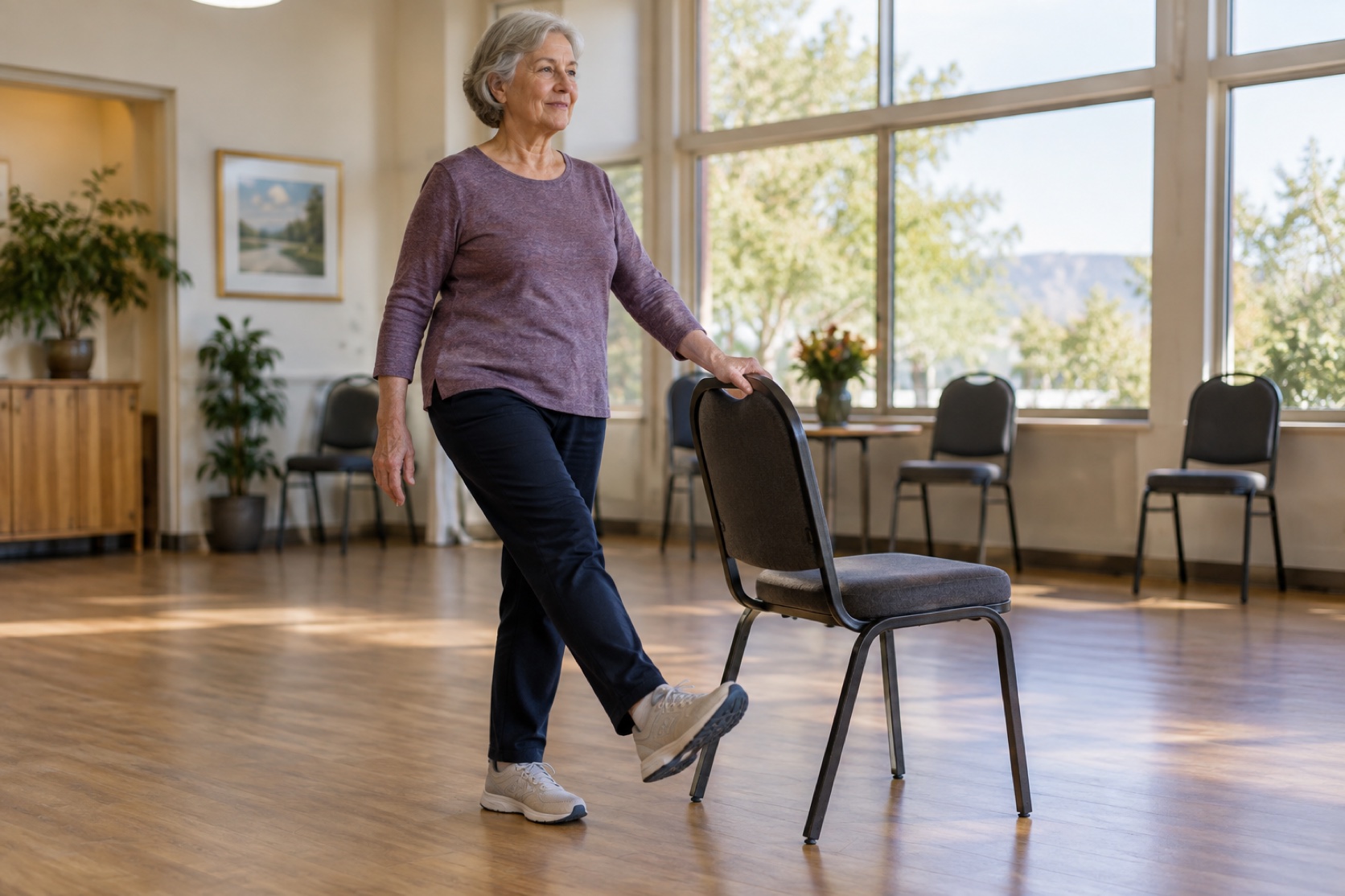
Don't panic — treat it as a training target, not a verdict. Balance improves fast with daily practice: start holding onto a chair back with two fingers, work toward one finger, then none. Most people gain the full 10 seconds within weeks.
Non-slip exercise or yoga mat
Provides a stable, comfortable surface for mobility or floor-based exercise.
⚠️ None expected; it does not treat pain or replace injury-specific care.
Check price on Amazon →The 10-Minute Daily Routine
Stability and mobility respond to frequency more than intensity. Ten minutes a day beats an hour on Sunday:
| Move | Dose | What it trains |
|---|---|---|
| Single-leg balance (each side) | 3 × 30 sec | Ankle and hip stability — the fall-prevention muscle |
| Heel-to-toe walking (tandem gait) | 2 × 10 steps | Dynamic balance under movement |
| Deep squat hold (assisted if needed) | 3 × 20 sec | Ankle, knee, and hip mobility — the "get up off the floor" skill |
| Hip hinge (good-morning pattern) | 10 slow reps | Posterior-chain mobility without spinal flexion |
| World's-greatest-stretch lunge sequence | 5 per side | Hip, thoracic, and hamstring mobility in one flowing move |
| Cat-cow / thoracic rotations | 10 each | Spine mobility — the "looking over your shoulder" skill |
Pair this with the strength topic's advice and the picture completes itself: strength gives you the capacity to catch yourself, stability gives your nervous system the wiring to do it automatically, and mobility gives your joints the range for the catch to happen without strain. Cardio gives you the endurance to keep doing all of it.
Progressions: From Wall to No Hands
Every exercise in the routine scales down to "too easy" and up to "very hard." The balance ladder is the cleanest example:
| Level | Single-leg balance version | When to move up |
|---|---|---|
| 1 | Both feet, eyes open, holding a wall | Comfortable for 60 seconds |
| 2 | Single leg, two fingers on a wall | 30 seconds, minimal grip pressure |
| 3 | Single leg, arms free, eyes open | Hold 30 seconds each side |
| 4 | Single leg on a soft surface (towel, cushion) | Hold 20–30 seconds |
| 5 | Single leg, eyes closed (near a wall) | Any consistent hold — this is advanced |
Desk-Bound? Two-Minute Resets
If the daily ten minutes feels like too much, start with a two-minute reset every hour at your desk. Each reset: stand up, reach both arms overhead (thoracic extension), hinge at the hips and let the arms hang for a slow breath (hamstrings and low back), rotate the torso both ways while looking over each shoulder, then hold a deep squat or lunge for 20 seconds per leg. Sixty seconds of movement, repeated five or six times across a workday, delivers most of the anti-sitting benefit without ever leaving the office. The goal isn't a workout — it's interrupting the position that does the damage.
When to Modify vs. When to Push
A practical distinction: sharp pain is a stop signal, while stiffness, muscle burn, and mild discomfort are normal parts of regaining range. If an exercise causes sharp or shooting pain, modify it (smaller range, support, different angle) or swap it for a neighbor in the routine — mobility work should feel like gentle negotiation, not like fighting. Persistent pain that doesn't improve over two weeks deserves a professional look: a physical therapist can diagnose and progress better than any topic. Mobility training is remarkably safe territory, but it isn't diagnosis-free.
The Payoff: The Marginal Decade
The longevity case for stability and mobility crystallizes in a phrase coined in longevity medicine: the marginal decade. Most people's final ten years are decided decades earlier — not by a single diagnosis, but by the slow accumulation of small losses: the squat that stopped happening, the balance that stopped being challenged, the range that quietly shrank. The person who practiced ten minutes daily from their 50s enters their 80s with reserves; the person who didn't enters with a cascade risk. No single workout today will feel heroic. The heroism is entirely in the accumulation — ten unremarkable minutes that, over thirty years, decide whether your last decade is spent walking independently or recovering from a fall. That's the trade the marginal decade is asking you to make now.
Stumble recovery runs on the fast half of strength — see Why Power Declines First.
The Bottom Line
- Stability is control, mobility is reach, flexibility is optional. Train the first two.
- Falls are preventable — balance-focused exercise cuts fall rates by roughly a quarter, and more practice cuts them further.
- Test yourself quarterly with the 10-second single-leg stand and the 30-second chair stand.
- Ten minutes daily — balance, deep squat, hip hinge — is the entire program, and it needs no gym.
Go Deeper: Subtopics
- 🔎 Balance as a trainable system — the progression ladder: from two-leg stance to dynamic single-leg work. Read it →
- 🔎 The mobility–stability spectrum — which joints need mobility (hips, ankles, spine) and which need stiffness (knees, lumbar). Read it →
- 🔎 Fall prevention — the strongest evidence in this topic: balance + strength programs and the hip-fracture numbers. Read it →
- 🔎 The daily 10-minute mobility routine — a minimal joint-maintenance sequence with no equipment. Read it →
- 🔎 Mobility myths, audited — static stretching vs strength, foam rolling, and fascia claims: what survives the evidence. Read it →
Related Topics
- Sherrington et al., "Exercise for preventing falls in older people living in the community," Cochrane Database of Systematic Reviews (2019)
- Araujo et al., "Successful 10-second one-legged stance performance predicts survival in middle-aged and older individuals," British Journal of Sports Medicine (2022)
- de Brito et al., "Ability to sit and rise from the floor as a predictor of all-cause mortality," European Journal of Preventive Cardiology (2014)
- Studenski et al., "Gait speed and survival in older adults," JAMA (2011)
- Behm et al., "Acute effects of muscle stretching on physical performance, range of motion, and injury incidence," Applied Physiology, Nutrition, and Metabolism (2016)