Strength Training After 40: Why Muscle Matters More
Sometime in your 30s, your body starts quietly losing muscle — 3 to 8% per decade, faster after 60. The condition has a name (sarcopenia), a measurable cost (frailty, falls, metabolic decline), and a well-tested solution that works at every age: lifting heavy things, progressively, twice a week.
What the evidence supports
- Resistance training increases muscle mass and strength in randomized trials — including in people in their 80s and 90s.
- Muscle strength is independently associated with lower all-cause mortality in large cohorts.
- Strength and balance training reduce falls in older adults (consistent trial and meta-analytic evidence).
What remains uncertain
- How much of the strength–mortality association is causal versus a marker of overall health remains debated.
- Optimal frequency and volume for longevity (as opposed to bodybuilding) aren't precisely defined.
- Muscle's role as a glucose "sink" is well-supported mechanistically, but its independent clinical impact is still being quantified.
Evidence last reviewed: August 13, 2026. Conclusions may change as new research is published.
What You're Losing — and When It Matters
After roughly age 30, muscle mass declines 3–8% per decade, and strength declines faster than mass — power (force × speed) drops most of all. The clinical consequences arrive on a schedule:
| Decade | What's typically happening | What it means day-to-day |
|---|---|---|
| 40s | Slow loss begins; most people don't notice | Recovery slows; strength becomes "use it or lose it" |
| 50s | Loss accelerates; power declining noticeably | Stairs and lifting feel heavier; first falls risks appear |
| 60s | Sarcopenia becomes common | Getting up from the floor, carrying groceries become genuine tests |
| 70s+ | Frailty risk in untrained people | Falls → hip fracture → loss of independence — the classic cascade |
The cascade is the point. For older adults, a fall is often the first event in a decline that ends in lost independence — and leg strength and balance are the two most modifiable protective factors. Muscle isn't cosmetic; it's your structural and metabolic insurance.
Product picks are generic categories, not brands. We may earn a commission on Amazon or iHerb purchases at no cost to you — this never changes our evidence conclusions. Full disclosure
Adjustable dumbbells
Allows progressive loading at home across common strength movements.
⚠️ Poor technique or rapid load increases raise injury risk; not required to begin moving more.
Check price on Amazon →The Study That Proved It's Never Too Late
If you ever doubt that age is a barrier, know the Fiatarone study. In 1994, researchers at Tufts put 90-year-old nursing-home residents — frail, using walkers, some with multiple chronic conditions — on a simple high-intensity leg-press program. Over ten weeks, muscle strength increased by roughly 174% on average, and walking speed improved by almost 50%. Some participants stopped using walkers. The oldest human muscle ever studied adapted like any other muscle. There is no age at which "too late" is biologically true — and the same finding has been replicated across dozens of studies since: muscle tissue keeps its trainability for life.
The Missing Ingredient: Power
Here's a finding most strength advice skips: as you age, power — force expressed quickly — declines faster than strength itself, and power is what actually catches you when you trip. A 70-year-old can be strong in a slow squat yet unable to extend a leg fast enough to stop a stumble. The fix is small, safe doses of explosive movement: sit-to-stands performed quickly, light jump squats or step-ups done with intent, medicine-ball throws, or simply walking up stairs two at a time with purpose. Research on power training in older adults shows large, rapid improvements in function from surprisingly light loads moved fast. If strength training is the foundation, power is the insurance policy on top of it. The protocol series takes that layer further in Building Power: The Quality That Fades First.
What Strength Buys You, Beyond the Mirror
A bigger glucose sink
Muscle is where most of your dietary glucose goes. More muscle means better glucose disposal — your built-in insulin-sensitivity program.
Bone density
Bones strengthen in response to load. Resistance training helps slow — and in some studies reverse — age-related bone loss.
Independence
Getting out of chairs, cars, and bathtubs — the tasks that define independent living — are all leg-strength tasks in disguise.
Resting metabolism
Muscle burns energy even at rest. More muscle raises your resting metabolic rate, making weight management easier.
How to Start — and Keep Going
The essentials, stripped of gym mythology — whether you train in a gym, at home with dumbbells and bands, or in a park with bodyweight, the principles are identical:
| Variable | Evidence-based guidance |
|---|---|
| Frequency | 2× per week per muscle group is the efficient minimum; 2–3 full-body sessions weekly work well |
| Exercises | Compound movements first: squat pattern, hinge (deadlift), push (press), pull (row), carry |
| Sets & reps | 2–4 sets of 8–15 reps at moderate load; the key is approaching fatigue on the last 1–2 reps |
| Progression | Add weight or reps when the current load gets easier — progressive overload is the whole game |
| Protein | ~1.6 g per kg of body weight daily supports muscle building (see the Nutrition pillar) |
| Recovery | 48+ hours between hard sessions for the same muscles; sleep does the actual building |
🏋️ Three myths, retired
"I'll get bulky" — building large amounts of muscle requires years of dedicated, high-volume training and often favorable genetics; it doesn't happen by accident. "Machines are safer than free weights" — both are safe when technique is sound; bodyweight and dumbbells need no gym at all. "I'm too old to start" — the Fiatarone study, and dozens since, say otherwise. Start light, progress slowly, and get clearance from your doctor if you have joint disease or heart conditions.
Smart band or smartwatch
Can make activity, exercise, and routine patterns easier to notice over time.
⚠️ Step, heart-rate, and sleep estimates can be inaccurate and may encourage unhelpful over-monitoring; consumer readings are not medical diagnoses.
Check price on Amazon →A Starter Program: The First Eight Weeks
A concrete on-ramp, twice weekly, using nothing but bodyweight and a pair of dumbbells:
| Exercise | Weeks 1–4 | Weeks 5–8 |
|---|---|---|
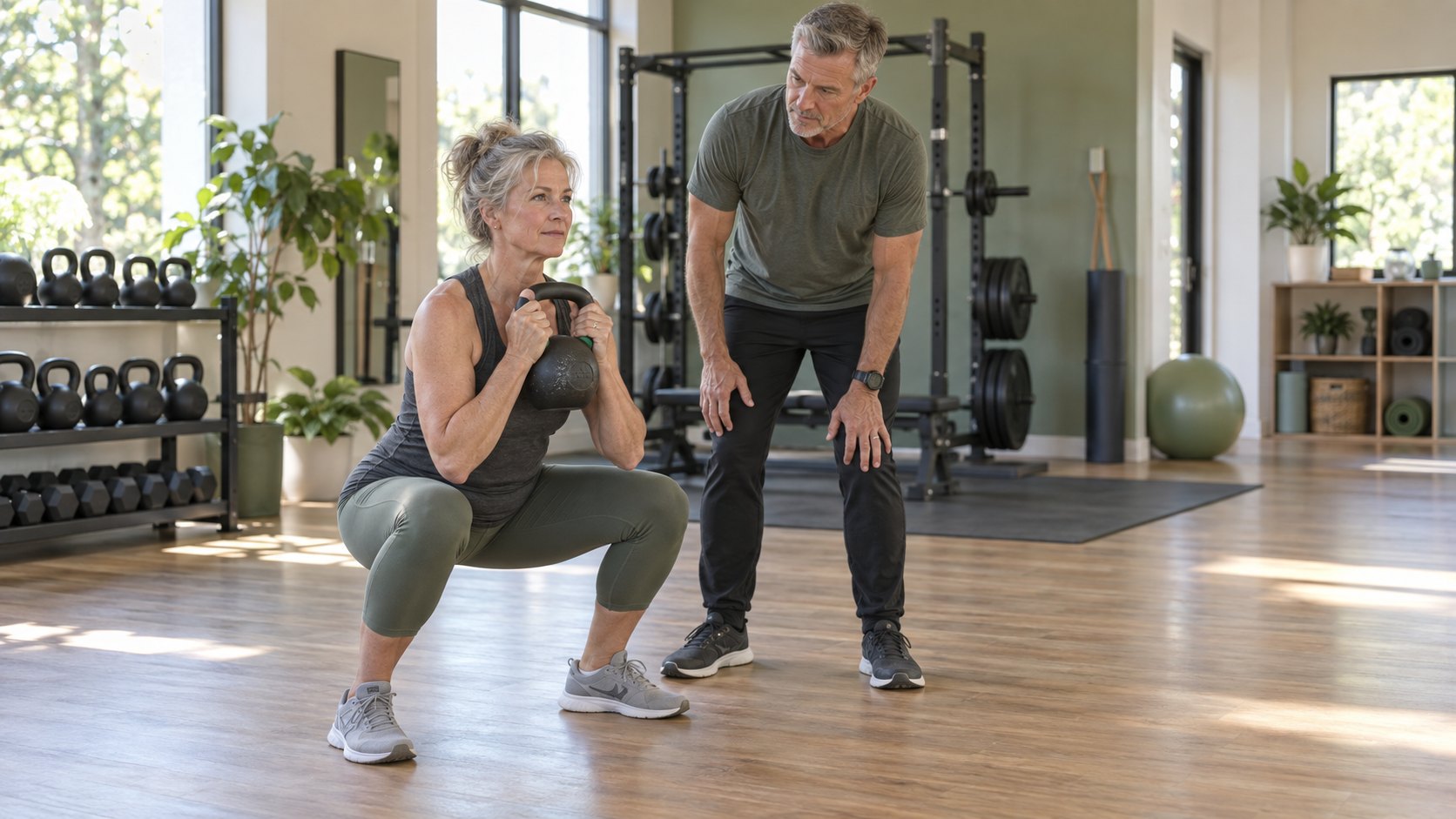
| Goblet squat (or sit-to-stand) | 3 × 10 | 3 × 12, slightly heavier |
| Romanian deadlift (or hip hinge to wall) | 3 × 10 | 3 × 12 |
| Push-up (incline if needed) | 3 × 6–10 | 3 × 10–15 |
| Dumbbell row (or band row) | 3 × 10 / side | 3 × 12 / side |
| Farmer's carry | 3 × 30 sec | 3 × 45 sec |
Rest 60–90 seconds between sets. The rule for progression: when the last rep of every set stops feeling challenging, add weight or reps next session. That's the entire programming manual for the first year.
The Mistakes That Stall Progress
- Ego loading. Weight that forces bad form doesn't build anything except injuries. The last two reps should be hard with perfect form — that's the ceiling, not the weight on the bar.
- Skipping legs. Lower-body strength is what gets you out of chairs and off the floor. Upper-body-only programs miss the point of longevity training entirely.
- No progression. Doing the same weight for six months is maintenance, not training. The muscle only changes when the demand changes — a little more, regularly.
- Ignoring protein. Training without adequate protein is like ordering materials for a build and only half of them arriving. (Details in the Nutrition pillar — ~1.6 g/kg daily is the studied sweet spot.)
Strength Training and Women: The Bone Case
If there's one group with the strongest reason to lift, it's postmenopausal women — and it's about bone. The Women's Health section runs the full case. Estrogen's decline accelerates bone loss, and osteoporosis-related fractures are a leading cause of disability in older women. Bone, like muscle, responds to load: resistance training and high-impact activities (jumping, hopping — scaled appropriately) are consistently associated with better bone mineral density, and strength-trained older women fall less and fracture less when they do fall, because stronger muscles and better balance prevent the fall in the first place. The outdated image of the "weights room as men's territory" has done measurable harm; the modern evidence says the opposite — the room is arguably most valuable to women over 50.
Resistance bands
A low-space way to begin or supplement resistance training.
⚠️ Bands can snap and unstable anchoring can cause injury; stop movements that provoke pain.
Check price on Amazon →How Strength Fits With Cardio
A question that stops many people from starting: "should I lift or do cardio?" The longevity answer is both, but sequenced thoughtfully. Research on concurrent training shows the combination is generally complementary, with two practical rules. First, space them out — strength and hard cardio on the same day are fine if separated by several hours, but back-to-back sessions can blunt both stimuli. Second, order by priority — if strength is the day's focus, lift before you run, and vice versa. For most people following the 3-2-1 formula, the natural rhythm handles this automatically: strength and intervals live on different days, and zone 2 cardio sits between them as active recovery. The real-world evidence is encouraging: people who do both live, on average, with more function for longer than people who do either alone. Bone-specific loading across life is covered in Exercise & Bone Health. The companion audit — Cardio vs Strength — covers how the two modes compare for mortality and disease risk.
The Bottom Line
- Muscle loss is the silent thief of independence — 3–8% per decade, faster after 60, and entirely addressable.
- Strength is a mortality predictor in large cohorts, independently of how much you weigh.
- Two sessions a week of the big movements — squat, hinge, push, pull, carry — with progressive overload, covers most of the benefit.
- It works at any age. The oldest humans ever studied grew stronger in ten weeks.
Go Deeper: Subtopics
- 🔎 Sarcopenia & anabolic resistance — why muscle becomes harder to build: the biology of the aging muscle. Read it →
- 🔎 The minimum effective dose — how little lifting still works: 2 sessions, the evidence, and when more pays. Read it →
- 🔎 Barbells vs machines vs bands — the evidence on each tool, and why the answer is "what you'll keep doing". Read it →
- 🔎 Lifting for bone — loading principles for osteopenia risk (cross-references Women's Bone Health topic, which owns osteoporosis). Read it →
- 🔎 Injury-proofing the program — tendon adaptation, warm-up protocols, and deload weeks for the over-40 body. Read it →
Related Topics
- Fiatarone et al., "Exercise training and nutritional supplementation for physical frailty in very elderly people," New England Journal of Medicine (1994)
- Cruz-Jentoft et al., "Sarcopenia: revised European consensus on definition and diagnosis," Age and Ageing (2019)
- Leong et al., "Prognostic value of grip strength: findings from the Prospective Urban Rural Epidemiology (PURE) study," The Lancet (2015)
- Sherrington et al., "Exercise for preventing falls in older people living in the community," Cochrane Database of Systematic Reviews (2019)
- Morton et al., "A systematic review, meta-analysis and meta-regression of the effect of protein supplementation on resistance training-induced gains in muscle mass and strength," British Journal of Sports Medicine (2018)