Strength Through the Transition: Muscle in the Change
The menopause transition accelerates muscle loss — and strength training, the most effective counter, is also the most underused intervention in this population. The honest rates, the protein numbers, the body-composition shift, and a starting protocol that fits on one page.
What the evidence supports
- Resistance training reliably increases muscle mass, strength, and physical function in older adults, including well past menopause — the trial base is large and consistent.
- Lean mass and strength decline measurably across the menopause transition in longitudinal cohorts.
- Higher protein intake (roughly 1.6–2.2 g/kg daily) supports training-induced muscle gains in older adults.
What remains uncertain
- How much of the transition's muscle loss is hormonal versus chronological aging remains hard to separate — the cohort data show acceleration, not a clean mechanism.
- Whether hormone therapy meaningfully preserves muscle is unclear; the evidence is weak and inconsistent.
- Muscle gains from training are real but modest in absolute terms — expectations should match the honest effect sizes.
Evidence last reviewed: August 13, 2026. Conclusions may change as new research is published.
The Muscle Math of the Transition
Muscle loss is a background process from about age thirty onward — roughly three to eight percent of lean mass per decade for sedentary adults, with strength falling faster than mass. What the menopause transition does is step on the accelerator. In SWAN, the large longitudinal cohort that tracked women across the transition, the rate of lean-mass loss roughly doubled from the premenopausal years to the early postmenopausal years. The honest caveat: cohort data can't fully separate estrogen withdrawal from the passage of time — but the timing of the inflection, centered on the final menstrual period rather than distributed evenly across aging, points at the transition itself.
Product picks are generic categories, not brands. We may earn a commission on Amazon or iHerb purchases at no cost to you — this never changes our evidence conclusions. Full disclosure
Adjustable dumbbells
Allows progressive loading at home across common strength movements.
⚠️ Poor technique or rapid load increases raise injury risk; not required to begin moving more.
Check price on Amazon →The Most Underused Intervention in the Room
Here is the uncomfortable symmetry: the population losing muscle fastest is the population least likely to train against it. Only about one in five US women over forty-five meets the basic muscle-strengthening guideline — two sessions a week — and participation keeps falling with age. Meanwhile, the intervention has a trial record most drugs would envy: in untrained older adults, a few months of two-day-a-week training reliably produces double-digit strength gains and measurable lean-mass gains, with functional carryover into daily life. The gap between what the evidence promises and what gets used is the widest of any longevity lever available to women in this stage of life. The strength-training pillar lays out the full case, and the resistance training protocol is the operational version.
Protein powder
A convenient way to add dietary protein when food intake is insufficient or impractical.
⚠️ May cause digestive symptoms; formulation matters for allergies and intolerances. It does not replace a varied diet.
Check price on Amazon →Protein: The Building Block Arithmetic
Training creates the stimulus; protein supplies the material. For older adults engaged in resistance training, the evidence-based target is roughly 1.6 to 2.2 grams of protein per kilogram of body weight per day — substantially above the modest official minimum, which is a deficiency-prevention number rather than a muscle-building one. For a sixty-five-kilogram woman that's about one hundred to one hundred forty grams daily. Two wrinkles matter with age: anabolic resistance — older muscle responds less to small protein doses, so meals should carry a real dose (roughly twenty-five to forty grams each) rather than a trickle — and the distribution — three to four protein-containing meals beats one big dinner. The Protein pillar covers the sources, the math, and the plant-versus-animal tradeoffs in full.
The Body-Composition Honesty
What many women experience through the transition is not simply weight gain but recomposition in the wrong direction: muscle down, fat up, with the new fat preferentially landing around the organs. The scale can stay nearly flat while this swap proceeds underneath it — same weight, worse body. The mechanism runs through both the muscle loss above (less metabolically active tissue) and a hormonal shift in where fat is stored: visceral fat rises measurably across the transition in cohort studies, and it's the visceral compartment — not the subcutaneous one — that drives metabolic and cardiovascular risk. The Visceral Fat topic explains why location matters more than amount. The practical read: waist circumference and strength are more honest reporters of your trajectory through this decade than the bathroom scale.
Muscle and Bone Are One Project
Bone and muscle don't age separately — they're coupled through loading. Every time a muscle contracts against resistance, it pulls on the bone it attaches to, and bone responds to that pull by maintaining or adding density; remove the pull and bone gets the message to economize. This is why strength training is simultaneously the muscle intervention and a bone intervention: trials of high-intensity resistance training in postmenopausal women with osteopenia and osteoporosis have improved spine bone density by roughly three percent in eight months while the control groups lost density — results in the same direction as medication in some comparisons, without the side-effect ledger. The full story lives in the Bone Health topic; the operational takeaway is that the same two weekly sessions serve both systems, which doubles the return on a single habit.
Starting From Zero, Over Fifty: The Protocol in Brief
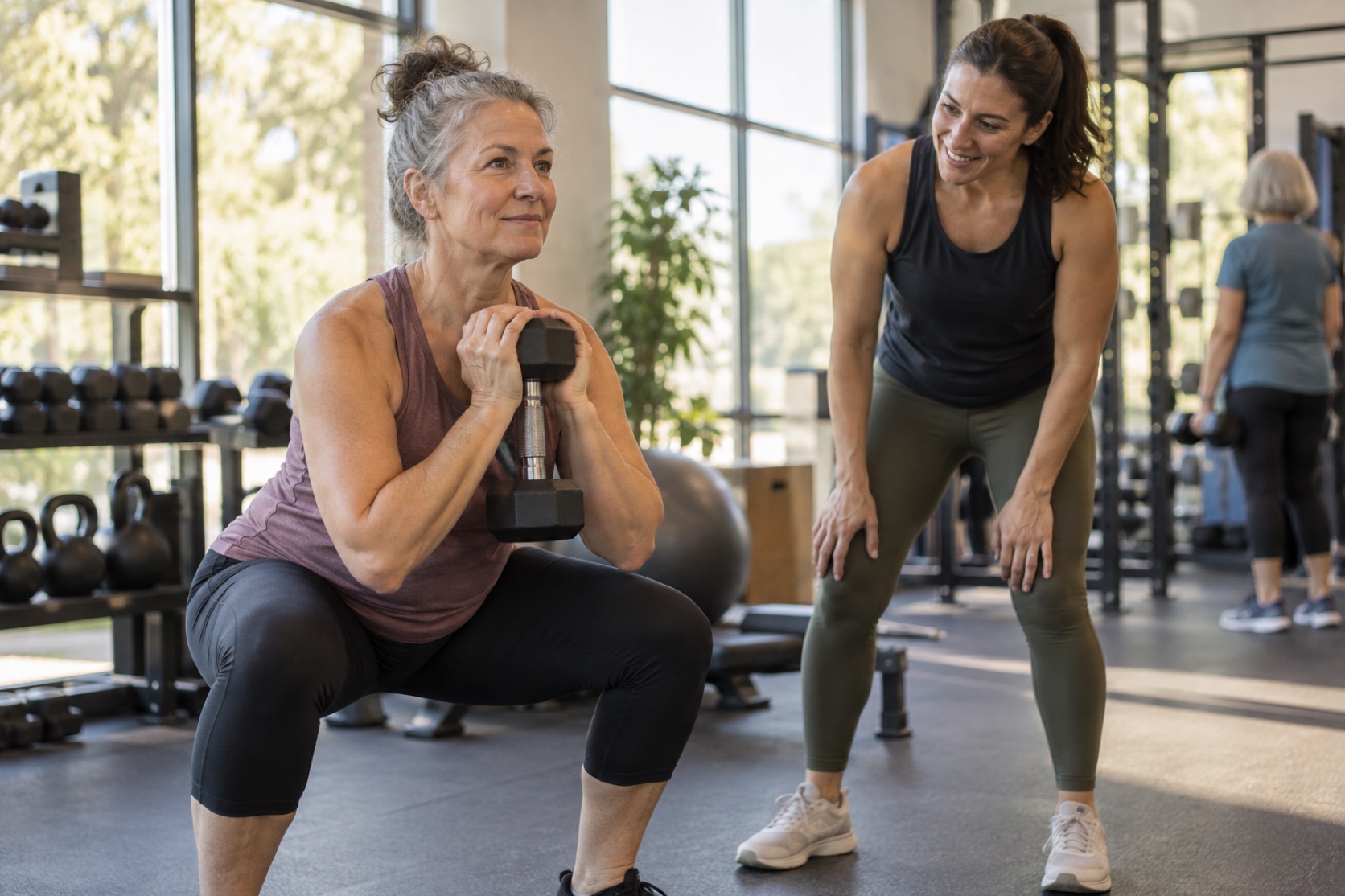
The full system is the Resistance Training protocol; here is the compressed, honestly achievable version for a beginner over fifty. Train two days a week on non-consecutive days — enough to drive adaptation, with recovery built in. Cover five movement patterns: squat, hinge, push, pull, and carry — that's the whole map of human movement, and five exercises chosen one per pattern is a complete program.
| Pattern | What it looks like | Why it matters now |
|---|---|---|
| 🧎 Squat | Sit down and stand up, with weight — chair squat, goblet squat | The functional pattern of daily life; loads hips and thighs, the strongest bone-building site below the waist |
| 📐 Hinge | Bend at the hips with a flat back — deadlift, kettlebell swing | Trains the posterior chain — the muscles that keep you upright and pain-free |
| 🤲 Push | Press weight away — wall push-up, dumbbell press | Upper-body strength for daily life; loads wrist and shoulder bone |
| 🚣 Pull | Row weight toward you — band row, cable row | Posture and back strength — the antidote to a lifetime of desk spine |
| 🧳 Carry | Walk holding weight — farmer's carry | Grip, core, and balance in one move — and grip strength tracks longevity in cohorts |
Start with two to three sets of six to twelve repetitions per pattern, using weights light enough to leave a few reps in reserve, and add a little load or a rep or two every week or so — the protocol's progressive-overload chapter handles the details. Ten minutes of easy cardio as a warm-up is enough. The entire session fits inside forty-five minutes, twice a week. That is the whole intervention, and it is enough to reverse the direction of the chart at the top of this topic.
💪 The "bulky" worry, in one paragraph
The fear that lifting will make women bulky is the most persistent barrier in this population, and the honest answer is that it misunderstands how slowly muscle grows. Women carry roughly five to ten percent of the testosterone of men, and even under optimal training, natural muscle gain in a new lifter maxes out near half a kilogram of lean mass a month — briefly — before settling much lower. The physiques women associate with "bulky" took years of deliberate hypertrophy programming, surplus calories, and often substances you don't want. What two sessions a week actually produces is the look the fitness industry sells as "toned" — because toned is muscle, plus a modest amount of it.
The Bottom Line
- The transition accelerates muscle loss — but the decline is trainable, not destiny; the SWAN inflection cuts both ways.
- Two sessions a week is the entire ask: squat, hinge, push, pull, carry — five patterns, five exercises, forty-five minutes each.
- Feed the project: roughly one and a half to two grams of protein per kilogram daily, spread across three to four meals.
- Dismiss the bulk myth: without years of deliberate effort you'll get stronger and denser — bone included — not bigger.
Go Deeper: Subtopics
- 🔎 Anabolic resistance & estrogen loss — why the muscle math gets harder, mechanistically. Read it →
- 🔎 The protein requirement shift — the 1.6–2.2 g/kg target and distribution (links Nutrition's Protein topic). Read it →
- 🔎 Lifting through symptoms — training around hot flashes, joint pain, and disrupted sleep. Read it →
- 🔎 The bone-muscle double win — why resistance training is the two-for-one intervention of the transition. Read it →
- 🔎 Starting from zero — the beginner's 2-day program for women new to lifting (links Resistance Training Protocol). Read it →
Related Topics
- Greendale GA et al., "Changes in body composition and weight during the menopause transition," JCI Insight (2019)
- Maltais ML et al., "Changes in muscle mass and strength after menopause," Journal of Musculoskeletal and Neuronal Interactions (2009)
- Morton RW et al., "A systematic review, meta-analysis and meta-regression of the effect of protein supplementation on resistance training-induced gains in muscle mass and strength," British Journal of Sports Medicine (2018)
- Watson SL et al., "High-Intensity Resistance and Impact Training Improves Bone Mineral Density and Physical Function in Postmenopausal Women With Osteopenia and Osteoporosis: The LIFTMOR Randomized Controlled Trial," Journal of Bone and Mineral Research (2018)
- Peterson MD et al., "Influence of resistance exercise on lean body mass in aging adults: a meta-analysis," Medicine & Science in Sports & Exercise (2011)
- Elgaddal N et al., "Physical Activity Among Adults Aged 18 and Over: United States, 2020," NCHS Data Brief (2022)