Bone Health & Osteoporosis: The Silent Erosion
Bone is not a scaffold — it's a living ledger. Every year, roughly a tenth of the adult skeleton is demolished and rebuilt, and estrogen has been the bookkeeper keeping the two columns in balance. When the bookkeeper leaves, the demolition column runs ahead — quietly, invisibly, for years — until a fall or a fracture announces what has been eroding. This is the anatomy of that erosion, and the evidence-ranked toolkit for staying ahead of it.
What the evidence supports
- Spinal bone loss runs about 2% per year in the first years after the final period — the resorption brake is estrogen, and it is gone.
- Resistance training plus impact genuinely increases or preserves bone density in postmenopausal women, including those with low bone mass.
- Low bone density is a risk factor, not a disease; fracture is the outcome that matters.
- Medications (bisphosphonates and newer agents) reduce fracture risk substantially for people at high risk.
What remains uncertain
- Whether calcium and vitamin D supplements prevent fractures in community-dwelling adults — trial evidence is weak; food-first is the defensible default.
- How often to repeat DEXA scans — guidelines disagree, and bone density changes slowly.
- The best dose and format of balance training for fracture prevention — balance clearly helps, the prescription details are unsettled.
Evidence last reviewed: August 13, 2026. Conclusions may change as new research is published.
The Remodeling Ledger
Two crews work your skeleton around the clock: osteoclasts demolish old bone, osteoblasts pour new bone into the cavities. For the first three decades of adulthood the columns roughly balance — you reach peak bone mass around 30 and coast on the surplus. Estrogen is the brake on the demolition crew; when it falls across the menopause transition, markers of bone resorption rise sharply while bone formation increases only about half as much. The ledger tilts negative, and it tilts hardest where it matters most: the spine's spongy interior loses roughly 2% per year in the first postmenopausal years, with the hip at about half that rate. Across the whole transition, the average woman loses on the order of a tenth of her spinal density — most of it before any symptom, scan, or ache announces the fact. That's the "silent" in the silent erosion. The full estrogen story is in the Menopause 101 topic.
Product picks are generic categories, not brands. We may earn a commission on Amazon or iHerb purchases at no cost to you — this never changes our evidence conclusions. Full disclosure
Calcium supplement
May help meet calcium needs when diet is insufficient, particularly in relevant bone-health contexts.
⚠️ Can cause constipation and may interact with some medicines; excess supplemental calcium is not automatically beneficial.
Check price on Amazon →What Osteoporosis Actually Is (and Isn't)
Osteoporosis is diagnosed by a DEXA scan's T-score: how many standard deviations your density sits from the average healthy 30-year-old woman. The bands are clinical convention, not natural law:
| Category | T-score | What it actually means |
|---|---|---|
| Normal | ≥ −1.0 | Density in the expected range |
| Osteopenia | −1.0 to −2.5 | Low density — a risk marker, not a disease |
| Osteoporosis | ≤ −2.5 | High fracture risk — treatment territory |
| Severe osteoporosis | ≤ −2.5 plus a fragility fracture | The fracture has already announced itself |
The honest read, stated plainly: low bone density is a risk factor, not a disease — the same category as blood pressure, not the same category as a broken hip. The disease is the fracture. Two consequences follow. First, an osteopenia diagnosis is not a medical emergency; it's a signal to act on the levers below. Second, the population arithmetic is humbling: because there are so many more osteopenic than osteoporotic women, most fractures happen in women with osteopenia. Tools like FRAX exist for exactly this reason — they convert density plus age plus risk factors into a ten-year fracture probability, which is the number that should drive decisions. About half of women over 50 will have an osteoporosis-related fracture in their remaining lifetime. That's the statistic the toolkit below exists to bend.
The Stakes: A Hip Fracture, in Numbers
Among osteoporotic fractures, the hip is the one that changes a life. The numbers deserve to be stated without flinching: about one in five women who fractures a hip dies within a year — a mortality figure comparable to some cancers, though part of it reflects the frailty that was already there. Among survivors, the functional ledger is steeper than the mortality one: a year out, most need help with basic daily activities, and a minority walk as well as they did before. A fracture both reveals frailty and manufactures it. The single most useful fact in this section, though, is the one nobody volunteers: a hip fracture almost always requires a fall, and falls are modifiable — which is why the toolkit below ends with balance, not supplements.
Vitamin D3
May help correct low vitamin D intake or deficiency when clinically appropriate; broad benefits for people who are already replete are uncertain.
⚠️ Excess intake can cause high calcium levels and harm; review dose, testing, kidney conditions, and relevant medications with a clinician or pharmacist.
Check price on Amazon →The Prevention Toolkit, Ranked by Evidence
| Lever | Evidence | The honest note |
|---|---|---|
| 🏋️ Resistance training + impact | Strong | Load is the signal bone builds to. In the LIFTMOR trial, women with low bone mass doing heavy lifting plus jumps gained ~3% spinal density while controls lost some. Start at the Strength pillar, build with the Resistance Training Protocol. |
| 🥚 Protein | Moderate | Bone is a third protein; intakes around 1.0–1.2 g/kg associate with better density and recovery after fracture. Food-first — the Protein pillar has the numbers. |
| ☀️ Vitamin D | Moderate | Needed for calcium absorption and clearly helps the deficient; trial benefit for fracture prevention in community-dwelling adults has mostly evaporated. Correct a deficiency, don't chase a supplement protocol. |
| 🥛 Calcium supplements | Weak | Small density bump, no clear fracture reduction in meta-analyses, plus a kidney-stone cost. Food-first; see the callout below. |
| 💊 Hormone therapy | Strong | Genuinely preserves bone and cuts fractures — but for bone alone it's usually second line; the WHI-corrected topic covers the arithmetic. |
| 🚶 Walking & leisure cardio | Moderate | Excellent for fall fitness and everything else; on its own, not enough mechanical signal to build bone. |
| 🦴 Bone medications | Strong | Bisphosphonates cut vertebral fractures by roughly 40–70% and hip fractures by roughly a quarter in high-risk women; denosumab and newer agents are alternatives. Clinician territory — decided on ten-year fracture risk, not on the T-score alone. |
The ranking is the message: the top of the list is a barbell, and the bottom is the supplement aisle. Bone responds to load and food — mechanical tension tells the osteoblasts to build, and protein supplies the raw material — while the supplement evidence has quietly deflated over the past decade. The medication row is real and important, but it belongs to a different conversation: one you have with a clinician when ten-year fracture risk crosses into treatment territory. For the exercise side — youth loading, men, fracture rehabilitation, and low energy availability — see Exercise & Bone Health.
🥛 The calcium-supplement honesty
Calcium pills raise bone density a little and have never clearly lowered fracture risk in community-dwelling adults — a large 2017 meta-analysis found no association between calcium or vitamin D supplements and fewer fractures, and the WHI calcium arm actually saw more kidney stones. The defensible policy is boring: get calcium from food (dairy, fortified drinks, sardines with bones, leafy greens — roughly 1,000–1,200 mg/day), and use a supplement only to close a measured gap, not as insurance. Vitamin D follows the same logic: test if you're at risk, correct a deficiency, skip the megadoses.
Adjustable dumbbells
Allows progressive loading at home across common strength movements.
⚠️ Poor technique or rapid load increases raise injury risk; not required to begin moving more.
Check price on Amazon →The Scan: When, and What It Tells You
The DEXA scan is a low-radiation density measurement of the hip and lumbar spine, and the US Preventive Services Task Force now recommends it for all women at 65, and earlier for postmenopausal women with elevated risk. The "earlier" list is short and worth memorizing: a fracture after 50, early menopause, long-term corticosteroid use, low body weight, a parental hip fracture, smoking, or heavy drinking. The scan reports a T-score (against young-adult peak), a Z-score (against age peers — a low Z-score suggests something beyond menopause is at work), and it feeds FRAX, the ten-year fracture probability. Density changes slowly, so rescanning annually is mostly noise; every two to five years is the defensible band depending on baseline — and the honest caveat is that even guidelines disagree here. If you're under 65 without risk factors, the highest-value moves in this topic don't require a scan at all.
Falls: Half the Equation Nobody Mentions
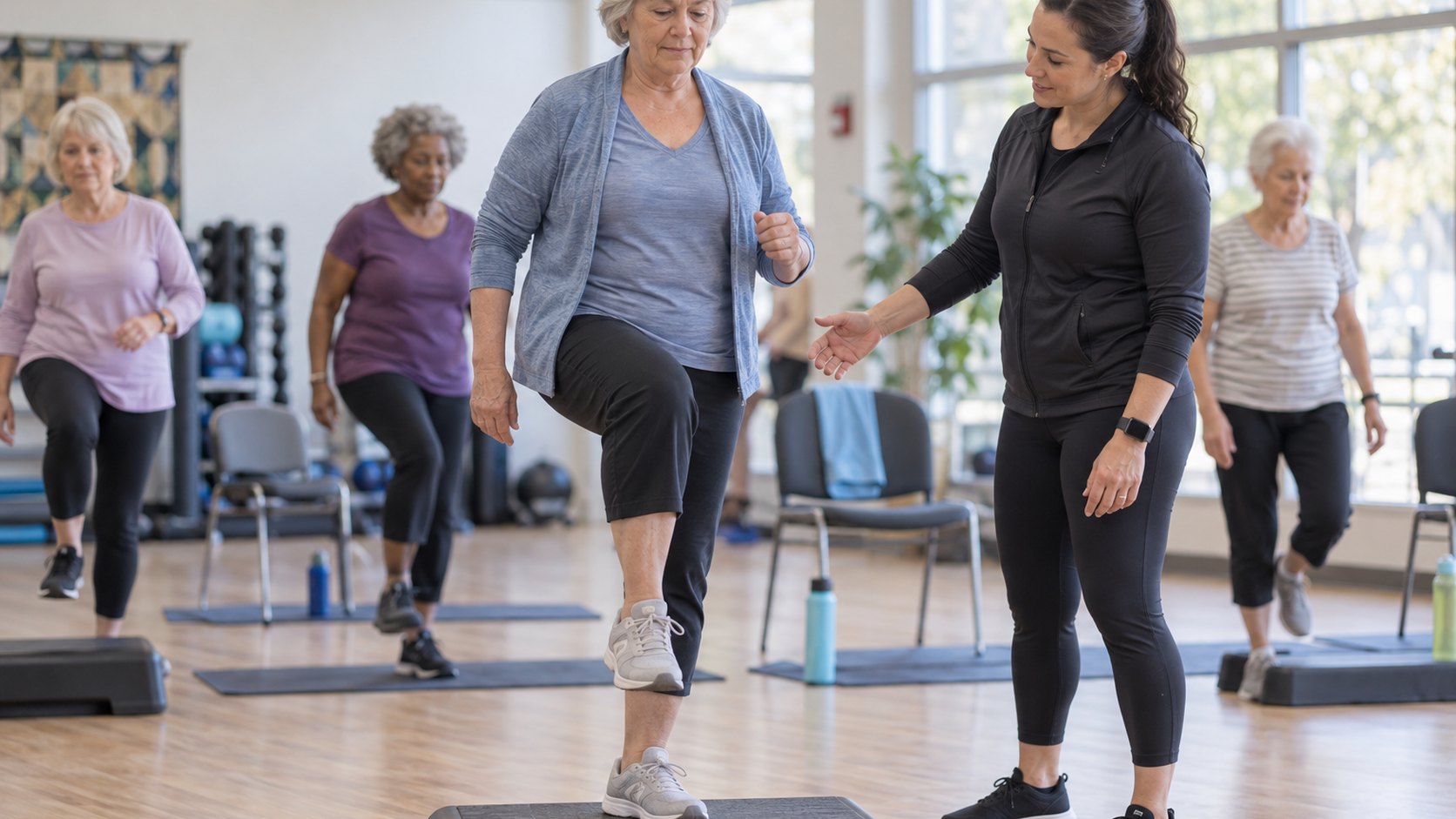
A fragile bone that never meets the floor never breaks. Most osteoporotic fractures are fall-and-force events, which means fracture prevention is at least half a balance and environment problem: strength and balance training — the one-leg stand from the Quarterly Audit is a working proxy (thirty seconds, eyes open, hands free), and the Hidden Vital Signs topic explains what grip and balance predict; home engineering — rugs, cords, stairs, lighting, a bedside path that works at 3am; medication review — sedatives and some blood-pressure drugs raise fall risk, a clinician conversation; and vision — the underrated fall risk factor. You cannot osteoporosis-proof the floor, but you can fall-proof the body and the house. For most women, that half of the equation is where the return on effort lives.
The Bottom Line
- The erosion is real and early — spinal density falls about two percent a year in the first years after the final period, mostly before anything feels wrong.
- Osteoporosis is a risk factor, not a disease — the outcome that matters is fracture, and the odds are genuinely modifiable.
- The strongest levers are load, protein, and falls — resistance training with impact sits at the top of the evidence stack; the supplement aisle sits near the bottom.
- Know your scan timing and your fracture odds — screening from sixty-five, earlier with risk factors, and a FRAX conversation with your clinician.
Go Deeper: Subtopics
- 🔎 The remodeling ledger — osteoclasts vs osteoblasts, and why the menopause transition tips the balance. Read it →
- 🔎 The fracture math — hip, spine, wrist: the absolute risks and why a fracture at 60 changes everything. Read it →
- 🔎 DEXA & the T-score — reading a bone density report without a medical degree. Read it →
- 🔎 Loading & the muscle-bone unit — the training evidence (links Exercise pillar's strength topics). Read it →
- 🔎 Calcium, vitamin D & the drug tier — what diet and supplements do, and when medication becomes the answer (⚠️). Read it →
Related Topics
- Finkelstein JS et al., "Bone mineral density changes during the menopause transition in a multiethnic cohort of women," Journal of Clinical Endocrinology & Metabolism (2008)
- Bliuc D et al., "Mortality risk associated with low-trauma osteoporotic fracture and subsequent fracture in men and women," JAMA (2009)
- Watson SL et al., "High-intensity resistance and impact training improves bone mineral density and physical function in postmenopausal women with osteopenia and osteoporosis: the LIFTMOR randomized controlled trial," Journal of Bone and Mineral Research (2018)
- Zhao JG et al., "Association between calcium or vitamin D supplementation and fracture incidence in community-dwelling older adults," JAMA (2017)
- US Preventive Services Task Force, "Screening for osteoporosis to prevent fractures: recommendation statement," JAMA (2025)
- Eastell R et al., "Pharmacological management of osteoporosis in postmenopausal women: an Endocrine Society clinical practice guideline," Journal of Clinical Endocrinology & Metabolism (2019)