Loading & the Muscle-Bone Unit
Bone is nearly alone among tissues in getting stronger when stressed — and it ignores most of what people do for it. This page is the training evidence: why heavy lifting plus impact is the strongest stimulus we have, what the landmark trial actually showed, which activities don't count, and how to train safely when the scan already says low bone mass.
What the evidence supports
- Bone adapts to mechanical load — high-intensity resistance plus impact training increased spine density by about 3% in eight months in the LIFTMOR trial.
- Muscle and bone respond to the same signal: strength training builds both at once, and load is the variable that matters most.
- Walking and leisure cardio are healthful but do not, by themselves, deliver an osteogenic stimulus.
What remains uncertain
- The minimal effective dose — exact frequency, load, and impact counts — trials use varied prescriptions.
- How much exercise prevents actual fractures: density gains are modest, and the fracture evidence rides mostly on falls and function.
- Long-term adherence outside supervised trials — what people sustain at home is rarely what the study delivered.
Evidence last reviewed: August 15, 2026. Conclusions may change as new research is published.
Product picks are generic categories, not brands. We may earn a commission on Amazon or iHerb purchases at no cost to you — this never changes our evidence conclusions. Full disclosure
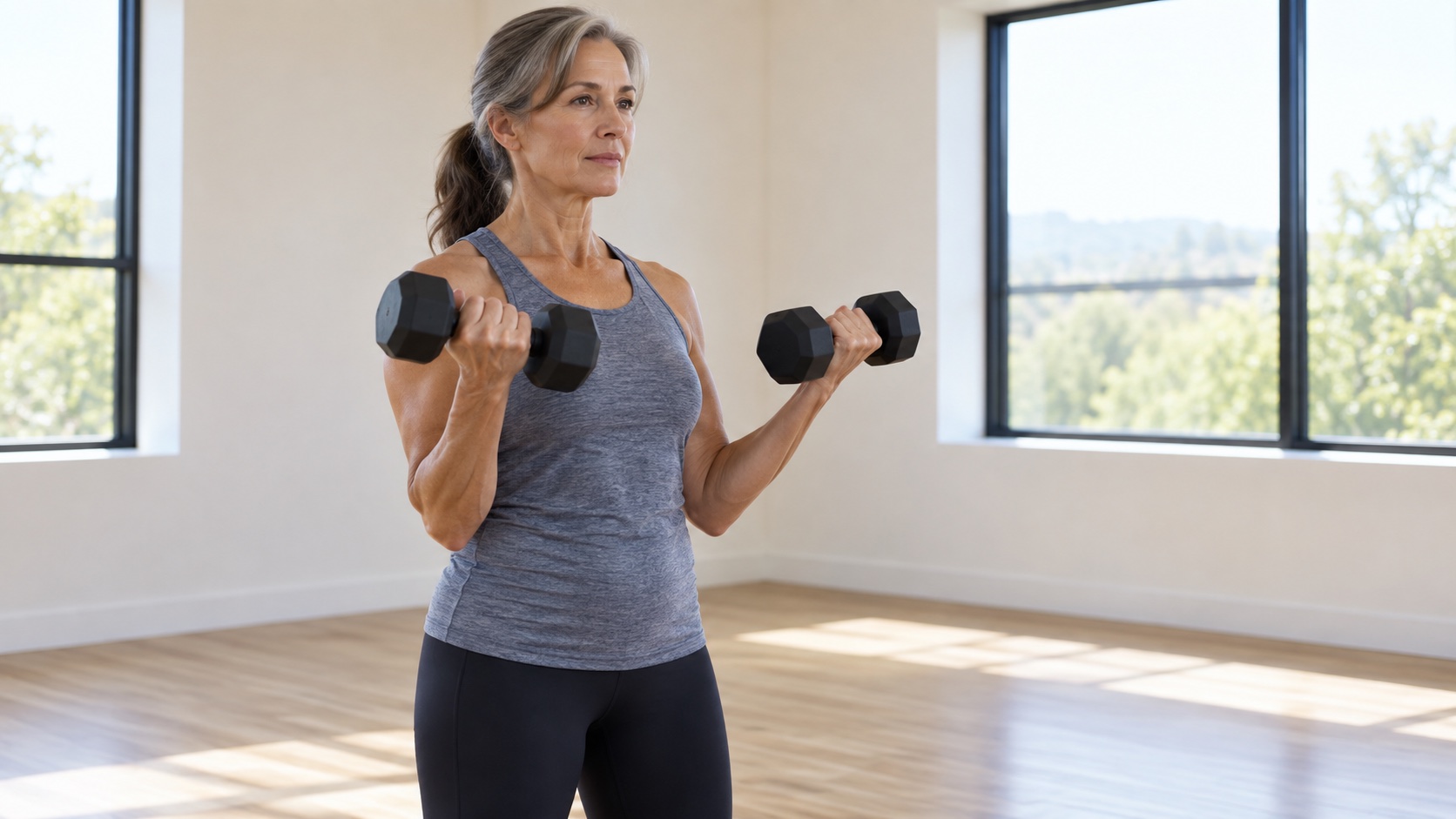
Adjustable dumbbells
Allows progressive loading at home across common strength movements.
⚠️ Poor technique or rapid load increases raise injury risk; not required to begin moving more.
Check price on Amazon →Bone Is Lazy: The Mechanostat
The idea that bone follows load is older than X-rays — Wolff's law dates to 1892 — and its modern form is Harold Frost's mechanostat (Frost, Anatomical Record, 1987): bone, like a thermostat set to a target temperature, adjusts its mass to keep the strain it experiences inside a comfortable band. Strain too low and the skeleton economizes, resorbing what isn't used — bed rest and spaceflight shed bone on the order of a percent a month. Strain too high and the builders are summoned. Three properties of the signal decide whether bone bothers to respond: magnitude (how much force), rate (how suddenly it arrives — a jump beats a stroll), and novelty (unusual patterns, because bone "accommodates" to a repeated routine and the response fades). This is why progression is not a refinement of a bone program; it is the mechanism.
The Muscle-Bone Unit
The largest load a bone ever feels isn't the ground — it's the pull of its own muscles. Muscle and bone are developmentally and functionally one system: they grow together in childhood, and they decline together in aging, which is why sarcopenia and osteopenia so often travel as a pair after midlife. The conversation runs both ways chemically too — muscle releases signals such as IGF-1 and irisin that reach bone, while bone's osteocalcin influences muscle and energy metabolism (Kawao & Kaji, Journal of Cellular Biochemistry, 2015). The clinical corollary is simple and it reframes the whole topic: training for bone is training for muscle, and vice versa — one stimulus, two organs. The exercise-side detail of that stimulus — programming, progression, and the aging-muscle biology — lives in the Strength Training After 40 topic and in Strength Through the Transition; this page keeps its focus on what the bone evidence shows.
The Trial That Set the Bar
The reference trial in this space is LIFTMOR (Lifting Intervention For Training Muscle and Osteoporosis Rehabilitation). It randomized 101 postmenopausal women with low bone mass — T-scores at or below −1.0 — to either a home-based low-intensity program or a supervised, twice-weekly, thirty-minute session of genuinely heavy lifting: deadlifts, squats, and overhead presses at 80–85% of maximum, plus jumping chin-ups with drop landings for impact (Watson et al., Journal of Bone and Mineral Research, 2018). After eight months, the lifting group had gained roughly 3% in lumbar spine density while the home-exercise group lost a little — a swing equivalent to reversing one to two years of typical postmenopausal spine loss, achieved in the population everyone had been told to handle gently. Hip changes were smaller and noisier, physical function improved substantially, and reported adverse events were minor — important, because the study directly answered the question of whether heavy loading is tolerable with low bone mass. The honest scale-setting matters as much as the headline: 3% is meaningful, but it is not the 50%+ fracture reductions that medications in the Drug Tier page produce in high-risk groups. Exercise and drugs play different positions — this page is about the one you can play yourself.
The Stimulus, Ranked
Not all movement is load-bearing in the sense bone cares about. The ranking below is a synthesis of trial evidence and the mechanostat logic — the Cochrane review of exercise for osteoporosis treatment lands on the same ordering (Howe et al., Cochrane Database of Systematic Reviews, 2011): combined high-force and impact training moves density; walking does not.
Protein powder
A convenient way to add dietary protein when food intake is insufficient or impractical.
⚠️ May cause digestive symptoms; formulation matters for allergies and intolerances. It does not replace a varied diet.
Check price on Amazon →The Prescription, in One Table
The LIFTMOR dose is the best-validated starting point. The practical translation, variable by variable:
| Variable | What the evidence supports | Practical version |
|---|---|---|
| Frequency | Twice-weekly sessions were enough in LIFTMOR; three times is common in other positive programs | 2–3 sessions a week, thirty to sixty minutes |
| Load | Heavy — 80–85% of one-rep maximum in the trial, roughly a five-rep effort | Weights you can lift about five times with good form; progress as strength rises |
| Movements | Compound lifts that load the spine and hip: deadlift, squat, overhead press, plus jumps | The same five movements, machine or barbell — the Resistance Training Protocol has the exercise-selection detail |
| Impact | Drop landings in the trial; jump programs use a few dozen firm landings per session, a few times a week | Start with heel drops and hops, progress to low box jumps; skip when contraindicated |
| Horizon | Eight months to a measurable density change in the trial | Plan in years, measure every couple — the T-score page explains why scans can't see faster |
The nutrition half of the unit matters too: bone is a third protein, and the builders need raw material — intakes around 1.2 grams per kilogram support the process, per the Protein topic.
Training Safely With Low Bone Mass
Osteoporosis changes the rules at the margins, not the conclusion. The safety logic that follows from biomechanics and the trial experience:
- 🚫 Avoid loaded spinal flexion. Crunches, sit-ups, toe touches, and Russian twists bend the spine forward under load — the loading pattern vertebral fractures fear. Axial compression — squatting and pressing with a neutral spine — is the stimulus you want.
- 🧑🏫 Start supervised. A few sessions with a trainer experienced in osteoporosis gives you the movement patterns; LIFTMOR's clean safety record came with supervision, and unsupervised form errors are where the risk lives.
- 🪜 Progress by stage, not by courage. Impact starts gentle — heel drops, marching, small hops — and builds toward box landings over months. Load progresses the way the progressive-overload protocol prescribes: small, regular, earned increments.
- 🧘 Yoga and Pilates are conditionally good. Valuable for balance and mobility — but the flexion poses deserve modification or skipping, per the same rule above.
- 🩺 Get clearance when the history is heavy. Recent or unhealed fracture, very high fracture risk, or multiple vertebral fractures — that is clinician territory, and a supervised plan beats a heroic one.
🏋️ Exercise and medication are not rivals
Training moves bone density by a few percent over months to years; medications in the Drug Tier page move fracture risk by half or more in the highest-risk groups. The mistake is picking one. Exercise's unique wins — falls averted, strength kept, function and independence preserved — are exactly what medication does not buy, and they matter most in the same people who qualify for treatment. The stack, not the either-or, is the whole game.
Questions, Answered Briefly
- ⏱️ How long until I see it on a scan? Eight to twelve months at the earliest — and only on a scan far enough apart to detect it. Judge progress by strength and function long before density.
- 🚶 Is walking enough? For bone, no — the signal is too small and too familiar. For falls, function, and everything cardiovascular, keep walking; it just isn't the bone prescription.
- 🏋️ Can I lift heavy with osteoporosis? With supervision, neutral spine, and staged progression — yes, and LIFTMOR is the evidence it is tolerable. Clearance first if your history includes recent fractures.
- 🪢 Do resistance bands count? Bands are excellent for muscle and convenient for travel, but the loads they produce rarely reach the magnitude bone responds to. Weights win for the bone half of the unit.
- 🏊 Why not swimming — isn't all exercise load-bearing? Swimming and cycling unload the skeleton almost entirely — that's their virtue for joints and their limit for bone. They complement a bone program; they cannot replace it.
The Bottom Line
- Bone answers to load — magnitude, rate, and novelty set the signal, and a lazy skeleton resorbs what you don't use.
- The muscle-bone unit is one system — training builds both organs with one stimulus, which is why sarcopenia and osteopenia travel together.
- The evidence has a face: LIFTMOR — twice-weekly heavy lifting plus impact gained about 3% spine density in eight months in women with low bone mass, with minor adverse events.
- Training is safe and insufficient by itself at the extremes — avoid loaded flexion, progress in stages, and pair training with the medical tier for the highest-risk subset.
Related Topics
- Watson SL et al., "High-intensity resistance and impact training improves bone mineral density and physical function in postmenopausal women with osteopenia and osteoporosis: the LIFTMOR randomized controlled trial," Journal of Bone and Mineral Research (2018)
- Frost HM, "Bone 'mass' and the 'mechanostat': a proposal," Anatomical Record (1987)
- Howe TE et al., "Exercise for preventing and treating osteoporosis in postmenopausal women," Cochrane Database of Systematic Reviews (2011)
- Kemmler W et al., "Exercise effects on bone mineral density, falls, coronary risk factors, and health care costs in older women: the randomized controlled senior fitness and prevention (SEFIP) study," Archives of Internal Medicine (2010)
- Kawao N & Kaji H, "Interactions between muscle tissues and bone metabolism," Journal of Cellular Biochemistry (2015)
- Beck BR et al., "Exercise and Sports Science Australia position statement on exercise prescription for the prevention and management of osteoporosis," Journal of Science and Medicine in Sport (2017)