The Resistance Training Protocol
Muscle is the organ of aging: it buffers glucose, survives illness, and keeps you independent. The pillar's strength page owns the why — this page is the how: a two-day full-body template, progression rules that remove the guesswork, and equipment tiers from barbell to living-room floor.
What the evidence supports
- Twice-weekly full-body training captures most of the strength and muscle benefits of higher frequencies in untrained and older adults.
- Sets taken within ~1–3 reps of failure build strength and muscle comparably across rep ranges from 5 to 30.
- Progressive overload — adding load or reps over time — is the engine that drives all adaptation.
What remains uncertain
- The exact minimum dose for longevity outcomes (vs strength outcomes) is less studied — function and falls are the better-tested endpoints.
- Optimal training splits for advanced lifters are individual; this protocol is written for the first 12 months of training.
Evidence last reviewed: August 13, 2026. Conclusions may change as new research is published.
The Weekly Structure
- 📅 Two full-body sessions — e.g., Monday and Thursday. Three sessions is a fine ceiling; two is the reliable floor.
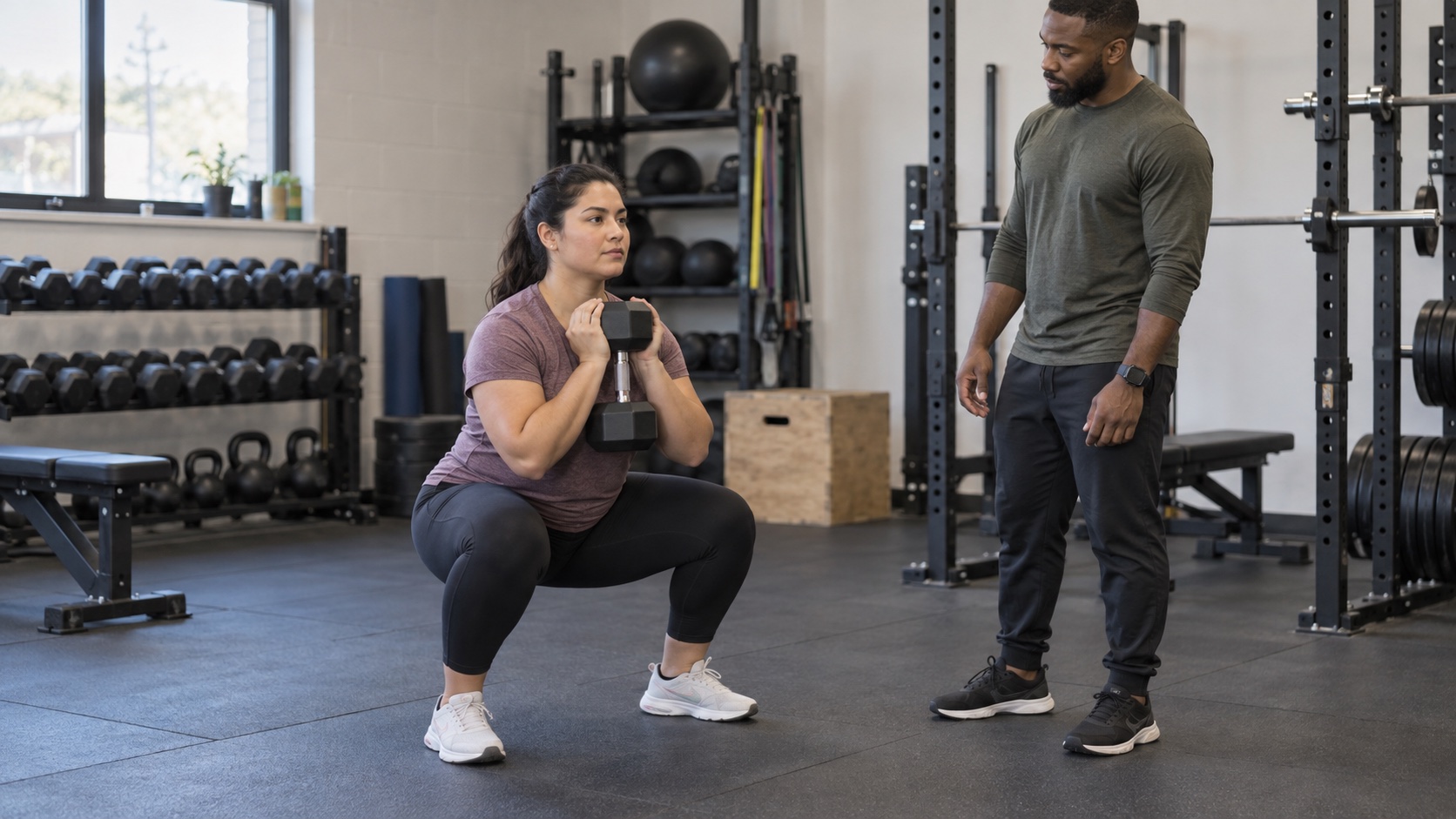
- 🧱 Compound-first — squat pattern, hinge, push, pull, loaded carry. The five patterns cover the body with five exercises.
- 🔢 2–4 sets × 5–12 reps — compounds in the 5–8 range, accessories 8–12. Rest 2–3 minutes between work sets.
- 🔄 Leave 1–3 reps in reserve — each set hard but not maximal. Grinding every set to failure buys soreness, not much extra growth.
The Five-Pattern Template
| Pattern | Barbell / gym | Dumbbells | Bodyweight |
|---|---|---|---|
| 🪑 Squat | Back squat | Goblet squat | Split squat |
| 🔗 Hinge | Romanian deadlift | Dumbbell RDL | Glute bridge |
| 🚪 Push | Bench / overhead press | Dumbbell press | Push-up |
| 🪝 Pull | Row / lat pulldown | One-arm row | Doorway / table row |
| 🎒 Carry | Farmer's carry | Farmer's carry | Loaded backpack walk |
Product picks are generic categories, not brands. We may earn a commission on Amazon or iHerb purchases at no cost to you — this never changes our evidence conclusions. Full disclosure
Doorway pull-up bar or suspension trainer
Can expand upper-body pulling options in a small home space.
⚠️ Incorrect installation or using an unsuitable door frame can cause falls; shoulder pain requires modification or assessment.
Check price on Amazon →Progression: The Double Progression Rule
- 1. Hit the top of the rep range — e.g., 3 sets of 8 on the squat.
- 2. Add the smallest load — 2.5 kg / 5 lb. Drop back to the bottom of the range.
- 3. Rebuild to the top — the wave repeats. This one rule replaces every complicated program.
- 📉 When progress stalls for 2–3 weeks — take a light week (50% load), then resume. Deloads are part of the plan, not a failure of it.
Session Checklist
- 🔥 Warm-up — 5 minutes easy cardio, then warm-up sets at 50% and 75% of working weight for the first lift only.
- 📓 Log it — load × reps × sets, every session. The log is the progression engine.
- 🥚 Protein around training — total daily protein (1.6–2.2 g/kg) matters more than timing; the protein topic owns the detail.
- 🧊 Skip the cold plunge right after lifting — cold immersion after resistance sessions may blunt hypertrophy; save the cold for off days.
- 🩺 The safety line — new to lifting or living with cardiovascular disease? A form-check session with a trainer or physio is the smart first investment.
💪 Why this protocol, not that one
The internet sells a hundred programs; the evidence sells the boring principles — compound patterns, 1–3 RIR, double progression, twice a week. This page is those principles in a schedule. The Exercise pillar's Strength Training After 40 topic is the deep-dive on the muscle-matters-more evidence.
Equipment Tiers: The Same Program, Three Budgets
The five patterns work at every equipment level. Pick your tier, run the same two-session weekly structure — only the tools change.
| Pattern | Tier 1 · Gym | Tier 2 · Dumbbells | Tier 3 · Bodyweight |
|---|---|---|---|
| 🦵 Squat | Barbell back/front squat | Goblet squat | Split squat, wall sit |
| 🔗 Hinge | Deadlift, RDL | Dumbbell RDL | Single-leg hip hinge, glute bridge |
| 🤲 Push | Bench press, overhead press | Floor press, dumbbell press | Push-up (incline → floor) |
| 🏹 Pull | Row, lat pulldown | One-arm dumbbell row | Inverted row, doorframe row |
| 🧳 Carry | Farmer's walk | Suitcase carry | Heavy-bag carry, wall plank |
- 🏠 Tier 3 works — bodyweight training builds real muscle and strength, especially for beginners and with slow tempo and hard variations. The progression is leverage and tempo instead of load.
- 💰 The minimal buy — if you buy one thing: adjustable dumbbells. The second thing: a pull-up bar. Everything else is optional.
- 🏋️ Tier 1 is not "better" for longevity — the barbell lets you load the patterns heaviest, which serves strength goals, but every tier can build the strength that predicts lower mortality. Consistency picks the tier, not ambition.
Adjustable dumbbells
Allows progressive loading at home across common strength movements.
⚠️ Poor technique or rapid load increases raise injury risk; not required to begin moving more.
Check price on Amazon →The Series Map
Six parts, in install order — each part assumes the one before it, and the first two parts install the engine everything else runs on. If you are brand new, read the equipment tiers above, block two sessions, and start Part 2 next week.
| Part | Page | What you'll get |
|---|---|---|
| 1 | This page | The full program in one pass — structure, patterns, progression, equipment tiers |
| 2 | Progressive Overload: The Engine | Double progression step-by-step, micro-loading, plateaus and resets |
| 3 | Training vs Recovery | The half most people skip — sleep, deloads, and the overtraining signals |
| 4 | Protein: The Muscle-Building Half | The 1.6–2.2 g/kg target, meal distribution, and the source ranking |
| 5 | Exercise Selection: The Five Patterns | Each pattern mastered, session ordering, the balanced-program test |
| 6 | Reps, Sets & Weights | The loading schemes — rep ranges, RIR, the ramp test, rest periods |
The Rest of This Series
Deeper pages in this series — one per situation, in no particular order. Read them when the situation arrives; none of them replace the plan above.
- 🦴 Bone Health & Resistance Training: Loading the Skeleton, Safely — What exercise can and cannot do for bone — the loading case, the trial record, the safety line.
- 🏠 The Home Strength Plan: Building a Durable Minimal Setup — A minimal, durable home setup for resistance training: the equipment ladder from floor to garage, the five patterns a small kit must cover.
- 🏋️ Joint-Friendly Strength Training: Modifications Without Quitting — How to keep training when a joint complains — the range, load, and tempo levers, pattern substitutions, the return-to-loading ladder.
- 🧭 Resistance Training for Women Through Midlife — What the evidence says about strength, muscle, and bone for women in midlife — and a working two-session template that trains through the transition.
- ⚡ Building Power: The Quality That Fades First — The quality that leaves first, and how to train it without leaving the ground.
Where the Evidence Lives
- 💪 Why muscle matters — the Strength Training After 40 topic owns the mortality case and the age-related muscle-loss science.
- 📅 Where lifting fits the week — the 3-2-1 Weekly Formula topic owns the cardio-strength split.
- 🥚 The protein numbers — the Protein topic owns the dosing evidence; Part 4 operationalizes it.
- ✋ The strength outcomes that matter — the Hidden Vital Signs topic owns grip and functional strength as predictors.
- 😴 The recovery half — the Sleep Protocol owns the adaptation window; Part 3 runs the training-side recovery rules.
Troubleshooting the First Month
- 🚩 Soreness so bad you skip sessions — first-session soreness is the worst of your training life and it's normal. Move anyway: a short walk and light versions of the patterns clear it faster than rest. It never recurs at that intensity.
- 🚩 The numbers stopped moving — that's a plateau, not a verdict. Part 2's reset protocol (drop 10%, rebuild) is the standard answer.
- 🚩 Always tired, sleep degrading — recovery debt, not weakness. Part 3's deload week is the fix; pushing through makes it worse.
- 🚩 Every session takes 90 minutes — the program is bloating. Two sessions × 45–60 minutes is the target: one warm-up set, 2–3 working sets per pattern, done. More exercises ≠ more progress.
- 🚩 Skipping the carries because they feel odd — the carry is the pattern that ages best and the one nobody does. Ten minutes of loaded carries weekly pays for itself in grip, core, and posture.
- 🚩 Joints ache, muscles don't — form or load selection, not age. Drop the weight, slow the tempo, and film one set per lift; Part 5 owns the cues.
Questions, Answered Briefly
- ❓ Two sessions really enough? — Yes, for health and steady progress, especially if each session covers all five patterns. More sessions add results, but two is the adherence-sweet spot.
- ❓ Bodyweight or weights? — Both work; the table above maps the same program across tiers. Pick the tier you can run twice a week for a year.
- ❓ Am I too old to start? — No. Strength is trainable into the 80s and 90s, and it's among the best-documented physical predictors of independence — start with the tier that feels safest and progress slowly.
- ❓ Machines or free weights? — Free weights train the patterns as patterns (balance included); machines are a fine entry point and fine for accessories. Either builds muscle — the five patterns are what matter.
This Page in One Workflow
- 1. Pick the tier — gym, dumbbells, or bodyweight, from the table above.
- 2. Block the sessions — two full-body sessions, 48+ hours apart, in the calendar now.
- 3. Find the working weights — one light session through all five patterns, stopping 2–3 reps short of failure.
- 4. Run the log — every session: exercises, sets, reps, load. Part 2's double progression drives it.
- 5. Recover on purpose — protein daily (Part 4), sleep protected, one deload week every 6–8 weeks (Part 3).
The Resistance Setup Checklist
- Equipment tier chosen — gym, dumbbells, or bodyweight
- Two full-body sessions in the calendar, 48+ hours apart
- All five patterns in each session (squat, hinge, push, pull, carry)
- Working weights found with the 2–3 reps-in-reserve test
- Training log started (date, lifts, sets, reps, load)
- Protein target computed (1.6–2.2 g/kg) and hit daily
- Deload week penciled in 6–8 weeks out
- Sleep protected — the adaptation window (Sleep Protocol)
- Session length capped at 60 minutes — two sessions a week beats three abandoned
- One set filmed per new lift — form check before load increases
The Bottom Line
- Two full-body sessions, five movement patterns — that's the program.
- Double progression is the whole progression system — top of range, add weight, rebuild.
- Leave 1–3 reps in reserve — hard, not destroyed.
- Log every session — the notebook is the plan.
Go Deeper: The Resistance Training Protocol
These five companion pages turn the topic into smaller, testable practices.
- 🔗 The five-pattern philosophy
- 🔗 The three equipment tiers
- 🔗 The 2-day minimum
- 🔗 The 12-week build
- 🔗 Strength as the longevity keystone
Related Topics
- Schoenfeld, Grgic & Krieger, "How many times per week should a muscle be trained to maximize muscle hypertrophy?" Journal of Sports Sciences (2019)
- Grgic et al., "Effect of resistance training frequency on gains in muscular strength: a systematic review and meta-analysis," Sports Medicine (2018)
- Refalo et al., "Influence of resistance training proximity-to-failure on skeletal muscle hypertrophy," Sports Medicine (2024)
- Fragala et al., "Resistance training for older adults: position statement from the National Strength and Conditioning Association," Journal of Strength and Conditioning Research (2019)