Exercise Selection: The Five Patterns Mastered
The program doesn't need a catalogue of forty exercises; it needs five patterns, chosen well and ordered deliberately. This page is the anatomy of the template.
What the evidence supports
- Multi-joint exercises alone build strength and muscle comparably to programs that add isolation work — the compounds carry the program.
- Five patterns (squat, hinge, push, pull, carry) together cover every major muscle group and the movement skills of daily life.
- Ordering heavier, technique-heavy lifts first is standard practice and matches the fatigue literature.
What remains uncertain
- Whether any specific accessory (say, curls) meaningfully changes long-term outcomes for general lifters — the effect is small and individual.
- The carry pattern is the least studied of the five; its inclusion is grounded in function (grip, trunk) more than hypertrophy trials.
Evidence last reviewed: August 13, 2026. Conclusions may change as new research is published.
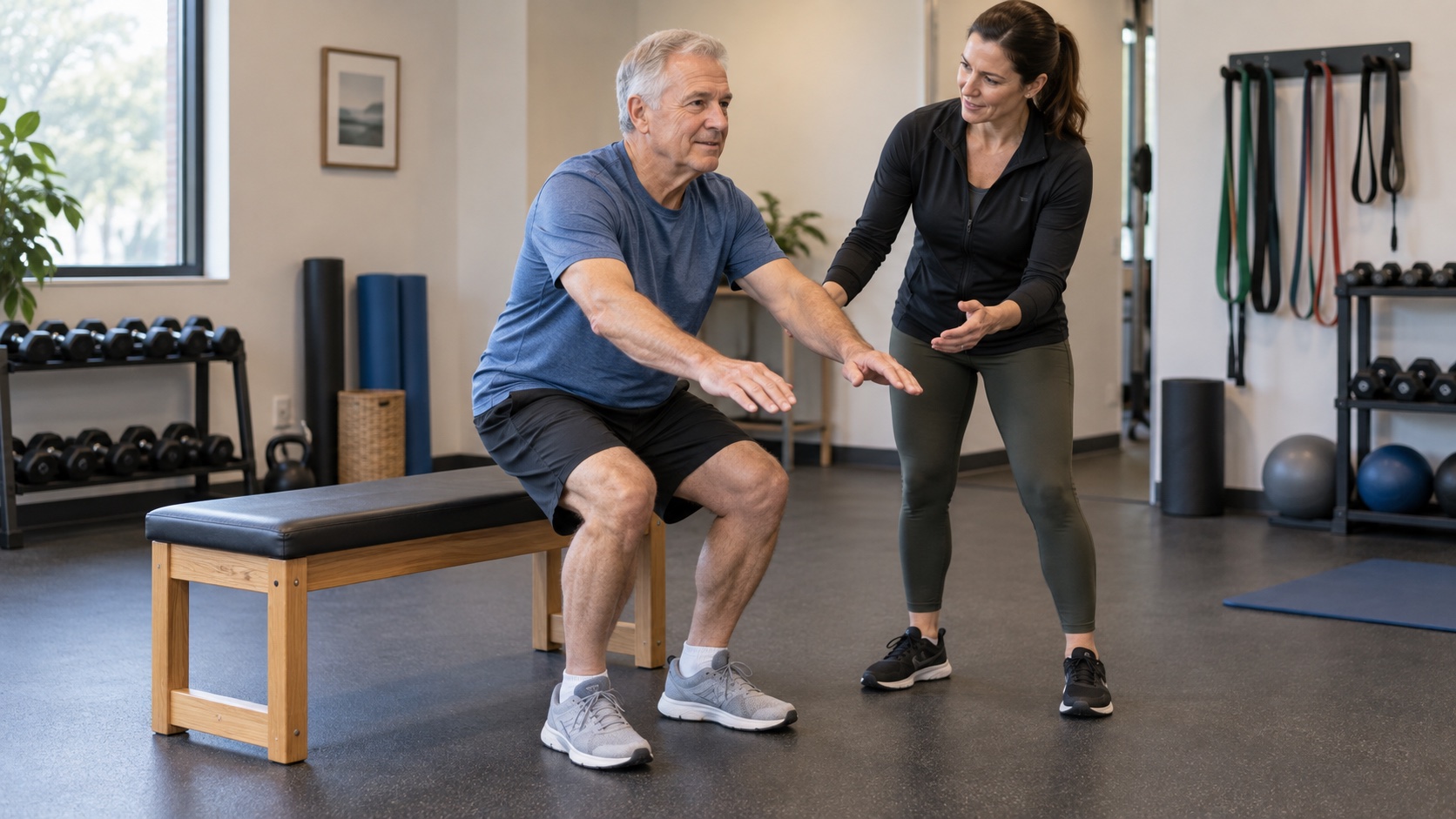
Why Five Patterns
Movement is a small alphabet. Most of life — and every gym exercise — is a variation on five verbs: stand up and sit down, pick something up, push, pull, and walk with a load. Train the verbs, and the body follows.
- 🪑 Squat — sitting and standing: quads, glutes. The independence pattern — chairs, stairs, floors.
- 🔗 Hinge — picking things up with a flat back: hamstrings, glutes, erectors. The "don't hurt yourself lifting the couch" pattern.
- 🚪 Push — pressing things away: chest, shoulders, triceps.
- 🪝 Pull — drawing things toward you: back, biceps. The posture pattern — most people live over-pressed and under-pulled.
- 🎒 Carry — walking under load: grip, trunk, traps. The oldest and most functional of the five.
| Pattern | Why it matters | Example lifts | Prime movers |
|---|---|---|---|
| 🪑 Squat | Chairs, stairs, independence | Back squat · goblet · split squat | Quads, glutes |
| 🔗 Hinge | Safe lifting from the floor | RDL · deadlift · bridge | Hamstrings, glutes, back |
| 🚪 Push | Pressing, catching a fall | Bench · overhead press · push-up | Chest, shoulders, triceps |
| 🪝 Pull | Posture, carrying kids, opening doors | Row · pulldown · chin-up | Back, biceps, rear delts |
| 🎒 Carry | Walking with anything heavy | Farmer's walk · loaded backpack | Grip, core, traps |
Ordering the Session: Biggest First
- 🏆 Heaviest, most technical first — squat and hinge open the session while you're fresh; skill and load both degrade with fatigue.
- 🔁 Push, then pull — presses before rows for most people; the reverse is fine too. What matters is that both happen.
- 🎒 Carry last — grip fatigue makes everything else worse; save it for the end.
- ➕ Accessories after — if at all. The next section sizes their role honestly.
Product picks are generic categories, not brands. We may earn a commission on Amazon or iHerb purchases at no cost to you — this never changes our evidence conclusions. Full disclosure
Adjustable dumbbells
Allows progressive loading at home across common strength movements.
⚠️ Poor technique or rapid load increases raise injury risk; not required to begin moving more.
Check price on Amazon →Accessories: The Fine Print
- 🎯 What they are — isolation work: curls, lateral raises, calf raises, face pulls.
- 📏 The honest size of the effect — adding isolation work to a compound program produces small, individual gains. Compounds are the house; accessories are the paint.
- ✅ The rule — add 0–2 accessories, aimed at weak points, and only after the five patterns are dialed in.
- ⏱️ The budget — if accessories crowd recovery or session time, cut them first. They are the most expendable line item in the program.
The Balanced-Program Test
Run any program — yours, an app's, a magazine's — through five questions before you commit a week to it.
- ✅ A squat and a hinge? — does it train both patterns every week, or just one leg machine?
- ✅ Push and pull, balanced? — does pull volume at least match push volume?
- ✅ Something heavy on the spine and legs? — a real loaded compound, not only machines and cables.
- ✅ Loaded locomotion? — a carry, a lunge, or some other moving-under-load work.
- ✅ Can you explain each exercise? — if an exercise can't justify its place, it's decoration.
Variants Worth Knowing: One Swap per Pattern
Each pattern has a regression ladder — an easier rung and a harder rung. You don't need the whole ladder; you need the rung you can do with honest form today, and the next rung to grow into.
| Pattern | Easier rung | Working rung | Harder rung |
|---|---|---|---|
| 🪑 Squat | Box squat | Goblet squat | Back or front squat |
| 🔗 Hinge | Glute bridge | RDL or trap-bar deadlift | Conventional deadlift |
| 🚪 Push | Wall or kneeling push-up | Push-up or dumbbell press | Bench or overhead press |
| 🪝 Pull | Band row | Cable row or dumbbell row | Chin-up or weighted row |
| 🎒 Carry | Single loaded bag | Farmer's walk | Heavier, longer, or one-armed |
Progress is rarely a new exercise — it's the next rung of the one you already trust.
- 🪜 Climb one rung at a time — swap upward only when the current rung's last reps stay clean under load. A rung taken too early is how pattern pain starts.
- 🔧 The swap rule — change one exercise at a time, keep everything else identical for two weeks, then judge. Changing the whole program at once hides what worked.
Resistance bands
A low-space way to begin or supplement resistance training.
⚠️ Bands can snap and unstable anchoring can cause injury; stop movements that provoke pain.
Check price on Amazon →The Same Template, Three Sessions a Week
The five patterns don't demand five dedicated days — they fit inside two or three weekly sessions by rotating the emphasis:
- 🗓️ Day A — legs heavy — squat loaded heavy for lower reps; hinge lighter; push, pull, and carry at working weights.
- 🗓️ Day B — hinge heavy — hinge loaded heavy; squat lighter; the rest of the template at working weights.
- 🗓️ Day C — full template at working weight — every pattern, moderate load, one clean rep left in the tank. The optional third session: two holds ground, three builds it.
- 📆 The spacing rule — leave at least one full day between sessions that repeat a pattern; the recovery side of that math lives in Part 3.
Assembling Your Session
Selection and ordering only pay off once they're assembled into an actual hour. The template below is the default session this series assumes — the same shape at every equipment tier, with the loading numbers owned by Part 6. Forty-five to sixty minutes, all five verbs, biggest first.
| Order | Block | Example | Sets × reps | Rest |
|---|---|---|---|---|
| 1 | Warm-up | 5 min easy cardio + ramp-up sets on the first lift | — | — |
| 2 | 🪑 Squat | Goblet squat → box squat → back squat | 3 × 5–10 | 2–3 min |
| 3 | 🔗 Hinge | RDL or trap-bar deadlift | 3 × 6–10 | 2–3 min |
| 4 | 🚪 Push | Bench or overhead press | 3 × 6–10 | 90 s–2 min |
| 5 | 🪝 Pull | Row or pulldown | 3 × 8–12 | 90 s |
| 6 | 🎒 Carry | Farmer's walk, 30–40 m | 3 trips | 90 s |
| 7 | ➕ Accessories (0–2, optional) | Face pulls, curls | 2 × 10–15 | 60 s |
The session's skeleton — Part 6 owns the loading science; this table is the shape.
- Pick one exercise per pattern — the one you can do with honest form today, not the one you plan to learn someday. A goblet squat beats a skipped back squat, every time.
- Order them biggest-first — squat, hinge, push, pull, carry. Load and technical demand decide the slot; preference doesn't.
- Warm the first lift, not every lift — five minutes of easy cardio, then two or three ramp-up sets on the squat. The rest of the session inherits the warmth.
- Run the working sets deliberately — the last rep of each set should feel hard but stay honest: no grinding, no "one more ugly one."
- Log it before you leave — exercise, load, reps. Next session reads the log, not memory — that's the progressive-overload engine from Part 1.
- End with the carry, always — grip last means grip never sabotages the lifts that came before it.
If the week only fits two sessions, don't truncate the template — split it: Day A runs squat, push, carry; Day B runs hinge, pull, carry. The carry appears both days because it's the one pattern a busy week can't afford to lose.
Where the Evidence Lives
This page is the template layer. The case for the template lives in the pillars:
- 💪 Why the compounds carry the program — Strength Training After 40 owns the case for multi-joint lifts and what they do to aging muscle.
- 🩺 The carry pattern's hidden importance — grip strength predicts outcomes in Hidden Vital Signs; the carry is the pattern that trains it.
- 🧘 Squat depth and hinge mobility — Stability & Mobility owns the range-of-motion and joint-health side of the two hardest patterns.
- 🥩 The substrate for all of it — the Nutrition pillar's protein topic covers the dose that turns training into adaptation.
- 😴 When adaptation actually lands — Sleep: The Science of Repair owns the night shift; sessions without sleep are rehearsal, not progress.
What to Do When It Goes Wrong
A template breaks in predictable ways — five common failures, with the response that has worked:
- 🚩 Pain in a pattern, not in a muscle — joint pain that repeats with the same movement every session is a pattern problem, not a bad day. Drop the load, slow the tempo, and if it persists across two sessions, swap the exercise within the pattern: barbell → goblet → split squat; flat bench → floor press → push-up. Pain that sharpens under load or lingers after the session belongs with a clinician, not a substitution chart.
- 🚩 You're bored stiff of the five patterns — boredom is a real program threat, but the fix is variation within the pattern, not abandonment: rotate squat variants every six to eight weeks, swap rows for pulldowns. The verbs stay; the nouns change.
- 🚩 Sessions keep blowing past your time budget — the five patterns in 45 minutes is the feature, not the promise you're breaking. Cut accessories first — they're the paint. Then superset push and pull to halve the rests. If only 30 minutes exist, run squat, push, carry and let the full template own the longer days.
- 🚩 One side or one pattern is visibly behind — train the lagging side first while fresh, match volume to the weaker side rather than the stronger, and give the laggard pattern one extra set per session for a few weeks. The balanced-program test above is the audit that catches this early.
- 🚩 A pattern keeps stalling while the others progress — usually recovery or scheduling, not the exercise itself. Check that the stalled pattern isn't always parked after the heaviest lift, give it a fresh slot for a few weeks, and re-check the loading numbers in Part 6. A plateau inside one pattern is programming, not character.
How the fast work is dosed, and where it sits in a session: The Programming Rules.
Questions, Answered Briefly
- ❓ Do I need all five patterns in every session? — No. The week is the unit: each pattern once or twice across the week is balanced. All five every session is optional, not mandatory.
- ❓ Can I just use machines? — Machines train muscles; the patterns train movements. A machine-only program covers pieces of squat, push, and pull, but nothing replaces loaded standing, hinging, and carrying. If machines are your only option, add bodyweight squats, a banded hinge, and a loaded carry.
- ❓ What if I physically can't do one of the patterns? — Train around it, not through it. Bad knees: box squat or leg press instead of free squats. Bad back: a bridge instead of a barbell hinge. Keep the other four honest and let a clinician clear the return to the missing verb.
- ❓ Do carries count as cardio too? — They're conditioning in disguise: grip and trunk under load with the heart rate up. They count as the pattern first; whatever aerobic bonus they add is a bonus, not the plan.
This Page in One Workflow
- Choose — one exercise per pattern you can do with honest form today.
- Order — squat, hinge, push, pull, carry, then accessories.
- Warm — easy cardio plus ramp-up sets on the squat only.
- Lift — hard final reps, honest form, log before you leave.
- Review — weekly: run the balanced-program test; swap a stalling variant, never the template.
🧭 Five verbs, for life
The five patterns aren't just gym architecture — they're the movements that predict independence: standing from a chair, lifting a suitcase, pushing a door, pulling a grandchild into a hug, carrying the groceries. Training them is rehearsing the life you want to keep.
The Bottom Line
- Five patterns cover the body — squat, hinge, push, pull, carry.
- Order biggest first — heavy and technical work while fresh.
- Accessories are paint, not structure — add sparingly, cut first.
- Run the balanced-program test on anything you're about to follow.
The Daily Checklist
- All five patterns on today's menu — or on the week's schedule
- Heaviest, most technical lift first, while fresh
- Warm-up done — easy cardio plus ramp-up sets on the first lift
- Every working set ended with honest form — no ugly last reps
- Log filled in before leaving: exercise, load, reps
- Carry last — grip saved for the final block
The Weekly Checklist
- All five patterns hit at least once this week — twice is better
- Pull volume at least matching push volume
- Balanced-program test run on the current plan
- Accessories still 0–2, still aimed at a weak point
- Any stalling pattern given a fresh slot or a new variant
Go Deeper: Exercise Selection
These five companion pages turn the topic into smaller, testable practices.
- 🔗 The pattern library
- 🔗 Compound vs isolation
- 🔗 The 10-exercise core
- 🔗 Movement quality screens
- 🔗 Swapping exercises
Related Topics
- Paoli A, et al. "Resistance training with single vs. multi-joint exercises at equal total load volume." Frontiers in Physiology (2017)
- Gentil P, et al. "Effect of adding single-joint exercises to a multi-joint exercise resistance-training program on strength and hypertrophy in untrained subjects." Applied Physiology, Nutrition, and Metabolism (2013)
- Simão R, et al. "Exercise order in resistance training." Sports Medicine (2012)
- Fragala MS, et al. "Resistance training for older adults: position statement from the National Strength and Conditioning Association." Journal of Strength and Conditioning Research (2019)