The Sleep Protocol
The Sleep pillar explains why — the repair programs, the glymphatic wash, the mortality numbers. This page is the how: one wake anchor, one evening cascade, one environment checklist. Install this protocol first; everything else works better on top of it.
What the evidence supports
- Sleep regularity — consistent timing — predicts mortality and cognition as strongly as duration in large cohorts.
- Bright light anchors the circadian clock; dim light in the last hour measurably improves sleep onset.
- A cool room (18–20°C) and a dark, quiet environment improve sleep quality in controlled studies.
What remains uncertain
- The "3-2-1" cascade (food/work/screens hours) is a practical synthesis, not a single trial — the evidence supports each cut independently.
- Individual chronotype shifts the ideal window; the protocol prioritizes consistency over clock time.
Evidence last reviewed: August 13, 2026. Conclusions may change as new research is published.
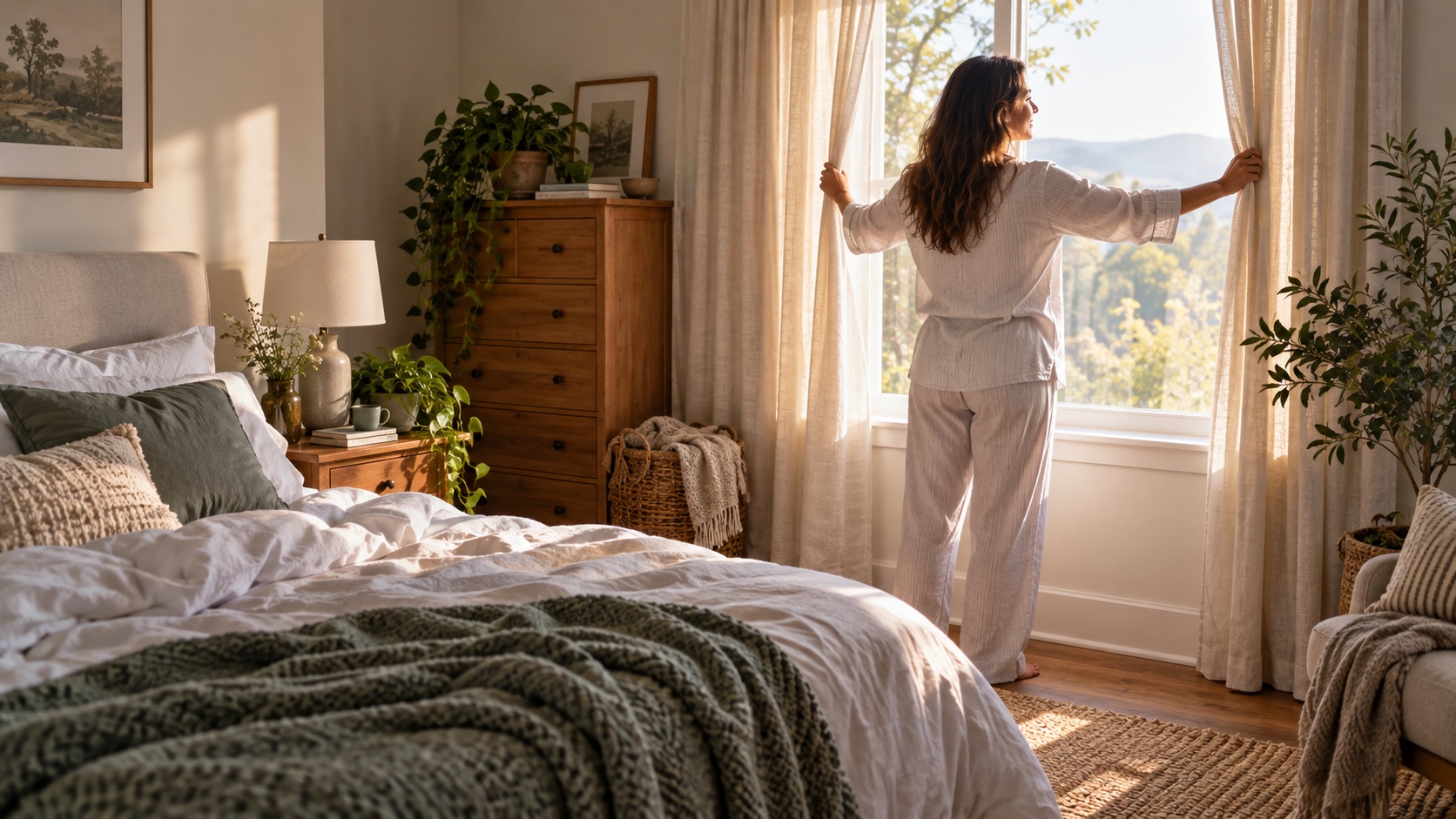
Step 1: Anchor the Wake Time
- ⏰ One fixed wake time, 7 days a week — within ±30 minutes. Wake time anchors the whole system; bedtime drifts, wake time doesn't.
- ☀️ Light within 30 minutes of waking — 10+ minutes of outdoor or bright indoor light. The circadian clock's main setting signal.
- 🚶 Movement soon after — a short walk combines light, movement, and the day's first anchor (see the Habit Formation Protocol).
- 🔢 Work backward — if wake is 6:30 and you need 7.5–8 hours, lights-out lands 22:30–23:00. Set an alarm for the wind-down, not just the wake.
Step 2: The Evening Cascade
| Time before bed | Cut | Why (with the pillar page) |
|---|---|---|
| 8–10 hours | ☕ Caffeine | Half-life ~5–6 hours; late caffeine fragments deep sleep (caffeine-alcohol-blue-light) |
| 3 hours | 🍽️ Food | Late meals delay sleep onset and fragment the night (when-to-sleep) |
| 3 hours | 🍺 Alcohol | Sedation ≠ sleep; alcohol suppresses REM and worsens apnea (caffeine-alcohol-blue-light) |
| 1–2 hours | 💼 Work & problem-solving | Cognitive arousal keeps the sympathetic system idling (cortisol-101) |
| 1 hour | 📱 Screens | Bright, close light suppresses melatonin; content drives arousal regardless of night mode |
| 30 minutes | 💡 Dim the house | Light is the strongest circadian signal; dimness is the body's "wind down" cue |
Product picks are generic categories, not brands. We may earn a commission on Amazon or iHerb purchases at no cost to you — this never changes our evidence conclusions. Full disclosure
Blackout shades or curtains
May reduce unwanted bedroom light and make a dark sleep setting easier to maintain.
⚠️ None expected from the product itself; install securely and preserve a safe route to exits.
Check price on Amazon →Step 3: The Environment Checklist
- 🌡️ Cool — 18–20°C (65–68°F); a warm bath 1–2 hours before bed helps by triggering the post-bath temperature drop.
- 🌑 Dark — blackout curtains, tape over LED lights; eye mask as the portable fallback.
- 🔇 Quiet — earplugs or a fan/white noise for environmental hum; consistency matters more than silence.
- 📵 Phone outside the room — the single highest-leverage environment change: removes the screen, the scroll, and the 2am check in one move.
The "Can't Sleep" Protocol
- 🛏️ 20 minutes awake in bed → get up — lying awake trains the bed to mean wakefulness. Go dim, go boring.
- 📖 Do something dull, dim, and screen-free — paper book, folding laundry. Return when sleepy.
- 😮💨 Slow breathing helps — 4-in, 6-out for a few minutes downshifts the nervous system (the breathwork page).
- ⚠️ Know the red flags — loud snoring, witnessed pauses, daytime sleepiness = ask about sleep apnea. It's treatable, and it's the difference between a protocol and a diagnosis.
The Series Map
Seven parts, one install path. Work through them in order — each part assumes the one before it, and the early parts build the anchor that everything downstream hangs from: the wake time, the light, and the cascade that defends them.
If you want the honest short version: don't change anything tonight except the wake time for tomorrow. One anchor held for a week outperforms a full cascade attempted for one night and abandoned — this series is built so you can install it at that pace, one part per week.
| Part | Page | What you'll get |
|---|---|---|
| 1 | This page | The full system in one pass — wake anchor, cascade, environment |
| 2 | The Wake-Time Anchor & Morning Light | The fixed wake time, the light dose, caffeine timing — the circadian foundation |
| 3 | The Evening Cascade, Hour by Hour | The countdown run backwards: caffeine → food → screens → dim, with exact windows |
| 4 | Bedroom Engineering | Temperature, darkness, noise, and the 12-point room audit |
| 5 | Naps, Catch-Up Sleep & Shift Work | The disruption playbook for days the anchor slips |
| 6 | When Sleep Won't Come | The 20-minute rule, the racing mind, and the apnea red flags |
| 7 | Wind-Down Tricks & Shortcuts | The automation layer that makes the cascade stick |
The Rest of This Series
Deeper pages in this series — one per situation, in no particular order. Read them when the situation arrives; none of them replace the plan above.
- 💊 Sleep Medications & Supplements: An Evidence-Aware Conversation — The honest conversation about sleep medications and supplements: what the evidence supports, the real risks of tolerance, dependence.
- 🌙 Sleep, Pain & Nighttime Awakenings: The 2 a.m. Loop — The 2 a.m. loop: why pain gets louder at night, how broken sleep amplifies pain, the awakening log and comfort stack for bad nights.
- 🧰 Sleep Tracking & Wearables: Useful Signals, False Precision — What a wrist tracker actually measures, which sleep numbers deserve attention, why trends beat nightly scores, and when the gadget should come off.
Book or skill-learning workbook
Can support sustained reading or structured skill practice.
⚠️ None expected; a product cannot prevent dementia or replace assessment of new cognitive symptoms.
Check price on Amazon →Where the Evidence Lives
The Sleep pillar owns the science; this series owns the schedule. For the evidence behind each line below, the pillar pages are one click away:
- 🧠 Why sleep matters at all — the Science of Repair topic owns the stakes: repair programs, glymphatic wash, mortality numbers.
- 🌗 Why the anchor works — Circadian Rhythm 101 owns the clock biology behind wake-time anchoring and light.
- ☕ Why the cutoffs work — Caffeine, Alcohol & Blue Light owns the saboteur science behind every cascade line.
- 🫁 Why the red flags matter — Sleep Apnea owns the escalation path when the protocol isn't the answer.
- 🌅 Why timing is personal — The Optimal Bedtime owns chronotype and the window math this page compresses into one line.
Troubleshooting the First Week
- 🚩 Still awake at lights-out — the cascade started too late. Move the wind-down alarm 30 minutes earlier; the cascade needs its full length to work.
- 🚩 Waking at 3am, staring at the ceiling — the 20-minute rule applies (see the "Can't Sleep" Protocol below); don't lie there training the bed to mean wakefulness.
- 🚩 The weekend erased the week — the anchor slid by hours. Part 2 covers the ±30–60 minute weekend rule; hold the anchor even after a bad night.
- 🚩 Tired all day despite 7+ hours — environment and timing are fine, sleep is not. Part 6's apnea red-flag list is the next stop.
- 🚩 Falling asleep fine but waking wired at 4am — classic stress-hormone signature: the cascade ended but the mind didn't. The tomorrow-list from Part 7 plus a slow-exhale practice (the Breathwork page) closes the loop most nights.
This Page in One Workflow
- Anchor — pick one wake time, 7 days a week, ±30 minutes.
- Light — outdoor light within 30–60 minutes of waking, 10+ minutes.
- Cascade — caffeine 8–10h out, food 3h out, screens 1h out, dim at 30 minutes.
- Engineer — 18–20°C, dark to <10 lux, quiet, phone out of the room.
- Recover — bad night? Same wake time, full cascade, no over-correction.
The Sleep Protocol Checklist
- Wake time chosen and set 7 days a week, ±30 minutes
- Morning light: 10+ minutes outside or at a bright window within an hour of waking
- One part of this series installed per week — don't attempt the full cascade on night one
- The 2-day rule rehearsed: one missed night is noise, two is a pattern
- A three-week re-check booked: the baseline vs. how the morning actually feels
- Caffeine done by early afternoon (8–10 hours before bed)
- Last meal ~3 hours before lights-out; alcohol rare and early if ever
- Wind-down alarm set — the cascade starts on a schedule, not on willpower
- Bedroom at 18–20°C, dark to <10 lux, phone charging outside the room
- The 20-minute rule rehearsed: awake in bed → up, dim, boring, return when sleepy
- Snoring, witnessed pauses, or 3+ months of broken sleep → Part 6, then a clinician
Light-blocking sleep mask
A portable option when room light cannot be controlled.
⚠️ Can feel uncomfortable or trap heat for some people; do not use as a substitute for evaluating persistent sleep symptoms.
Check price on Amazon →If You Only Do Three Things
- ⏰ The wake anchor — one wake time, every day. It is the master dial; every other improvement compounds off it.
- ☀️ Morning light — 10 minutes outside within an hour of waking. The cheapest circadian medicine that exists.
- 📵 Phone out of the bedroom — removes the late-night scroll, the 2am check, and the morning alarm-doomscroll in one move.
Everything else in this series is refinement. These three, held for two weeks, move the needle on their own — and they make the refinement easier to install.
Questions, Answered Briefly
- ❓ I'm a night owl — does the protocol still apply? — Yes, with a shifted window. The anchor, light, and cascade rules hold; only the clock times move. Chronotype shifts the window, not the physics (see The Optimal Bedtime).
- ❓ How long before I notice a difference? — Most people feel a change within one to two weeks of holding the anchor. Fragmented sleep needs longer; if nothing improves in a month, Part 6's red-flag list is the next stop.
- ❓ Do I have to do every cascade line? — No. The cascade is a menu ordered by leverage: caffeine timing and the screen cutoff carry most of the benefit. Install the lines you can hold.
- ❓ What if my partner's schedule fights mine? — Negotiate the anchor as a household default rather than a personal one; Part 4 covers the environment (earplugs, eye mask, separate alarm) that makes two schedules live in one bedroom.
The Bottom Line
- Anchor wake time first — everything else hangs off it.
- Run the cascade — caffeine 8–10h out, food and alcohol 3h out, screens 1h out.
- Design the room — cool, dark, quiet, phone elsewhere.
- Two bad nights is weather, not a failed protocol — return to the anchor and the 2-day rule.
Go Deeper: The Sleep Protocol
These five companion pages turn the topic into smaller, testable practices.
- 🔗 The one-anchor philosophy
- 🔗 The install order
- 🔗 The 2-week test rule
- 🔗 Personalizing the protocol
- 🔗 When the protocol isn't enough
Related Topics
- Windred et al., "Sleep regularity is a stronger predictor of mortality risk than sleep duration," Sleep (2024)
- Haghayegh et al., "Before-bedtime passive body heating by warm shower or bath to improve sleep," Sleep Medicine Reviews (2019)
- Okamoto-Mizuno & Mizuno, "Effects of thermal environment on sleep and circadian rhythm," Journal of Physiological Anthropology (2012)
- Drake et al., "Caffeine effects on sleep taken 0, 3, or 6 hours before going to bed," Journal of Clinical Sleep Medicine (2013)