Sleep Apnea: The Under-Diagnosed Risk
You might "sleep" eight hours a night while your airway collapses hundreds of times, starving your brain and heart of oxygen. Roughly 80% of people with sleep apnea don't know they have it — and it's quietly among the most damaging conditions for longevity.
What the evidence supports
- OSA affects roughly a billion adults worldwide, the large majority undiagnosed.
- Untreated OSA is associated with hypertension, cardiovascular events, and metabolic disease in cohort studies.
- CPAP improves symptoms and intermediate outcomes in randomized trials; weight loss improves or resolves OSA in many cases.
What remains uncertain
- Long-term cardiovascular outcome data for CPAP are mixed across trials — the mortality picture is still debated.
- Long-term durability of newer treatments (e.g., hypoglossal nerve stimulation) needs more follow-up.
- Home sleep tests may under-detect mild disease compared to lab studies.
Evidence last reviewed: August 13, 2026. Conclusions may change as new research is published.
What It Actually Is
Obstructive sleep apnea (OSA) is the repeated collapse of the upper airway during sleep. Each collapse causes a pause in breathing (an "apnea") lasting 10 seconds to a minute or more. Oxygen drops, the brain registers the emergency, and it briefly wakes you up to reopen the airway — sometimes hundreds of times a night. You rarely remember these awakenings, but your body never gets the deep, continuous sleep it needs.
The severity is measured by the AHI — apnea-hypopnea index — the number of breathing events per hour of sleep. The scale:
| AHI (events/hour) | Classification | What it means |
|---|---|---|
| 0–5 | Normal | Occasional pauses are normal. |
| 5–15 | Mild | Treatment recommended if symptoms are present. |
| 15–30 | Moderate | Treatment strongly recommended — measurable cardiovascular risk. |
| 30+ | Severe | Urgent treatment. An airway collapsing every 2 minutes is an ongoing hypoxic injury. |
The Anatomy of a Collapse
Why does the airway close? During sleep, muscles throughout the body relax — including the tongue, soft palate, and throat muscles that hold the airway open. In most people that's fine. In someone with apnea, anatomy conspires against them: a narrow airway, a large tongue, a recessed jaw, or extra tissue around the neck (from weight) means that when muscle tone drops, the airway folds shut. The brain then faces a brutal choice: wake up enough to breathe, or let oxygen fall. It chooses waking — hundreds of times a night — and that's the disease: the shattered sleep and the oxygen rollercoaster it produces.
Alcohol and sedatives pour gasoline on this fire: they relax the airway muscles even further, lengthening apneas. That's why the "nightcap" is worst precisely for the people at highest risk.
The Scale of the Problem
Why "Silent" Is the Right Word
The classic stereotype — the loud snorer who wakes gasping — misses most cases. Many people with apnea don't snore dramatically, and almost nobody remembers the micro-awakenings. The common presentation is subtler:
Daytime fatigue
Especially morning grogginess that doesn't improve with more hours in bed.
Brain fog
Poor concentration, memory slips, irritability that feels like "normal" aging.
Night urination
Waking 2+ times to urinate is a surprisingly strong apnea sign — airway collapse triggers atrial natriuretic peptide release.
Morning headaches
From overnight oxygen dips and carbon dioxide retention.
Treatment-resistant issues
High blood pressure, reflux, or depression that don't respond to usual treatment.
⚠️ The 30-second self-check
Three questions predict apnea risk remarkably well: 1) Do you snore loudly enough to be heard through a door? 2) Are you often tired during the day despite adequate sleep time? 3) Has anyone observed you stop breathing or choke during sleep? Two or more "yes" answers — especially with hypertension, a large neck circumference (43cm+ men, 41cm+ women), or BMI over 30 — warrant a sleep study.
The Longevity Price Tag
Apnea isn't just a sleep problem — the nightly oxygen deprivation and stress-response spikes injure nearly every system:
| System | Consequence of untreated OSA | Severity |
|---|---|---|
| Cardiovascular | Independent risk factor for hypertension, atrial fibrillation, heart attack, stroke | Severe |
| Metabolic | Worsens insulin resistance and type 2 diabetes — independently of obesity | Severe |
| Cognitive | Accelerates cognitive decline; untreated OSA is associated with earlier dementia onset | Severe |
| Hormonal | Suppresses testosterone; elevates cortisol; blunts growth hormone release | Moderate |
| Mortality | Severe untreated OSA roughly doubles all-cause mortality risk over ~18 years | Severe |
| Public safety | Drowsy driving is a leading accident cause; apnea roughly doubles to triples crash risk in observational studies | Moderate |
The good news: nearly all of this is reversible with treatment. Treated apnea patients see blood pressure improve, metabolic markers normalize, cognitive complaints resolve — and, most dramatically, they often feel a decade younger within weeks. Few conditions in medicine offer a return this large for a diagnosis this overlooked.
Children Have It Too — and It Looks Different
Pediatric sleep apnea is usually caused by enlarged tonsils and adenoids rather than weight. Its signature also differs from adults': instead of daytime sleepiness, kids present with hyperactivity, poor attention, behavioral problems, and bedwetting — symptoms frequently misdiagnosed as ADHD. Studies find that a meaningful share of children referred for ADHD evaluation have treatable sleep-disordered breathing, and that tonsillectomy often resolves both the breathing and the behavior.
The screening rule is simple: if a child snores regularly (beyond occasional cold-related snoring), pauses breathing, or mouth-breathes at night, a pediatric sleep evaluation is warranted. The stakes are high — childhood is when the brain builds its lifelong architecture, and chronic fragmented sleep during development is exactly the wrong foundation to build on.
Getting Diagnosed
Diagnosis requires a sleep study. Home sleep apnea tests (HSATs) — a wearable kit measuring breathing, oxygen, and pulse overnight — are now the standard first step for uncomplicated cases. They're convenient, cheap compared to lab studies, and accurate for diagnosing moderate-to-severe OSA. In-lab polysomnography (full EEG + breathing monitoring) is reserved for complex cases, suspected central apnea, or when home results are inconclusive. Either way, the path is: talk to your doctor → get the study → get your AHI number. Everything else follows from that number.
A Brief History: From Pickwick to CPAP
Sleep apnea isn't new — it just took medicine an embarrassingly long time to notice it. The first clinical descriptions date to the 19th century, when doctors noticed that extremely sleepy, obese patients — nicknamed "Pickwickian" after the character Joe in Dickens' The Pickwick Papers, who fell asleep mid-sentence — seemed to suffocate in their sleep. For a century it remained a curiosity. The breakthrough came in 1981, when Australian physician Colin Sullivan, treating a patient whose apnea events were so severe he'd been advised to have a tracheostomy, rigged a vacuum-cleaner motor to blow air through a mask taped to the patient's face. The airway stayed open. Continuous Positive Airway Pressure — CPAP — was born, and within a decade it transformed a "rare curiosity" into one of the most commonly diagnosed sleep disorders on earth.
The history carries a lesson for the longevity-minded: today's "rare curiosity" — the condition your doctor never asks about — may be tomorrow's epidemic. Sleep apnea was invisible for 150 years because nobody thought to look. It's still invisible in most people who have it, for exactly the same reason.
Treatment: More Options Than Ever
| Treatment | Best for | Reality check |
|---|---|---|
| CPAP | Moderate-to-severe OSA | Reference standard — highly effective when used consistently. Adherence is the battle; modern auto-titrating machines and mask fitting help enormously. |
| Oral appliance (mandibular advancement) | Mild-to-moderate OSA | Moves the jaw forward to hold the airway open. Well-tolerated; less effective than CPAP for severe cases. |
| Weight loss | Everyone with excess weight | The most established disease-modifying intervention — 10–15% weight loss can resolve or substantially improve OSA. Slow but durable. |
| Positional therapy | Supine-dominant OSA | If events happen mostly on your back, side-sleeping aids (tennis-ball trick, wearable buzzers) genuinely work. |
| Myofunctional therapy | Mild OSA, adjunct | Exercising tongue/throat muscles shows real but modest effect. Worth adding, rarely sufficient alone. |
| Surgery (UPPP, Inspire implant) | CPAP-intolerant, select anatomy | Last resort for most. Hypoglossal nerve stimulation (Inspire) is promising for specific profiles. |
💡 The apnea–longevity loop
Apnea worsens weight gain (hunger hormones + fatigue), and weight gain worsens apnea — a vicious cycle that drags every pillar down. Breaking it — even partially — pays compound interest: better sleep improves exercise adherence, diet discipline, and metabolic health. In longevity terms, treating sleep apnea is one of the highest-ROI moves available.
CPAP Realities: How People Actually Make It Work
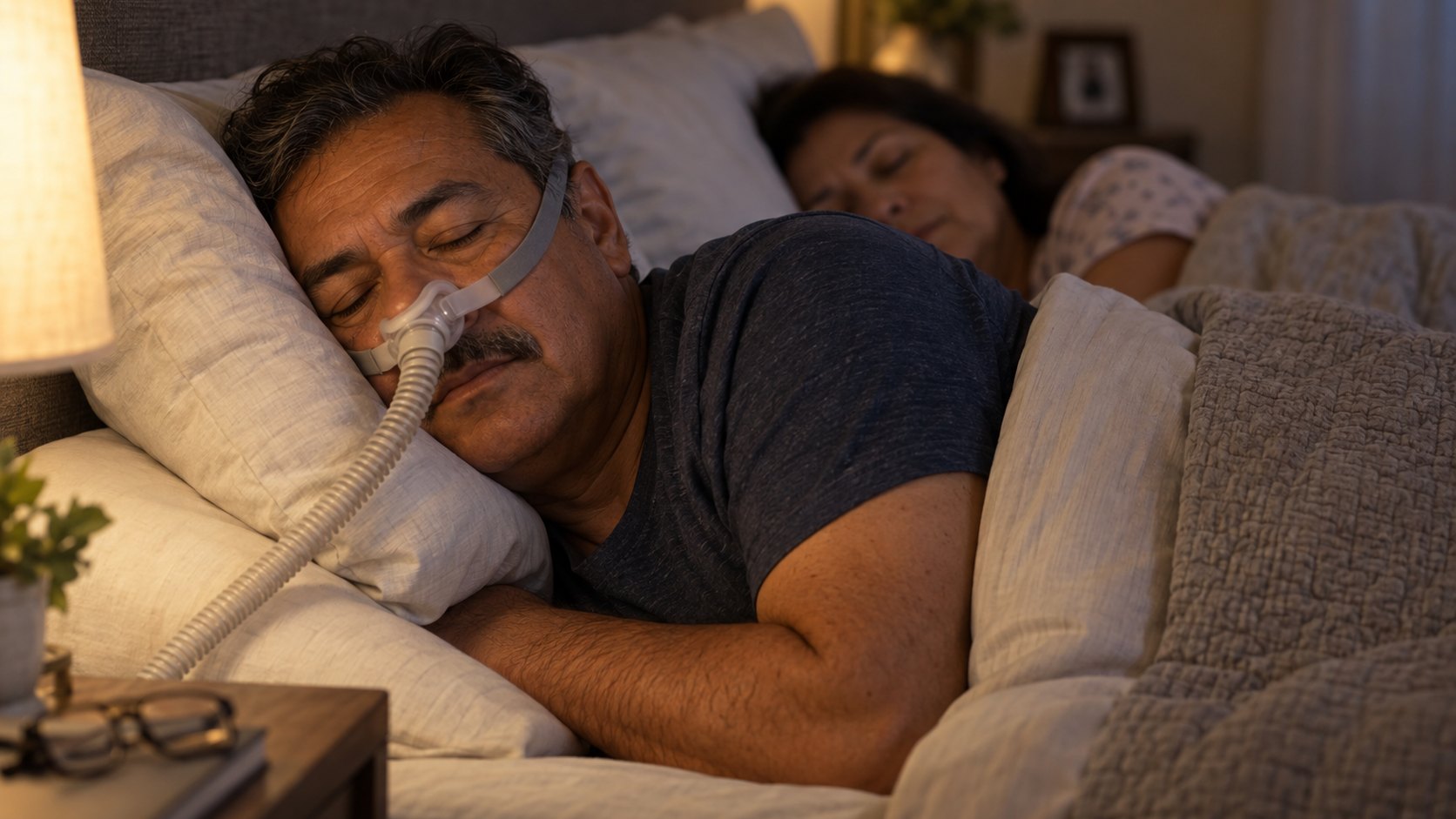
CPAP's effectiveness is undisputed; its problem is adherence — roughly a third of users abandon it. The difference between success and the junk drawer is usually three things: mask fit (try multiple styles — nasal pillows suit many side-sleepers who hate full-face masks), pressure comfort (modern auto-adjusting machines ramp gently, and expiratory pressure relief ends the "blowing back" feeling), and humidification (heated humidifiers prevent the dry mouth and congestion that drive people off). Treat the first month as an experiment: expect an adjustment period, chase comfort relentlessly, and measure the payoff — most successful users report a dramatic energy change within 2–4 weeks.
If CPAP genuinely fails after a fair trial, the alternatives are real: oral appliances work well for mild-to-moderate disease; weight loss attacks the root cause; and hypoglossal nerve stimulation (an implanted device that activates the tongue with each breath) is transforming treatment for a subset of CPAP-intolerant patients. The worst option is doing nothing. The insomnia overlap and what treatment actually involves are covered in Insomnia, Honestly. The wider cardiovascular picture — and its limits — is weighed in Sleep & the Heart.
Your Action Checklist
- Run the self-check. Snoring heard through a door + daytime fatigue = get evaluated. Don't self-dismiss because you "sleep through the night."
- Ask your partner. Witnessed breathing pauses are the single strongest sign — but only someone else can see them.
- Get a study if indicated. Home tests are cheap and done. Your AHI number changes your risk profile for a dozen diseases.
- Treat it like the chronic disease it is. CPAP isn't a punishment — it's nightly organ protection. Weight loss attacks the root cause.
Go Deeper: Subtopics
- 🔎 The STOP-Bang screen & who should test — the 8-question tool, and why "I don't snore" doesn't rule apnea out. Read it →
- 🔎 Home sleep tests vs lab polysomnography — accuracy trade-offs, what each misses, and what the results actually say. Read it →
- 🔎 Beyond CPAP — mandibular advancement devices, positional therapy, weight loss, and surgical options, ranked by evidence. Read it →
- 🔎 Apnea's metabolic toll — the hypertension, atrial fibrillation, and diabetes links: why treating apnea moves other pillars. Read it →
- 🔎 Not just obesity — apnea in lean people, women's different symptom profile, and central vs obstructive causes. Read it →
Related Topics
- Benjafield et al., "Estimation of the global prevalence and burden of obstructive sleep apnoea," The Lancet Respiratory Medicine (2019)
- Young et al., "The occurrence of sleep-disordered breathing among middle-aged adults," NEJM (1993)
- Marshall et al., "Sleep apnea as an independent risk factor for all-cause mortality," Sleep (2008)
- Gottlieb & Punjabi, "Diagnosis and Management of Obstructive Sleep Apnea," JAMA (2020)
- Chung et al., "STOP-Bang questionnaire: a practical approach to screen for obstructive sleep apnea," Chest (2016)
- Marcus et al., "Diagnosis and management of childhood obstructive sleep apnea syndrome," Pediatrics (2012)
- Weaver & Grunstein, "Adherence to continuous positive airway pressure therapy," Proceedings of the American Thoracic Society (2008)