7 Habits of Great Sleepers
Great sleepers aren't born — they run the same seven plays every day. None require willpower at 11pm; all of them are set up hours earlier. Here's the complete playbook, plus an honest scorecard of every popular sleep aid.
What the evidence supports
- CBT-I and stimulus control are first-line insomnia treatments with strong trial evidence.
- Consistent wake time and morning light are well-supported behavioral anchors.
- A cool, dark, quiet bedroom measurably improves sleep quality in controlled studies.
What remains uncertain
- Most sleep supplements (magnesium, glycine, valerian, chamomile) rest on small or mixed trials — effect sizes are modest at best.
- Melatonin is better understood as a timing signal than a sedative; optimal dosing is debated.
- Individual responses to each habit vary; what's essential for one person is optional for another.
Evidence last reviewed: August 13, 2026. Conclusions may change as new research is published.
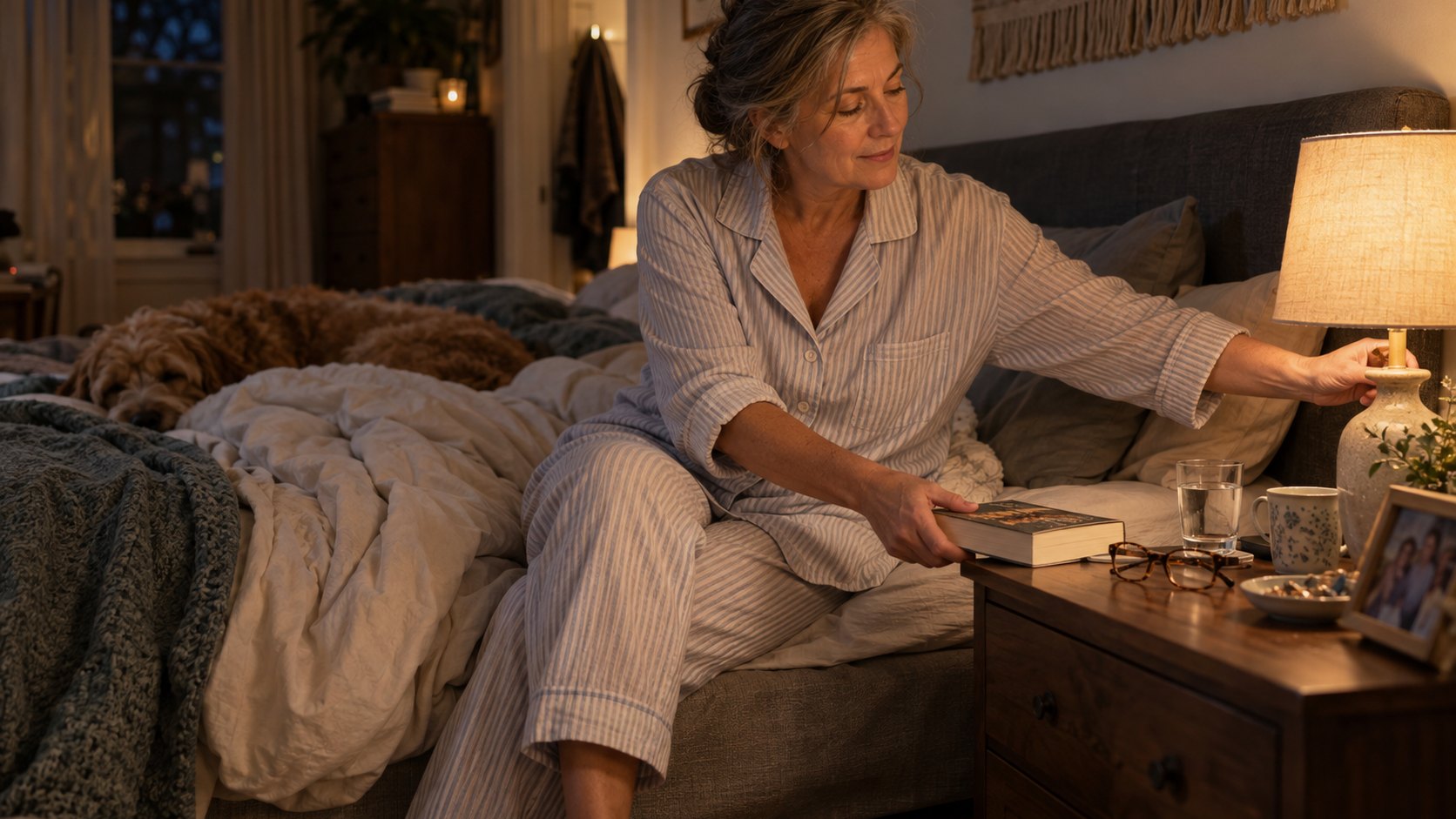
Fixed Wake Time — the Master Anchor
Consistency of wake time is the single strongest behavioral predictor of good sleep. Your circadian rhythm anchors to when you get light and get up, not when you go to bed. Wake at the same time every day — weekends included (within ~1 hour) — and bedtime largely takes care of itself.
Morning Light Within the Hour
10–20 minutes of outdoor light shortly after waking fires your cortisol spike, anchors your clock, and sets the timer for melatonin release 14–16 hours later. No sunglasses, no window glass — your eyes need the real brightness. On a gray morning, 30 minutes.
The Caffeine Curfew
Caffeine's half-life is 5–6 hours, and slow metabolizers clear it even slower. A 4pm espresso is still half-active at 10pm — hiding adenosine, fragmenting deep sleep, even when you "slept fine." Curfew: no caffeine within 8–10 hours of bed.
The Cool, Dark, Quiet Room
Your core temperature must drop roughly 1°C to initiate and sustain deep sleep. A room at 18–19°C (65–67°F) makes that drop effortless. Blackout curtains or a sleep mask handle light; earplugs or white noise handle sound. This is unglamorous infrastructure — and it outperforms most supplements.
The 90-Minute Wind-Down
You can't go from 200km/h to zero. Build a bridge: screens off or heavily dimmed, warm low lamps, and a ritual — reading (paper), stretching, journaling, or a warm shower (the post-shower temperature drop actively promotes sleep). Same sequence nightly, and it becomes a conditioned trigger for sleepiness.
Exercise Early, Eat Earlier
Regular exercise is one of the few things that measurably increases deep sleep — but intense sessions within ~3 hours of bed can delay onset, so schedule them earlier. And close the kitchen 2–3 hours before bed: a full stomach raises core temperature and tells your gut clock it's daytime.
Alcohol: None Within 3 Hours of Bed
Alcohol is the single most reliable way to suppress REM and fragment the night while convincing you it "helps you sleep." If you drink, front-load it earlier in the evening and stop at least 3 hours before bed. On nights where sleep is the priority: zero.
Product picks are generic categories, not brands. We may earn a commission on Amazon or iHerb purchases at no cost to you — this never changes our evidence conclusions. Full disclosure
Blackout shades or curtains
May reduce unwanted bedroom light and make a dark sleep setting easier to maintain.
⚠️ None expected from the product itself; install securely and preserve a safe route to exits.
Check price on Amazon →A Day in the Life of a Great Sleeper
Great sleep is won 16 hours before your head hits the pillow. Here's the full-day playbook at a glance:
The beauty of this schedule: the evening asks almost nothing of you, because the morning and afternoon already did the work. Willpower is not a sleep strategy — architecture is. Build the day right and the night takes care of itself.
If You Can't Sleep: The 20-Minute Rule
Lying awake trains your brain to associate bed with frustration. The protocol used by sleep clinicians: if you're awake for roughly 20 minutes, get up. Go to another room, keep lights dim, do something calm (paper book, gentle stretching), and return to bed only when sleepy. Repeat as needed. This is stimulus control — one of the most effective insomnia treatments in the literature, and it costs nothing.
Book or skill-learning workbook
Can support sustained reading or structured skill practice.
⚠️ None expected; a product cannot prevent dementia or replace assessment of new cognitive symptoms.
Check price on Amazon →Naps, Done Right
A 10–20 minute nap in the early afternoon (before 3pm) is one of the best-validated performance tools in sleep science — measurable gains in alertness, mood, and motor skill, without sleep inertia. The pitfalls to avoid: napping too late (delays night sleep), napping too long (waking from deep sleep leaves you groggier than before), and using naps to patch chronic night-time debt — naps supplement good nights; they don't replace them. One refined variant with decent evidence: the "nappuccino" — coffee immediately before a 20-minute nap, waking just as the caffeine kicks in.
The Bedroom Itself: Mattresses, Pillows, and Light Leaks
The seven habits cover behavior — the environment deserves its own audit. Three upgrades beat the rest:
- Darkness: hunt the light leaks. Charger LEDs, alarm clocks, router lights, window gaps — each is only a few lux, but together they measurably fragment sleep and blunt melatonin. Blackout curtains or a good sleep mask fix most of it; a strip of electrical tape fixes the rest.
- Sound: consistency beats silence. A fully silent room amplifies every discrete noise — the door slam, the garbage truck. A fan, white-noise machine, or earplugs create a stable baseline that masks sudden sounds. It's not noise that wakes you; it's change in noise.
- Bed and pillow: don't overthink. The evidence on mattress types is genuinely weak — medium-firm works for most people, and the real variables are age (mattresses sag past ~8–10 years) and comfort. What matters more than any premium foam: breathable bedding and a cool room.
Treat the bedroom like a cave built for one purpose. If you work, eat, scroll, or argue in bed, you're training your brain that bed = awake. The strongest environmental signal you can send is a room that only ever means sleep.
🛏️ The 2-minute bedroom audit
Turn the lights off and lie in bed until your eyes adjust. Note every glowing dot you can see, every sound you can identify, and whether you can see your hand when you hold it up. Then eliminate them one by one. Most bedrooms fail this test within 30 seconds — and most "mysterious" sleep problems pass it easily once the leaks are gone.
Sleep Aids: The Honest Scorecard
The supplement aisle is crowded with sleep promises. Ranked from strongest evidence to weakest:
| Intervention | Evidence | The honest take |
|---|---|---|
| Morning light exposure | Strong | The most underrated sleep tool in existence. 10–20 min outdoors anchors your clock. |
| Cool, dark, quiet room | Strong | 18–19°C, blackout curtains, earplugs. Boring but bulletproof. |
| Magnesium glycinate | Moderate | Helps if you're deficient (most adults are). ~200–400mg before bed. |
| Glycine | Moderate | 3g lowers core body temperature, aiding sleep onset. Few side effects. |
| Melatonin | Moderate | A timing signal, not a sedative. Best for jet lag and shifting schedules; take 0.5–1mg, not 10mg. |
| Valerian, chamomile | Weak | Mostly placebo-level effect sizes. Harmless, but don't expect much. |
| Alcohol ("nightcap") | Counterproductive | Sedates you into light sleep, fragments the night, and crushes REM. The worst "sleep aid." |
One more tool worth knowing: wearables and sleep trackers. They're decent at measuring duration and bedtime consistency but unreliable for stage-by-stage accuracy (consumer devices misclassify stages roughly 30–60% of the time versus lab polysomnography). Use them for trends — time in bed, consistency, resting heart rate — not for chasing "perfect" deep-sleep scores, which can itself become a source of sleep anxiety (a condition researchers have nicknamed orthosomnia).
Layered, breathable bedding
Can make it easier to adjust bedding during overnight warmth or temperature swings.
⚠️ Comfort response varies; it does not evaluate or treat persistent sleep disruption, hot flashes, or sleep apnea.
Check price on Amazon →When Habits Aren't Enough: CBT-I
If you've run the seven habits consistently for a month and sleep is still broken, the next step is not a stronger supplement — it's Cognitive Behavioral Therapy for Insomnia (CBT-I), the first-line treatment for chronic insomnia in every major clinical guideline. CBT-I combines stimulus control (the 20-minute rule), sleep restriction (temporarily compressing time in bed to rebuild sleep pressure), cognitive work (dismantling the anxiety spirals around sleep), and relaxation training.
The results explain its gold-standard status: meta-analyses show roughly 70–80% of patients improve, with effects that persist years after treatment — something no sleeping pill can claim. It's available through trained therapists, structured online programs, and increasingly as well-designed apps. If chronic insomnia is your problem, this is the highest-ROI intervention in the entire sleep field.
🪜 The escalation ladder
1) Habits (this topic) → 2) Targeted supplements from the scorecard → 3) CBT-I for persistent insomnia → 4) Medical evaluation (anemia, thyroid, apnea, medication side effects). Each rung gets more specific as the problem proves more stubborn. Don't jump to rung 4 while skipping rung 1 — most "incurable" insomnia is a rung-1 problem wearing a rung-4 costume.
Sleep Banking: The Traveler's Edge
When you know a short night is coming — red-eye flight, deadline, newborn — prepare like an athlete tapering for a race. Bank 1–2 extra hours of sleep in the 2–3 nights before. Research on athletes and shift workers shows pre-loaded sleep measurably buffers performance, reaction time, and recovery through the deficit. Banking before beats binge-catching-up after, because it prevents the debt from ever forming.
One classic habit deserves an audit — the "no exercise before bed" rule: Where the Rule Came From. When rough nights become a clinical pattern, Insomnia, Honestly maps the response.
Start Tonight (Or Rather, This Morning)
- Set tomorrow's alarm to your fixed wake time — and keep it there for a month, weekends included.
- Tomorrow morning: 15 minutes outside. This single habit starts the cascade.
- Tonight: dim everything at 9:30. Warm lamps, screens down. Same again tomorrow.
- Audit your bedroom: 18–19°C, dark enough that you can't see your hand, quiet or masked.
- Pick ONE supplement from the scorecard if you want a trial — magnesium glycinate is the sensible default. Skip everything else until habits 1–4 are solid.
Go Deeper: Subtopics
- 🔎 The evidence ranking of the 7 — which habits carry the most weight, so readers can triage where to start. Read it →
- 🔎 One-habit install order — the sequencing logic: fix wake time before anything else, then cascade outward. Read it →
- 🔎 Habit bundling for sleep — attaching wind-down steps to existing evening routines (links Habit Formation Protocol). Read it →
- 🔎 Sleeping well when your household doesn't — partners, kids, pets: coordination tactics that preserve the anchor. Read it →
- 🔎 When habits aren't enough — the red-flag list that means the next step is a clinician, not a better routine. Read it →
Related Topics
- Bootzin & Epstein, "Understanding and treating insomnia," Annual Review of Clinical Psychology (2011)
- Okamoto-Mizuno & Mizuno, "Effects of thermal environment on sleep and circadian rhythm," Journal of Physiological Anthropology (2012)
- Kredlow et al., "The effects of physical activity on sleep: a meta-analytic review," Journal of Behavioral Medicine (2015)
- Ferracioli-Oda et al., "Meta-analysis: melatonin for the treatment of primary sleep disorders," PLoS ONE (2013)
- de Zambotti et al., "Wearable sleep technology in clinical and research settings," Medicine & Science in Sports & Exercise (2019)
- Morin et al., "Psychological and behavioral treatment of insomnia: update of the recent evidence," Sleep (2006)