Sleeping well when your household doesn't
The seven habits assume a bedroom you control. Most people do not have one. A partner who scrolls, a toddler who wakes, a cat that hunts at 3am — this page is about protecting the anchor anyway: the coordination tactics that work when the household is not aligned with your sleep.
What the evidence supports
- Partners' night-to-night sleep quality tracks together, and daytime relationship quality predicts night sleep (Psychosomatic Medicine, 2010).
- Letting a dog sleep in the bedroom is associated with measurably worse sleep efficiency, even when the dog stays off the bed (Mayo Clinic Proceedings, 2017).
- A consistent pre-bed routine measurably improves young children's sleep — and, downstream, maternal mood (Sleep, 2015).
What remains uncertain
- Most couple-level tactics — separate beds, shifts, two duvets — have not been tested in controlled trials; the evidence is observational.
- Whether treating one partner's snoring translates into the other partner's sleep gains is under-studied.
- The pet-in-bedroom finding is associational: the direction of cause is not fully settled.
Evidence last reviewed: August 15, 2026. Conclusions may change as new research is published.
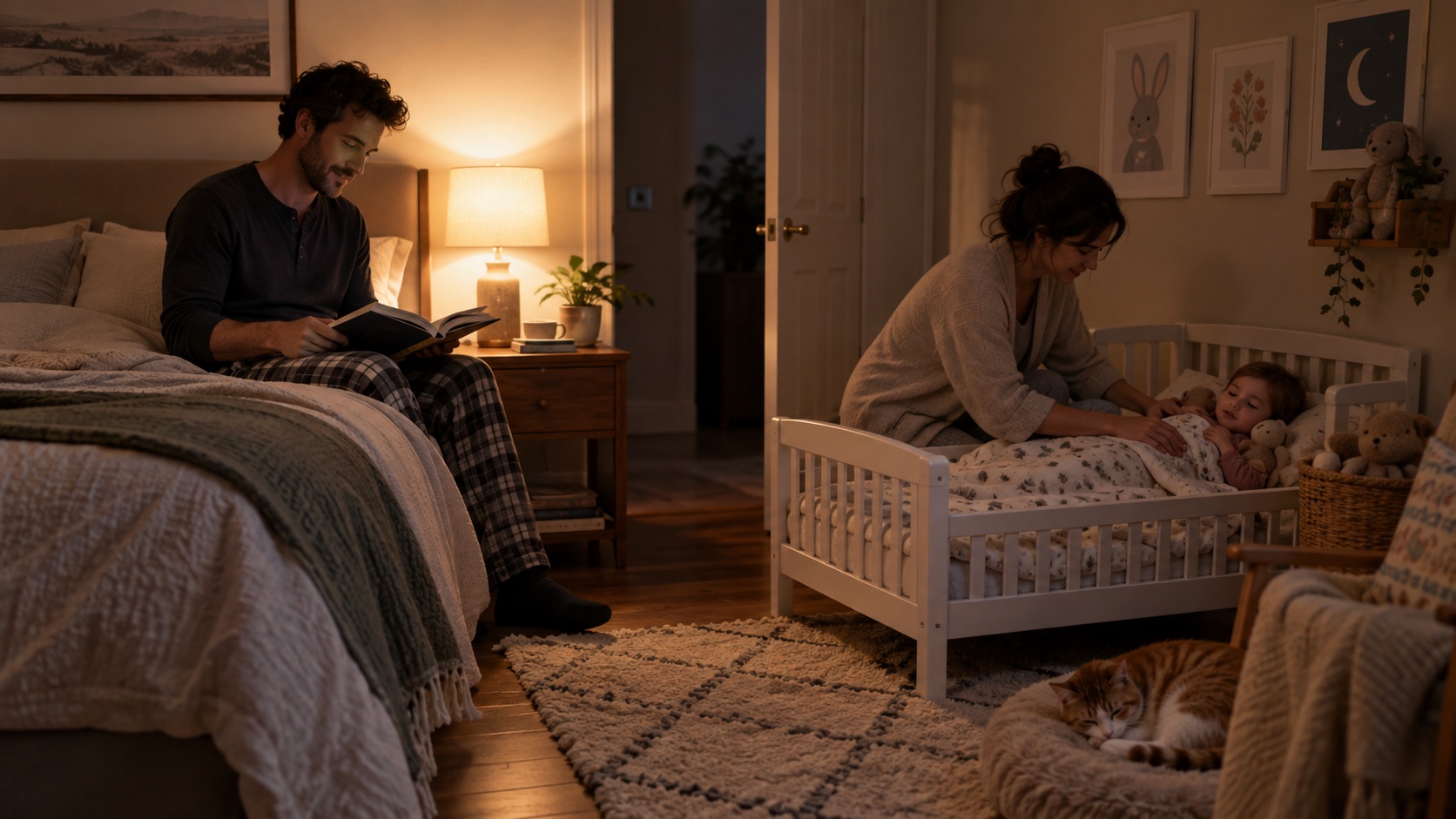
The Bedroom Is a Social Space
Sleep is not a solo sport. Couples' sleep efficiency co-varies night to night — one partner's bad night predicts the other's — and daytime relationship quality feeds back into night sleep (Psychosomatic Medicine, 2010). That cuts both ways: a household can be your biggest sleep liability, and it can also be your biggest lever, because fixing one shared problem often repairs two nights at once. The strategy that follows rests on two principles: protect the anchor (your wake time and morning light — the one thing that is yours regardless of the house) and negotiate the environment (everything else is a conversation, not a solo project).
Product picks are generic categories, not brands. We may earn a commission on Amazon or iHerb purchases at no cost to you — this never changes our evidence conclusions. Full disclosure
Reusable earplugs
May reduce intermittent environmental noise at bedtime.
⚠️ Improper use can irritate the ear canal; users who need to hear alarms or caregiving cues should choose cautiously.
Check price on Amazon →Partner Problems, Ranked by Fixability
| Problem | Why it matters | Tactic with the best odds |
|---|---|---|
| 💤 Partner snoring | Fragments both nights; the snorer usually has no idea | Get the snorer assessed — the apnea topic covers why; earplugs or white noise as the bridge meanwhile |
| 📱 Late-night scrolling partner | Light and alertness in the bed you are trying to associate with sleep | A "bedroom is a cave" agreement: phones charge outside the room, screens end at lights-down |
| 🦉 Owl + lark chronotypes | One partner's bedtime is the other's active evening | Quiet-hours zones: the early partner gets headphones and red-light reading; the late partner does the wind-down outside the bedroom |
| 🌡️ Thermostat wars | Temperature is the strongest environmental lever on sleep | Cool room (18–19°C) plus personal layers and one-sided cooling pads — heat is addable, cold is not negotiable |
| 🛏️ Cover-stealing, restless sleeper | Micro-awakenings all night that neither person remembers | The Scandinavian method: two single duvets on one bed — the cheapest high-yield fix in this page |
Separate Beds, Without the Stigma
"Sleep divorce" is a cultural panic disguised as a medical term. The honest framing: sleeping apart is environment management — the same category as separate desks for work — not a relationship verdict. Some couples report better sleep and less mutual resentment after the switch, and the relationship cost, where one appears, usually traces to the stigma rather than the arrangement. The evidence base here is surveys and clinical observation, not trials, so treat it as an option rather than a prescription.
If you try it, run it as a reversible experiment: keep the shared wind-down — the conversation and the cuddle happen before sleep, then each person retires to their own room — and review after two weeks. Intimacy does not live in the unconscious hours; moving it out of them often protects it.
Kids: Protecting the Anchor When Nights Are Chaos
The newborn phase bends every rule, so bend them deliberately instead of abandoning them. The anchor's temporary form: a wake time held inside a two-hour window, and any sleep banked wherever it will land. Three tactics carry the load:
- 🌗 Split the night, not the whole week. One parent owns 21:00–02:00, the other 02:00–07:00. Each gets a protected block of real sleep; nobody "takes turns" feeling dead.
- 🔴 Feed in red, not white. A dim red night-light preserves the melatonin rhythm that a white ceiling light suppresses — for the parent doing the feed as much as the baby.
- 📅 Routines are the toddler lever. In a controlled comparison, a consistent nightly bedtime routine led to earlier bedtimes, shorter sleep-onset latency, fewer night wakings, and better maternal mood (Sleep, 2015). The child's routine is a household anchor too.
From school age onward, the highest-yield move is a household-wide wind-down: dimming the whole house at the same hour serves every body's clock at once, and it is easier to enforce on a ten-year-old when the adults are visibly doing it too. The evening cascade protocol scales to the whole floor plan.
White-noise device
May mask inconsistent background sounds for some sleepers.
⚠️ Volume that is too high may be unsafe for hearing; it may not suit people who find continuous sound disruptive.
Check price on Amazon →The Split-Shift Night, Drawn
Pets: The Honest Math
The actigraphy data is not kind: adults whose dogs sleep in the bedroom show measurably worse sleep efficiency than those whose dogs sleep elsewhere, even when the dog stays off the bed (Mayo Clinic Proceedings, 2017) — and cats are nocturnal by design. The fair trade: the pet gets 23 hours of household access; the 8-hour sleep window is yours. A pet bed outside the bedroom door, white noise to mask the 4am patrol, and — where the arrangement starts — a few weeks of patient door-training, which is a negotiation with a cat, so expect the cat to renegotiate seasonally. The morning cuddle survives; only the sleeping hours are off limits.
One honest caveat on that data: the association runs in both directions — some people with already-poor sleep bring the dog in for comfort. Excluding the pet is still the experiment worth running: two weeks of door-closed nights gives you your own answer, and the door is reversible.
Coordination Tactics That Preserve the Anchor
- ⚓ Agree on the one protected constant. Your wake time and morning light are non-transferable household facts, not preferences — everything else is negotiable.
- 🤫 Set quiet-hours zones (22:00–07:00). Headphones for screens, no laundry, no slamming doors. Zones beat ad-hoc requests.
- 🌫️ Mask the house, not just the bedroom. A white-noise machine at the door absorbs the entire household's 23:00 life.
- 📝 Decide the "who gets up" rule before bed. The 3am argument is decided at 21:00, in writing, once.
- 📊 Negotiate with data, not complaints. Two weeks of a shared sleep log beats "you always…" — and often reveals that both partners are wrong.
🏠 The household conversation script
Open with the anchor, not the complaints: "I'm trying to hold my wake time steady because it's the one lever that's genuinely mine — can we pick one thing to try for two weeks?" A single, named, time-boxed request beats a list of grievances, and two weeks is short enough that nobody is signing away their way of life. When the trial works, it negotiates its own extension.
The Quiet-Hours Agreement, Written Down
Household sleep negotiations fail when they stay verbal — "I thought we agreed…" is the opening line of the 11pm argument. Writing the deal down, however briefly, fixes most of it. A working agreement needs four lines:
- 🤫 The window. Quiet hours 22:00–07:00: headphones for any screen with sound, no laundry, no slamming. Name the hours; vagueness is where the fights happen.
- 🛏️ The zones. What belongs in the bedroom (sleep, one calm activity) and what does not (work, scrolling, arguments). Zones are easier to honor than rules about feelings.
- 🌅 The anchor. One line: "[Name]'s wake time and morning light are protected." One protected constant per person keeps the deal symmetric.
- 📅 The review date. Two weeks out, in the calendar, both parties' consent revocable. A time-boxed trial lowers the stakes enough that people actually start.
The written version also converts the conversation from blame to design: the problem is the environment, not the person — and environments can be changed by agreement, which is the one power any of us has over someone else's evening.
When the Household Is the Problem
If coordination fails and your sleep stays broken for months, the household is usually not the root cause — it is the loudest symptom. A partner's loud, habitual snoring with witnessed pauses is a reason for a medical evaluation, not better earplugs: most obstructive sleep apnea is first noticed by the person in the next pillow, and treating it repairs two nights at once. When you have run the coordination playbook honestly and sleep still will not hold, the red-flag page is the next rung — the house is rarely the whole story.
The Bottom Line
- Protect the one thing that is yours — wake time and morning light survive whatever the house does.
- Fix partner snoring at the source — an apnea assessment beats a decade of earplugs.
- Two duvets, cool room, quiet-hours zones — the unglamorous fixes that settle most shared-bedroom wars.
- With kids: split the night, feed in red light, and run a consistent bedtime routine — the trial evidence favors routine.
- Pets belong outside the sleep window — a pet bed beyond the door beats a 3am patrol.
Related Topics
- Hasler & Troxel, "Couples' nighttime sleep efficiency and concordance: evidence for bidirectional associations with daytime relationship functioning," Psychosomatic Medicine (2010)
- Patel et al., "The effect of dogs on human sleep in the home sleep environment," Mayo Clinic Proceedings (2017)
- Mindell et al., "A nightly bedtime routine: impact on sleep in young children and maternal mood," Sleep (2015)
- Troxel, "It's more than sex: exploring the dyadic nature of sleep and implications for health," Psychosomatic Medicine (2010)
- Young et al., "The occurrence of sleep-disordered breathing among middle-aged adults," New England Journal of Medicine (1993)