Home sleep tests vs lab polysomnography
Two devices can watch the same night of sleep and return different numbers — because they are not measuring the same thing. This page explains what a home sleep test and a lab polysomnography each actually record, what each one quietly misses, and how to read the AHI report you walk away with.
What the evidence supports
- For uncomplicated adults with a high pretest probability, home testing produces outcomes comparable to lab testing in randomized trials.
- Home tests detect moderate-to-severe OSA reliably; their weakness is mild disease and borderline cases.
- Because home tests cannot measure sleep stages, their AHI tends to run lower than the lab's — same night, same patient.
What remains uncertain
- How often home tests mislabel or miss complex cases (central apnea, hypopnea-only disease) outside research settings.
- Whether newer multi-sensor devices (peripheral arterial tonometry, for example) narrow the accuracy gap at scale.
- Long-term outcomes of home-first pathways versus lab-first pathways beyond the existing trial follow-ups.
Evidence last reviewed: August 15, 2026. Conclusions may change as new research is published.
The Same Number, Different Denominators
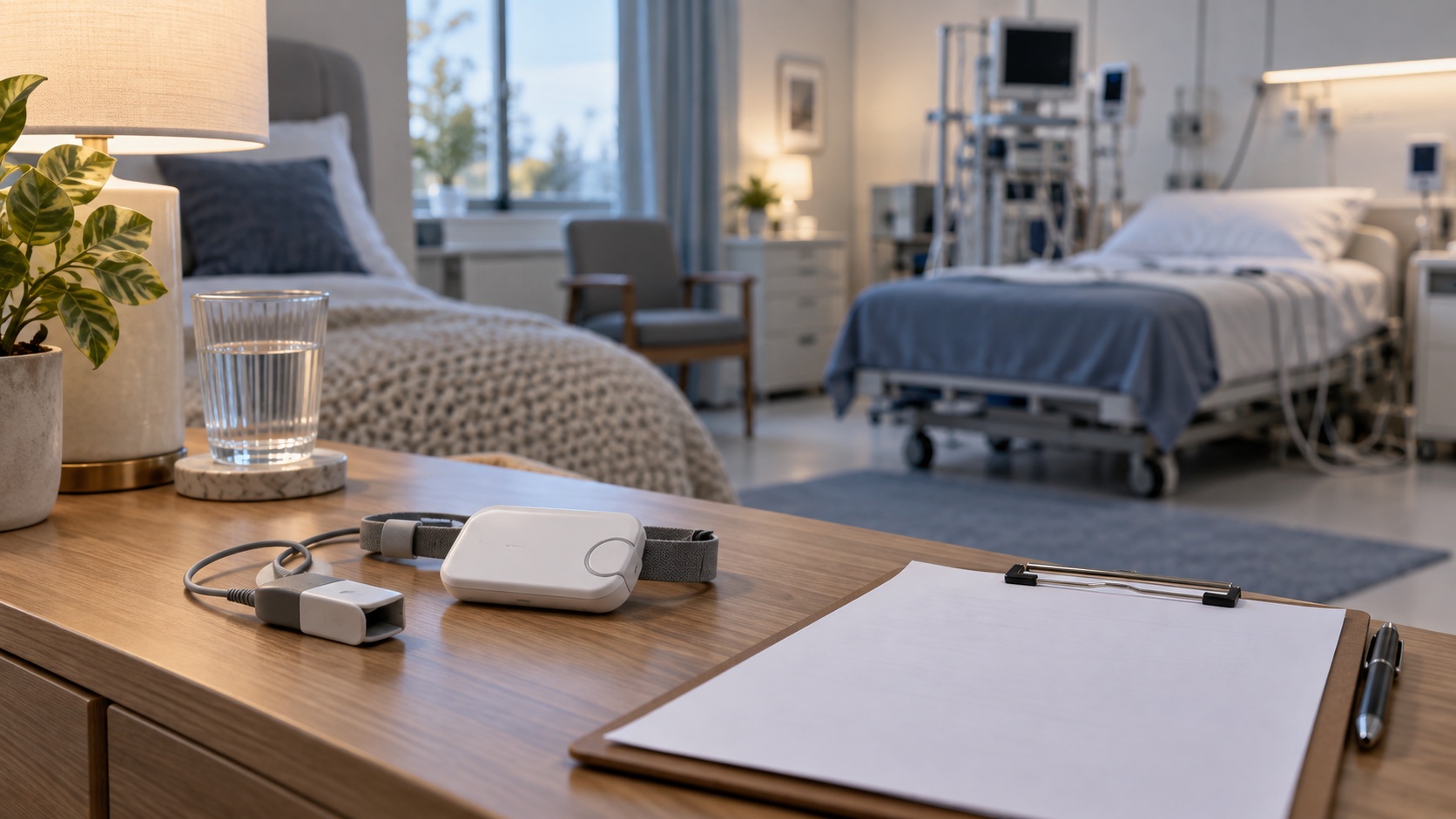
Every sleep study ends in one headline number: the AHI — apnea-hypopnea events per hour. What the parent topic calls "everything follows from that number" deserves one sharp footnote: the AHI is a ratio, and the denominator matters enormously. In the lab, electrodes on your scalp record actual sleep, so the denominator is hours asleep. At home, most devices have no EEG, so the denominator is hours in bed with the device on — including the hour you spent reading. Fewer events divided by more hours yields a lower number. This is the single most important fact about home testing: it systematically under-reads, and it under-reads most precisely in the mild range where the diagnosis hangs in the balance.
What Each Device Actually Measures
| Signal | 🏠 Home test (Type III/IV) | 🏥 Lab polysomnography (Type I) |
|---|---|---|
| Breathing (airflow, effort) | Yes — nasal cannula, chest/abdomen bands | Yes — full airflow, effort, and snore sensors |
| Oxygen (SpO2, heart rate) | Yes — finger pulse oximeter | Yes — plus continuous ECG |
| Sleep stages (EEG, eye, chin) | No (a few devices estimate stage indirectly) | Yes — full electroencephalography |
| Leg movements, position, video | Position sometimes; no EEG arousal data | Yes — full montage |
| Where you sleep | Your bed, normal routine | A monitored room, foreign mattress, wires |
The device classes formalize this. A Type I study is attended lab polysomnography with everything above. Type III is the typical home test: airflow, effort, oximetry, sometimes position — no EEG. Type IV strips further still, often just oximetry and one or two channels. The AASM's guidance on portable monitoring (Collop et al., J Clin Sleep Med, 2007) and its diagnostic-testing guideline (Kapur et al., J Clin Sleep Med, 2017) both draw the same line: home testing is for adults with a high pretest probability and no significant complicating conditions. Everything else belongs in the lab.
What the Home Test Misses
- 😴 Sleep stage. No EEG means no knowledge of when you were asleep. Apneas concentrate in REM sleep and in supine REM especially; if a bad REM period falls outside the recording window, the worst of the night simply is not counted.
- 🌬️ Hypopneas without big desaturations. Home devices score breathing dips largely by oxygen drops. People who arouse from shallow breathing before oxygen falls much — common in lean, younger patients — can generate real sleep disruption that a home test reads as unremarkable. The lab's EEG catches the arousal; the home device catches nothing.
- 🌀 Central versus obstructive. Effort bands let a Type III device tell most obstructive from central events, but without EEG the distinction is coarser — and the treatment is completely different (see Not just obesity for central apnea).
- 🦵 Everything non-respiratory. Periodic limb movements, insomnia-type hyperarousal, and parasomnias are invisible to a home test. A patient whose real problem is restless legs walks away with a clean apnea report and no answer.
- 🛏️ Mild disease, precisely. A systematic review put Type III accuracy for moderate-to-severe OSA in the high 80s percent for sensitivity — but agreement deteriorates at the mild end of the AHI scale (El Shayeb et al., CMAJ, 2014). Near the 5–15 border, the underestimate matters most.
What the Lab Misses
Fairness cuts both ways. The lab has its own blind spots. The first-night effect is real: sleeping in a strange room, wired head to toe, with altered sleep architecture — some people simply do not produce a representative night. Home testing sidesteps this by keeping you in your own bed. The lab is also slower and costlier; in many health systems the queue is weeks to months, which is exactly how the treatment gap grows. The home-first pathway was tested head-on in the HomePAP trial, which randomized patients to home portable testing with auto-titrating treatment versus lab-based care: functional outcomes were comparable at follow-up (Rosen et al., Sleep, 2012). That trial is why a home test is now the sensible default for the typical high-probability patient — not because it is equal to the lab, but because it is good enough for that patient, and much faster.
Who Should Go Straight to the Lab
| Presentation | Route | Why |
|---|---|---|
| High-probability symptoms, no major comorbidity | Home test fine | Home-first is validated and fast. |
| Suspected central apnea (heart failure, opioids, brainstem disease) | Lab | A lab study records airflow, respiratory effort, oxygen, and sleep staging — needed to separate central from obstructive events and guide a different treatment path. |
| Significant cardiopulmonary or neuromuscular disease | Lab | Guideline exclusion for home testing — events interact with the underlying disease. |
| Significant insomnia or fragmented sleep without obvious snoring | Lab usually | Sleep-stage data matter; home tests can't see the arousal problem. |
| Home result negative but symptoms persist | Lab follow-up | An inconclusive home study is not a clean bill — it is a signal to look harder. |
Reading the Report Honestly
The report gives you the AHI, usually an oxygen-desaturation index (ODI), the lowest oxygen saturation of the night, and time spent below 90% saturation. Read them as a set, not a headline:
- 📏 AHI. The classification ladder (mild 5–15, moderate 15–30, severe 30+) is laid out on the parent topic. Remember the denominator caveat above — a home AHI of 12 may be a lab AHI of 15 or more.
- 🩸 ODI and nadir SpO2. How often and how low oxygen actually fell. A patient with AHI 10 and nadir 72% is a different clinical story from AHI 10 and nadir 91%, even though the headline matches.
- 😩 Symptoms outrank numbers. The literature's awkward truth: AHI and symptom burden correlate only modestly. Severe sleepiness with mild AHI deserves treatment and possibly a lab study; severe AHI with no symptoms still carries the long-term risk profile described in Apnea's metabolic toll.
- 🔁 One night is one night. Apnea severity varies night to night with alcohol, position, and congestion. A borderline number is an estimate, not a constant.
⚠️ Clinician territory
Choosing a test, interpreting the report, and acting on it are clinical decisions — the guideline (Kapur et al., 2017) deliberately conditions home testing on a clinician's assessment of pretest probability and comorbidity. If your home result says "negative" and your symptoms say otherwise, the next step is a qualified clinician and likely a lab study — not reassurance.
Practical Path Through the Options
The realistic sequence for most people follows from the STOP-Bang logic: a concerning score or condition list gets you an order for a study. If you are an uncomplicated adult with clear symptoms, the home test is the faster, cheaper route and usually sufficient. If anything complicates the picture — heart disease, suspected central events, insomnia, or an ambiguous home result — the lab earns its cost. Costs vary widely by region and insurer; as a rule of thumb the home test is a fraction of the lab's price, which is why health systems prefer it as the first step. Whichever route you take, the same rule applies after diagnosis: treatment adherence, not test choice, determines the outcome — see the Sleep protocol and Beyond CPAP for what comes next.
Questions, Answered Briefly
- ⌚ Is my watch's SpO2 a home test? No. Consumer wearables lack airflow and effort sensors and are not validated as diagnostic devices. They can raise suspicion; they cannot diagnose.
- 🩸 What about WatchPAT-style devices? Peripheral arterial tonometry devices estimate sleep stages from finger blood-flow signals — a middle ground between classic home tests and the lab. Early evidence is encouraging; the field's verdict on where they sit in the accuracy hierarchy is still forming.
- 🔁 I lost weight since diagnosis — retest? Meaningful weight loss can change severity enough to warrant re-titration or reassessment; the Beyond CPAP page covers the dose-response. Ask your clinician about re-test timing.
- 🛏️ Does it matter that I slept badly during the home test? Less than you fear. Bad sleep during testing tends to understate, not overstate, the AHI — a clearly positive result on a rough night is especially informative.
The Bottom Line
- Home tests under-read by design. No EEG means the denominator is recording time, not sleep time — treat borderline home numbers as floor, not ceiling.
- Home-first is validated for uncomplicated, high-probability patients. Faster, cheaper, and comparable in outcomes (HomePAP).
- Complex cases belong in the lab. Suspected central apnea, cardiopulmonary disease, insomnia, or an inconclusive home result all argue for polysomnography.
- Read the whole report. ODI, nadir oxygen, and symptoms matter as much as the AHI — and symptoms outrank numbers when they disagree.
Related Topics
- Kapur et al., "Clinical practice guideline for diagnostic testing for adult obstructive sleep apnea: an American Academy of Sleep Medicine clinical practice guideline," Journal of Clinical Sleep Medicine (2017)
- Collop et al., "Clinical guidelines for the use of unattended portable monitors in the diagnosis of obstructive sleep apnea in adult patients," Journal of Clinical Sleep Medicine (2007)
- El Shayeb et al., "Diagnostic accuracy of level 3 portable sleep tests versus level 1 polysomnography for sleep-disordered breathing: a systematic review and meta-analysis," CMAJ (2014)
- Rosen et al., "A multisite randomized trial of portable sleep studies and positive airway pressure autotitration versus laboratory-based polysomnography for the diagnosis and treatment of obstructive sleep apnea: the HomePAP study," Sleep (2012)
- Berry et al., "The AASM Manual for the Scoring of Sleep and Associated Events," American Academy of Sleep Medicine (2012)
- Gottlieb & Punjabi, "Diagnosis and management of obstructive sleep apnea," JAMA (2020)