Wind-Down Tricks & Shortcuts: Making the Cascade Automatic
Thirteen tricks, ranked by what they actually buy you. The evening cascade is the plan; this page is the shortcut shelf that makes the plan automatic — set once, run nightly, no willpower required at 10:30 p.m. Pick two to four, run them for two weeks, and let the ones that stick become the protocol's autopilot.
What the evidence supports
- Passive body heating — a warm shower or bath before bed — improves sleep onset in meta-analysis.
- Evening bright-light exposure delays melatonin onset; scheduled dimming and device warm modes blunt that effect.
- Writing tomorrow's to-do list before bed has a controlled polysomnography trial behind it — faster onset than other writing tasks.
What remains uncertain
- Standalone effect sizes for individual tricks are modest; they compound as a bundle more than they impress alone.
- The wind-down alarm's rank is mechanism plus pragmatism — no trial randomizes people to an alarm, because it's an implementation device, not a therapy.
Evidence last reviewed: August 13, 2026. Conclusions may change as new research is published.
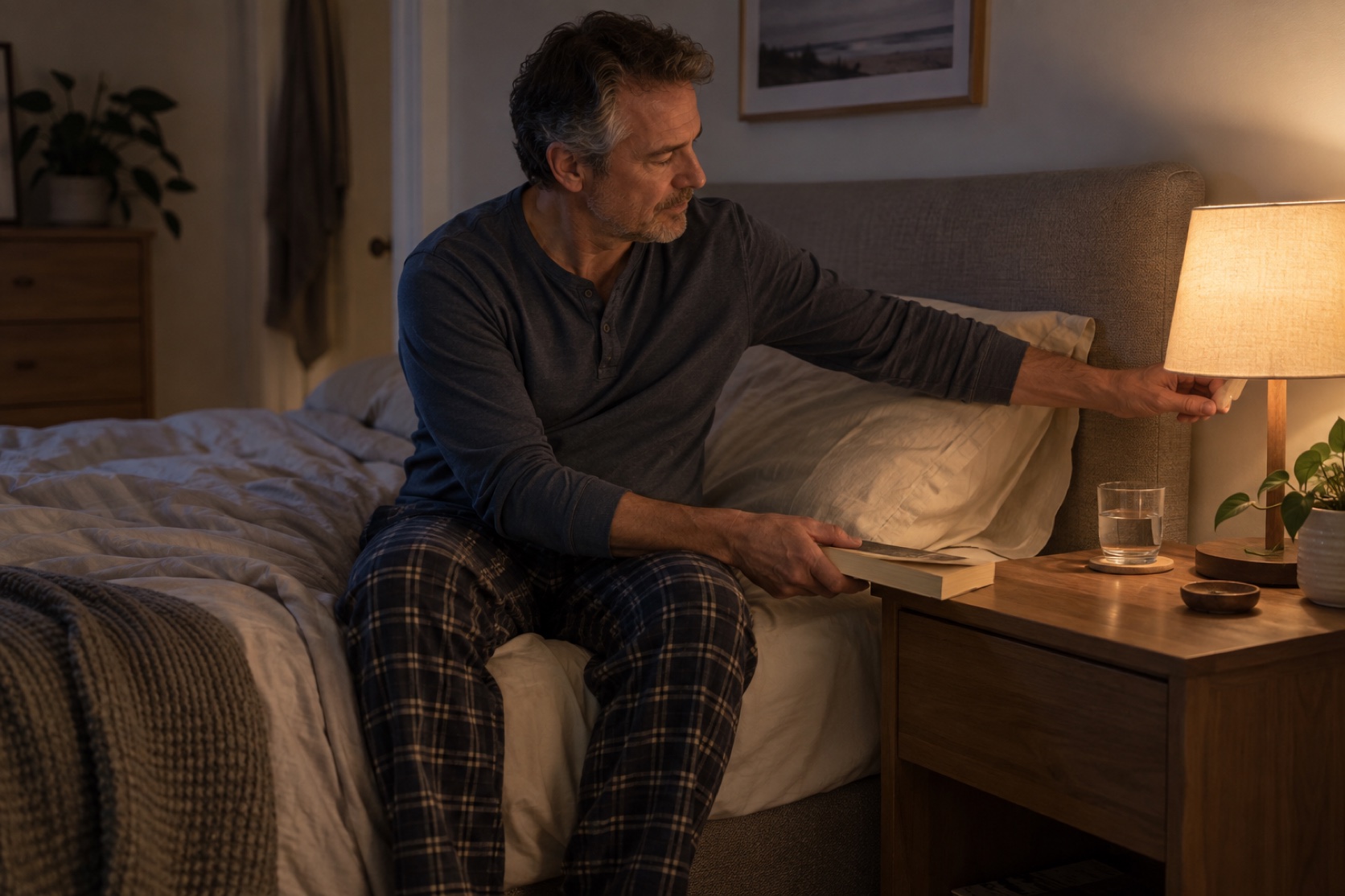
The Anchor Trick: An Alarm for Bed
- #1 · ⏰ The wind-down alarm — set a daily alarm 30–45 minutes before lights-out, same time every night. When it rings, the cascade starts — no negotiation. Why it works: the cascade's biggest failure mode is never starting. Bedtime drifts in ten-minute increments until the window is gone. An alarm converts "I should probably head up" into a recurring external cue — and in habit science, reliable cues do what nightly willpower can't. It is the strongest single trick on this shelf because every other trick hangs off the moment it creates.
Removal Tricks: Make the Wrong Thing Hard
- #2 · 📵 Phone jail — the charger moves outside the bedroom, permanently: kitchen counter, hallway, desk drawer. A plain alarm clock takes over the wake-up job. Why it works: the phone is the strongest arousal source in the evening — scroll, notifications, and the 2 a.m. check in one device. Moving it costs two minutes once and removes the temptation instead of negotiating with it. The light and arousal science is the pillar's domain; this is the operational fix.
- #3 · 🌗 Auto-dimming schedules — one-time setup, three parts: warm/night mode scheduled on every device (an hour or two before bed, not "sunset" which drifts), smart bulbs or lamps set to dim to warm light at a fixed time, and overhead lights off in the final hour. Why it works: bright, blue-shifted light suppresses melatonin; a scheduled taper delivers the dim signal every night with zero nightly effort. Dimming the room matters more than dimming the screen — devices are one input; the walls are the whole field.
Body Tricks: Let Physiology Do the Work
- #4 · 🚿 The hot shower, 60–90 minutes out — a 10-minute warm shower or bath 60–90 minutes before lights-out. Why it works: warming the skin draws blood to the surface; when you step out, core temperature drops — and that falling core temperature is one of the body's sleep-onset signals. Meta-analysis associates before-bed passive body heating with measurably faster sleep onset. The seven habits pillar owns the full temperature story.
- #8 · 🚰 The liquid cut-off — taper fluids about two hours before bed; last full glass at dinner, small sips after. Why it works: every 3 a.m. bathroom trip fragments the night, and late hydration stacks directly against sleep continuity. Don't go to bed thirsty — just front-load the day's water and let the evening taper.
- #10 · 🌡️ The thermostat program — schedule the bedroom for 18–20°C starting an hour before bed (or open a window; programmable thermostats do this automatically). Why it works: sleep onset needs a falling core temperature, and a cool room is the cheap, permanent version of the shower trick. A drop that happens on a schedule doesn't depend on you remembering it at 10 p.m.
- #13 · 🧦 Warm feet — socks in bed, or a one-minute warm footbath during the wind-down. Why it works: vasodilation in the hands and feet helps the body dump core heat — a classic study found warm feet associated with faster sleep onset. It's the sixty-second fallback when the shower gets skipped.
Product picks are generic categories, not brands. We may earn a commission on Amazon or iHerb purchases at no cost to you — this never changes our evidence conclusions. Full disclosure
Book or skill-learning workbook
Can support sustained reading or structured skill practice.
⚠️ None expected; a product cannot prevent dementia or replace assessment of new cognitive symptoms.
Check price on Amazon →Mind Tricks: Close the Loops, Quiet the Noise
- #5 · 📝 The tomorrow list — two to five minutes, pen and paper, before the wind-down hour: tomorrow's top items only, each with a next action. Why it works: unfinished tasks keep the mind's loops open — the brain rehearses what it hasn't filed. Writing the list outsources the remembering; a polysomnography study found people who wrote to-do lists fell asleep faster than those who wrote about completed tasks. Paper, not a phone app: the phone undoes the trick.
- #6 · 📖 Reading rules — paper book or dim e-reader at minimum brightness, a low warm lamp, 15–20 minutes as the last activity of the night. Fiction preferred. Why it works: reading is passive attention — it occupies the mind without engaging it in tomorrow's problems, and fiction in particular doesn't hand the brain real open loops. Bright backlit screens are the exception that proves the rule: trials show light-emitting e-readers delay melatonin and sleep onset, so the device stays dim.
- #7 · 🎧 Ambient sound setup — a fan, a white-noise machine, or a sleep-sound app on a timer at low volume; set once, runs nightly. Why it works: it's not the noise that wakes people — it's the change in noise: a door, a siren, a partner's cough. Steady low-level sound smooths those spikes into the background. Consistency matters more than the specific sound.
Rescue Tricks: Busy Nights, Weekends, and Road Trips
- #11 · 🛌 The 2-minute version — for compressed nights, the minimum viable wind-down: bathroom, teeth, three-item tomorrow list, lights down, bed. Why it works: consistency beats completeness — a tiny ritual keeps the habit alive on the nights a full cascade can't fit, and habit research shows skipped repetitions matter less than the cue staying intact. It's the floor, never the goal. The downshift habit pillar owns the underlying habit mechanics.
- #9 · 🌅 The weekend rule — wake within ±30–60 minutes of the weekday wake time, even on weekends; if the night ran long, a nap of 20 minutes or less before 3 p.m. is the safety valve, not a 2 p.m. lie-in. Why it works: the wake anchor is the clock's reference point; sleeping in two hours on Saturday is the circadian equivalent of flying west — social jet lag — and it makes Monday's alarm hurt. The wake anchor page owns the full argument.
- #12 · 🧳 The travel kit — a small pouch that lives in the suitcase: eye mask, earplugs, your own pillowcase, and a white-noise app pre-installed. Why it works: hotels break darkness, quiet, and familiarity in the same night. The mask and plugs rebuild darkness and quiet; the pillowcase is a smell-and-touch cue that says "home" to a brain that doesn't trust hotel sheets. Pack it once; it stays packed.
| Trick | What it buys | Setup | Verdict |
|---|---|---|---|
| ⏰ Wind-down alarm | The cascade always starts on time | 1 minute, once | Best |
| 📵 Phone jail | Removes the strongest arousal source | 2 minutes, once | Best |
| 🌗 Auto-dimming | Light taper with no nightly effort | 20 minutes, once | Best |
| 🚿 Hot shower 60–90 min out | Core-temperature drop eases onset | 10 minutes, nightly | Good |
| 📝 Tomorrow list | Closes open loops before bed | 5 minutes, nightly | Good |
| 📖 Reading rules | Passive focus replaces rumination | 15–20 minutes, nightly | Good |
| 🎧 Ambient sound | Masks noise spikes | 10 minutes, once | Moderate |
| 🚰 Liquid cut-off | Fewer 3 a.m. bathroom trips | Habit, nightly | Moderate |
| 🌅 Weekend rule | Protects the wake anchor | Weekly habit | Good |
| 🌡️ Thermostat program | Cool room on a schedule | 5 minutes, once | Good |
| 🛌 2-minute version | Keeps the habit on bad nights | As needed | Good |
| 🧦 Warm feet | Vasodilation aids core cooling | 1 minute, nightly | Moderate |
The full shelf, one glance. One-time setups quietly dominate: three of the top four verdicts are set-and-forget, which is the whole point of the page.
🪄 A shelf of tricks is not a plan
The evening cascade still runs the show — these exist to make it automatic, not to replace it. Pick two to four, run them for two weeks, keep what sticks (the habit science is the pillar's job). And if sleep stays broken after a month of honest tricks, that's not a trick problem — that's the insomnia and apnea path.
Light-blocking sleep mask
A portable option when room light cannot be controlled.
⚠️ Can feel uncomfortable or trap heat for some people; do not use as a substitute for evaluating persistent sleep symptoms.
Check price on Amazon →Where the Evidence Lives
This page is the implementation layer — the pillars own the science behind each mechanism, and this series references rather than repeats them:
- 🛌 The nightly behaviors — the Seven Habits of Great Sleepers pillar owns the evidence for the behaviors these tricks install: regularity, temperature, light, and quiet. Every trick on this shelf is a shortcut to one of those habits.
- ☕ The substance layer — the Caffeine, Alcohol & Blue Light pillar owns the half-lives and the light physiology behind the dimming tricks. The tricks don't argue with chemistry; they schedule around it.
- 🧠 The habit mechanics — the Downshift Habit pillar owns why one-time setups beat nightly willpower: cues, friction, and the slow crawl from effort to automatic.
What to Do When It Goes Wrong
Five ways the shelf fails in practice — with the fix that has worked:
- 🚩 The wind-down alarm keeps getting snoozed — the alarm is a cue, not a request. Pair it with something that doesn't take requests: a lamp on a timer that dims when the alarm fires. Treat a snoozed alarm as the cascade starting late, and the 2-minute version as the floor you never skip.
- 🚩 Screens win anyway — night mode is not permission: the content, not just the brightness, is often the arousal (the pillar covers this). If dimming alone doesn't hold, phone jail is the removal trick that solves the root instead of the symptom.
- 🚩 The shower gets skipped on late nights — that's exactly what the 2-minute version exists for, and warm socks are the sixty-second fallback. A skipped trick is a cue problem, not a character problem — shrink the trick, don't scrap the night.
- 🚩 The tricks worked for a week, then faded — the normal novelty curve. Habits form over weeks, not days; pick two to four maximum, run them two weeks before judging, and let the weekly audit retire the ones you're not actually using (see the habit pillar).
- 🚩 A month of honest tricks, sleep still broken — tricks are environment, not treatment. Red flags or 3+ bad nights a week mean the next move is the insomnia and apnea path, not trick number fourteen.
Reusable earplugs
May reduce intermittent environmental noise at bedtime.
⚠️ Improper use can irritate the ear canal; users who need to hear alarms or caregiving cues should choose cautiously.
Check price on Amazon →Common Pitfalls and How to Overcome Them
The tricks fail in predictable ways — and each failure has a countermove already built into this page. If one of these looks familiar, the fix is the right-hand column.
| Pitfall | Why it happens | The countermove |
|---|---|---|
| Collecting tricks instead of installing them | Reading about wind-down routines feels like doing them | One trick installed per night; the reading list waits until the first three are automatic |
| The ignored wind-down alarm | The alarm goes off, gets dismissed, and the cascade never starts | Pair the alarm with an action: it doesn't mean "consider winding down," it means "phone into the jail now" |
| Perfectionism skips the whole thing | If the full cascade can't happen, nothing happens | The 2-minute version exists for exactly this — a shortened wind-down still beats none |
| Scrolling as the wind-down | Night mode and dimmed screens justify an hour of scrolling in bed | Night mode is damage reduction, not a wind-down — the phone jail is the only fix that actually works |
| Gadget shopping as a substitute | New lamps and sleep gadgets bought while the routine stays untouched | The free moves first: dimming, the tomorrow list, the shower. Gear comes after the routine holds |
| Weekend exception creep | Friday and Saturday slide the whole system by hours | The ±30–60 minute weekend rule — the anchor bends, it doesn't break |
Questions, Answered Briefly
- ❓ Which trick do I start with? — The wind-down alarm. One minute to set, and every other trick hangs off the moment it creates. Alarm first, phone jail second — the two cheapest tricks are also the two highest-leverage.
- ❓ Do I need all thirteen? — No. Two to four, chosen from the top of the list. The table's setup column shows the cost; a full shelf is a museum, not a routine. The weekly audit keeps you honest about what's actually running.
- ❓ Shower or bath? — Either: warm, not scalding, about ten minutes, 60–90 minutes before lights-out. The mechanism is the temperature drop after the heat, so a shower right at bedtime misses the window — and a scalding one keeps core temperature high.
- ❓ Will these tricks fix real insomnia? — They're the environment layer: they make good sleep easy and bad sleep harder, but they are not treatment. Chronic insomnia — 3+ nights a week for 3+ months — points to CBT-I, and red flags point to a doctor. Both routes live on the previous page.
The Bottom Line
- One alarm, set once — outperforms nightly willpower, every night.
- Removal beats resistance — phone jail and auto-dimming make the wrong choice inconvenient instead of forbidden.
- The body tricks borrow physiology — shower, cool room, warm feet ride the temperature system.
- Two to four tricks, two weeks, then judge — and a month of honest tricks without improvement is a clinician question, not a trick question.
This Page in One Workflow
- Tonight — set the wind-down alarm; move the charger outside the bedroom.
- This weekend — one-time layer: auto-dim schedules, thermostat program, ambient sound.
- Nightly — alarm → tomorrow list → shower or reading or warm feet → lights out. The 2-minute version is the floor.
- Weekends and travel — wake within ±30–60 minutes; travel kit packed and in the suitcase.
- At two weeks — audit: keep the used tricks, cut the ignored ones, and if sleep is still broken, escalate to the insomnia and apnea path.
The Daily Checklist
- Wind-down alarm fired on time — cascade started
- Phone charging outside the bedroom before the wind-down hour
- Tomorrow list written — five items max, pen and paper
- One body trick done — hot shower, warm socks, or the 2-minute version
- Lights down and screens away in the final hour
- Bed used for sleep only — no work, no scroll
The Weekly Checklist
- Wake times held within ±30–60 minutes all week
- Auto-dim, thermostat, and ambient-sound settings confirmed still running
- Travel kit restocked if anything was borrowed
- One trick audited — kept or cut (max four running)
- 3+ bad nights this week — escalate to the insomnia and apnea path
Go Deeper: Wind-Down Tricks & Shortcuts: Making the Cascade Automatic
These five companion pages turn the topic into smaller, testable practices.
Related Topics
- Haghayegh et al., "Before-bedtime passive body heating by warm shower or bath to improve sleep: A systematic review and meta-analysis," Sleep Medicine Reviews (2019)
- Kräuchi et al., "Warm feet promote the rapid onset of sleep," Nature (1999)
- Scullin et al., "The effects of bedtime writing on difficulty falling asleep: A polysomnographic study comparing to-do lists and completed activity lists," Journal of Experimental Psychology: General (2018)
- Chang et al., "Evening use of light-emitting eReaders negatively affects sleep, circadian timing, and next-morning alertness," PNAS (2015)
- Lally et al., "How are habits formed: Modelling habit formation in the real world," European Journal of Social Psychology (2010)
- Stepanski & Wyatt, "Use of sleep hygiene in the treatment of insomnia," Sleep Medicine Reviews (2003)