The Bone–Muscle Double Win
Muscle and bone do not age separately — they age as one loaded system, and the estrogen withdrawal of the transition hits both at once. The unusually good news is that the same twice-weekly sessions that rebuild muscle also signal bone to hold or add density. This page explains the coupling, the trial numbers, and how to load for both ledgers at once.
What the evidence supports
- Bone responds to mechanical load — the mechanostat principle is among the oldest and best-established ideas in skeletal biology.
- In postmenopausal women with osteopenia or osteoporosis, eight months of twice-weekly supervised heavy lifting improved spine bone density in a randomized trial (LIFTMOR).
- Balance and functional exercise programs reduce falls — and thereby fractures — in community-dwelling older adults (Cochrane).
What remains uncertain
- Whether training-induced bone-density gains translate into fewer fractures over decades has not been shown in a dedicated trial — density is a surrogate, though a strong one.
- Muscle-bone crosstalk mechanisms (myokines, osteocalcin) are mostly established in animal models; the human balance sheet is still being written.
- How training interacts with bone medication in high-risk women is clinician territory, not yet well mapped by trials.
Evidence last reviewed: August 15, 2026. Conclusions may change as new research is published.
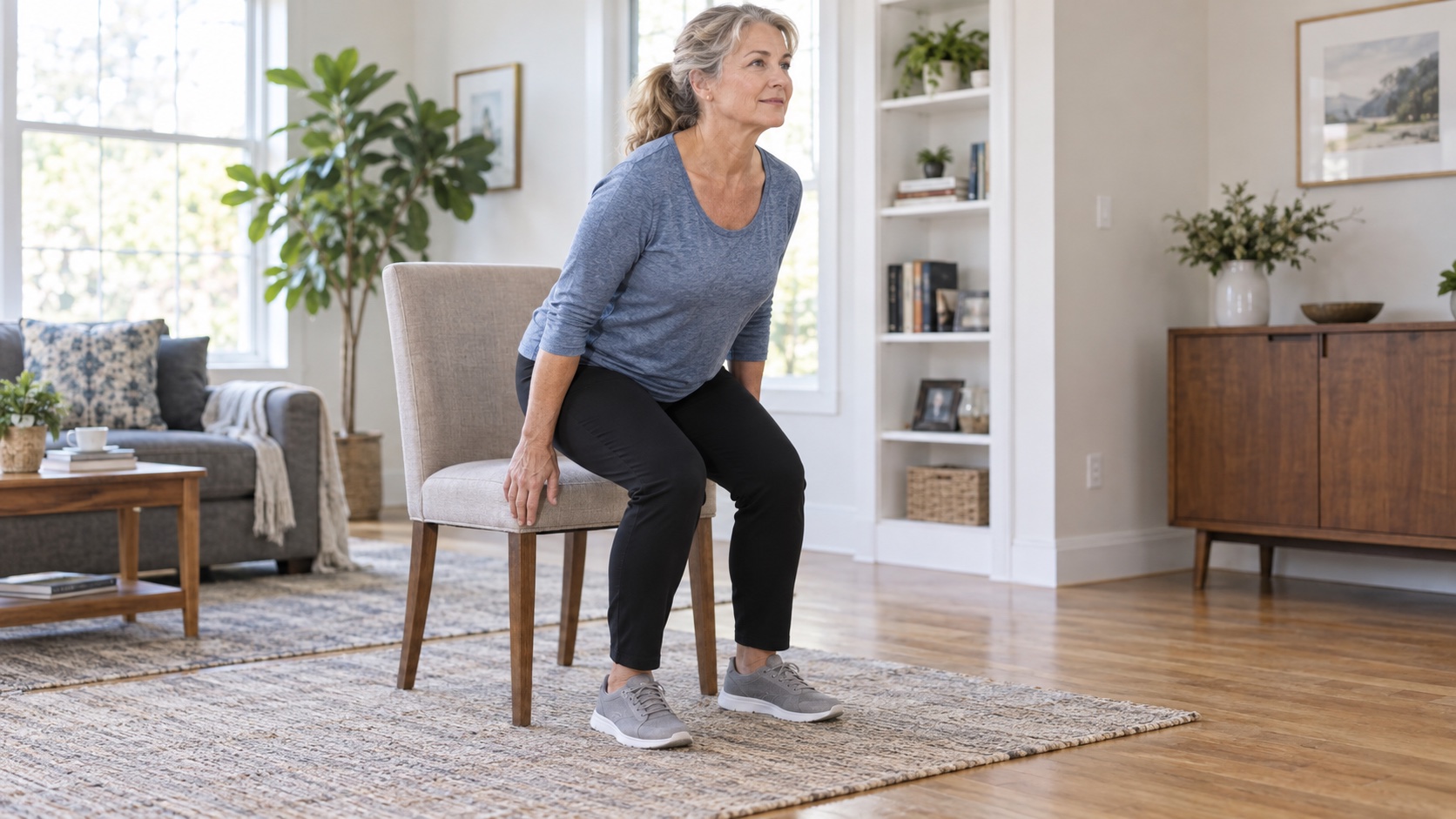
One Signal, Two Systems
The foundational idea is called the mechanostat, and it is older than most of exercise science. Harold Frost proposed in the 1980s that bone behaves like a thermostat for load: it senses the mechanical strain it experiences, and adds or sheds mineral to keep that strain inside a preferred band (Frost, Anatomical Record, 1987). Strain too low — bed rest, weightlessness, or a sedentary decade — and bone economizes, quietly resorbing itself. Strain high enough, repeatedly, and bone thickens where the load lands. The muscle connection is direct: every maximal contraction pulls on the tendon, which pulls on the bone, and that pull is the signal. Muscle is, in effect, the endocrine organ of bone's ambition — no muscle, no meaningful strain, no building signal. Which is why the same decade that steps on muscle loss steps on bone loss too: when the pull weakens, the skeleton hears "economize" through two channels at once — the falling strain and the falling estrogen. The Bone Health topic owns the full osteoporosis story; this page is about the training end of it.
The Transition's Bone Timeline
Bone loss accelerates sharply around the final menstrual period — longitudinal data from the Malmö cohort showed forearm bone loss running at roughly 1.5–2% per year in the early postmenopausal years, several times the premenopausal rate (Ahlborg et al., New England Journal of Medicine, 2003). Trabecular bone — the spongy interior of the spine and hip, the sites most exposed to fracture — thins first and fastest. Put that timeline next to the muscle timeline from the first page of this series and the strategic point is hard to miss: both systems accelerate their losses in the same window, driven by the same hormonal event, and both respond to the same intervention. The transition is not two separate problems — it is one loaded system losing its maintenance signals, and the fix is to supply the missing signal directly.
LIFTMOR: The Trial That Made It Concrete
For years the conventional wisdom was that postmenopausal women with low bone mass should exercise gently — brisk walking, light weights, careful machines — while heavy loading was reserved for healthy bones. LIFTMOR tested the opposite. The trial randomized postmenopausal women with osteopenia or osteoporosis to eight months of twice-weekly, 30-minute, supervised high-intensity resistance and impact training — deadlifts, squats, overhead presses, and jump-based pull-ups with drop landings, all loaded progressively — against a home-based low-intensity program (Watson et al., Journal of Bone and Mineral Research, 2018). The lifting group gained about 2.9% in spine bone mineral density while the control group lost about 1.2%; at the hip the contrast was a small gain versus a loss of nearly 2%. Serious adverse events were not reported in either arm — notable, because the population was exactly the one clinicians had been protecting from heavy loads. The caveats are real: one hundred and one women, one site, expert supervision, and bone density as a surrogate for fracture risk. But the direction — training at high loads in low-density women, done well, builds bone rather than breaking it — has since anchored the field's guidance.
How Muscle Talks to Bone
Beyond the mechanical pull, the two tissues run a chemical conversation. Contracting muscle releases a cocktail of signal molecules — the myokines — that include exercise-responsive factors like irisin and IL-6 in its beneficial, transient exercise form. Bone answers back: the skeleton releases osteocalcin, a hormone that feeds back into muscle and energy metabolism, closing a loop in which the two organs negotiate their common budget (Karsenty & Olson, Cell, 2016). The honest annotation: most of this map was drawn in mice and cell cultures, and the human dose-response — which signals matter, at what loads, in what people — is still under construction. For a reader holding a dumbbell rather than a pipette, the practical version is simpler than the biochemistry: the same contraction that builds the muscle sends both the mechanical and the chemical signal the bone is waiting for. One session, two ledgers.
| Movement | Muscle ledger | Bone ledger | Practical note |
|---|---|---|---|
| 🧎 Squat | Quadriceps and glute strength | Hip and spine load signal | The single highest-yield row on the table |
| 📐 Deadlift / hinge | Posterior chain — back, hips, hamstrings | Spine and hip density | The LIFTMOR program's spine-building anchor |
| 🤲 Overhead press | Shoulders and arms | Wrist and forearm loading | Loads the upper skeleton, often neglected |
| 🦘 Jump or drop landing | Leg power — the fall-catching speed | Brief high-magnitude impact at the hip | Only when joints tolerate it |
| 🧳 Carry | Grip, core, and trunk stability | Whole-body axial loading | The balance-and-bone combination in one walk |
Falls: The Other Half of the Fracture Equation
Bone density is only half of fracture risk; the other half is whether you fall, and most hip fractures in older adults arrive that way — by falling from standing height, not by spontaneous failure. Strength training buys on both sides of that equation. The Cochrane evidence on falls is among the most replicated in geriatrics: balance and functional exercise programs reduce the rate of falls by roughly a quarter in community-dwelling older adults (Sherrington et al., Cochrane, 2019), and strength training is a standard ingredient in those programs. Power matters specifically — the ability to produce force quickly is what catches a stumble, and fast, light movements train it directly. The loading principles that serve bone (below) therefore also serve the fall ledger, which is what makes the intervention a two-for-one in the fracture sense as well: denser bone, fewer falls, and the muscles to catch yourself when one happens anyway.
Loading Principles That Matter
- 🏋️ Magnitude beats duration. Bone responds to the size of the strain, not the length of the session — a heavy set of five loads bone more than an hour of light repetitions. High load, few reps, progressive over months.
- 🔁 Progress is the signal. Bone adapts to what is new, not what is comfortable — the load has to keep creeping up, which is the progressive-overload engine of the resistance training protocol.
- 🦿 Multi-joint, loaded through the spine and hip. Squats, deadlifts, and overhead presses load the sites that matter most — the LIFTMOR menu is the evidence-backed template.
- 🦘 Impact when tolerated. Jumping and drop landings deliver brief, high-magnitude strain — meta-analyses of impact exercise in postmenopausal women support mixed loading programs (Martyn-St James & Carroll, British Journal of Sports Medicine, 2009).
- 📅 Years, not months. Bone turns over slowly; the payoff compounds across years of the same two sessions — which is exactly why the habit from the beginner page is the real investment vehicle.
⚠️ Low-density bone: clinician territory first
The LIFTMOR results are encouraging, but they came with expert supervision, individualized progression, and screening. If you have diagnosed osteoporosis, vertebral fractures, or medications affecting bone, the loading plan — especially loaded spinal flexion, twisting under load, and jump landings — is a conversation with your clinician or a bone-savvy physiotherapist, not something to self-prescribe from a web page. Start conservative, progress supervised, and let the Bone Health topic walk the medical side.
Questions, Answered Briefly
- 🚶 Does walking build bone? Walking helps density weakly at best — the strain is too small and too habitual. It earns its keep for cardiovascular and metabolic health, not as the bone prescription.
- 🏋️♀️ How heavy is "heavy enough"? For bone, the rule of thumb is loads you could lift roughly five to ten times with good form, progressed over months — the LIFTMOR program aimed high and got supervised results.
- ⏱️ How long until bone responds? Trials measure density over six to twelve months; the honest horizon is years of consistent sessions. The muscle and strength gains arrive much sooner, which is the argument for starting with patience.
- 💊 Does training replace bone medication? No — in high-risk women the two are complementary, and the decision about medication belongs to a clinician. Training is the loading half of the plan, not a substitute for the medical half.
- 🧘 What about yoga or Pilates for bone? They build strength and balance — genuinely useful for the fall ledger — but they generate modest strain at the spine and hip, so they complement rather than replace heavy progressive loading.
The Bottom Line
- Muscle and bone are one loaded system — the mechanostat means the same contractions that build muscle signal bone to hold or add density.
- The trial evidence is real and recent: twice-weekly supervised heavy lifting improved spine density by roughly 3% in eight months in women with low bone mass, while controls lost density.
- Training also buys the fall ledger — balance and functional programs cut fall rates by roughly a quarter, and strength is the catch-yourself insurance.
- Load for magnitude and progression, and let clinicians own the medical side — heavy, multi-joint, progressive loading done safely, with medication decisions left to the professionals.
Related Topics
- Frost HM, "Bone 'mass' and the 'mechanostat': a proposal," Anatomical Record (1987)
- Watson SL et al., "High-intensity resistance and impact training improves bone mineral density and physical function in postmenopausal women with osteopenia and osteoporosis: The LIFTMOR randomized controlled trial," Journal of Bone and Mineral Research (2018)
- Ahlborg HG et al., "Bone loss and bone size after menopause," New England Journal of Medicine (2003)
- Sherrington C et al., "Exercise for preventing falls in older people living in the community," Cochrane Database of Systematic Reviews (2019)
- Karsenty G, Olson EN, "Bone and muscle endocrine functions: unexpected paradigms of inter-organ communication," Cell (2016)
- Martyn-St James M, Carroll S, "A meta-analysis of impact exercise on postmenopausal bone loss: the case for mixed loading exercise programmes," British Journal of Sports Medicine (2009)