VO₂ Max: A Leading Longevity Predictor
If there's one number that summarizes your cardiovascular system's age, it's VO₂ max — the maximum oxygen your body can use per minute. Large studies place it among the strongest predictors of all-cause mortality ever identified, ahead of many familiar risk factors. The good news: it's trainable at any age.
What the evidence supports
- Cardiorespiratory fitness is inversely associated with all-cause mortality across dozens of large cohort studies.
- In the Aerobics Center Longitudinal Study, low fitness carried mortality risk comparable to or exceeding smoking and diabetes.
- Training — including interval protocols — reliably raises VO₂ max in controlled trials, at every age studied.
What remains uncertain
- Whether improving VO₂ max extends lifespan is inferred from cohort gradients; no long-term randomized trial proves it directly.
- Genetic ceiling varies — some people respond more to training than others.
- Consumer-device estimates are approximations; lab testing remains the reference.
Evidence last reviewed: August 13, 2026. Conclusions may change as new research is published.
What the Number Means
VO₂ max is your body's maximal oxygen uptake — the ceiling of how much oxygen your heart, lungs, blood, and muscles can process together during all-out effort. It's expressed in milliliters of oxygen per kilogram of body weight per minute (ml/kg/min). A trained endurance athlete might measure 60–80; a sedentary middle-aged adult might be in the 20s or 30s. It reflects the integrated capacity of every link in the oxygen chain — which is exactly why it predicts health so well: nothing in your cardiovascular system can hide from it.
Context for the numbers: in cohort studies of healthy adults, fitness of roughly 5 METs (a unit equivalent to about 17.5 ml/kg/min) separates high-risk from moderate-risk groups, and each additional MET is associated with meaningful reductions in mortality. You don't need to become an athlete — you need to climb out of the bottom tertile.
| Percentile | Men (40s) | Women (40s) | Interpretation |
|---|---|---|---|
| 90th (excellent) | ~52+ | ~45+ | Athletic capacity; strong longevity profile |
| 50th (average) | ~38–40 | ~32–34 | Typical active adult |
| 25th (low) | ~33 | ~28 | Below average — room to gain quickly |
| 10th (poor) | ~28 or lower | ~24 or lower | Associated with elevated risk; treat as a priority |
Product picks are generic categories, not brands. We may earn a commission on Amazon or iHerb purchases at no cost to you — this never changes our evidence conclusions. Full disclosure
Smart band or smartwatch
Can make activity, exercise, and routine patterns easier to notice over time.
⚠️ Step, heart-rate, and sleep estimates can be inaccurate and may encourage unhelpful over-monitoring; consumer readings are not medical diagnoses.
Check price on Amazon →Why It Declines — and Why That's Reversible
Untrained VO₂ max declines roughly 5–15% per decade after age 30, driven mostly by inactivity, muscle loss, and the heart's declining maximal output. But the decline is far from fixed: trained older adults routinely maintain values 20–30% above sedentary peers of the same age, and studies of 70- and 80-year-olds show that starting training late still produces substantial gains — typically 10–25% within months. Age sets a lower ceiling; it doesn't set your floor.
How to Measure It
Three levels of accuracy, in increasing order of precision:
| Method | Accuracy | Notes |
|---|---|---|
| Lab test (treadmill/bike with mask) | Reference standard | Direct gas analysis. The reference-standard measure; costs time and money. |
| Field test (e.g., 12-minute Cooper run) | Good estimate | Distance covered in 12 minutes predicts VO₂ max within a few ml/kg/min. Free. |
| Wearables (watch/ring estimates) | Approximate, improving | Useful for tracking trends over months, not for exact values; treat ±10% as noise. |
The Overlooked Engine Room: Your Heart
It's worth a moment on the physiology, because it reframes what "cardio" actually upgrades. VO₂ max is the product of three things working at once: cardiac output (how much blood the heart pumps per minute — the product of stroke volume and heart rate), oxygen-carrying capacity (hemoglobin in the blood), and extraction (how much oxygen the muscles pull from that blood). Training attacks all three — the left ventricle grows slightly stronger and pumps more per beat, blood volume expands, and trained muscles sprout more capillaries and mitochondria. That's why a trained heart idles lower at rest yet can surge far harder under demand: it has become a bigger, more efficient pump. The longevity dividend of that adaptation is precisely what the cohort studies measure — a heart with margin.
Reading Your First Test Result
A lab report gives you the raw number and, usually, your percentile against age- and sex-matched norms. Two readings matter more than the headline. First, your percentile: a 45-year-old man at 35 ml/kg/min may be "average," but average in a sedentary population is not the same as healthy — the norms describe how people score, not how they should. Second, your trend: a single test is a snapshot; three tests a year apart are a trajectory. Treat the first test as your baseline and refuse to judge yourself against anyone but your previous result.
If lab testing isn't available, the free Cooper 12-minute run (or walk, if you can't run continuously) gives a reasonable estimate: the distance you cover in 12 minutes maps onto VO₂ max through well-validated formulas, and repeating it every few months tracks your progress just as well as the expensive version.
How to Raise It — At Any Age
VO₂ max responds to two types of stress: volume (aerobic base — see the Zone 2 topic) and intensity (intervals that touch your ceiling). The most-studied recipe:
The 4 × 4 interval
4 minutes hard (85–95% max HR), 3–4 minutes easy, repeated 4 times, twice weekly. The "Norwegian protocol" — among the most studied interval formats, with consistent VO₂ max gains of ~10% over 8–12 weeks.
The 80/20 split
Roughly 80% of cardio time easy (zone 2), 20% hard. Endurance athletes have trained this way for decades; the science supports it over all-moderate training.
Body weight
VO₂ max is per kilogram. Losing excess fat raises the number without any training change — one reason fitness and metabolic health are inseparable.
Consistency
Gains compound over 6–12 weeks and plateau without progression. The best program is the one you repeat weekly for years.
⚠️ Before hard intervals
High-intensity work raises cardiovascular demand sharply. If you have heart disease, hypertension, or have been sedentary for years, get medical clearance and build a base of easy aerobic work first. Intervals are powerful — and dose-dependent.
How Fast Will It Improve?
Expect the timeline of a realistic transformation: measurable gains within 4–8 weeks (typically 5–10%), substantial gains within 3–6 months (10–20% in previously untrained adults), and a plateau thereafter unless training volume increases. Untrained people improve fastest — which is good news, because untrained people also have the most to gain. Expect the curve to resemble a fast start followed by slower, steadier climbs — that's adaptation, not failure. A realistic 12-week starter:
| Weeks | Focus | Weekly plan |
|---|---|---|
| 1–4 | Build the base | 3–4 easy zone-2 sessions; no intervals yet |
| 5–8 | Introduce intensity | 2–3 zone-2 sessions + 1 session of 4×4 intervals |
| 9–12 | Add volume | 2–3 zone-2 + 2 interval days, spaced apart; test VO₂ max (12-min run) at week 12 |
What the Number Means in Daily Life
It's easy to file VO₂ max under "athlete statistics," but it translates directly into ordinary life. A higher VO₂ max is what lets you chase a bus without your chest hurting, carry a child up three flights of stairs while talking, hike all day on vacation, and recover fast from hard physical days. In clinical terms, it's the margin between "fine at rest" and "functional under load" — and longevity is mostly about functioning under load. One of the most useful ways to think about training is that you're not chasing a number; you're widening the gap between what life asks of your heart and lungs and what they can actually deliver. For the side-by-side audit of aerobic and strength training across outcomes, see Cardio vs Strength: What Actually Matters More.
VO₂ Max Questions, Answered Briefly
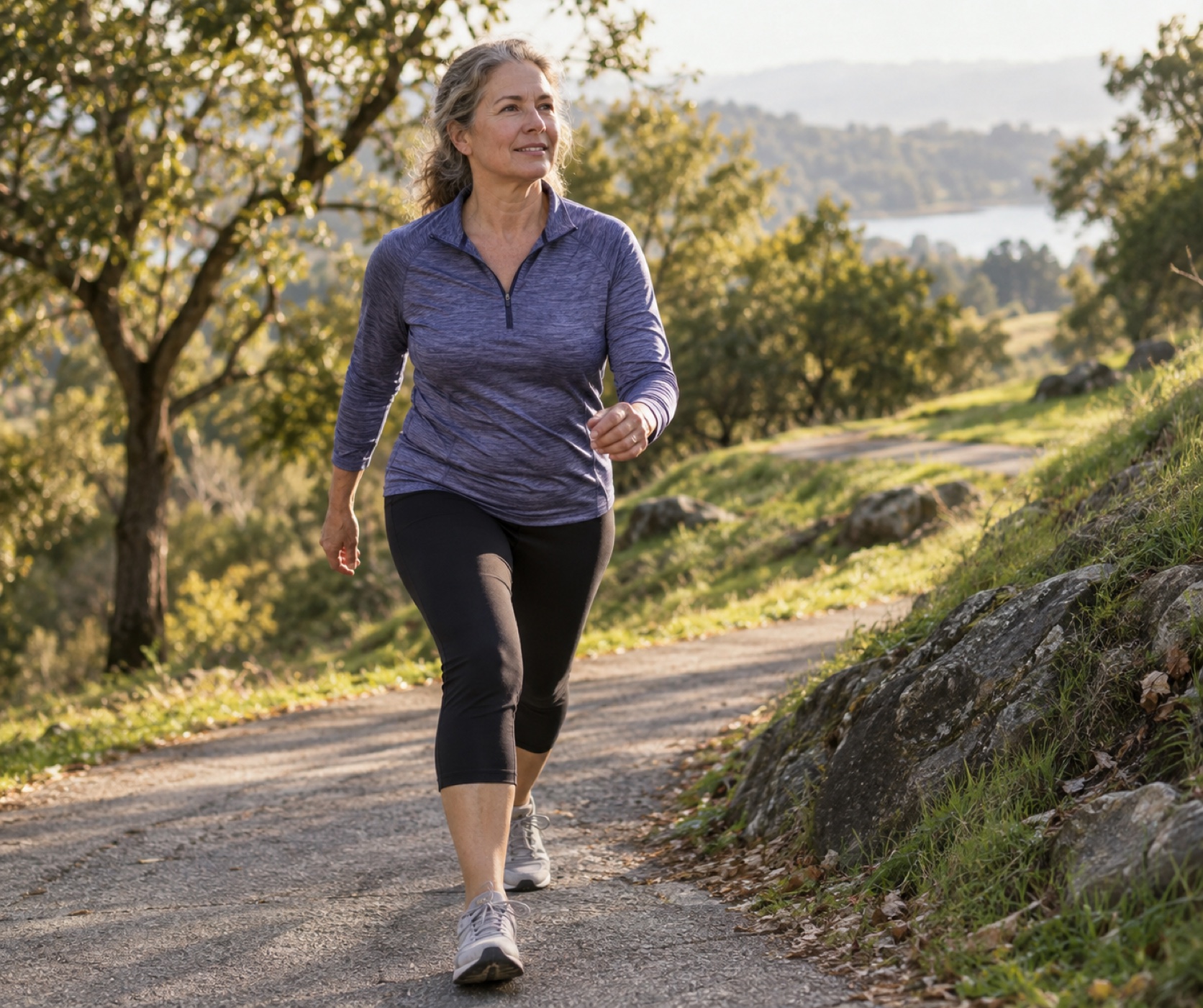
- Can walking raise it? Yes, meaningfully, if you're untrained — brisk or uphill walking can produce solid gains. Beyond a point, you need higher-intensity work to keep climbing.
- How much is genetics? Baseline fitness is substantially heritable, and training response varies too — but almost everyone can improve 10–20% from their starting point, which is what moves the health needle.
- How often should I retest? Every 3–6 months is plenty. Testing too often just measures noise — and obsessing over the number can become its own problem, the fitness cousin of the "orthosomnia" loop described in the sleep pillar.
- Does age cap me? Training response exists at every age studied. You won't out-train a 25-year-old you — but you'll decisively out-age an untrained you.
The Bottom Line
- VO₂ max is your cardiovascular ceiling — and one of the strongest mortality predictors in exercise science.
- It declines with age only if you let it. Training at 70 can produce gains like training at 40.
- Climb out of the bottom quartile first. The biggest health returns come from going low → average, not average → elite.
- Raise it with the 80/20 mix: mostly easy volume, some 4×4-style intervals, and attention to body weight.
Go Deeper: Subtopics
- 🔎 What the number measures — the Fick equation: cardiac output vs muscle oxygen extraction, in plain terms. Read it →
- 🔎 Testing without a lab — the 12-minute Cooper test, ramp tests, and what watch estimates get wrong. Read it →
- 🔎 Genetics & the ceiling — how much of VO₂ max is inherited, the age decline curve, and realistic improvement targets. Read it →
- 🔎 The mortality numbers — the famous cohort findings (e.g., low vs elite fitness quintiles) and how to read them honestly. Read it →
- 🔎 Interval prescriptions that raise it — 4×4 and its variations: the dose, frequency, and progression (links Cardio Protocol). Read it →
Related Topics
- Blair et al., "Physical fitness and all-cause mortality: a prospective study of healthy men and women," JAMA (1989)
- Myers et al., "Exercise capacity and mortality among men referred for exercise testing," New England Journal of Medicine (2002)
- Helgerud et al., "Aerobic high-intensity intervals improve VO₂ max more than moderate training," Medicine & Science in Sports & Exercise (2007)
- Fleg et al., "Accelerated longitudinal decline of aerobic capacity in healthy older adults," Circulation (2005)
- Kaminsky et al., "Reference standards for cardiorespiratory fitness," Progress in Cardiovascular Diseases (2019)