Testing Without a Lab
A lab test with a mask is the reference standard, but most people will never take one — and they don't have to. Field tests have been validated against lab values since the 1960s, and with a few standardization rules they're accurate enough to track real progress. The watch on your wrist is a different instrument entirely, and this page explains the difference.
What the evidence supports
- The Cooper 12-minute run has been validated against lab VO₂ max since 1968, with correlations around 0.9 in the validation literature.
- Walk-based tests (Rockport) and submaximal bike protocols give usable estimates for people who don't run.
- Watch estimates are systematically noisier — typically ±3–5 ml/kg/min — and are best treated as trends, not measurements.
What remains uncertain
- How well your personal estimate matches your true value — individual error can exceed the group averages by a wide margin.
- Whether the newest wearable algorithms have closed the gap; validation studies tend to lag device releases.
Evidence last reviewed: August 15, 2026. Conclusions may change as new research is published.
Why Test at All
The parent topic makes the case that a single VO₂ max value is a snapshot while three tests a year apart are a trajectory — and the trajectory is the thing worth knowing. That reframes the whole question of which test to use: the right test is the one you'll actually repeat every couple of months, under conditions you can keep constant. Perfection you never redo beats accuracy you do once.
A reasonable rhythm: test every 8–12 weeks, which is roughly how long a training block takes to move the number measurably (see the interval prescriptions page). More frequent testing mostly measures noise.
Product picks are generic categories, not brands. We may earn a commission on Amazon or iHerb purchases at no cost to you — this never changes our evidence conclusions. Full disclosure
Smart band or smartwatch
Can make activity, exercise, and routine patterns easier to notice over time.
⚠️ Step, heart-rate, and sleep estimates can be inaccurate and may encourage unhelpful over-monitoring; consumer readings are not medical diagnoses.
Check price on Amazon →The Cooper 12-Minute Run
Kenneth Cooper, a US Air Force physician, published the test in JAMA in 1968 as a mass-fitness tool for military populations: run (or walk, if you must) as far as possible in 12 minutes, then convert distance to a VO₂ max estimate. The classic formula is VO₂ max ≈ (distance in meters − 504.9) ÷ 44.73 — or in miles, (miles × 35.97) − 11.29. Validations against treadmill testing have repeatedly landed near r ≈ 0.9 in the populations studied, most recently in healthy young adults (Bandyopadhyay, Biology of Sport, 2015) — with the honest caveat that validation samples skew young and reasonably fit, so the formula's precision in older or very untrained testers is less certain.
- 🔥 Warm up properly. 10 easy minutes with a few short pickups, so the first minute of the test isn't a shock.
- 🧭 Pace evenly. The classic failure is going out too hard and fading. Aim for a pace you can hold for the full 12 minutes; your last two minutes should be the hardest.
- 📍 Use a measured loop. A 400 m track is ideal; GPS is acceptable if you always run the same course — GPS drift is part of why "same course, same watch" matters more than absolute precision.
- 🌡️ Mind the weather. Heat and wind depress distance and therefore the estimate. A sweltering test day is a bad data point, not a fitness verdict.
The Rockport One-Mile Walk Test
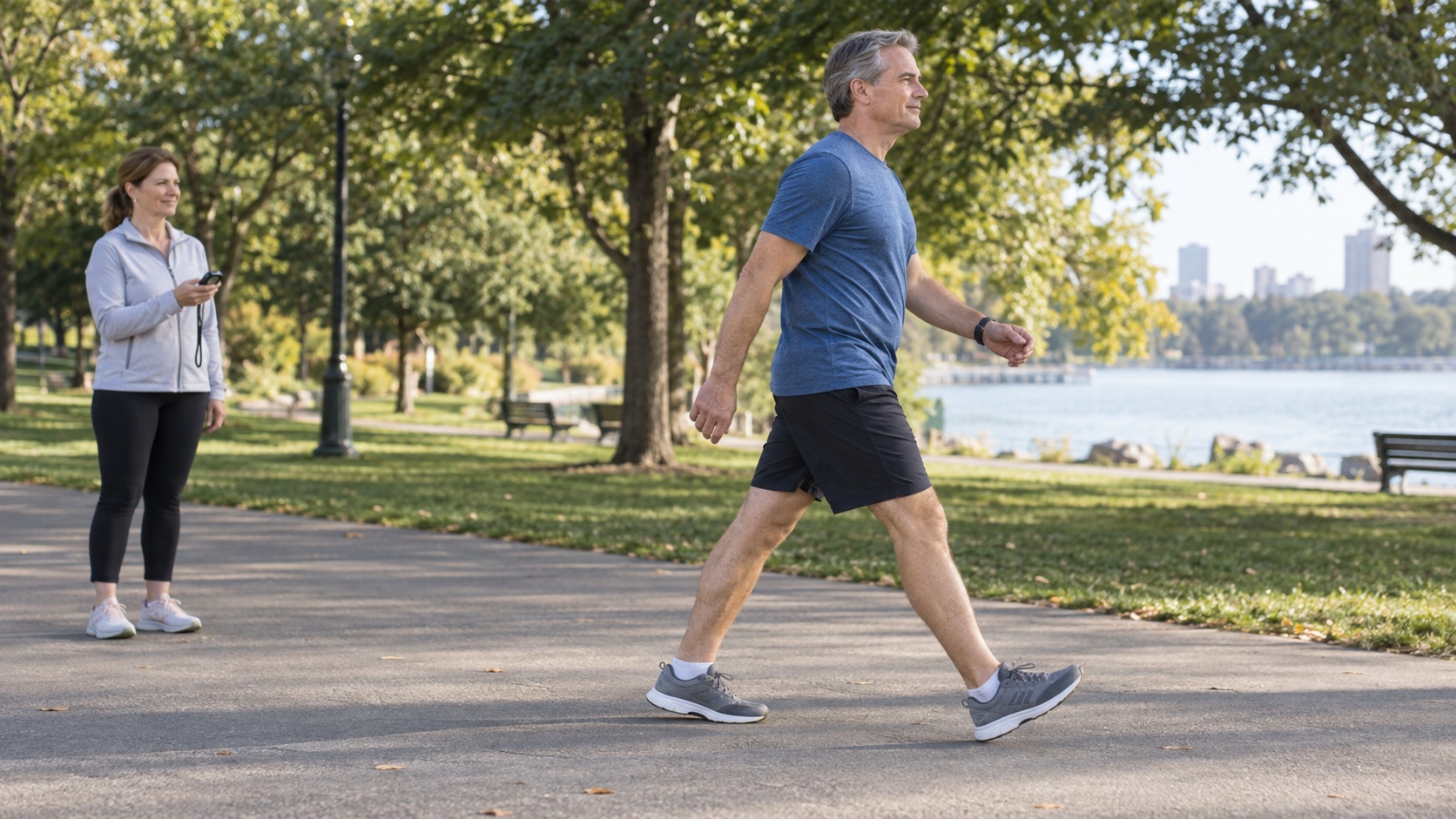
Not everyone should run, and the walking alternative has its own validation pedigree. The Rockport test, from Kline et al. (Medicine & Science in Sports & Exercise, 1987): walk one mile on a flat, measured course as fast as you can without jogging, then record your time and your heart rate at the finish. The estimating formula folds in age, sex, body weight, walk time, and finishing heart rate — roughly 133 − (0.077 × weight in pounds) − (0.39 × age) + (6.3 if male) − (3.26 × time in minutes) − (0.16 × heart rate). Its error is larger than the Cooper test's in runners — around ±4–5 ml/kg/min — and the heart-rate reading is the weak link: a chest strap beats wrist optical sensors for this purpose. For non-runners and older adults, though, it's a repeatable quarterly estimate that requires nothing but a mile and a watch.
Ramp and Submaximal Bike Protocols
Stationary bikes open a third family of tests, and they split into two species worth keeping straight:
- 🚴 Submaximal estimates. The Åstrand-Ryhming test (Journal of Applied Physiology, 1954) has you pedal a fixed, submaximal workload for six minutes, then reads your steady-state heart rate off a nomogram. It works because heart rate rises predictably with oxygen demand — but it assumes your maximal heart rate matches an age estimate, and that assumption is worth roughly ±10 beats per minute. The estimate inherits the error.
- 📈 Ramp tests. Incremental stages that climb every minute until you can't continue are maximal tests in portable form — commonly done on trainers or rowers. No max-HR assumption needed; you just need the honesty to actually reach failure.
- 📣 The beep test. Léger and Lambert's 20-meter shuttle run (European Journal of Applied Physiology, 1982) is the classic group test — run back and forth to an accelerating beep until you miss. Excellent for teams and schools; demanding on motivation and hard to standardize alone.
The principle across all of them: maximal tests measure, submaximal tests estimate. Both are legitimate; the estimate just carries assumptions you should know about.
Heart-rate chest strap
May provide more consistent exercise heart-rate feedback than wrist estimates for some users.
⚠️ Consumer readings can be wrong and should not be used to self-diagnose heart problems.
Check price on Amazon →What Watch Estimates Actually Do
Your watch does not measure VO₂ max. It watches your heart rate while you move at known speeds and asks: for this person's age and weight, what VO₂ max would make this submaximal effort look this easy? The estimate therefore inherits every error in the inputs — and the inputs are noisy. Wrist optical heart-rate sensors perform worst precisely when the algorithm needs them most, at higher intensities, and their accuracy varies with skin tone and fit (Shcherbina et al., Journal of Personalized Medicine, 2017). GPS drift, wind, and hills corrupt the speed side. The result: validation studies typically put watch estimates within ±3–5 ml/kg/min of lab values at best — enough error to flip a percentile — and the number can also move for reasons that have nothing to do with your heart: a weight edit, a stride change, a firmware update.
The honest use, then, is the trend: the same device, worn the same way, averaged over months. If your watch's number climbs 3 ml/kg/min across a season of training and holds, that's probably real. If it jumps week to week, that's probably noise. And never compare the number across brands — they're estimating with different assumptions.
Running Your Own Test Well
The difference between a useful self-test and a random number generator is standardization. Whatever method you pick, hold these constant across retests:
- 🛣️ Same course, same surface. A different loop is a different test.
- 🛌 Similar readiness. Avoid the morning after a short night or a heavy meal; don't test the day after a hard workout.
- 🌤️ Mild conditions. If it's unseasonably hot, reschedule rather than record a depressed number.
- 🗒️ Log your effort, not just your distance. A subjective 1–10 effort rating tells you whether the test was honest. Same distance at lower effort is progress.
⚠️ When to skip the self-test
A maximal self-test is a substantial cardiovascular demand. If you have known heart disease, unexplained chest pain or breathlessness, dizziness on exertion, or years of inactivity, the decision to do one is a clinician's to make — not a weekend project. Get cleared, and consider whether the testing belongs in a lab with supervision anyway.
Stationary bicycle
Offers an indoor, lower-impact way to accumulate aerobic activity.
⚠️ Fit, intensity, and medical context matter; chest pain, fainting, or concerning exertional symptoms require medical evaluation.
Check price on Amazon →Reading the Result Honestly
Whatever the method, resist two misreadings. First, don't compare your number to a friend's measured on a different instrument — cross-method comparisons mix measurement error with real differences, and part of your baseline was inherited anyway (see Genetics & the ceiling). Second, don't panic over a single disappointing result: one test is a snapshot, and the trend across three retests is the actual measurement. The Cardio protocol's testing page walks through what a lab report adds when you eventually want reference-standard numbers.
| Method | Best for | Typical error vs lab | Verdict |
|---|---|---|---|
| 🏃 Cooper 12-min run | Runners; repeated trend tracking | ~±3 ml/kg/min | Good |
| 🚶 Rockport 1-mile walk | Non-runners, older adults | ~±4–5 ml/kg/min | Moderate |
| 🚴 Submaximal bike (Åstrand) | Gym bikes; joint issues | ~±5+ ml/kg/min | Moderate |
| ⌚ Watch estimate | Long-horizon trends only | ~±3–5 ml/kg/min | Moderate |
| 🎽 Lab test (mask) | Baseline, clinical context | Reference | Good |
Questions, Answered Briefly
- 🏁 Which test should I start with? If you can run: the Cooper 12-minute test. If you can't: the Rockport walk. If you have a gym bike: a submaximal Åstrand-style protocol. Pick one, and never switch methods mid-comparison.
- 🏢 Can I use a gym treadmill? Yes — set a fixed 1% incline (flat treadmill running reads slightly easier than outdoors), keep the fan on, and use the same machine and settings every retest.
- 📱 My watch VO₂ max jumped 4 points after an update. Real? Almost certainly not. Algorithm and firmware changes move the estimate more than your heart did. Judge the watch on months, not days.
- 🌪️ How much can one bad test day distort things? Heat, a short night, or caffeine withdrawal can depress a maximal effort by several percent — enough to look like a lost training block. Retest after a normal week rather than trusting a single bad number.
The Bottom Line
- Field tests are real measurement. The Cooper run and Rockport walk carry decades of validation — they're not consolation prizes.
- Standardize everything. Same course, same conditions, same readiness; the trend across retests is the signal.
- Watches estimate, they don't measure. Expect ±3–5 ml/kg/min, ignore week-to-week jumps, and never compare across brands.
- Cardiac symptoms or disease make testing a clinician decision first. Maximal effort is a dose.
Related Topics
- Cooper, "A means of assessing maximal oxygen intake: correlation between field and treadmill testing," JAMA (1968)
- Kline et al., "Estimation of VO2max from a one-mile track walk, gender, age, and body weight," Medicine & Science in Sports & Exercise (1987)
- Åstrand & Ryhming, "A nomogram for calculation of aerobic capacity (physical fitness) from pulse rate during submaximal work," Journal of Applied Physiology (1954)
- Léger & Lambert, "A maximal multistage 20-m shuttle run test to predict VO2 max," European Journal of Applied Physiology (1982)
- Bandyopadhyay, "Validity of Cooper's 12-minute run test for estimation of maximum oxygen uptake in male university students," Biology of Sport (2015)
- Shcherbina et al., "Accuracy in wrist-worn, sensor-based measurements of heart rate and energy expenditure in a diverse cohort," Journal of Personalized Medicine (2017)