What the Number Measures
VO₂ max gets treated like a test score, but it's a flow rate — the liters of blood your heart can move per minute, multiplied by how much oxygen your muscles can pull out of that blood. The parent topic explains why the number predicts longevity; this page explains what the number actually measures, because the equation behind it is also a map of what training should change.
What the evidence supports
- The Fick equation — cardiac output times arteriovenous oxygen difference — has framed maximal oxygen uptake since 1870 and remains the field's working model.
- Stroke volume, not maximal heart rate, is the term that separates trained hearts from untrained ones.
- Training raises both sides of the equation: a larger stroke volume on one side, denser capillaries and mitochondria in muscle on the other.
What remains uncertain
- In any single person, how much of their VO₂ max is set by the heart versus the muscles — the mix differs with training state and is hard to pin down.
- Why near-elite athletes plateau: delivery and extraction become jointly limiting, and individual bottlenecks resist simple explanation.
Evidence last reviewed: August 15, 2026. Conclusions may change as new research is published.
Product picks are generic categories, not brands. We may earn a commission on Amazon or iHerb purchases at no cost to you — this never changes our evidence conclusions. Full disclosure
Smart band or smartwatch
Can make activity, exercise, and routine patterns easier to notice over time.
⚠️ Step, heart-rate, and sleep estimates can be inaccurate and may encourage unhelpful over-monitoring; consumer readings are not medical diagnoses.
Check price on Amazon →The Number Is a Flow Rate, Not a Score
VO₂ max is expressed in milliliters of oxygen consumed per kilogram of body weight per minute (ml/kg/min), and "consumed" is the operative word. The oxygen you breathe in makes a fixed journey: lungs, then hemoglobin in the blood, then a pump — the heart — pushing it through arteries into working muscle, where capillaries deliver it and mitochondria burn it. VO₂ max measures the throughput of that entire chain at full demand. A weak link anywhere — a stiff heart, thin blood, sparse capillaries — shows up as a lower number, which is precisely why the measure carries so much health information.
The chain's two big links give the equation its structure. The principle, first stated by Adolf Fick in 1870, says the oxygen you consume equals what your heart delivers multiplied by what your tissues extract: VO₂ = cardiac output × (arterial O₂ content − venous O₂ content). Cardiac output is itself heart rate × stroke volume. Everything in VO₂ max physiology is a comment on those three terms.
The Heart's Side: Cardiac Output
Maximal heart rate is the loud part of the equation and the boring part of the story: it's set mostly by age (the common estimate is 208 − 0.7 × age, from Tanaka et al., JACC, 2001), it's similar in trained and untrained people of the same age, and you cannot train it upward. The term that does the real work is stroke volume — how much blood the left ventricle ejects per beat — and that is exquisitely trainable:
- ❤️ A bigger, more elastic chamber. Years of aerobic training enlarge the left ventricle and stiffen its ejection. A trained heart may pump roughly 110–140 ml per beat at max effort against an untrained 80–100 ml.
- 🩸 More blood to pump. Training expands plasma volume modestly but meaningfully, so the same chamber works with a fuller tank.
- 💉 Hemoglobin as the delivery lever. Oxygen rides on hemoglobin, which is why altitude exposure and (illicitly) EPO move VO₂ max without touching the heart — a reminder that delivery, not just the pump, matters.
The result shows up where you'd least expect it: a trained heart idles lower at rest because each beat delivers more. The same adaptation that raises VO₂ max is what lowers resting heart rate. They're the same heart.
The Muscles' Side: Extraction
The second term — the arteriovenous oxygen difference, or a-v O₂ diff — is the amount of oxygen a given volume of blood loses on its way through muscle. At rest, tissues extract only about 4–5 ml of oxygen from every 100 ml of blood passing by; at maximal effort, working muscle is a much greedier customer, pulling out roughly 15–17 ml per 100 ml. Trained muscle is greedier still, and for structural reasons:
- 🕸️ Capillary density. Endurance training grows new capillaries around muscle fibers, shortening the distance oxygen must diffuse.
- 🔋 Mitochondrial volume. More and bigger mitochondria mean the arriving oxygen is burned faster, pulling the venous oxygen level down — the extraction term rises.
- 🧭 Blood-flow distribution. Trained muscle opens more of its capillary beds to working fibers, so delivered blood meets demand rather than bypassing it.
Where the Bottleneck Sits
The practical question the Fick equation answers is: which side should you train? The classic review by Bassett and Howley (Medicine & Science in Sports & Exercise, 2000) distilled decades of experiments into a clear picture. In untrained people, the heart is the primary limit — raise cardiac output and VO₂ max follows. In well-trained athletes, delivery and extraction are both near their limits and improvements come in small, joint increments. The training implication falls out directly: hard intervals overload the heart's stroke volume (the delivery side), while the easy aerobic work covered in the Zone 2 topic builds the capillaries and mitochondria (the extraction side). Both sides of the equation are trainable; they just need different stresses.
⚖️ The denominator: your body weight
The number is per kilogram, which means the scale is a silent third lever. Lose fat and your VO₂ max rises even if your heart changes not at all — same absolute oxygen consumption, smaller denominator. That's why fitness and body composition can't be separated on paper, even though they're different levers in life.
Why an Equation Makes a Good Longevity Test
Most clinical tests look at one organ. VO₂ max is unusual because the Fick equation forces the heart, lungs, blood, vessels, and muscle mitochondria to perform together — any underperformer drags the number down. That integration is the likely reason the number tracks all-cause mortality so closely in the cohort studies dissected on the mortality numbers page. A heart with margin is a summary statistic for a resilient cardiovascular system.
Two honest limits. First, the measurement is a snapshot: a single maximal test reflects the day it was taken — sleep, heat, motivation, and pacing all move it by a few percent, which is why retesting matters more than any single value. Second, a high number is capacity, not virtue: it doesn't offset smoking or bad blood lipids. It's the strongest single physiological summary of your aerobic system — not a clean bill of health.
What the Number Doesn't Measure
- 🫁 It isn't lung capacity. In healthy people at sea level, ventilation almost never limits performance — the lungs have reserve. VO₂ max tests the transport chain, not the bellows.
- 🚗 It isn't economy. Two runners with identical VO₂ max can be minutes apart over 10 km, because economy — how much oxygen each stride costs — varies independently. Capacity and efficiency are different traits.
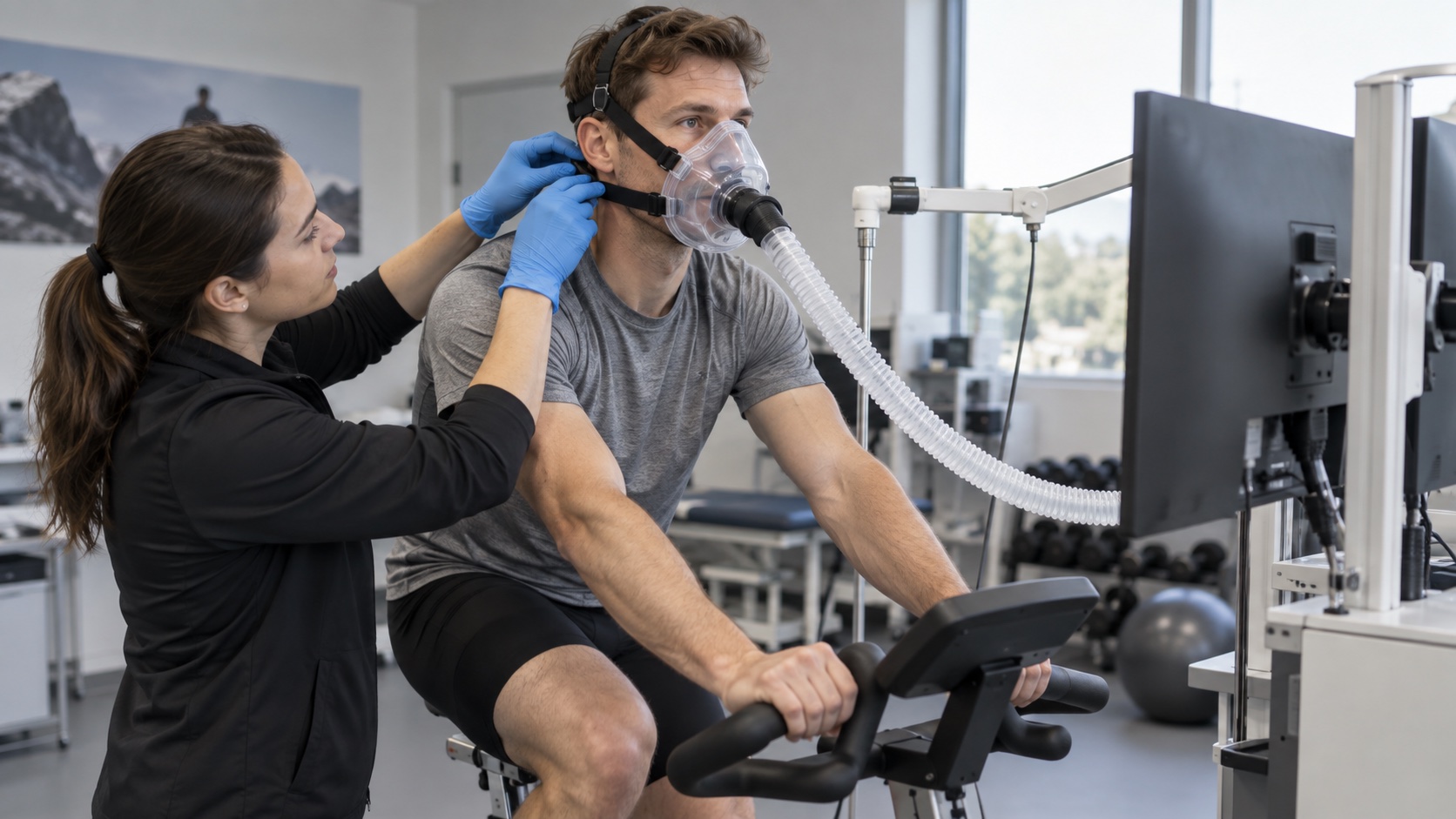
- 🧠 It isn't willpower. A maximal test measures what the chain can do when driven to the limit; it can't tell you whether the person being tested actually reached theirs. That's a measurement problem the field tests page takes seriously.
The Number in a Table
| Link in the chain | Untrained adult | Trained adult | What moves it |
|---|---|---|---|
| 🫀 Max cardiac output (L/min) | ~15–20 | ~25–30 | Chamber growth + blood volume (stroke volume) |
| ❤️ Stroke volume (ml/beat, max) | ~80–100 | ~110–140 | Years of aerobic training |
| 🩸 a-v O₂ difference (ml/100 ml) | ~14–15 | ~16–17 | Capillary + mitochondrial density |
| 💓 Max heart rate (beats/min, age 40) | ~180 | ~180 | Almost nothing — age, not training |
Two People, Same Number, Different Hearts
Because the equation multiplies two terms, the same final number can hide different machines. Take two people who both measure 40 ml/kg/min. One gets there with a big heart and average extraction — a large stroke volume doing the heavy lifting. The other has an ordinary heart and exceptional extraction — muscle so dense with capillaries and mitochondria that it wrings every last milliliter from the blood it receives. A standard lab report cannot tell them apart; only component measurements can. Why it matters: the two bodies need different training. The first gains more from the sustained cardiac load of intervals; the second has nearly maxed the extraction side and needs to grow the pump. In practice you rarely know which type you are — which is the argument for training both sides of the equation across the week rather than betting on a single mechanism.
Questions, Answered Briefly
- 💗 Does a lower resting heart rate mean a higher VO₂ max? Directionally, often — a bigger stroke volume lets the heart idle lower. But resting heart rate also reflects sleep, stress, caffeine, and temperature, so it's a weak proxy. The number itself requires a maximal test.
- ⚖️ Is per-kilogram scoring unfair to bigger people? It's the standard because oxygen must move a body. In absolute terms (L/min), larger people often score higher; the per-kilogram form is the one that predicts health across body sizes.
- 🫁 Can lungs ever be the limit? Rarely in healthy people at sea level — pulmonary reserve is large. Some elite athletes approach ventilatory limits at maximal effort, but for most of us the lungs are spectators.
- 🧪 Can I measure my own components? Not without equipment. What you can feel: intervals that leave you gasping are loading the pump; long easy sessions that leave you warm and able to talk are building the extraction side.
The Bottom Line
- VO₂ max is a flow rate: cardiac output multiplied by oxygen extraction — one pump, two inputs.
- Stroke volume is the trainable heart term; maximal heart rate is mostly age and won't budge.
- Zone 2 builds the extraction side; intervals build the pumping side. Training both is training the whole equation.
- The number integrates your entire oxygen chain — which is exactly why it predicts longevity so well.
Related Topics
- Bassett & Howley, "Limiting factors for maximum oxygen uptake and determinants of endurance performance," Medicine & Science in Sports & Exercise (2000)
- Levine, "VO2max: what do we know, and what do we still need to know?" Journal of Physiology (2008)
- Joyner & Coyle, "Endurance exercise performance: the physiology of champions," Journal of Physiology (2008)
- Ekblom & Hermansen, "Cardiac output in athletes," Journal of Applied Physiology (1968)
- Tanaka et al., "Age-predicted maximal heart rate revisited," Journal of the American College of Cardiology (2001)