Balance as a trainable system
Balance feels like something you either have or you don't — until you see how fast a few weeks of practice moves the needle. The parent topic sketched the ladder's top rungs; this page builds the whole staircase, rung by rung, with the numbers that tell you where you stand.
What the evidence supports
- Balance training produces large, fast improvements on balance tasks at any age (Lesinski et al., Sports Medicine, 2015).
- Single-leg stance time declines steadily across the adult decades — published norms exist (Springer et al., Journal of Geriatric Physical Therapy, 2007).
- Gains are task-specific: you improve most on the exact challenges you practice (Kümmel et al., Sports Medicine, 2016).
What remains uncertain
- How much balance-task gain converts into fewer falls depends on program content and dose — transfer is not automatic.
- No single progression scheme (sets, reps, progression rate) is established as standard across populations.
- Dual-task training's added value for real-world falls is suggestive but supported by fewer trials.
Evidence last reviewed: August 15, 2026. Conclusions may change as new research is published.
Product picks are generic categories, not brands. We may earn a commission on Amazon or iHerb purchases at no cost to you — this never changes our evidence conclusions. Full disclosure
Non-slip exercise or yoga mat
Provides a stable, comfortable surface for mobility or floor-based exercise.
⚠️ None expected; it does not treat pain or replace injury-specific care.
Check price on Amazon →Balance Is a Skill, Not a Muscle
Balance training works because it targets the nervous system, and the nervous system adapts quickly when challenged daily. The three input systems — vision, inner ear, and the proprioceptors in muscles and joints — don't improve much on their own; what improves is the brain's ability to weight them, notice drift early, and fire corrections in time. That weighting is a learned skill, and it behaves like one: it responds to frequency, it plateaus without progressive challenge, and it decays when unused.
The practical reading of the training literature: programs of roughly 30–45 minutes, two to three times weekly, produce meaningful gains on balance tests within weeks in healthy older adults, with large pooled effect sizes across dozens of trials (Lesinski et al., 2015). Older adults gain about as much as younger ones when training dose is matched — age makes the starting point lower, not the ceiling. In one systematic review of healthy adults, training on unstable surfaces improved balance performance with a large effect, while the same review found little transfer to strength or jumping (Kümmel et al., 2016). You get what you practice.
Underneath all of this sits one mechanism worth naming: sensory reweighting. When the ground is uneven or the lights go out, the brain must rapidly shift how much it trusts each input — less vision, more inner ear, more proprioception — and aging slows that shift. Balance practice is, in large part, reweighting practice: every eyes-closed hold and soft-surface stance teaches the system to swap inputs faster. That is why the same drill that feels silly at 50 is the skill that catches you at 80.
The Full Ladder, Rung by Rung
Every balance progression is a negotiation with two levers: base of support (how much foot you have on the ground) and sensory demand (how much the brain must rely on inner-ear and proprioceptive input instead of eyes and hands). The ladder below moves both levers in small steps. Spend a week or two on a rung; move up when you can hold it calmly, not when you can survive it.
| Rung | Position | Why it's harder | Ready when… |
|---|---|---|---|
| 1 | Two feet, feet together, eyes open | Narrows the base without leaving it | 60 seconds, no sway or grab |
| 2 | Semi-tandem — heel of one foot at arch of the other | Front-to-back support shrinks | 30 seconds each lead foot |
| 3 | Full tandem — heel to toe, in line | Base is now a single line | 30 seconds, steady gaze |
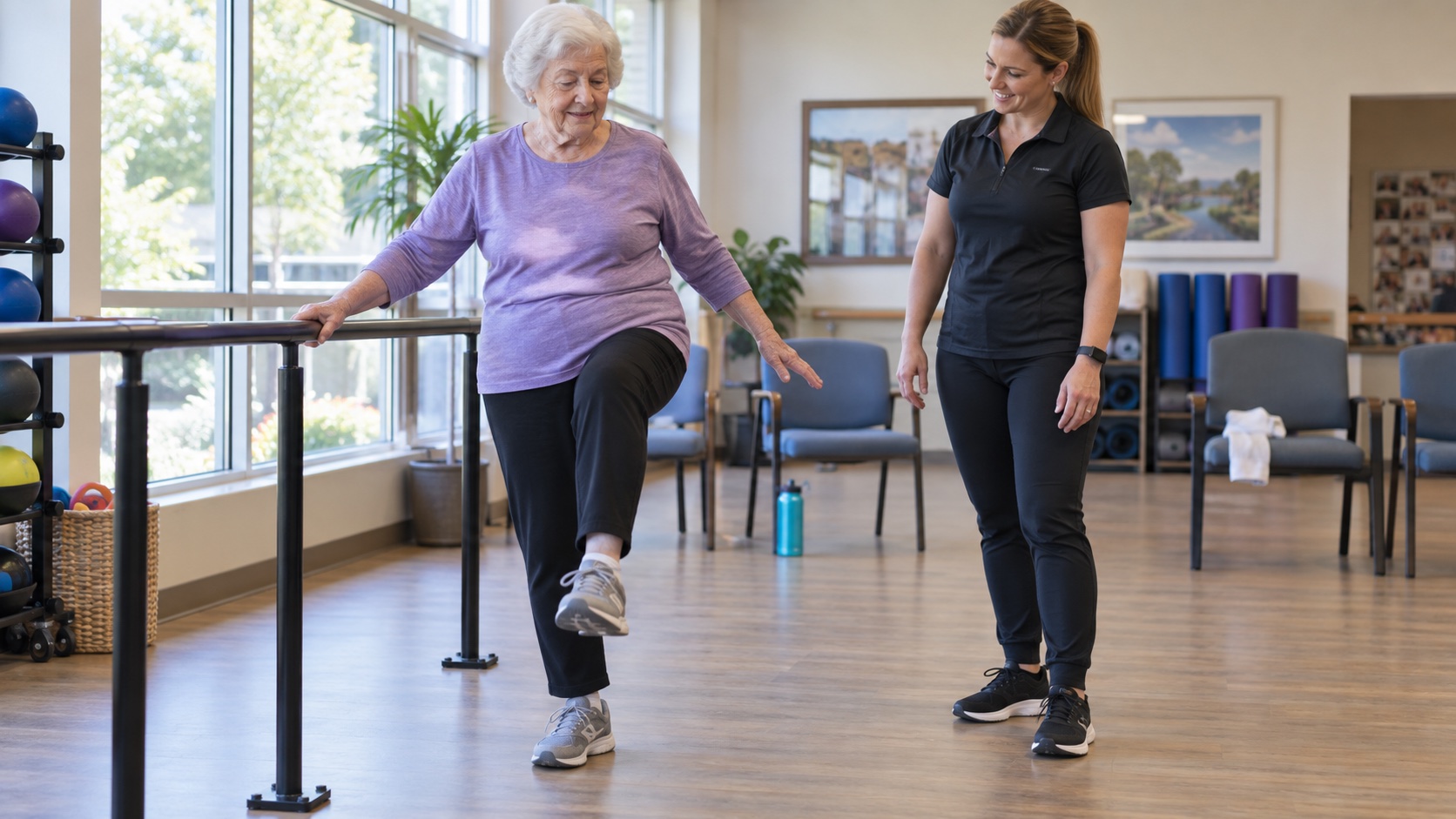
| 4 | Single leg, arms free, eyes open | Half the base is gone entirely | 30+ seconds each side |
| 5 | Single leg on a soft surface — cushion or folded towel | Proprioception gets noisy, fuzzier signals | 20–30 seconds each side |
| 6 | Single leg, eyes closed, near a wall | Vision removed; inner ear and proprioception must carry the load | Any consistent 10-second hold |
| 7 | Dynamic — tandem walking, turning, stepping over low obstacles | Balance must survive movement, the actual real-world demand | Rung 4 is easy; add rung 7 as the moving version |
Two notes. First, rung 6 is a different animal from rungs 1–5: eyes-closed work multiplies demand, so always practice it beside a wall or counter. Second, the ladder's top is not a stunt — it's dynamic work: walking a line, turning in place, stepping over a rolled towel while carrying something. That is where the falls evidence points, because it is where real falls happen.
What Normal Looks Like, Decade by Decade
The most useful reference set for single-leg stance comes from Springer and colleagues (2007), who timed adults without balance disorders across six age bands. The typical values, eyes open:
| Age band | Typical single-leg time (eyes open) | Practical read |
|---|---|---|
| 18–39 | ~43 seconds | Young baseline — under 30 seconds here is worth investigating |
| 40–49 | ~40 seconds | Nearly unchanged |
| 50–59 | ~38 seconds | The slow slide begins |
| 60–69 | ~27 seconds | Loss accelerates |
| 70–79 | ~18 seconds | Below the 10-second threshold that predicted mortality in the 2022 analysis |
| 80–99 | ~9 seconds | On average, under the survival threshold — and improvable with practice |
Eyes closed, the same study recorded far shorter times — a few seconds for most adults, dropping to one or two in the oldest bands. That gap between eyes-open and eyes-closed performance is the training opportunity: closing your eyes in practice recruits exactly the non-visual systems that must catch you in the dark or on ice.
Smart band or smartwatch
Can make activity, exercise, and routine patterns easier to notice over time.
⚠️ Step, heart-rate, and sleep estimates can be inaccurate and may encourage unhelpful over-monitoring; consumer readings are not medical diagnoses.
Check price on Amazon →Why Gains Don't Automatically Transfer
The specificity finding deserves emphasis because it breaks the common assumption that "doing balance work" is one thing. In Kümmel and colleagues' 2016 meta-analysis, balance training improved balance tasks with a large effect, but transfer to strength, jumping, and sprinting was close to nil — and even between different balance tasks, improvement was only partial. The training effect is real and it is narrow.
- 🎯 Train the task you need. If the goal is stair safety, practice stepping; if it's walking on uneven ground, practice on uneven ground. Static single-leg stance is the gateway, not the destination.
- 🔄 Rotate challenges. Because transfer is partial, a varied menu — tandem, soft surface, eyes closed, dynamic — covers more real-world ground than perfecting one drill.
- 🏋️ Pair with strength. Balance is the control system; leg strength is the engine that executes the catch. The two together is what the fall-prevention trials tested.
Dual-Tasking: The Real-World Skill
Most falls don't happen while standing still and concentrating — they happen while walking and talking, carrying groceries, or looking at a phone. Training balance while doing something else has its own small evidence base: a randomized trial in older adults found that adding a cognitive task during balance training improved balance under dual-task conditions more than training balance alone (Silsupadol et al., Archives of Physical Medicine and Rehabilitation, 2009).
The takeaway for practice is simple: once steady walking is comfortable, add a second demand — count backwards by sevens, name cities alphabetically, carry a glass of water. Start with the cognitive task seated or while standing still, then add it to walking. The skill being built is keeping balance automatic when attention is elsewhere, which is the actual demand of a busy hallway.
⚠️ Progress by removing a sense, not by adding danger
The honest progression rule: make balance harder by narrowing the base, softening the surface, or closing the eyes — never by practicing near sharp furniture or without something sturdy in reach. Recurrent falls, dizziness, or a sudden change in balance are clinician territory: they can signal vestibular, neurological, blood-pressure, or medication problems that no exercise program addresses.
Programming the Practice
- 📅 Frequency beats volume. Ten minutes of ladder work most days beats an hour on weekends — the nervous system consolidates frequent, fresh practice.
- 📈 Progress by difficulty, not duration. Holding rung 4 for five minutes adds little; spending five minutes across rungs 4, 5, and 6 adds a lot.
- 🧱 Stack it on existing habits. The daily routine page reserves its final minute for exactly one balance task — a natural home for the ladder.
- 📊 Re-test quarterly. Time your single-leg hold monthly and track it; the hidden vital signs topic covers the full battery and its thresholds.
Questions, Answered Briefly
- 🕰️ How long until I notice improvement? Most training studies run six to twelve weeks and see measurable gains within that window; in daily practice, people typically notice steadier one-leg holds within two to four weeks.
- 🦶 Is it better to practice barefoot or in shoes? Either works. Barefoot or in socks gives the proprioceptors richer input and is worth adding to rungs 4 and 5 if the floor is safe; shoes are fine for everything dynamic.
- 🚶 My balance is fine — do I still need the ladder? Balance is use-it-or-lose-it. The question is whether you can still do the ladder in twenty years; the way to guarantee it is to never fully stop.
The Bottom Line
- Balance is a trainable nervous-system skill — gains come in weeks, at every age, and decay without practice.
- Use the full ladder — two-leg stance through eyes-closed single-leg work to dynamic, dual-task movement — and progress by difficulty, not duration.
- Expect task-specific gains — train the challenges you'll actually face, and pair balance with strength for the complete fall-prevention package.
- Track against norms — typical eyes-open single-leg time falls from ~43 seconds at 30 to ~9 seconds at 85; your job is to hold your decade's line or climb one.
Related Topics
- Springer et al., "Normative values for the unipedal stance test with eyes open and closed," Journal of Geriatric Physical Therapy (2007)
- Lesinski et al., "Effects of balance training on balance performance in healthy older adults: a systematic review and meta-analysis," Sports Medicine (2015)
- Kümmel et al., "Specificity of balance training in healthy individuals: a systematic review and meta-analysis," Sports Medicine (2016)
- Silsupadol et al., "Effects of single-task versus dual-task training on balance performance in older adults: a double-blind, randomized controlled trial," Archives of Physical Medicine and Rehabilitation (2009)
- Sherrington et al., "Exercise for preventing falls in older people living in the community," Cochrane Database of Systematic Reviews (2019)
- Araujo et al., "Successful 10-second one-legged stance performance predicts survival in middle-aged and older individuals," British Journal of Sports Medicine (2022)