The mobility–stability spectrum
"Stretch everything" is bad advice, because some joints are built to move and others are built to brace. This page maps the spectrum — which joints owe you range, which owe you stiffness — and what happens when a joint plays the wrong role.
What the evidence supports
- Joints differ structurally — ball-and-socket hips and shoulders have inherently more range than hinge knees.
- Age-related loss of active range at the hip is measurable and progressive (Roach & Miles, Physical Therapy, 1991).
- Coordinated trunk-muscle activation contributes to lumbar spine stability (Cholewicki & McGill, Clinical Biomechanics, 1996; McGill et al., 2003).
What remains uncertain
- The "joint-by-joint" table itself is a coaching heuristic, not a validated taxonomy — its specific prescriptions have only indirect support.
- Whether targeted mobility work prevents injury in healthy adults is unproven in trials.
- There is no agreed threshold for "adequate" ankle dorsiflexion or hip extension.
Evidence last reviewed: August 15, 2026. Conclusions may change as new research is published.
A Coaching Model, Not a Law of Nature
The joint-by-joint idea comes from coaches Mike Boyle and Gray Cook: looking at the body from the ground up, the joints alternate — mobile ankle, stable knee, mobile hip, stable lumbar spine, mobile thoracic spine, stable shoulder blade, mobile shoulder. When a "mobile" joint goes stiff, the neighboring "stable" joint gets asked to move, and problems follow: a stiff ankle makes the knee absorb motion it wasn't designed for, and a stiff hip makes the lumbar spine flex under load. Cook's Movement (2010) popularized the framework; it has since become standard coaching language.
What deserves the honest caveat: this is a practical model, not a finding of a trial. Nobody has randomized people to "train the joint-by-joint way" and counted injuries. What the model rests on is anatomy and biomechanics — hinge joints with ligament boxes versus ball-and-socket joints with open capsules — plus decades of clinical pattern recognition. Use it as a map, not a scripture.
Product picks are generic categories, not brands. We may earn a commission on Amazon or iHerb purchases at no cost to you — this never changes our evidence conclusions. Full disclosure
Smart band or smartwatch
Can make activity, exercise, and routine patterns easier to notice over time.
⚠️ Step, heart-rate, and sleep estimates can be inaccurate and may encourage unhelpful over-monitoring; consumer readings are not medical diagnoses.
Check price on Amazon →The Spectrum, Joint by Joint
| Joint | Structure | Default job | The typical failure pattern |
|---|---|---|---|
| 🦶 Ankle | Hinge | Mobility — dorsiflexion carries you over your foot | Stiff from heeled shoes and sitting; the knee and hip pay for it |
| 🦵 Knee | Hinge with ligament box | Stability — a controlled door hinge between two mobile joints | Asked to twist and slide when ankle or hip range runs out |
| 🍑 Hip | Ball-and-socket | Mobility in all directions — flexion, extension, rotation | Frozen by sitting; the lumbar spine flexes in its place |
| 🪑 Lumbar spine | Stacked segments | Stability — force transfer between upper and lower body | Over-mobile under load, especially rounded under weight |
| 🎽 Thoracic spine | Segments with ribs | Mobility — rotation and extension | Stiff from screens; shoulder and neck take the slack |
| 💪 Shoulder | Ball-and-socket, shallow socket | Mobility with dynamic stability — range you can control | Loose without control when the shoulder blade doesn't anchor it |
Why the Model Says What It Says
The knee's default job follows from its anatomy: a hinge wrapped in cruciate and collateral ligaments, sandwiched between the two joints with the most range in the lower body. When the ankle can't dorsiflex, the knee translates and twists to make up the missing centimeters; when the hip can't rotate, the knee twists instead. The knee isn't fragile — it's being asked to do two jobs at once. The fix is usually upstream: restore ankle and hip range, and the knee gets to be a hinge again.
The lumbar spine's default job — stability — has actual mechanics behind it. Cholewicki and McGill's work in the 1990s showed that the lumbar spine relies on coordinated muscle co-contraction for its stiffness, and that repeated full flexion under load stresses the discs. Later work mapped the specific coordination patterns (McGill et al., 2003). This is why the model prescribes anti-movement strength — holding a neutral spine against forces trying to bend, extend, or rotate it — rather than stretching the lower back. If your hips can hinge, your lumbar spine rarely needs to bend under load at all.
The honest counterpoint: the model is often sold too rigidly. A spine that can flex, extend, and rotate comfortably through full range is normal and healthy — spines bend every day. The principle is about load: rounded, repeated, loaded flexion is where the risk concentrates, while unloaded movement variety is generally welcome. The myths page unpacks where the stretching-and-flexibility advice genuinely fails and where it survives.
The shoulder completes the pattern with a twist: it is a mobility joint that needs dynamic stability — the socket is shallow, so the surrounding muscles must hold the ball in place while the arm travels. When the thoracic spine stiffens, the shoulder blade loses its platform and the shoulder is asked to produce range it never owned, which is the classic recipe for impingement and strain. The chain runs all the way up: hip drives lumbar, lumbar drives thorax, thorax drives shoulder. Fixing any joint means fixing the one below it.
Adjustable dumbbells
Allows progressive loading at home across common strength movements.
⚠️ Poor technique or rapid load increases raise injury risk; not required to begin moving more.
Check price on Amazon →Two Free Screens, Five Minutes
- 🦶 The knee-to-wall test. Toes four inches from a wall, knee tracking over the toes — touch the wall without the heel lifting. Under 10 centimeters of toe-to-wall distance is a common coaching flag for ankle dorsiflexion debt. Repeat monthly.
- 🍑 The hip hinge check. Stand a fist's width from a wall behind you. Push the hips back and touch the wall with your glutes while keeping your back neutral and knees soft. If you must round the spine to get there, your hips aren't doing their hinge job.
- 🎽 The thoracic rotation check. Sitting, knees together, arms crossed, rotate the torso each way. Roughly 45 degrees each direction without the hips turning is the ballpark; less, and the neck and lower back will be asked to compensate in daily life.
None of these screens is a medical test — they are starting points for noticing which end of the spectrum you should train first. A physical therapist can measure the same ranges properly if pain or big asymmetries show up.
The Hip's Three Jobs
The hip is the spectrum's centerpiece, and it has three distinct ranges that all matter for daily life — which is why "hip mobility" as a single number misleads:
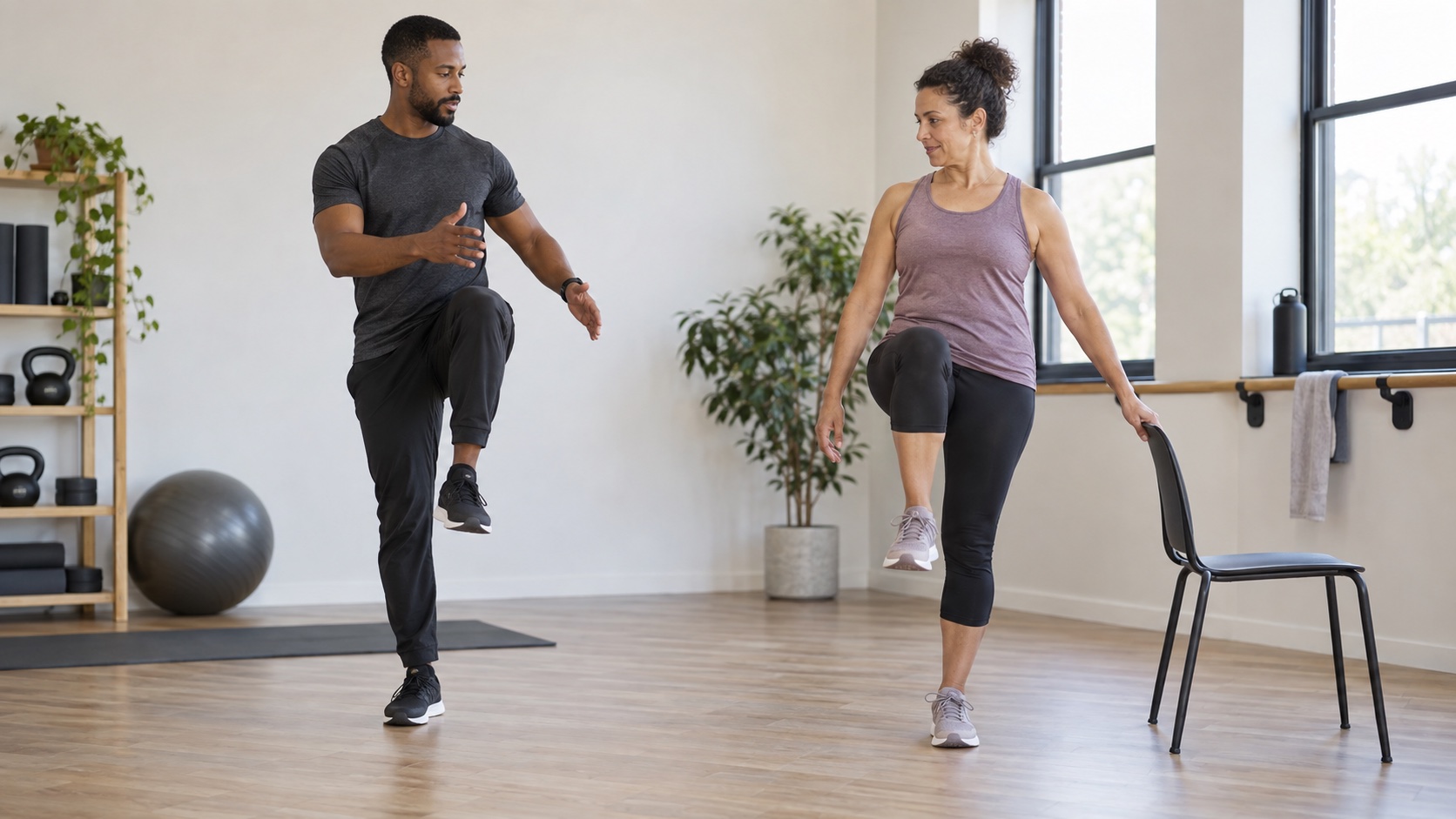
- 🪜 Flexion — lifting the knee toward the chest. Needed for stairs, squatting, and getting up from the floor. Trained by deep squats and slow knee lifts.
- 🚶 Extension — driving the leg behind the body. Needed for every walking stride. Trained by lunges and opening the front of the hip at the back of the stride.
- 🌀 Rotation — turning the thigh inward and outward. Needed for turning, balance corrections, and comfortable sitting. Trained by hip circles and gentle rotational work.
🎯 A stiff joint is usually the next joint's problem
When something hurts, the pain is rarely where the debt is. A sore knee often sits below a stiff ankle or hip; a sore neck often sits above a stiff thoracic spine. Before strengthening the painful joint, check the neighbors' range — that single habit redirects a lot of wasted training.
Resistance bands
A low-space way to begin or supplement resistance training.
⚠️ Bands can snap and unstable anchoring can cause injury; stop movements that provoke pain.
Check price on Amazon →Training Both Ends of the Spectrum
- 🦶 For the mobile joints: frequent, controlled movement through full range — ankle circles, deep squats, hip hinges, thoracic rotations — daily beats weekly. This is the ten-minute routine's whole premise.
- 🔩 For the stable joints: anti-movement strength — side planks, dead bugs, bird dogs, pallof presses — so the lumbar spine and knee hold position while force moves around them. The progressive overload protocol covers dosing.
- ⚖️ Range you can control is the goal. Passive flexibility without strength at the end range is exactly what the model warns about — the hypermobile person who folds easily but can't hold position. Train control through range, not range alone.
- 🧭 Re-screen quarterly. The same five-minute screens that flagged a stiff joint will tell you whether the training is working. Numbers beat feelings here.
Where the Model Meets Age
The age connection is why this spectrum belongs in a longevity site. Roach and Miles (1991) measured hip and knee active range across the adult lifespan and found a steady, significant decline at the hip with each passing decade — a statistical average, not a sentence. The decline tracks disuse more than destiny, and the same logic applies to every "mobile" joint on the list: range you stop using, you slowly stop owning. The balance ladder and the daily routine are the counter-program; the spectrum is the map that tells you which joints each dose of practice should prioritize. Keep the hips and ankles moving, the knees and lumbar braced, and the body keeps doing what it was designed to do — with the stiffness exactly where it belongs.
Questions, Answered Briefly
- 🤸 I'm hypermobile — does the spectrum apply in reverse? Yes, mostly: people who fold easily usually need more stability work (anti-movement strength) and less stretching — the model's stable joints become the priority.
- 💪 Can strength training really substitute for stretching? For range of motion, yes — full-range strength work improves flexibility comparably to stretching while adding control. For specific stubborn spots, a little targeted stretching still earns its place.
- 📏 How do I know which end to train? The screens answer it. Failing the knee-to-wall or hinge check says mobility; wobbling or pain under load says stability. Re-test monthly and let the weaker end set the agenda.
The Bottom Line
- Joints are not interchangeable — ankles, hips, and the thoracic spine need range; knees and the lumbar spine need controlled stiffness.
- The joint-by-joint model is a map, not a verdict — anatomy and biomechanics support it, but it has never been validated as an injury-prevention program in trials.
- Pain is usually one joint upstream — screen the neighbors (knee-to-wall, hip hinge, thoracic rotation) before training the painful spot.
- Train both ends — daily range work for the mobile joints, anti-movement strength for the stable ones, and re-screen quarterly to see which end is winning.
Related Topics
- Cook, Movement: Functional Movement Systems (2010)
- Boyle, Advances in Functional Training (2010)
- Roach & Miles, "Normal hip and knee active range of motion: the relationship to age," Physical Therapy (1991)
- Cholewicki & McGill, "Mechanical stability of the in vivo lumbar spine: implications for injury and chronic low back pain," Clinical Biomechanics (1996)
- McGill et al., "Coordination of muscle activity to assure stability of the lumbar spine," Journal of Electromyography and Kinesiology (2003)