Sleep Position & Side-Sleeping
One of this field's most-cited findings is also one of its most fragile: rats lying on their sides cleared a tracer from their brains faster than rats on their backs or stomachs. The study is real, the effect was real in those animals — and the jump to "sleep on your side to protect your brain" runs ahead of the evidence. This page separates the rodent finding from the human caution, then points at where position genuinely matters for people: the airway.
What the evidence supports
- In anesthetized rodents, the lateral (side) position cleared a cerebrospinal fluid tracer faster than supine or prone (Journal of Neuroscience, 2015).
- Supine sleeping worsens obstructive sleep apnea in a large share of patients — a real, human, airway-mediated effect.
- Side-sleeping is free, carries little downside for most people, and is the position most people already default to.
What remains uncertain
- The rodent position study used anesthesia — a state that itself boosts glymphatic flow — so the waking translation is unknown.
- No human study has measured brain clearance by sleep position; the human evidence is indirect at best.
- Whether position differences would persist in natural human sleep, or matter for long-term brain health, is untested.
Evidence last reviewed: August 15, 2026. Conclusions may change as new research is published.
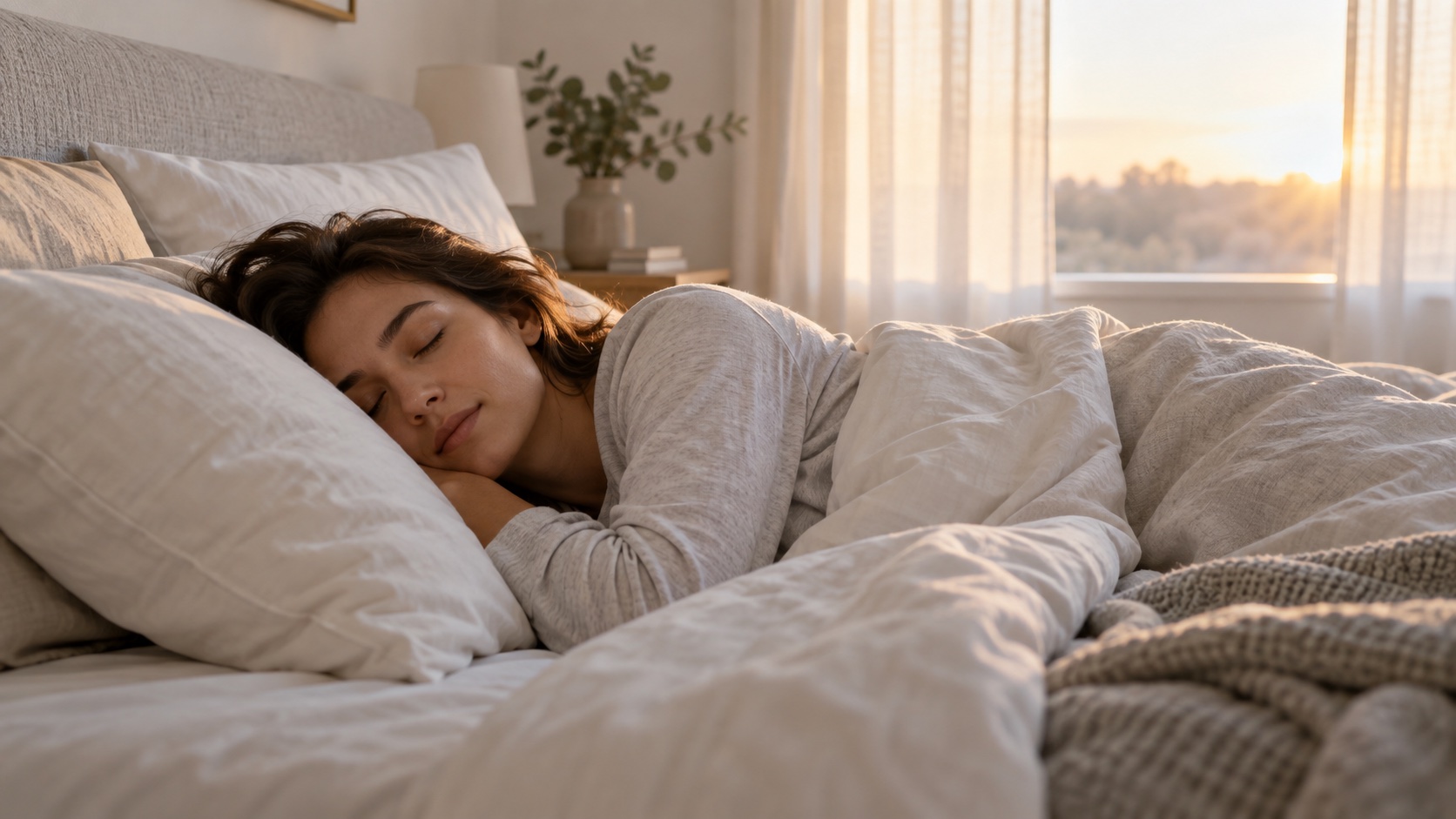
Why Position Could Matter at All
The idea is not absurd on its face. Cerebrospinal fluid flows along blood vessels and drains through the neck, and body posture shifts intracranial pressure, venous return, and the geometry of those corridors. If gravity and vessel position shape flow — and they plausibly do — then sleeping position could nudge the wash cycle's efficiency. Plausibility, though, is not evidence. A mechanism can be mechanically reasonable and still contribute nothing measurable in a living human — and this particular mechanism has to work through a system whose drivers are already contested. The test of the idea, when it finally came, was in rodents — and it carries asterisks this page will not hide.
The Rat Study That Started It
In 2015, Lee and colleagues anesthetized rats, injected a contrast tracer into their cerebrospinal fluid, and scanned the brain in three body positions: lateral (on the side), supine (on the back), and prone (on the stomach). The lateral position cleared the tracer fastest, supine was intermediate, and prone was slowest (Journal of Neuroscience, 2015). The authors' interpretation was intuitive: lateral sleep is the natural posture for many mammals, and the position may align the brain's drainage routes with gravity and the routes CSF takes out through the neck.
The Anesthesia Asterisk
The catch is in the methods, and it is a large one. The rats were anesthetized — and anesthesia is precisely the state that supercharges the glymphatic machinery being measured: the foundational 2012 experiments found cerebrospinal fluid influx rose about 95% under anesthesia versus wakefulness. A position effect demonstrated inside an artificially amplified system may shrink or vanish in natural sleep, where flow runs at physiological levels. Add the species gap — rat brains are small and smooth, human brains are large and deeply folded — and the honest reading is that the 2015 study proved the question is interesting, not that the answer applies to your bed. The parent topic flags exactly this: position data is interesting, preliminary, and free to adopt — not a headline intervention.
The Human Evidence, Such As It Is
In humans, the direct measurement simply has not been done. No study has imaged glymphatic clearance in the same person across positions, and the indirect evidence is thin. The closest human signal comes from Levendowski and colleagues, who found that older adults with mild cognitive impairment who spent more of the night supine showed worse cognitive and neurodegeneration markers (Journal of Alzheimer's Disease, 2019) — an association that cannot separate cause from effect, since sicker brains may simply be stuck in a position for reasons unrelated to drainage. Here is the position ledger, stated as plainly as the evidence allows.
| Position | What the evidence actually says | Read |
|---|---|---|
| 🛌 Lateral (side) | Fastest rodent clearance (anesthetized); the comfortable default most people already use; improves the airway in position-dependent apnea | Best available |
| 🧍 Supine (back) | Slower rodent clearance; worsens apnea in roughly half of patients — the human-relevant risk | Caution in apnea |
| 🙇 Prone (stomach) | Slowest rodent clearance; rare in adult humans; neck strain argues against it independently | Not recommended |
| 😮💨 Any position, untreated apnea | Position engineering cannot fix nightly oxygen drops — the real clearance threat regardless of posture | Screen instead |
Where Position Definitely Matters: The Airway
There is a human position finding that holds up, and it runs through breathing, not plumbing. In a large share of sleep apnea patients — roughly half, varying by study — the airway collapses specifically in the supine position, and moving to the side measurably improves the apnea-hypopnea index (Ravesloot et al., Sleep Medicine Reviews, 2013). Since apnea is the clearest threat to the wash cycle the next page documents, side-sleeping earns its keep in humans through the airway: it keeps oxygen flowing, which keeps sleep continuous, which keeps clearance running. The full diagnosis-and-treatment picture belongs to the Sleep pillar's apnea topic.
If You Want to Try Side-Sleeping
The intervention is free, and for most people the downside is trivial. A few practical notes for anyone who wants to run the experiment:
- 🛏️ Keep the spine neutral. A pillow that fills the gap between ear and shoulder keeps the neck straight; a pillow between the knees keeps the hips square. Comfort is what makes the position stick.
- 🔁 Gently discourage back-sleeping. A body pillow or a soft wedge behind the back makes rolling supine less automatic — no elaborate harness required.
- 📏 Do not chase metrics you cannot see. You cannot measure your own clearance. Judge the experiment by comfort and, if relevant, by your partner's snoring reports.
- 😮💨 Screen the real threat first. If nights are fragmented, with loud snoring, witnessed pauses, or daytime sleepiness, position is a footnote — the STOP-Bang screen and a clinician conversation come first.
What Would Upgrade the Evidence
The evidence could improve quickly: the tools now exist — intrathecal tracer imaging and MRI-based flow measures — to test clearance by position in sleeping humans, and longitudinal studies could ask whether habitual position tracks brain outcomes over decades. Until that work exists, the fair summary stands: in rodents under anesthesia, lateral wins; in humans, nobody has measured it; and the position logic that demonstrably matters runs through the airway. Adopt side-sleeping if it suits you. Expect nothing measurable from it. The Alzheimer's prevention topic ranks position nowhere near the top of its list for the same reason.
🛌 Don't rebuild your bedroom over a rat study
The 2015 position experiment used anesthetized rodents — the state that inflates the very flow it measured. Human translation is unknown, and no human study has tested it. Side-sleeping is free and fine to adopt for comfort or for its real, airway-mediated apnea benefit — just do not expect measurable brain outcomes from it.
Questions, Answered Briefly
- 🛏️ I am a lifelong back sleeper — should I switch? For brain clearance alone, no: the human case has not been measured. For breathing, it depends — if snoring, witnessed pauses, or daytime fatigue are present, side-sleeping is worth trying for the airway, and a screen is worth more.
- 🤰 Is side-sleeping recommended in pregnancy? Yes, but for a different reason: left-side sleeping in late pregnancy improves blood flow to the placenta and is standard obstetric guidance. That recommendation has nothing to do with glymphatic claims.
- 🧓 My parent sleeps on their back — should I worry? Not from the position itself. The supine association study in cognitively impaired older adults cannot establish direction, and the practical first question is apnea screening, not pillow rearrangement.
- ⌚ Could a wearable settle this question? Not yet. Consumer devices estimate sleep stages and breathing, not cerebrospinal fluid flow — position-specific clearance remains unmeasurable outside a lab.
The Bottom Line
- In anesthetized rats, lateral position cleared brain tracer fastest — still the field's direct position experiment, from 2015.
- The anesthesia caveat matters — anesthesia itself boosts glymphatic flow, so the finding may not translate to natural human sleep.
- Where position truly matters in humans is the airway — supine sleep worsens apnea in roughly half of patients, and apnea is the real clearance threat.
- Side-sleeping is a free experiment — adopt it for comfort and airway benefit; screen apnea if symptoms suggest it; expect nothing measurable for your brain.
Related Topics
- Lee et al., "The effect of body posture on brain glymphatic transport," Journal of Neuroscience (2015)
- Iliff et al., "A paravascular pathway facilitates CSF flow through the brain parenchyma and the clearance of interstitial solutes, including amyloid β," Science Translational Medicine (2012)
- Benveniste et al., "The glymphatic system and waste clearance with brain aging: a review," Gerontology (2019)
- Levendowski et al., "Head position during sleep: potential implications for patients with neurodegenerative disease," Journal of Alzheimer's Disease (2019)
- Ravesloot et al., "The undervalued potential of positional therapy in position-dependent snoring and obstructive sleep apnea," Sleep Medicine Reviews (2013)