Pasteurization and the Shelf-Stable Trap
Walk the fermented-foods aisle and most of what you see contains no live microbes at all. Heat treatment after fermentation — pasteurization — buys shelf life by killing the cultures that define the product. This page maps the aisle: what the heat does, which products are dead on arrival, and how to find the ones that are actually alive.
What the evidence supports
- Pasteurization reliably kills vegetative microbes; refrigerated fermented foods retain live communities (Rezac et al., 2018, measured typical counts).
- Many shelf-stable "fermented" products — especially pickles — were never fermented at all, just vinegar-brined.
- Fiber and most fermentation metabolites survive heat, so pasteurized ferments are not worthless.
What remains uncertain
- Whether killed microbes and their fragments ("postbiotics") still deliver health effects — early evidence, mostly cell and animal work.
- Live counts vary enormously from product to product, and labels rarely report them.
- The health relevance of live microbes in food, beyond yogurt's cohort data, is still being established.
Evidence last reviewed: August 15, 2026. Conclusions may change as new research is published.
Why the Shelf Is a Graveyard
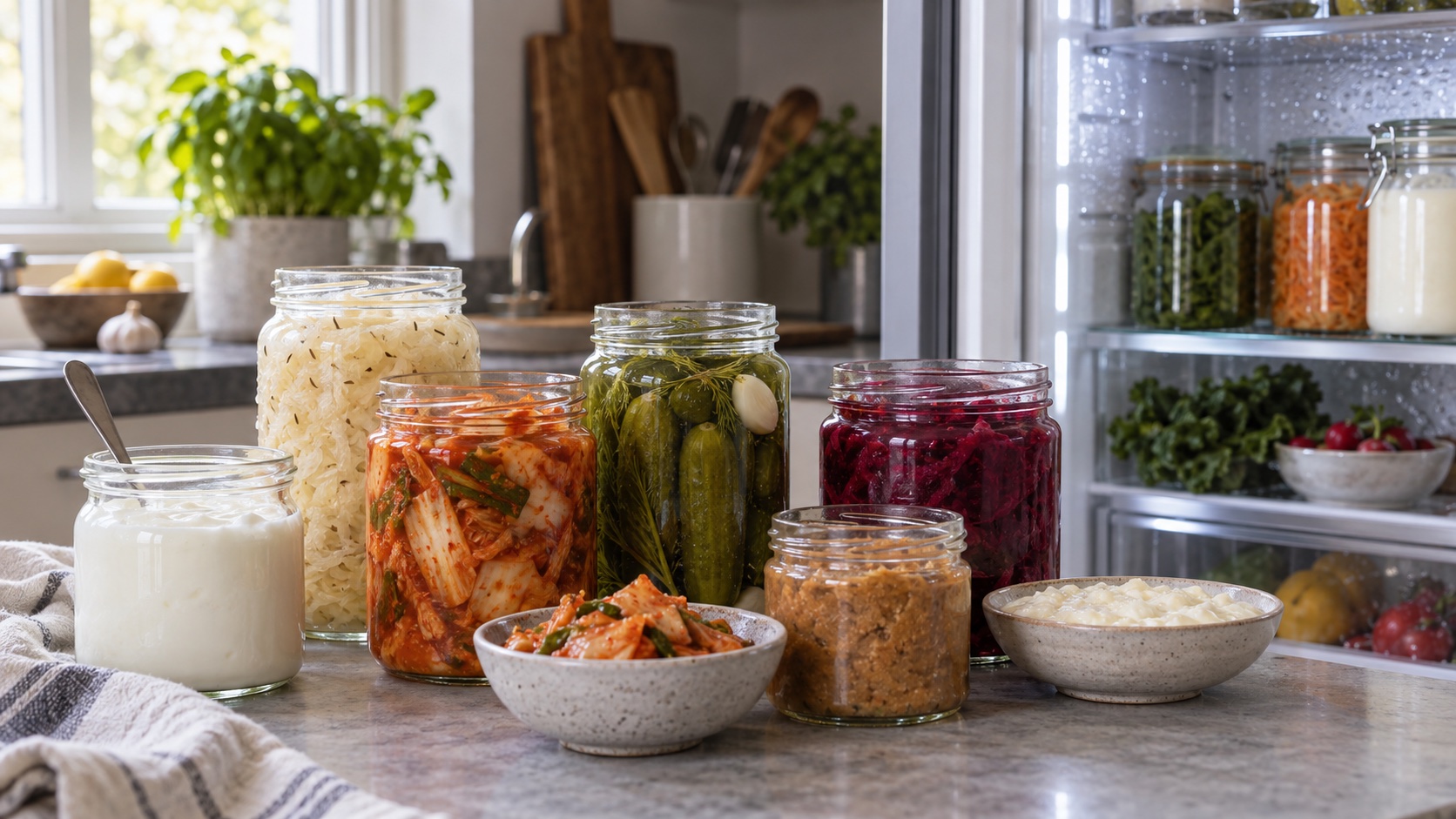
The one-sentence rule: live cultures need cold, and shelf-stable products don't have them. Manufacturers pasteurize fermented foods after the culture step because it stops the fermentation — no more acid building, no carbon dioxide swelling the jar, no alcohol creeping past legal limits — and that buys months of shelf life, cheap shipping, and uniform texture. The trade-off is the defining feature of the product. A shelf-stable sauerkraut is cabbage with sauerkraut's chemistry and none of its biology. The habit is inherited from milk: pasteurization solved a genuine safety problem in the dairy supply, and food manufacturers generalized the logic to products where the safety benefit is smaller and the cultural cost is the point. This matters because the live microbes are the entire reason the ranking page and the Stanford trial care about these foods in the first place.
Product picks are generic categories, not brands. We may earn a commission on Amazon or iHerb purchases at no cost to you — this never changes our evidence conclusions. Full disclosure
Refrigerated live fermented vegetables or kombucha
Can support a food-based fermented-food practice when the article specifically calls for a live refrigerated product.
⚠️ Kimchi and sauerkraut can be sodium-dense; raw kombucha can contain alcohol and added sugar can be substantial.
Grocery item — availability varies by region.
Check price on Amazon →What Pasteurization Does
Pasteurization is heat treatment that kills vegetative microbes — bacteria and yeasts in their active form — without sterilizing the food. The familiar standard is milk: 161 degrees Fahrenheit for 15 seconds, or ultra-high-temperature treatment at about 280 degrees for 2 seconds. Applied after fermentation, the heat kills the cultures that did the fermenting; the products they made — lactic acid, vitamins, flavor compounds — largely remain. What does not remain is anything alive. Note the asymmetry: pasteurization kills microbes, but it does not remove the fiber in the cabbage or the protein in the yogurt. "Dead" ferments are not zero-value foods — they are foods that no longer deliver live cultures.
The Pickle Truth
The biggest trap in the aisle is the pickle, because most jarred pickles were never fermented at all. They are cucumbers soaked in vinegar, salt, and sugar — pickled, not fermented. The word "fermented" on a label sometimes describes a brief vinegar bath, which is not the fermentation that matters for gut health. A real fermented pickle is a cucumber fermented in saltwater brine by lactic acid bacteria: it lives in the refrigerator case, its brine is cloudy, and it hisses when opened because the fermentation is still working. If it sits on a shelf at room temperature and lists vinegar in the ingredients, it was never alive.
Yogurt's Heat-Treated Loophole
In the United States, yogurt can be heat-treated after culturing and still be sold as yogurt — no live cultures required. The reliable marker is the voluntary "Live & Active Cultures" seal from the National Yogurt Association, which requires at least 100 million (10⁸) colony-forming units per gram at manufacture. Refrigerated yogurt with the seal is reliably live; frozen yogurt and many long-life products are usually heat-treated. "Greek" describes straining, not cultures, and "contains probiotics" on a label is not a verified claim. Note the asymmetry with milk: milk is pasteurized before culturing — a safety step on a product with no cultures to lose — while yogurt is heated after culturing, when the cultures are the point. The question of whether any pill or powder earns its place instead belongs to the probiotics-vs-prebiotics topic.
Kombucha and the Alcohol Law
Kombucha ferments sugars into alcohol and acid. In the US, to be sold as a non-alcoholic beverage it must stay below 0.5% alcohol by volume — so most commercial kombucha is pasteurized or sterile-filtered to stop the fermentation at the right moment. Raw kombucha in the fridge is a living product: it keeps fermenting, which is exactly why its alcohol content can drift upward over time — relevant for anyone avoiding alcohol, including during pregnancy. Raw bottles left warm can also keep building carbonation to the point of bursting. The other kombucha caveat is sugar: some brands bottle more residual sugar than the label's vibe suggests — treat sweetened kombucha as a soft drink with a microbiome story. The wider drinks evidence lives on the super-drinks topic.
⚠️ Raw ferments are not for everyone
Unpasteurized fermented foods carry small real risks — foodborne illness for anyone immunocompromised, and drifting alcohol in raw kombucha for anyone avoiding alcohol, including pregnancy. If you are immunocompromised, pregnant, feeding an infant, or living with severe gut disease, the raw-ferment question is clinician territory, not a grocery decision.
What Survives the Heat
Pasteurized ferments keep their fiber — the SCFA pipeline runs on it regardless — plus fermentation products like lactic acid and some vitamins. The open question is the "postbiotic" idea: that killed microbes and their cell fragments still modulate the immune system. The concept has a mechanistic basis and some human pilot data, but it is early; treat pasteurized ferments as decent foods that do not deliver live cultures, not as hidden probiotics. Certain vitamins synthesized during fermentation — vitamin K2 in natto among them — survive the heat as well. And remember what pasteurization cannot fix: the vinegar-brined pickle was never alive in any form, heated or not.
The Label-Reading Playbook
- 🧊 Shop the refrigerator case first — shelf-stable "ferments" are heat-treated or never fermented.
- 🏷️ Favor explicit words — "raw," "unpasteurized," "naturally fermented," "live cultures," or a live-culture count.
- 🥛 For yogurt, look for the seal — Live & Active Cultures; plain, not flavored.
- 🥒 For pickles and kraut — brine of salt and water, not vinegar; cloudy brine and bubbles are signs of life.
- 🍶 For kombucha — refrigerated and labeled raw if you want live microbes; mind the alcohol if it matters to you.
The Aisle, Decoded
| Product | What the label says | What is actually in the jar | Verdict |
|---|---|---|---|
| Shelf-stable sauerkraut | "Sauerkraut" | Pasteurized after fermentation; cultures killed | Dead |
| Jarred dill pickles | "Pickles" | Vinegar-brined; never fermented | Never alive |
| Refrigerated raw kraut / kimchi | "Raw, unpasteurized" | Live lactic acid bacteria | Alive |
| Yogurt with the seal | "Live & Active Cultures" | At least 10⁸ CFU/g at manufacture | Alive |
| Heat-treated yogurt | "Yogurt" | Cultured, then heated; cultures killed | Dead |
| Mass-market kombucha | "Kombucha" | Usually pasteurized or filtered for alcohol control | Mostly dead |
| Refrigerated kefir | "Kefir" | Usually live bacteria and yeasts | Alive |
Questions, Answered Briefly
- 🥫 Is pasteurized sauerkraut worthless? No: the fiber and fermentation products survive, so it feeds the SCFA pipeline. It just does not deliver live microbes — that is the one claim being withdrawn.
- 🤰 I'm pregnant — which ferments are safe? This is clinician territory rather than a label question. Pasteurized products avoid the live-microbe risk entirely, and raw kombucha adds alcohol drift on top. Ask your care team.
- 🍾 Does kombucha count as alcohol? Raw kombucha can drift past 0.5% alcohol over time; commercial pasteurized versions are engineered to stay under the limit. If alcohol matters to you, treat raw kombucha with caution.
- 🔬 What are postbiotics, really? The term covers killed microbes and their metabolic products. The idea that dead microbes still modulate immunity has mechanistic support and some human pilot data, but it is early science, not a buying rationale.
- 🧫 Are "live cultures" and "probiotics" the same? Not on labels. "Live cultures" describes the food's organisms; "probiotic" implies a specific, studied strain and dose. The probiotics-vs-prebiotics topic owns the distinction.
The Bottom Line
- Shelf-stable means dead — pasteurization after fermentation kills the cultures; the refrigerator case is where live products live.
- The pickle is the trap in miniature — most jarred pickles are vinegar-brined and were never fermented.
- Pasteurized ferments are not worthless — fiber and fermentation products survive — but they do not deliver live microbes.
- Raw ferments carry small real risks for some people — where those risks apply, the decision belongs in a clinician conversation.
Related Topics
- Rezac et al., "Fermented foods as a dietary source of live organisms," Frontiers in Microbiology (2018)
- Kok & Hutkins, "Yogurt and other fermented foods as sources of health-promoting bacteria," Nutrition Reviews (2018)
- Marco et al., "Health benefits of fermented foods: microbiota and beyond," Current Opinion in Biotechnology (2017)
- Dimidi et al., "Fermented foods: definitions and characteristics, impact on the gut microbiota and effects on gastrointestinal health and disease," Nutrients (2019)
- Stiemsma et al., "Does consumption of fermented foods modify the human microbiota?" Journal of Nutrition (2020)
- Wastyk et al., "Gut-microbiota-targeted diets modulate human immune status," Cell (2021)