Super Drinks for Gut Health: The Honest Verdict
The drinks aisle is where gut-health marketing does its loudest work: kombucha with a halo, bone broth with a story, and "probiotic" juices with the sugar content of soda. Here's what each drink actually has evidence for — ranked, with the caveats attached.
What the evidence supports
- Kefir has genuine trial data — it outperformed yogurt on some gut and inflammatory measures in small studies.
- Kombucha contains live acetic-acid bacteria and polyphenols — real ingredients, modest human data.
- Green tea polyphenols are prebiotic — bacteria convert them into bioactive metabolites (the Matcha topic's evidence).
What remains uncertain
- Bone broth's "gut-healing" claims have essentially no human trial support — the story outruns the data.
- Most commercial kombuchas and probiotic drinks carry added sugar that the label downplays.
- Store-bought versions of fermented drinks vary wildly in live cultures — and many are pasteurized.
Evidence last reviewed: August 13, 2026. Conclusions may change as new research is published.
Product picks are generic categories, not brands. We may earn a commission on Amazon or iHerb purchases at no cost to you — this never changes our evidence conclusions. Full disclosure
Matcha powder
Makes an unsweetened matcha routine convenient for people who enjoy and tolerate caffeine.
⚠️ Caffeine can worsen insomnia, anxiety, palpitations, reflux, or medication-related concerns; timing and total intake matter.
Check price on Amazon →The Drinks, Ranked
| Drink | Verdict | The honest detail |
|---|---|---|
| 🥤 Kefir (plain, live) | Best evidence | The strongest drink on the list — trials show gut and inflammatory-marker effects; a wider culture than yogurt (bacteria + yeasts) |
| 🍵 Green tea / matcha | Good | Polyphenols feed beneficial bacteria — the Matcha topic owns the detail; unsweetened is the operative word |
| 🍶 Kombucha (unsweetened, live) | Moderate | Real live cultures and polyphenols; human trials are small. Watch the sugar — many brands hide 10+ g per bottle |
| ☕ Coffee (unsweetened) | Moderate | Chlorogenic acid is prebiotic; coffee-drinkers' microbiomes differ measurably. The Hormetic pillar's dose rules apply |
| 🍖 Bone broth | Weak | The collagen-and-glutamine "gut healing" story is plausible biology with almost no human trial support. Fine as soup; not a treatment |
| 🧃 "Probiotic" juices & sodas | Mostly marketing | Pasteurized or sugared versions deliver neither meaningful cultures nor benefit — the sugar pillar's territory wearing a probiotic label |
Plain brewed green tea
A beverage option for people who enjoy tea and tolerate caffeine.
⚠️ Caffeine timing and tolerance matter; avoid conflating brewed tea with concentrated green-tea extracts, which have different safety considerations.
Check price on Amazon →Three Rules for the Drinks Aisle
- 🧊 Refrigerated = live — the same rule as the food page: shelf-stable "fermented" drinks are pasteurized.
- 🍬 Read the sugar line first — a gut drink with 12 g of added sugar per serving is a soft drink with a backstory.
- 🥤 Plain wins — plain kefir, plain tea, plain coffee. The flavors are where the sugar hides.
🍵 The matcha handoff
Tea appears on this list as a gut drink — but the hormetic pillar's Matcha & Hormetic Drinks topic owns the full story: the catechins, the theanine, the mortality cohorts, the caffeine dose curve. The division of labor: that topic asks what the drink does for you; this one asks what it does for your bacteria. The answers are different halves of the same molecule.
The Bottom Line
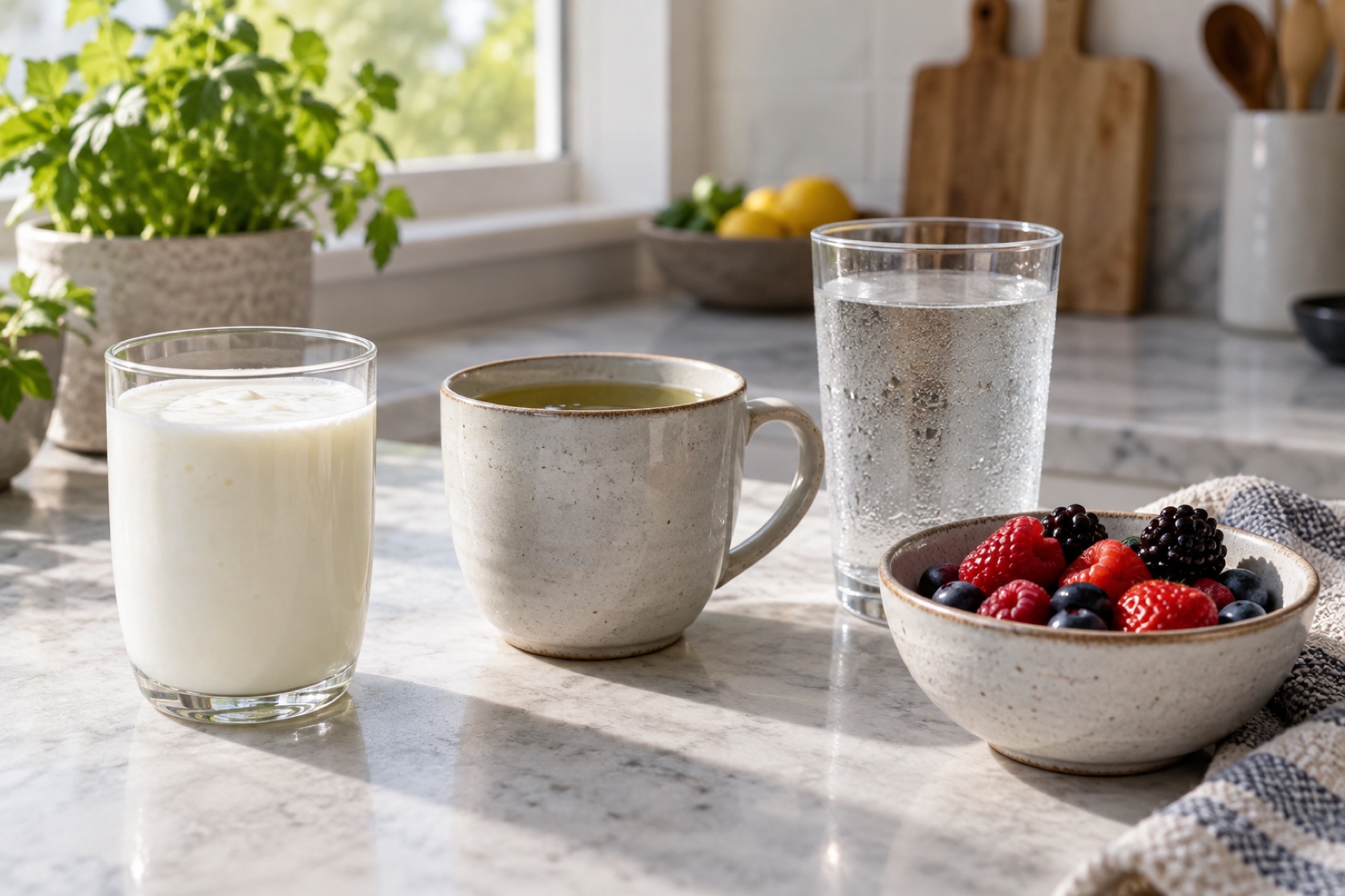
- Kefir is the evidence leader among gut drinks — plain, live, refrigerated.
- Unsweetened tea and coffee are legitimate prebiotic drinks — with the Hormetic pillar's dose rules.
- Kombucha is fine, not magic — and only in the unsweetened, live versions.
- Bone broth and probiotic sodas are mostly story — soup is soup, and sugar is sugar.
Plain live kefir
A fermented dairy option for people who choose and tolerate it.
⚠️ Lactose intolerance, sugar content, and individual GI tolerance matter; select plain, live products when the article specifies them.
Grocery item — availability varies by region.
Check price on Amazon →Go Deeper: Subtopics
- 🔎 Kefir, the strongest drink — the trial data (vs yogurt) and how to pick a live one. Read it →
- 🔎 Kombucha's real contents — live cultures, polyphenols, and the sugar problem in one cup. Read it →
- 🔎 Green tea & coffee as prebiotics — the polyphenol fermentation evidence (links Matcha topic). Read it →
- 🔎 Bone broth & collagen, honestly — the gut-healing claims vs the trial record. Read it →
- 🔎 The sugar audit for drinks — reading labels: the 10g-per-bottle trap and the plain-versions rule. Read it →
Related Topics
- Bellikci-Koyu et al., "Effects of regular kefir consumption on gut microbiota in patients with metabolic syndrome," Nutrients (2019)
- Marco et al., "Health benefits of fermented foods," Current Opinion in Biotechnology (2017)
- Chen et al., "Kombucha: a review on the evidence" — systematic reviews of human data
- Maruvada et al., "The human microbiome and obesity: moving beyond associations," Cell Host & Microbe (2017)
- Jaquet et al., "Impact of coffee consumption on the gut microbiota," International Journal of Food Microbiology (2009)