Matcha & Hormetic Drinks: Tea, Coffee & Polyphenols
The most common hormetic practice on Earth is drinking your morning cup. Caffeine is a textbook hormetic molecule — and matcha stacks the stress chemistry of tea into its most concentrated form. Here's the evidence on the drinks that gently stress you better.
What the evidence supports
- Coffee and green tea both associate with lower all-cause mortality in large cohorts, with clear dose-response curves.
- EGCG — the dominant green-tea catechin — has measurable effects on metabolism and vascular function in trials.
- L-theanine + caffeine produces "calm focus": improved attention with reduced jitter in controlled comparisons.
What remains uncertain
- Matcha-specific outcome data is thin — most of the evidence is for brewed green tea, extrapolated to matcha.
- Coffee associations are observational; the protective mechanism isn't isolated (caffeine? polyphenols? the social ritual?).
- Optimal caffeine dose varies enormously by genetics — one person's nootropic is another's insomnia.
Evidence last reviewed: August 13, 2026. Conclusions may change as new research is published.
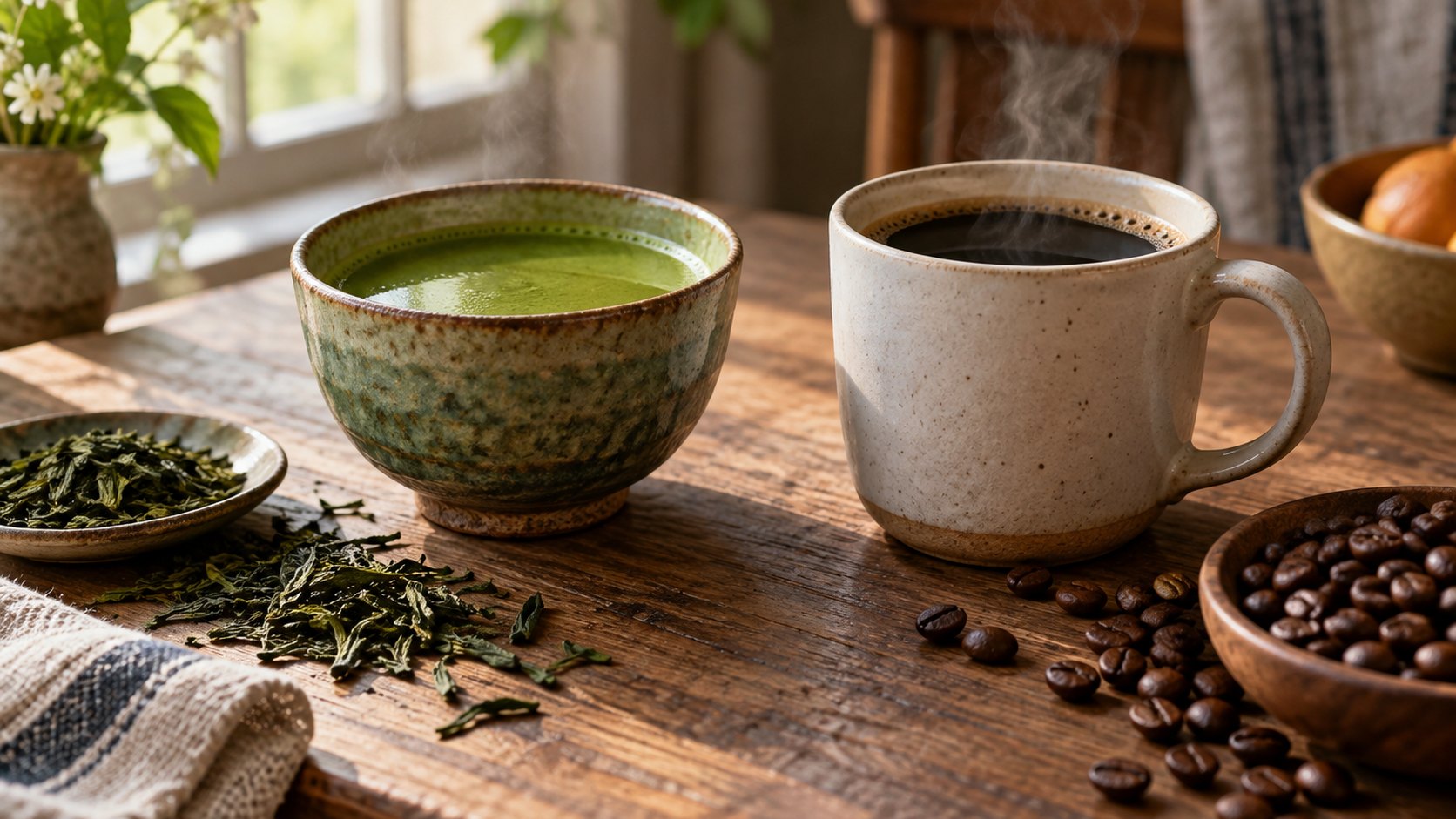
Why Caffeine Is Hormetic
Caffeine doesn't give you energy — it blocks the signal that you're tired (adenosine receptors), creating mild physiological stress that the body answers with alertness, focus, and — with regular use — adaptation. That's the hormetic signature: a controlled stress dose, a measurable response, and a tolerance curve that follows.
- 📈 The U-curve: coffee cohorts show the lowest mortality around 3–4 cups/day — and the curve bends back up at the extremes.
- 🧬 Adaptation is the giveaway: tolerance builds, withdrawal exists — caffeine behaves like a classic hormetic molecule, not a nutrient.
- ⏰ The timing rule from the Sleep pillar: the half-life (~5–6 hours) makes the 8–10 hour pre-bed cutoff the single most important caffeine hygiene rule.
Product picks are generic categories, not brands. We may earn a commission on Amazon or iHerb purchases at no cost to you — this never changes our evidence conclusions. Full disclosure
Matcha powder
Makes an unsweetened matcha routine convenient for people who enjoy and tolerate caffeine.
⚠️ Caffeine can worsen insomnia, anxiety, palpitations, reflux, or medication-related concerns; timing and total intake matter.
Check price on Amazon →Matcha vs Brewed Green Tea: The Chemistry
| Matcha | Brewed green tea | |
|---|---|---|
| What you consume | 🥣 The whole leaf, stone-ground | 🍵 The steeped extract only |
| EGCG (catechins) | Roughly 2–3× more per cup | Lower — much stays in the discarded leaf |
| L-theanine | Higher — the shade-grown harvest concentrates it | Present, lower |
| Caffeine | ~30–70 mg/cup (comparable to coffee) | ~20–45 mg/cup |
| The experience | Calm focus — theanine buffers the caffeine spike | Milder alertness |
The shade-grown detail matters: shading tea plants stresses them into producing more theanine and chlorophyll — plant hormesis, bottled. The "calm focus" of matcha is the caffeine spike flattened by theanine, and it's one of the few food experiences with controlled-study support for the subjective effect.
The Coffee Parallel
- ☕ The big cohorts (hundreds of thousands of people) repeatedly find 3–4 cups/day associated with the lowest all-cause mortality — often 10–15% below non-drinkers.
- 🫀 Cardiovascular & metabolic: associations extend to lower cardiovascular and type-2 diabetes risk.
- ⚠️ What the curves don't say: causation is unproven, the mechanism is likely multiple (polyphenols, caffeine, the social ritual), and unfiltered coffee's cholesterol-raising compounds deserve a footnote.
- 🧬 Genetics decides the ceiling: slow caffeine metabolizers (CYP1A2 variants) get more side effects from the same dose — the U-curve is personal.
🥤 The practical cup
The evidence-based drink protocol: morning caffeine only (the 8–10 hour pre-bed rule is the fixed part of the protocol — see the Sleep pillar's saboteur topic), 1–3 cups of green tea or matcha daily as the polyphenol base, coffee at 2–4 cups if you tolerate and enjoy it, and — the part no one wants to hear — skip the sugar: the mortality curves describe unsweetened beverages, and the Sugar pillar explains what the sweetened versions do instead.
Choosing Matcha, Honestly
- 🍃 Ceremonial vs culinary: ceremonial grade = young shade-grown leaves, more theanine, delicate flavor; culinary = later harvest, more bitterness (more catechins, if anything). Both are real matcha; ceremonial is for drinking.
- 🎨 Color is the tell: vibrant green means shade-grown and fresh; dull yellow-brown means oxidized — the compounds you want have degraded.
- 🥤 The fraud layer: "matcha lattes" at chain cafés are often sweetened blends with a dusting of matcha — the sugar pillar's territory. The hormetic benefit lives in the actual powder, not the branding.
Drink Questions, Answered Briefly
- Matcha or coffee — which is better? The cohorts don't crown a winner — both associate with lower mortality. Matcha wins on calm focus; coffee wins on sheer evidence volume. Many people do both, morning coffee and afternoon tea (the caffeine curve permitting).
- Does matcha's caffeine work differently? The theanine buffers the spike — the subjective "calm alertness" has controlled-study support — but it's still caffeine: the sleep-hygiene rules are identical.
- Decaf? Decaffeinated tea and coffee keep most of the polyphenol benefit while dropping the caffeine stressor — a legitimate option for slow metabolizers and the sleep-sensitive.
Theanine, Deep-Dive
- 🌿 What it is: L-theanine is an amino acid almost unique to tea — and concentrated by the shade-grown stress that matcha plants undergo.
- 🧠 What it does: promotes calm alertness — controlled trials show the caffeine + theanine combination improves attention and reduces the jitter of caffeine alone.
- ⚡ The proposed mechanism: theanine raises GABA and alpha brain waves — the relaxed-focus pattern — while caffeine drives arousal. Two mild stresses, balanced.
- 💊 The supplement question: theanine pills exist and have modest sleep-quality support — but the whole-leaf delivery (matcha) is the evidence base for the synergy. Tea remains the superior vessel.
The History: Zen Monks to Science
Matcha's origin story is a hormesis story in miniature: Zen monks needed to stay alert through long meditation without the agitation of coffee — and the tea ceremony that developed around matcha (whisked whole leaf, consumed completely) predates the EGCG research by eight centuries. The monks were running a caffeine-theanine protocol without knowing the molecules; the modern science simply measured what the tradition had already optimized. It's a useful humility lesson for this entire pillar: the best hormetic practices are usually old, boring, and culturally embedded — the lab coat came later.
The Bottom Line
- Caffeine is a textbook hormetic molecule — and tea/coffee are the most universal hormetic practice humans have.
- Matcha concentrates tea's chemistry — whole leaf, more EGCG, more theanine, calm focus.
- The cohorts point the same direction: regular unsweetened tea/coffee, moderate doses, lower mortality — with all observational caveats.
- Timing and dose are the whole game: morning only, and stop before the U-curve turns.
Go Deeper: Subtopics
- 🔎 The tea catechins — EGCG and theanine: the calm-focus mechanism and its replication record. Read it →
- 🔎 Coffee as hormetin — chlorogenic acid, the mortality cohorts, and the J-shaped dose curve. Read it →
- 🔎 Matcha vs brewed green tea — does the powder actually deliver more? The numbers. Read it →
- 🔎 Cacao & dark chocolate — flavanols and the COSMOS trial: what the supplement-grade evidence shows. Read it →
- 🔎 The caffeine ceiling — stacking tea + coffee + chocolate: total daily caffeine math (links Sleep pillar). Read it →
Related Topics
- Kuriyama et al., "Green tea consumption and mortality due to cardiovascular disease, cancer, and all causes in Japan: the Ohsaki study," JAMA (2006)
- Poole et al., "Coffee consumption and health: umbrella review of the meta-analyses," BMJ (2017)
- Dietz & Dekker, "Effect of green tea phytochemicals on mood and cognition," Current Pharmaceutical Design (2017)
- Hursel et al., "The effects of green tea on weight loss and weight maintenance: a meta-analysis," International Journal of Obesity (2009)
- Cornelis et al., "Coffee, CYP1A2 genotype, and risk of myocardial infarction," JAMA (2006)