The Tea Catechins
Green tea owes its reputation to two molecules: EGCG, the dominant catechin, and L-theanine, the amino acid that gives matcha its "calm focus." This page takes them apart — what each one does, how the combination works, and how well the headline findings have actually replicated when other labs tried them.
What the evidence supports
- Caffeine plus L-theanine improves attention and reaction speed more than caffeine alone in several controlled trials.
- Regular green tea drinking is associated with lower cardiovascular and all-cause mortality in large Japanese cohorts.
- Matcha and other whole-leaf preparations deliver several times more catechins than a standard steeped cup.
What remains uncertain
- The calm-focus effect sizes are small to moderate, and the optimal theanine dose is not pinned down.
- Nearly all long-term evidence is observational — tea drinkers differ from non-drinkers in many ways.
- Green tea extract supplements are not the same as the beverage, and high doses carry a rare liver-injury risk.
Evidence last reviewed: August 15, 2026. Conclusions may change as new research is published.
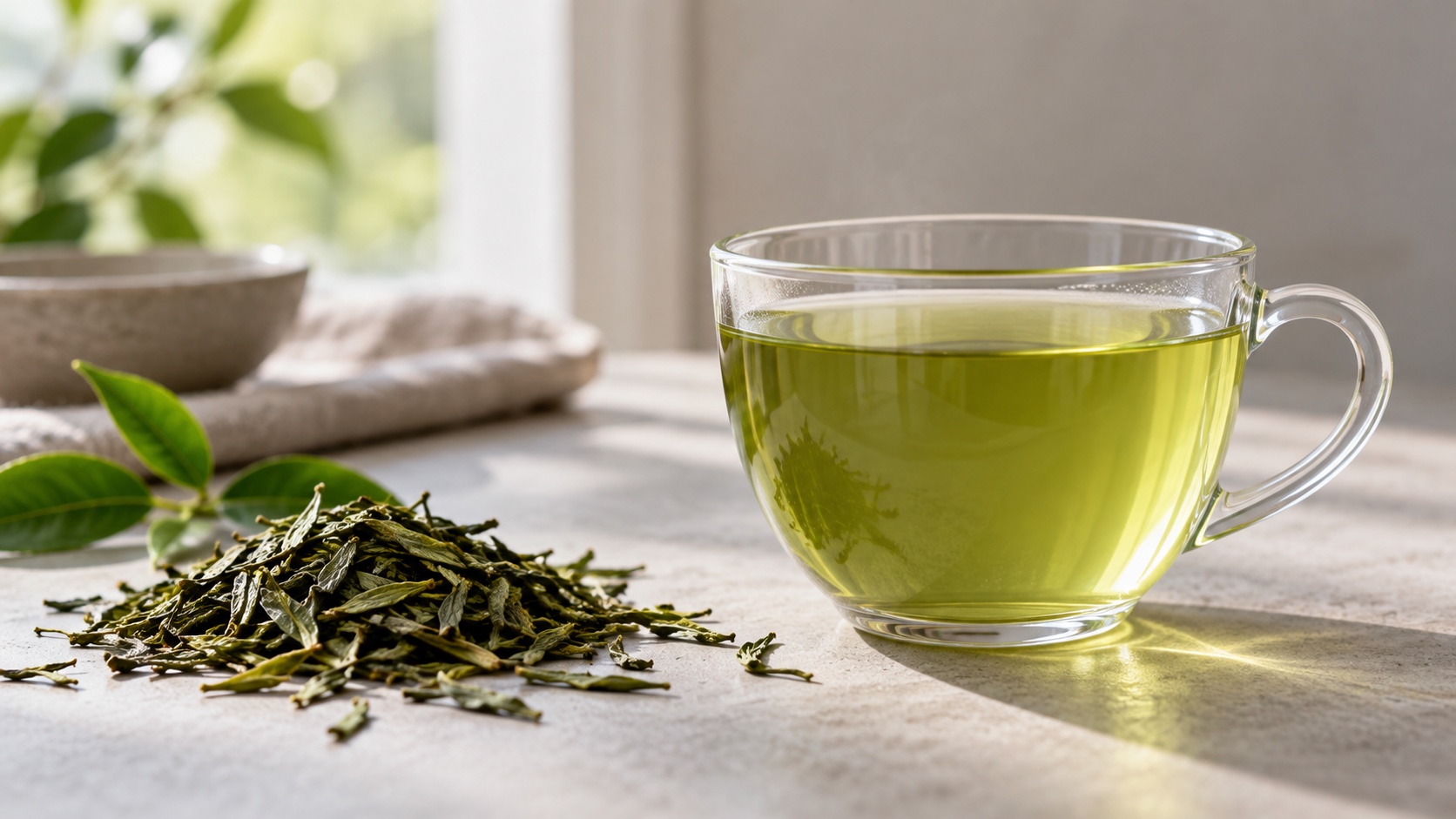
The Calm-Focus Cocktail
The experiment that defined the field gave volunteers 250 mg of L-theanine plus 150 mg of caffeine — roughly the balance found in several cups of green tea, though at higher absolute doses — and measured attention, reaction time, and mood against caffeine alone and placebo (Haskell et al., Biological Psychology, 2008). The combination improved speed and accuracy on demanding tasks within about an hour, and volunteers rated themselves less tired and less jittery than on caffeine alone. The subjective part matters as much as the scores: the claim behind matcha is not that it makes you sharper than coffee, but that it makes you sharp without the buzz. That is a testable claim, and the tests have largely agreed with it.
Product picks are generic categories, not brands. We may earn a commission on Amazon or iHerb purchases at no cost to you — this never changes our evidence conclusions. Full disclosure
Matcha powder
Makes an unsweetened matcha routine convenient for people who enjoy and tolerate caffeine.
⚠️ Caffeine can worsen insomnia, anxiety, palpitations, reflux, or medication-related concerns; timing and total intake matter.
Check price on Amazon →The Mechanism, Step by Step
- ☕ Caffeine blocks the tired signal. Adenosine accumulates while you are awake; caffeine sits in its receptors, so the "sleep pressure" message never lands. Alertness rises — along with heart rate and, for some people, jitter.
- 🧘 Theanine files the edges off. L-theanine crosses the blood–brain barrier and appears to nudge GABA and glutamate signaling while shifting brain activity toward the alpha band — the relaxed, wakeful rhythm (Nobre et al., Asia Pacific Journal of Clinical Nutrition, 2008).
- 🔀 They act on different systems. Caffeine pushes arousal; theanine pulls anxiety down. The result is not a bigger caffeine effect but a smoother one — the reason the combination outperforms caffeine alone on accuracy-heavy tasks.
- 📉 The buffer is dose-dependent, not magical. A cup of tea contains roughly 20–50 mg of caffeine and single-digit to tens of milligrams of theanine; the trial doses above are stronger than one cup. The everyday effect is a mild version of the experimental one.
- 🧬 Tolerance still applies. Theanine does not cancel caffeine's pharmacology — regular caffeine use still builds tolerance and withdrawal. The calm-focus effect changes the shape of the caffeine response, not its rules; the caffeine ceiling page works through the dose math.
The Replication Record
Single trials are cheap; the interesting question is what happened when other labs tried the same pairing. The record is better than most nutrition-adjacent findings:
- 🔁 Giesbrecht et al. (2010) replicated the core result with a much lower dose — 97 mg theanine plus 40 mg caffeine — finding faster simple reaction time and better accuracy on attention switching than caffeine alone (Nutritional Neuroscience, 2010).
- 🔁 Alpha waves again and again. EEG studies repeatedly show increased alpha activity after theanine, alone and with caffeine — a consistent neurophysiological signature, not just questionnaire noise.
- 📊 The honest caveat. A 2008 review of the combination's evidence concluded the effects were real but modest, and noted that most trials used doses far above a single cup of tea (Owen et al., Nutrition Bulletin, 2008).
- 🍵 Matcha-specific trials are thinner. One controlled study of matcha drinks and bars found limited mood and performance benefits at realistic serving sizes (Dietz et al., Food Research International, 2017) — a useful reminder that the lab cocktail and the ceremonial bowl are different doses. The matcha vs brewed page runs those numbers.
The Catechin Workhorse
EGCG is the most abundant catechin in green tea and the molecule most studies point to for tea's metabolic and vascular effects. It is a polyphenol — a plant defense compound that, in the human body, behaves like a mild hormetic stressor: it activates antioxidant and detoxification pathways (such as Nrf2) at doses far too low to act as a direct antioxidant in blood. It also has a short, poorly absorbed life — bioavailability is low, most of it is metabolized by gut bacteria, and what reaches circulation is a shadow of what was drunk. The tea plant is essentially a hormesis factory, which is why this series lives under the Matcha & Hormetic Drinks topic.
Plain brewed green tea
A beverage option for people who enjoy tea and tolerate caffeine.
⚠️ Caffeine timing and tolerance matter; avoid conflating brewed tea with concentrated green-tea extracts, which have different safety considerations.
Check price on Amazon →| Molecule | What it does | Evidence strength | Read |
|---|---|---|---|
| ☕ Caffeine | Adenosine blockade: alertness, arousal, faster reactions | Dozens of controlled trials | Strong |
| 🧘 L-theanine | Alpha-wave shift, relaxed alertness, jitter reduction | Replicated short trials; dose uncertain | Moderate |
| 🍃 EGCG | Nrf2 pathway activation, modest metabolic and vascular effects | Trials show small effects; long-term data observational | Moderate |
| 🔀 Caffeine + theanine | Calm focus: accuracy and speed without added jitter | Consistent across several independent labs | Good |
⚠️ Green tea extract is not green tea
Concentrated EGCG supplements have been associated with rare cases of liver injury, particularly at high doses and on an empty stomach; the European Food Safety Authority flagged a safety concern for EGCG above 800 mg per day as a supplement (EFSA, 2018). The beverage has no such signal in decades of use. If you are considering an extract — for any reason — that is a conversation for a clinician, especially if you take medications or have liver disease. Nothing on this page prescribes; the beverage is the form with the long safety record.
What Decades of Tea Drinking Is Associated With
The long-term data comes mostly from Japan, where green tea is a population-level habit. In the Ohsaki study of more than 40,000 adults followed for up to 11 years, drinking 5 or more cups of green tea per day was associated with roughly a quarter to a third lower cardiovascular mortality and meaningfully lower all-cause mortality compared with drinking less than one cup a day — with the benefit concentrated at the higher end of intake (Kuriyama et al., JAMA, 2006). Women showed the association more consistently than men, a detail the paper itself noted. On the metabolic side, pooled randomized trials find green tea lowers total cholesterol by roughly 7 mg/dL and LDL by about 2 mg/dL (Zheng et al., American Journal of Clinical Nutrition, 2011), and a systematic review of controlled trials found systolic blood pressure about 2 mmHg lower with regular catechin intake (Khalesi et al., European Journal of Nutrition, 2014). These are modest, real numbers — consistent with a beverage habit, not a pharmaceutical. The coffee page tells the parallel story for the other great hormetic drink, and the honest frame is the same: associations with decades of exposure, not proof that any single molecule moves mortality.
Practical Rules
- 🍵 Two to four cups a day sit in the range where the cohort signal lives. The association strengthens with more cups — but each cup carries caffeine, so the daily caffeine math sets the upper bound.
- 🌡️ Brew below boiling. Water around 80°C extracts catechins and theanine better than boiling water, which pushes tannins and bitterness. The temperature rule is one of the few tea claims with direct extraction data behind it.
- 🥣 Whole leaf beats steeped, gram for gram. Matcha and gyokuro deliver more of everything per cup — the matcha vs brewed page quantifies the advantage and its costs.
- 🚫 Skip the extract pills. For catechins, the beverage is the form with both the cohort data and the clean safety record. Supplements concentrate the risk without concentrating the evidence.
- ⏰ Watch the clock, not just the cup. Tea's caffeine is still caffeine — the Sleep pillar's caffeine topic owns the half-life math, and the 7 habits of great sleepers start with keeping the evening caffeine-free.
The Bottom Line
- Calm focus is real, replicated, and modest — caffeine plus theanine beats caffeine alone on attention in several independent labs, but effect sizes are small and trial doses exceed one cup.
- EGCG is a hormetic molecule, not a vitamin — it works through stress-response pathways at low doses, with poor bioavailability and most of its action via gut metabolism.
- The long-term signal is observational — heavy green tea drinking associates with roughly 25–30% lower cardiovascular mortality in Japanese cohorts; causation is not established.
- Drink the tea, skip the extract — the beverage carries the evidence and the safety record; concentrated EGCG supplements add a rare liver-injury risk and little else.
Related Topics
- Haskell et al., "The effects of L-theanine, caffeine and their combination on cognition and mood," Biological Psychology (2008)
- Giesbrecht et al., "The combination of L-theanine and caffeine improves cognitive performance and increases subjective alertness," Nutritional Neuroscience (2010)
- Nobre et al., "L-theanine, a natural constituent in tea, and its effect on mental state," Asia Pacific Journal of Clinical Nutrition (2008)
- Owen et al., "The combined effects of L-theanine and caffeine on cognitive performance and mood," Nutrition Bulletin (2008)
- Kuriyama et al., "Green tea consumption and mortality due to cardiovascular disease, cancer, and all causes: the Ohsaki study," JAMA (2006)
- Zheng et al., "Green tea intake lowers fasting serum total and LDL cholesterol in adults: a meta-analysis of 14 randomized controlled trials," American Journal of Clinical Nutrition (2011)
- Khalesi et al., "Green tea catechins and blood pressure: a systematic review and meta-analysis of randomised controlled trials," European Journal of Nutrition (2014)
- European Food Safety Authority, "Scientific opinion on the safety of green tea catechins" (2018)
- Dietz et al., "An intervention study on the effect of matcha tea, in drink and snack bar formats, on mood and cognitive performance," Food Research International (2017)