Matcha vs Brewed Green Tea
Matcha costs several times what a bag of green tea costs. The claim that justifies the price is concentration: you eat the whole leaf instead of drinking its steeped extract. This page checks the claim against the assay data — what the powder actually delivers, cup for cup, and what the numbers leave out.
What the evidence supports
- Matcha delivers roughly two to three times the EGCG of a brewed green tea cup, serving for serving.
- Assays consistently find far higher catechin concentrations in matcha than in steeped teas, including one widely cited 100-fold-plus comparison.
- Matcha carries more caffeine and more L-theanine than a standard brew — both come from the whole leaf.
What remains uncertain
- Whether the catechin advantage translates into health outcomes is untested in long-term matcha cohorts — the outcome data is for brewed tea.
- Values vary widely by cultivar, harvest, and grade, so any single "matcha contains X" number is an average of averages.
- The powder concentrates whatever is in the soil — including lead where soils carry it.
Evidence last reviewed: August 15, 2026. Conclusions may change as new research is published.
The Powder Difference, Mechanically
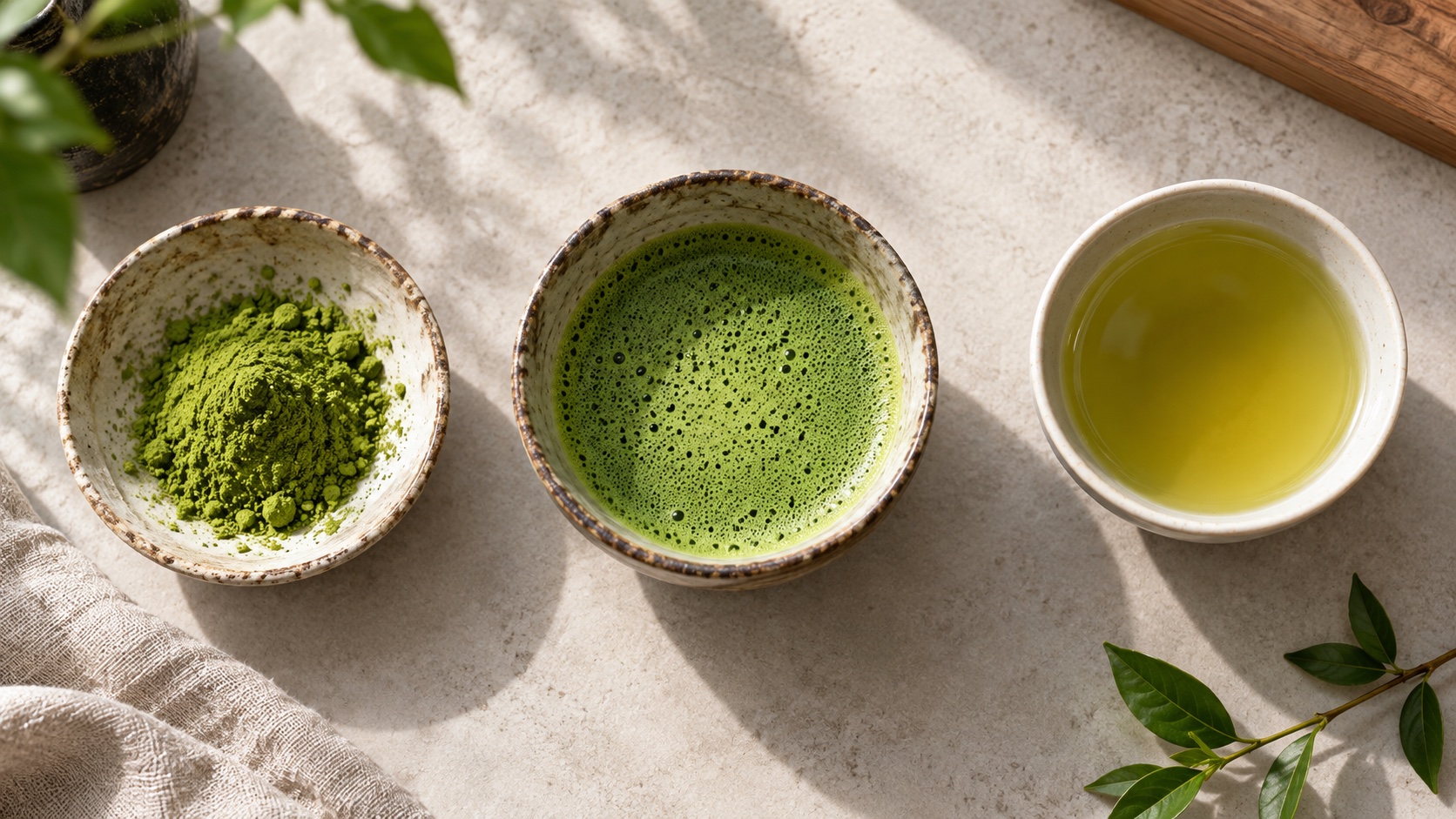
A brewed cup is an extract. You steep the leaves, the water pulls out what dissolves, and the leaf goes in the bin — carrying with it a large share of the catechins, which are only partially water-soluble. Matcha removes that step: the leaves are stone-ground and you consume the entire leaf suspended in water. Nothing is discarded, so the cup carries everything the leaf holds, including the insoluble fraction that a steep leaves behind. Two production details add to the difference. Matcha leaves are shade-grown for roughly the last three weeks before harvest, which stresses the plant into producing more chlorophyll and more L-theanine — plant hormesis, concentrated by agriculture. And the leaves are steamed rather than pan-fired, which preserves catechins that heat degrades. The result is not a different beverage but a denser one: the same molecules, more of them per cup. That density is the whole story of the Matcha & Hormetic Drinks topic in miniature.
Product picks are generic categories, not brands. We may earn a commission on Amazon or iHerb purchases at no cost to you — this never changes our evidence conclusions. Full disclosure
Matcha powder
Makes an unsweetened matcha routine convenient for people who enjoy and tolerate caffeine.
⚠️ Caffeine can worsen insomnia, anxiety, palpitations, reflux, or medication-related concerns; timing and total intake matter.
Check price on Amazon →What the Assays Show
The most-cited measurement comes from a chromatographic analysis that found matcha contained up to 137 times more EGCG than one commercial steeped green tea used as a comparison (Weiss & Anderton, Journal of Chromatography A, 2003). The number is real but easy to overread: the comparison tea was a low-catechin brew, and the figure marks the top of the range, not the typical gap. More recent analyses of commercial matcha powders find consistent but smaller advantages — total catechin content in the same league as the best whole-leaf green teas, with the edge coming from consuming the leaf rather than extracting it (Koláčková et al., Plant Foods for Human Nutrition, 2020). Against an average steeped green tea, the honest summary is the one the parent topic uses: roughly two to three times the EGCG per cup, with wide variance on both sides. Variance, not marketing, is the operative word: catechin content swings with cultivar, harvest timing, shading duration, and even the fineness of the mill. Two matchas at the same price point can differ twofold in EGCG, and two brewed cups steeped differently can differ nearly as much — which is why the table below uses center-of-range figures for comparison, not a certificate for any specific tin.
The Caffeine Numbers
Catechins are just one thing the powder concentrates. Because you consume the leaf, matcha's caffeine lands closer to coffee than to steeped tea — a detail the marketing photos never mention and the caffeine ceiling page insists on. The chart puts standard servings side by side using USDA reference values.
The Full Serving Table
| Per serving | Matcha (2 g whisked) | Brewed green tea (8 oz) | Advantage |
|---|---|---|---|
| 🥣 What you consume | The entire shade-grown leaf | The steeped extract only | Matcha |
| 🍃 EGCG (catechins) | Roughly 2–3× a brewed cup; assay-dependent | Lower — much stays in the discarded leaf | Matcha |
| 🧘 L-theanine | Higher — shade growth concentrates it | Present, lower per cup | Matcha |
| ☕ Caffeine | Roughly 30–70 mg, near coffee territory | Roughly 20–45 mg | Mixed |
| 💰 Cost per catechin | High — premium grades cost many times bagged tea | Low — the budget route to green tea catechins | Brewed |
| 🧪 Heavy-metal note | Concentrates soil lead — choose tested sources | Steeping extracts less of what is in the leaf | Caution |
Where Matcha Earns Its Price
- 🎨 Color is the honest label. The vivid green is chlorophyll from shade growth; dull or yellow-green powder is older leaf, pan-dried, or past its prime — lower theanine, flatter flavor. Buy for color before you buy for claims.
- 🌱 Freshness decays fast. Ground powder oxidizes in weeks, not years. Ceremonial-grade matcha consumed within months of opening is a different beverage from the two-year-old tin at the back of the cupboard.
- 🏷️ Grades track ceremony, not catechins. Ceremonial grade earns its price on flavor and texture; culinary grade is often similar in catechin content at a fraction of the cost — fine for smoothies and lattes.
- 🧪 Tested sources matter. Tea plants take up lead from soil, and matcha concentrates it. Third-party testing for heavy metals is the practical response — not avoidance of the beverage.
🍵 The powder advantage is real — and bounded
Cup for cup, matcha beats brewed green tea on every molecule the evidence cares about, typically by two to three times. What it does not buy is certainty about outcomes: the long-term cohort data that makes green tea interesting comes from brewed tea drinkers in Japan, not from matcha habits. And the extra caffeine is a real cost — a late-afternoon bowl of matcha is closer to a cup of coffee than to a cup of steeped tea, which matters for the sleep math. Treat matcha as the concentrated version of a good habit: more molecules per cup, more caffeine per cup, and a price tag that is about experience as much as chemistry.
Questions, Answered Briefly
- 🧪 Can I just take EGCG capsules instead? Not a straight swap. The beverage carries the cohort data and a long safety record; concentrated extracts carry a rare liver-injury signal — the tea catechins page details that trade.
- 💰 Is culinary grade nutritionally inferior? Mostly no. Catechin content is similar across grades; ceremonial grade earns its price on flavor, texture, and ceremony — not on molecule counts.
- 🍵 How much matcha equals my green tea habit? Roughly one teaspoon carries the catechins of two to three brewed cups — and the caffeine of about two. The swap is an upgrade in density, not a neutral exchange.
- ⚖️ Does the 137× figure apply to my grocery matcha? No. It was the top of an assay range against one low-catechin comparison tea. Against average brewed green tea, expect the two-to-three-fold gap in the table above.
- 🥣 Should I switch entirely? Unnecessary. Brewed tea captures much of the chemistry at a fraction of the price; matcha is a concentration upgrade and a ritual, not a requirement.
Practical Rules
- 🥄 One to two teaspoons a day is the sensible band — enough to capture the catechin advantage, small enough to keep caffeine inside the daily ceiling.
- 🌡️ Whisk below boiling. Water around 80°C preserves catechins and theanine and avoids the bitterness that boiling water extracts.
- ⏰ Keep matcha a morning drink. With 30–70 mg of caffeine per bowl, the same cutoff logic as coffee applies — great sleepers front-load their caffeine.
- 💸 Brewed green tea remains the budget option. Two to three steeped cups deliver catechins in the same range as one matcha serving, at a fraction of the price — the tea catechins page covers the molecules, and the cost difference is the most honest column in the table above.
- 🍫 Watch the stack. Matcha, coffee, and a square of dark chocolate are three caffeine sources before noon — the cacao page rounds out the audit.
The Bottom Line
- The powder advantage is real: roughly 2–3× the EGCG per cup versus brewed green tea, because you consume the whole leaf — with a documented ceiling far above that in extreme comparisons.
- Caffeine comes along for the ride — a matcha serving sits near coffee territory, two to three times a steeped cup, so the powder's sleep cost scales with its concentration.
- Composition data is not outcome data — the long-term evidence behind green tea comes from brewed-tea cohorts; matcha-specific outcomes are largely untested.
- Buy for color, freshness, and testing, not grade names — and remember brewed tea captures much of the chemistry at a fraction of the price.
Related Topics
- Weiss & Anderton, "Determination of catechins in matcha green tea by micellar electrokinetic chromatography," Journal of Chromatography A (2003)
- Koláčková et al., "Matcha tea: analysis of nutritional composition, phenolics and antioxidant activity," Plant Foods for Human Nutrition (2020)
- Dietz et al., "An intervention study on the effect of matcha tea, in drink and snack bar formats, on mood and cognitive performance," Food Research International (2017)
- US Department of Agriculture, FoodData Central — caffeine values for brewed beverages (2024)
- Kuriyama et al., "Green tea consumption and mortality due to cardiovascular disease, cancer, and all causes: the Ohsaki study," JAMA (2006)