Superfoods for Gut Health: The Evidence-Ranked List
"Superfood" is a marketing word — so this page replaces it with an evidence ranking. Below are the foods with the strongest gut-health cases, each with what the research actually shows. Fermented foods lead because the trial evidence for diversity and inflammation leads.
What the evidence supports
- Fermented dairy (yogurt, kefir) has the longest evidence trail, including live-culture trials.
- Kimchi and sauerkraut provide live lactic-acid bacteria and polyphenol compounds.
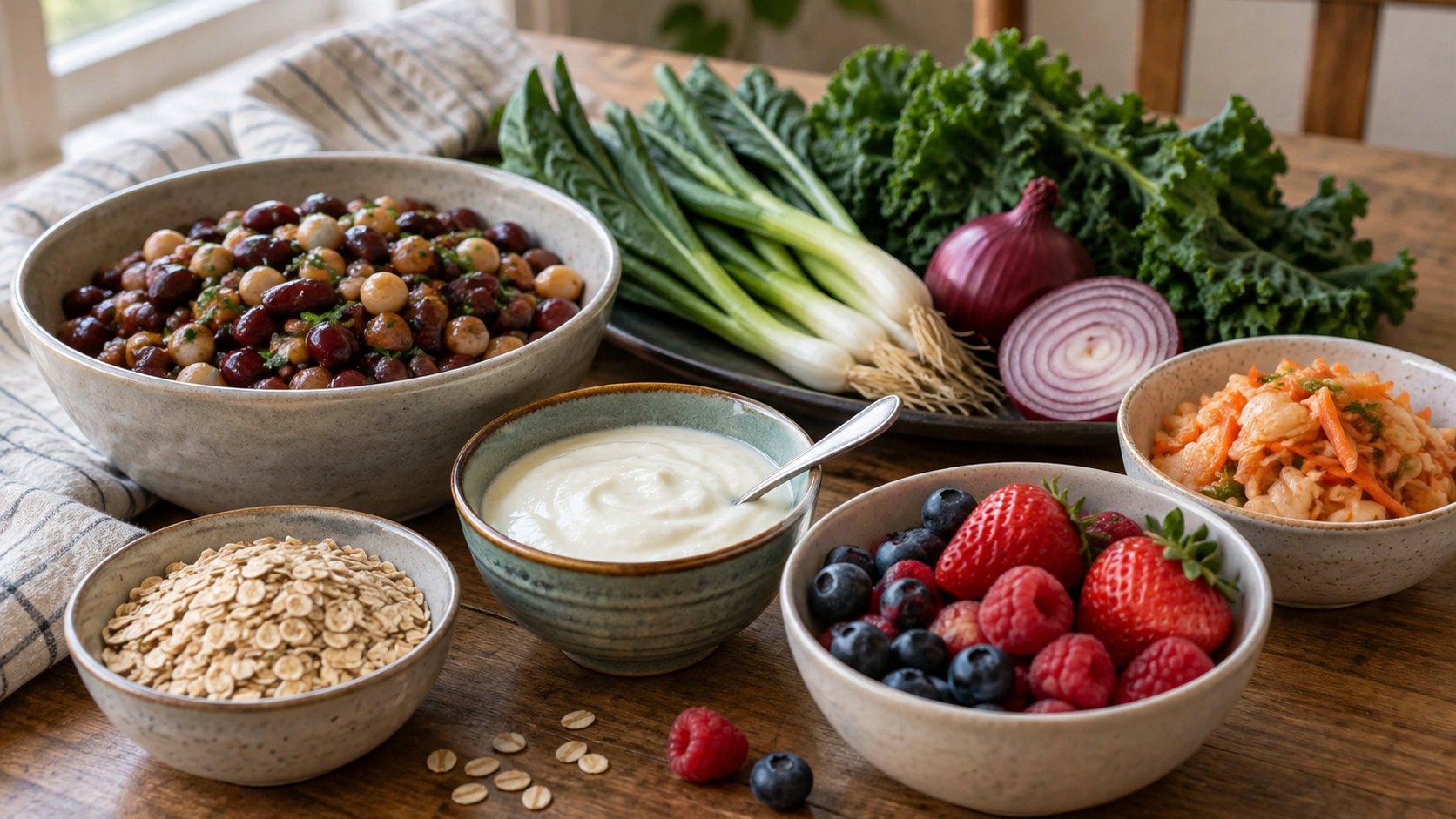
- Prebiotic foods (garlic, onions, oats, legumes) measurably feed beneficial bacteria.
What remains uncertain
- Most food-specific studies are small or short — the ranking is a judgment call on thin but real data.
- Individual responses vary: the same food helps some microbiomes and barely registers in others.
- Pasteurized versions of fermented foods lose the live-culture component — labels matter.
Evidence last reviewed: August 13, 2026. Conclusions may change as new research is published.
Product picks are generic categories, not brands. We may earn a commission on Amazon or iHerb purchases at no cost to you — this never changes our evidence conclusions. Full disclosure
Plain live kefir
A fermented dairy option for people who choose and tolerate it.
⚠️ Lactose intolerance, sugar content, and individual GI tolerance matter; select plain, live products when the article specifies them.
Grocery item — availability varies by region.
Check price on Amazon →The Ranked List
| Food | Evidence | What the research shows |
|---|---|---|
| 🥛 Yogurt (live cultures) | Strong | The best-studied fermented food; live-culture yogurt improves lactose tolerance and associates with lower type-2 diabetes risk; the Stanford fermented-foods trial's anchor food |
| 🥤 Kefir | Good | A more diverse culture than yogurt (yeasts + bacteria); small trials show gut and inflammatory-marker effects; the drinks topic owns its detail |
| 🥬 Kimchi | Good | Live lactic-acid bacteria + cabbage prebiotics + garlic/chili polyphenols — a three-in-one; Korean trials show modest lipid and inflammatory effects |
| 🥗 Sauerkraut (unpasteurized) | Moderate | Same live-culture logic; the catch: shelf-stable jars are pasteurized and contain no live bacteria — buy the refrigerated kind |
| 🧄 Garlic & onions | Good | Prebiotic inulin/fructans — fuel for beneficial bacteria; the hormetic pillar's allicin story adds the cardiovascular angle |
| 🌾 Oats & legumes | Good | The beta-glucan and resistant-starch sources — the fiber topic's territory, cross-linked not repeated |
| 🍜 Miso & natto | Moderate | Traditional ferments with cohort associations (Japan); natto adds vitamin K2 — promising, less trial data |
| 🫐 Berries & polyphenol foods | Moderate | Polyphenols act as prebiotics — bacteria convert them into bioactive metabolites; the vegetarian-hormesis topic's chemistry |
Plain live-culture yogurt
A convenient fermented-food option where an article specifically teaches live cultures as part of a dietary pattern.
⚠️ Dairy intolerance and added sugar matter; choose plain products with live cultures when that is the article-specific instruction.
Grocery item — availability varies by region.
Check price on Amazon →Three Rules for Buying
- 🧊 Buy from the refrigerator, not the shelf — shelf-stable sauerkraut, kimchi, and pickles are pasteurized: the live cultures are gone.
- 🏷️ Look for "live" or "active cultures" — on dairy; on vegetables, "unpasteurized" and "raw" are the signals.
- 🚫 Skip the sugar bombs — "probiotic" drinks with 15 g of added sugar are a dessert wearing a health claim; the cultures don't cancel the sugar (the Sugar pillar's evidence).
🌾 Where this page defers to the fiber topic
Beans, oats, vegetables, fruit, and seeds — the prebiotic heavyweights — appear here only as cross-links. The Nutrition pillar's fiber topic owns their fiber-quantity story; the hormetic pillar's vegetarian topic owns their phytochemistry. This page's unique contribution is the fermented foods — the live-culture half of the feeding strategy that the other pages only touch.
The Bottom Line
- Fermented foods lead the ranking — yogurt and kefir have the longest evidence trail.
- Buy refrigerated and live — pasteurization deletes the point.
- Prebiotic foods matter too — garlic, onions, oats, legumes feed the bacteria you're trying to keep.
- "Superfood" is marketing; the evidence is the ranking — and the ranking is a daily, varied, live-culture plate.
Refrigerated live fermented vegetables or kombucha
Can support a food-based fermented-food practice when the article specifically calls for a live refrigerated product.
⚠️ Kimchi and sauerkraut can be sodium-dense; raw kombucha can contain alcohol and added sugar can be substantial.
Grocery item — availability varies by region.
Check price on Amazon →Go Deeper: Subtopics
- 🔎 The ranking methodology — how the evidence tiers (T1–T3) were assigned, made transparent. Read it →
- 🔎 Beans & legumes, the undisputed champions — the resistant-starch and SCFA evidence. Read it →
- 🔎 The allium family — garlic, onion, leeks: prebiotic fructans and their cooking tricks. Read it →
- 🔎 The fermented tier — where kimchi and yogurt actually rank, with serving sizes. Read it →
- 🔎 "Superfood" as marketing — the honest reframe: why the list beats any single so-called wonder food. Read it →
Related Topics
- Wastyk et al., "Gut-microbiota-targeted diets modulate human immune status," Cell (2021)
- Kok & Hutkins, "Yogurt and other fermented foods as sources of health-promoting bacteria," Nutrition Reviews (2018)
- Marco et al., "Health benefits of fermented foods: microbiota and beyond," Current Opinion in Biotechnology (2017)
- Dimidi et al., "Fermented foods: definitions and characteristics, impact on the gut microbiota," Nutrients (2019)
- Han et al., "Contrasting effects of fresh and fermented kimchi consumption on gut microbiota," Molecular Nutrition & Food Research (2015)