Bone Broth & Collagen, Honestly
Bone broth is the drink with the best story and the thinnest file. The "heals your gut" narrative leans on real molecules — collagen, glutamine, glycine — but the gap between what a cup of broth contains and the doses used in actual trials is enormous. This page walks the claim against the record, then tells you what broth is still genuinely good for.
What the evidence supports
- Glutamine's role in supporting the intestinal barrier is real in clinical settings (Wischmeyer, Curr Opin Clin Nutr Metab Care, 2006).
- A randomized trial found glutamine supplements at 15 g per day improved symptoms in post-infectious IBS (Zhou et al., Gut, 2019).
- Glycine at 3 g before bed improved subjective sleep quality in a small trial (Yamadera et al., Sleep Biol Rhythms, 2007).
What remains uncertain
- No controlled human trials have tested bone broth itself for gut healing — none.
- Broth delivers its star amino acids at levels far below the doses used in the trials above (Alcock et al., Int J Sport Nutr Exerc Metab, 2019).
- Some broths carry measurable lead, concentrated from the bones they are made from (Monro et al., Med Hypotheses, 2013).
Evidence last reviewed: August 15, 2026. Conclusions may change as new research is published.
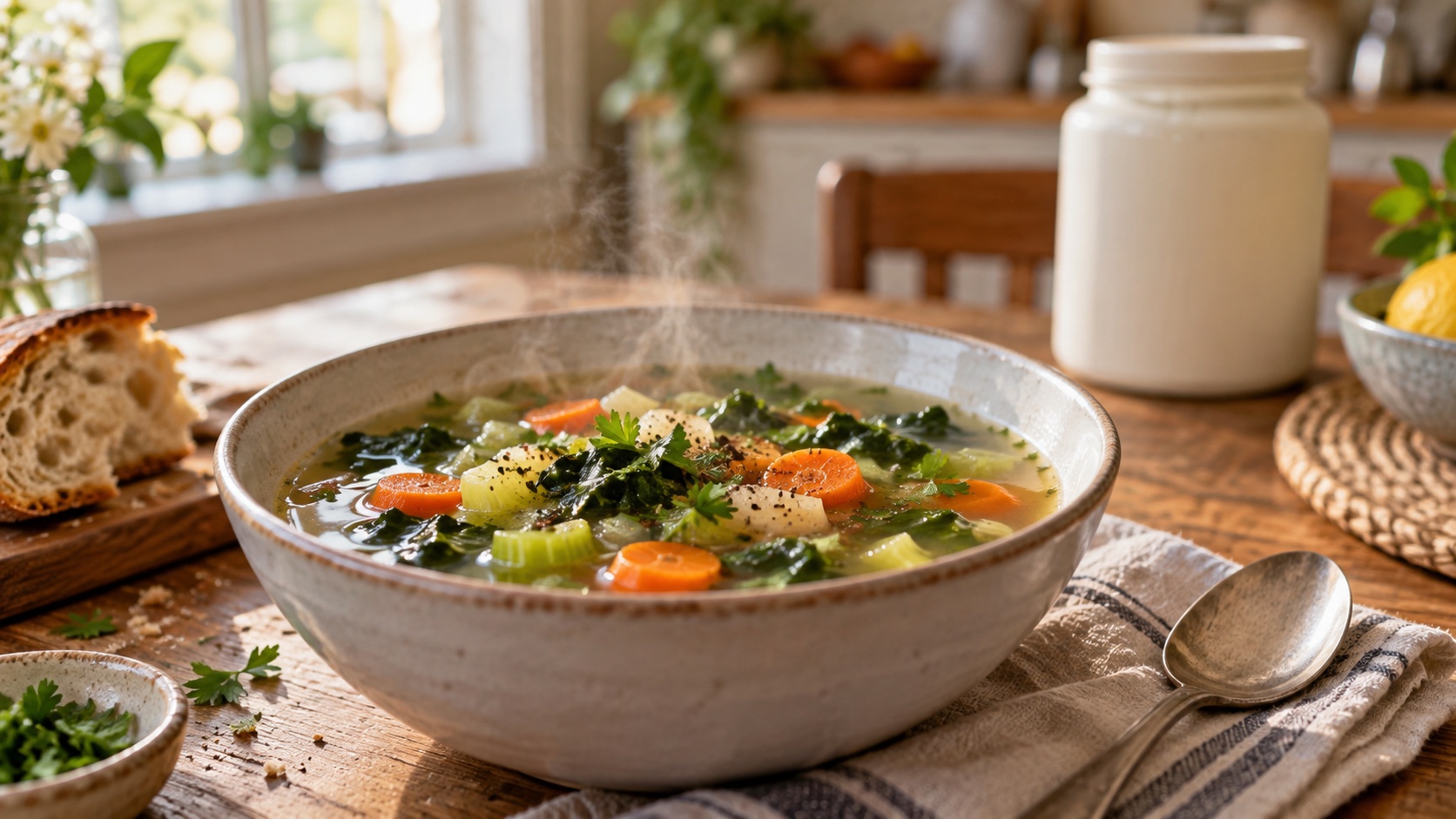
The Story Being Sold
The marketing narrative runs like this: simmered bones release collagen, collagen breaks down into glutamine and glycine, and those amino acids "seal and heal" the gut lining. Each link in that chain is real chemistry — collagen does hydrolyze, glutamine is a genuine fuel for intestinal cells, and glycine does have calming effects. The problem is not the biology; it is the dilution. At every step the story quietly skips how much actually survives the pot, and how much of what survives a cup actually delivers. The rest of this page puts numbers on those two gaps.
It is worth naming where the story comes from, because it was not born in a lab. The broth-as-gut-healer narrative grew out of ancestral-diet and elimination-diet communities, where it arrived bundled with a second claim — that a "leaky" gut is the hidden cause of everything from brain fog to joint pain. The leaky-gut topic audits that condition claim on its own terms; for this page the relevant point is that the two stories prop each other up. A comforting food with a plausible-sounding mechanism, attached to a hard-to-verify diagnosis, makes for a durable product narrative — durable because it is almost impossible to falsify with a cup of soup. The trial record below is what happens when someone actually tries.
Product picks are generic categories, not brands. We may earn a commission on Amazon or iHerb purchases at no cost to you — this never changes our evidence conclusions. Full disclosure
Low-sodium broth-based soup
A convenient volume-food option where an article explicitly teaches broth-based soup as part of a meal pattern.
⚠️ Sodium varies substantially by product; it is not a stand-alone weight-loss intervention and may not suit all dietary plans.
Check price on Amazon →What Broth Actually Contains
The most useful paper in this corner of nutrition is a composition study by Alcock, Shaw, and Burke (International Journal of Sport Nutrition and Exercise Metabolism, 2019). They analyzed eight commercial bone broths and concluded they are an unreliable source of collagen precursors compared with the supplements used in collagen research: protein content varied widely by brand — from a few grams to over ten per serving — and the collagen-specific amino acids glycine and proline were present at levels far below research doses. Long simmering also works against glutamine, which degrades with prolonged heat into glutamate and other compounds. A cup of broth is, chemically, a dilute and inconsistent version of the things its marketing says it is full of.
| Claim | What the record shows | Verdict |
|---|---|---|
| 🍲 Collagen "seals and heals" the gut lining | No human trials of broth or collagen for gut barrier function | No evidence |
| 🧪 Glutamine supports the barrier | Real — at 15 g per day of supplement-grade glutamine; a cup of broth delivers a small fraction | Partial |
| 😴 Glycine calms you down | One small trial at 3 g; a cup of broth delivers less, variably | Modest |
| 🦴 Rich in minerals | Sodium is the mineral you can count on; store broths are often quite salty | Varies |
The Trial Record for Gut Healing
Let it be said plainly: there are no controlled human trials of bone broth for intestinal permeability, IBS, IBD, or any other gut condition. The claim lives on plausibility, tradition, and the word "healing." The closest real evidence is about one of broth's supposed ingredients, not the broth: Zhou and colleagues randomized 106 people with post-infectious IBS with diarrhea to glutamine — 5 g three times daily, 15 g total — or placebo for eight weeks, and reported improved symptoms and normalized intestinal permeability in the glutamine group (Gut, 2019). That is a genuinely encouraging finding for glutamine at supplement doses. It is also the clearest possible illustration of the gap: the trial dose is many times what any reasonable serving of broth provides, and the broth's glutamine is partly degraded by heat before it reaches the spoon. Broth is not glutamine therapy; it is soup with a diluted whisper of it.
If you are managing an inflammatory bowel condition or persistent gut symptoms, the honest move is the one the leaky-gut topic spells out: work with a clinician on the interventions with actual trial support, and treat dietary changes — including supplements like glutamine — as a conversation, not a self-prescription. Nothing on this page is medical advice.
Collagen Peptides as a Supplement
A clarification that prevents a common confusion: collagen supplements are a different product from broth, and they do have trials — just not for the gut. A systematic review and meta-analysis of hydrolyzed collagen found improvements in skin aging measures (de Miranda et al., Int J Dermatol, 2021), and a randomized trial in older men reported that collagen peptides added to resistance training improved body composition versus the placebo combination (Zdzieblik et al., Br J Nutr, 2015). Those studies used standardized, dosed peptide powders — the form the Alcock analysis showed broth cannot reliably match. So the honest map is: collagen peptides have modest trial support for skin and, with exercise, muscle; broth has none for anything; and the gut specifically has neither. If gut healing is the goal, neither product is the answer the trials support.
The Evidence Ladder
What Broth Is Still Good For
None of this makes broth a bad food. It is a pleasant, hydrating, low-effort source of modest protein and salt — and "pleasant" has real value when appetite is poor or cooking energy is low. The defensible uses, in order:
- 🍳 A cooking base. As a braising liquid or soup foundation, broth earns its place without any health claims attached.
- 🍚 Appetite recovery. For low-appetite days after illness, a warm, salty cup is food you can actually finish — a genuine, modest benefit.
- 😴 The glycine sleep angle. The one ingredient with a real (small) trial: 3 g of glycine before bed improved subjective sleep quality. Broth delivers glycine, but variably and below that dose — an interesting curiosity, not a sleep protocol.
- 🧂 Watch the sodium. Store broths commonly carry several hundred milligrams of sodium per cup — relevant if you are watching blood pressure.
- ⚠️ And the lead. Bones concentrate lead from the environment, and organic chicken broth has measured measurably more lead than the water it was made with (Monro et al., 2013). An occasional cup is a non-issue; daily-gallon broth protocols are a different exposure.
If you make your own, the same honest lens applies: a pressure cooker shortens the hours, a splash of vinegar may modestly help mineral extraction, and salting it yourself — instead of trusting a store brand's sodium — keeps the one nutrient you can actually count on under control. Homemade broth is a genuinely good cooking ingredient. That is praise enough; it does not need the healing story to justify the pot on the stove.
🍲 Fine soup, weak medicine
Drink bone broth because it is warm and you like it — that is an honest reason, and it needs no study. Do not drink it expecting the work of a 15-gram glutamine protocol it never underwent. The gap between the story and the trial record is the widest on this entire drinks list, and it is worth naming: the broth is fine. The claims are the problem.
The Bottom Line
- The gut-healing claim has no human trials — the story rests on plausible biology, not on any study of broth itself.
- The dose gap is decisive: the glutamine RCT that worked used 15 g daily of supplement-grade glutamine; a cup of broth delivers a heat-degraded fraction of that.
- Broth is a fine food: a cooking base, a low-appetite rescue, and a modest protein source — enjoyed for taste, not for therapy.
- Two cautions are real — sodium in store brands and measurable lead in some broths — so an occasional cup beats a daily-gallon protocol.
Related Topics
- Alcock, Shaw & Burke, "Bone Broth Unlikely to Provide Reliable Concentrations of Collagen Precursors Compared With Supplemental Sources of Collagen Used in Collagen Research," International Journal of Sport Nutrition and Exercise Metabolism (2019)
- Zhou et al., "Randomised placebo-controlled trial of dietary glutamine supplements for postinfectious irritable bowel syndrome," Gut (2019)
- Yamadera et al., "Glycine ingestion improves subjective sleep quality in human volunteers, correlating with polysomnographic changes," Sleep and Biological Rhythms (2007)
- Monro, Leon & Puri, "The risk of lead contamination in bone broth diets," Medical Hypotheses (2013)
- de Miranda et al., "Effects of hydrolyzed collagen supplementation on skin aging: a systematic review and meta-analysis," International Journal of Dermatology (2021)
- Zdzieblik et al., "Collagen peptide supplementation in combination with resistance training improves body composition and increases muscle strength in elderly sarcopenic men," British Journal of Nutrition (2015)
- Wischmeyer, "Glutamine: role in gut protection in critical illness," Current Opinion in Clinical Nutrition and Metabolic Care (2006)