The 100-Trillion-Organism Ecology
Roughly 38 trillion bacteria share your body with you — about one for every human cell — and nearly all of them live in your colon. This page is the census: who actually lives there, how we count them, and why two rival methods (16S and metagenomics) keep giving the field different pictures. It ends with what the numbers do — and don't — justify buying.
What the evidence supports
- An adult gut carries on the order of 38 trillion bacteria — roughly one per human cell — with a mass of only about 200 grams (Sender et al., PLOS Biology, 2016).
- Two bacterial phyla, Firmicutes and Bacteroidetes, make up around 90% of the community, with thousands of species-level players in the long tail.
- The collective gene catalog — the metagenome — holds millions of unique genes, a far larger toolkit than the human genome's roughly 20,000.
What remains uncertain
- The famous "100 trillion" is a legacy estimate from the 1970s; revised counts are about a third of that, and the true number shifts with diet, transit time, and counting method.
- Knowing who is there is not the same as knowing what they do — most functional claims rest on DNA, not on measurements of live activity.
- There is no validated "normal" configuration: healthy people's microbiomes differ enormously, so no single census can grade anyone's health.
Evidence last reviewed: August 15, 2026. Conclusions may change as new research is published.
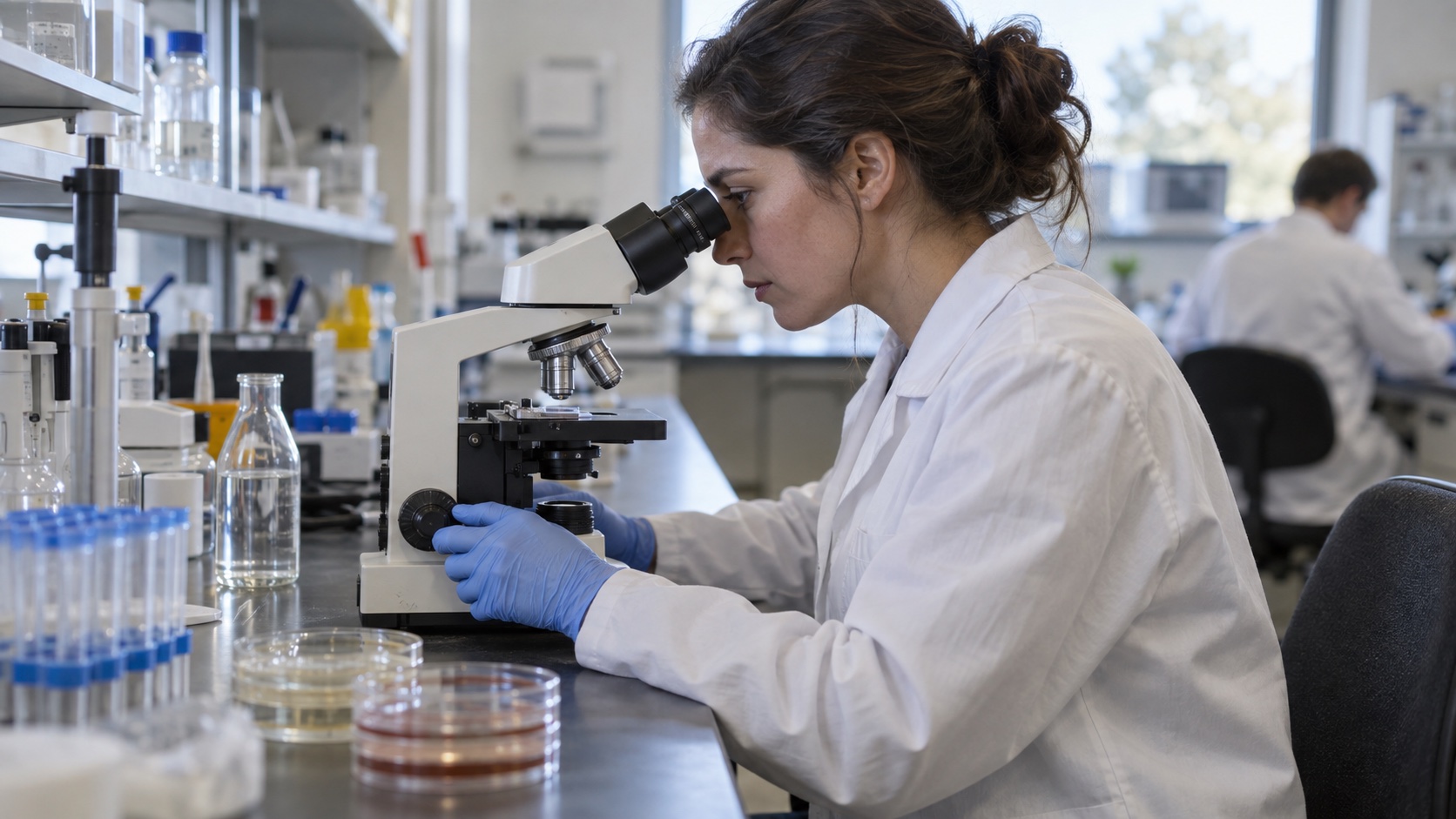
The 100 Trillion, Recounted
The number that launched a thousand supplement ads comes from Thomas Luckey's 1972 essay, which estimated the body hosts about 10^14 — one hundred trillion — microbes, most of them in the colon. For four decades that figure traveled unchallenged, usually dressed up as "10 times more bacteria than human cells." In 2016, a team at the Weizmann Institute sat down and re-did the arithmetic (Sender, Fuchs & Milo, PLOS Biology, 2016). Their revision: about 38 trillion bacteria and roughly 30 trillion human cells — a ratio close to 1:1, not 10:1. Total mass: on the order of 200 grams, about the weight of a small grapefruit. The corrected number is still staggering — it just earns its awe honestly. And like any census, it wobbles: transit time, fiber intake, and even the timing of your last bowel movement all move the count, which is one reason estimates span a wide band rather than a point value.
Who Actually Lives There
The gut community is not a random crowd. Two phyla dominate everywhere, and a long tail of minor players does most of the differentiating. The cast, in rough order of screen time:
- 🦠 Firmicutes (Bacillota). The largest phylum in most Western adults — roughly half of all bacteria. Includes Faecalibacterium, Lactobacillus, and the butyrate-producing Roseburia cluster.
- 🟣 Bacteroidetes (Bacteroidota). The second giant, roughly a third of the community. Fibers' first responders — the carbohydrate-degradation specialists.
- 🩵 Actinobacteria. A small but famous minority — home of the Bifidobacterium genus that dominates breastfed infants.
- 🟡 Proteobacteria (Pseudomonadota). Usually a few percent; a category that tends to expand when the gut is inflamed or disturbed.
- 🍄 Fungi, archaea, and viruses. Small by number, not by influence: methanogenic archaea shape gas and transit, fungi form a persistent minority, and phages — viruses that infect bacteria — outnumber everything else.
One Ecosystem, Thousands of Species
A single person's gut typically carries around 150 to 200 species of bacteria; across the human population, the MetaHIT consortium found more than 1,000 prevalent species (Qin et al., Nature, 2010). Beneath the species level sits the part of the census that usually gets skipped: strains. Two people can carry "the same" E. coli species while hosting different strains with different genes — which is why strain-level differences help explain why the same diet moves different people in different directions. That resolution gap is a known limitation of 16S surveys, documented bluntly by Johnson et al. in Nature Communications (2019): the popular marker often cannot tell strains apart at all. The gene math is the more humbling comparison. The first integrated catalog counted 3.3 million unique microbial genes — roughly 150 times the human genome's gene count — and later catalogs have pushed the figure higher still. Most of those genes are uncharacterized: we can read them, and often we cannot yet say what they do. For what the ecosystem does with that toolkit — short-chain fatty acids, vitamins, bile-acid recycling — see the Fiber & Fermented Foods topic, which owns the mechanism chain in detail.
Two Ways of Counting: 16S vs Metagenomics
Most of what the public hears about "your microbiome" comes from one of two laboratory methods, and they answer different questions. 16S sequencing reads a single marker gene that all bacteria carry and asks who is there. Shotgun metagenomics sequences all the DNA in the sample and asks what can they do. The trade-off is cost and depth:
| 🔍 Question | 16S rRNA sequencing | 🧬 Shotgun metagenomics |
|---|---|---|
| What it reads | One marker gene shared by all bacteria | All DNA in the sample — bacteria, fungi, viruses |
| Taxonomic resolution | Family and genus; species only sometimes | Species and often strain level |
| Function | Inferred from who is present | Genes and pathways read directly |
| Cost and speed | Cheaper, faster, older database | Costlier, heavier analysis, richer output |
| Verdict | Survey | Deep view |
The landmark population studies run both: the Human Microbiome Project (2012) mapped the healthy baseline across body sites, and its expanded follow-up added strain-level dynamics (Lloyd-Price et al., Nature, 2019). Most commercial stool tests run 16S — which is fine for a rough census and worth knowing when a product promises more than a survey can deliver.
What the Numbers Don't Tell You
- 📊 Presence is not activity. DNA in stool shows who was carried along; it does not show which genes were switched on, at what rate, doing what. Function follows measurement, not just detection.
- 🔄 The census moves. The ecosystem reshuffles within days of a diet change — the David et al. feeding study (Nature, 2014) showed an animal-based diet shifting the community within about a day. Single snapshots capture a moving target.
- 🧭 There is no healthy template. Healthy adults differ wildly in composition. A configuration that looks "low" in one person may be their lifelong normal.
- 🩺 Stool is not the gut wall. Fecal samples underrepresent the mucosa-associated communities doing much of the signaling — a sampling bias, not a conspiracy.
So What Should You Actually Do?
Nothing on this page requires you to commission your own census. The levers that shape the ecosystem are the boring ones, and they belong to other pages:
- 🌾 Feed it fiber. The dominant phyla run on the plant material you cannot digest — the evidence and dose are on the Fiber topic.
- 🥬 Vary the plants. Different fibers feed different species; variety is the cheap version of diversity-by-diet (Fiber & Fermented Foods).
- 💊 Go easy on the census-killers. Antibiotics prune the tree hard; what happens next — and how to rebuild — is the Antibiotics & Recovery page.
- 👶 And if you're curious how the tree got planted, the development page walks the first thousand days.
🔬 The $99 stool test, honestly
A commercial gut test can list which genera showed up in one sample. It cannot tell you what to change, because there is no validated reference range for "healthy composition" and no evidence that acting on a percentile score improves outcomes. Treat the report as a souvenir, not a treatment plan. Tests ordered by a clinician for a specific question — recurrent C. difficile, suspected infection — are a different, legitimate category.
The Bottom Line
- The census has been corrected. Roughly 38 trillion bacteria, about one per human cell, weighing only ~200 grams — the 100-trillion figure is a 1970s estimate that survived on inertia.
- Two phyla dominate, a long tail differentiates. Firmicutes and Bacteroidetes hold ~90% of the community; strains, not just species, explain individual differences.
- 16S tells you who; metagenomics tells you what they can do. Most functional claims rest on genes, not measured activity — and millions of those genes remain uncharacterized.
- You don't need a census to act. Diet moves the ecosystem within days, and the levers are fiber, plant variety, and antibiotic stewardship — not a stool test.
Related Topics
- Sender, Fuchs & Milo, "Revised estimates for the number of human and bacteria cells in the body," PLOS Biology (2016)
- Luckey, "Introduction to intestinal microecology," American Journal of Clinical Nutrition (1972)
- Qin et al., "A human gut microbial gene catalogue established by metagenomic sequencing," Nature (2010)
- Human Microbiome Project Consortium, "Structure, function and diversity of the healthy human microbiome," Nature (2012)
- Lloyd-Price et al., "Strains, functions and dynamics in the expanded Human Microbiome Project," Nature (2019)
- Johnson et al., "Evaluation of 16S rRNA gene sequencing for species and strain-level microbiome analysis," Nature Communications (2019)
- David et al., "Diet rapidly and reproducibly alters the human gut microbiome," Nature (2014)