Contrast Therapy
Hot then cold, cold then hot: contrast therapy is the oldest tradition in this pillar and the thinnest on evidence. Millions of Finns and Eastern Europeans have cycled sauna and cold water for centuries, and sports science has spent decades trying to find out whether it actually does anything — with results that are, at best, modest. This page separates the claimed benefits from what the trials actually show, then explains why you might do it anyway. The parent topic covers the basic cycle; here is the evidence ledger.
What the evidence supports
- Athletes report feeling more recovered after contrast water immersion, and perceived recovery matters for returning to training (Versey et al., Sports Medicine, 2013).
- The acute physiology is real: hot phases dilate skin vessels, cold phases constrict them, and blood pressure swings measurably through the cycle.
- Contrast baths do not meaningfully change deep muscle temperature — the classic "flush the muscles" story is not what the instruments measure (Higgins & Kaminski, Journal of Athletic Training, 1998).
What remains uncertain
- No trial has tested contrast therapy against hard health outcomes — cardiovascular events, mortality, or anything the longevity frame cares about.
- Whether cycling hot and cold beats either alone is unstudied at any serious scale; the sports trials compare contrast against rest, not against sauna-only.
- Protocol details (temperatures, durations, number of cycles) are tradition, not trial-derived — every study used a different recipe.
Evidence last reviewed: August 15, 2026. Conclusions may change as new research is published.
What Contrast Therapy Actually Is
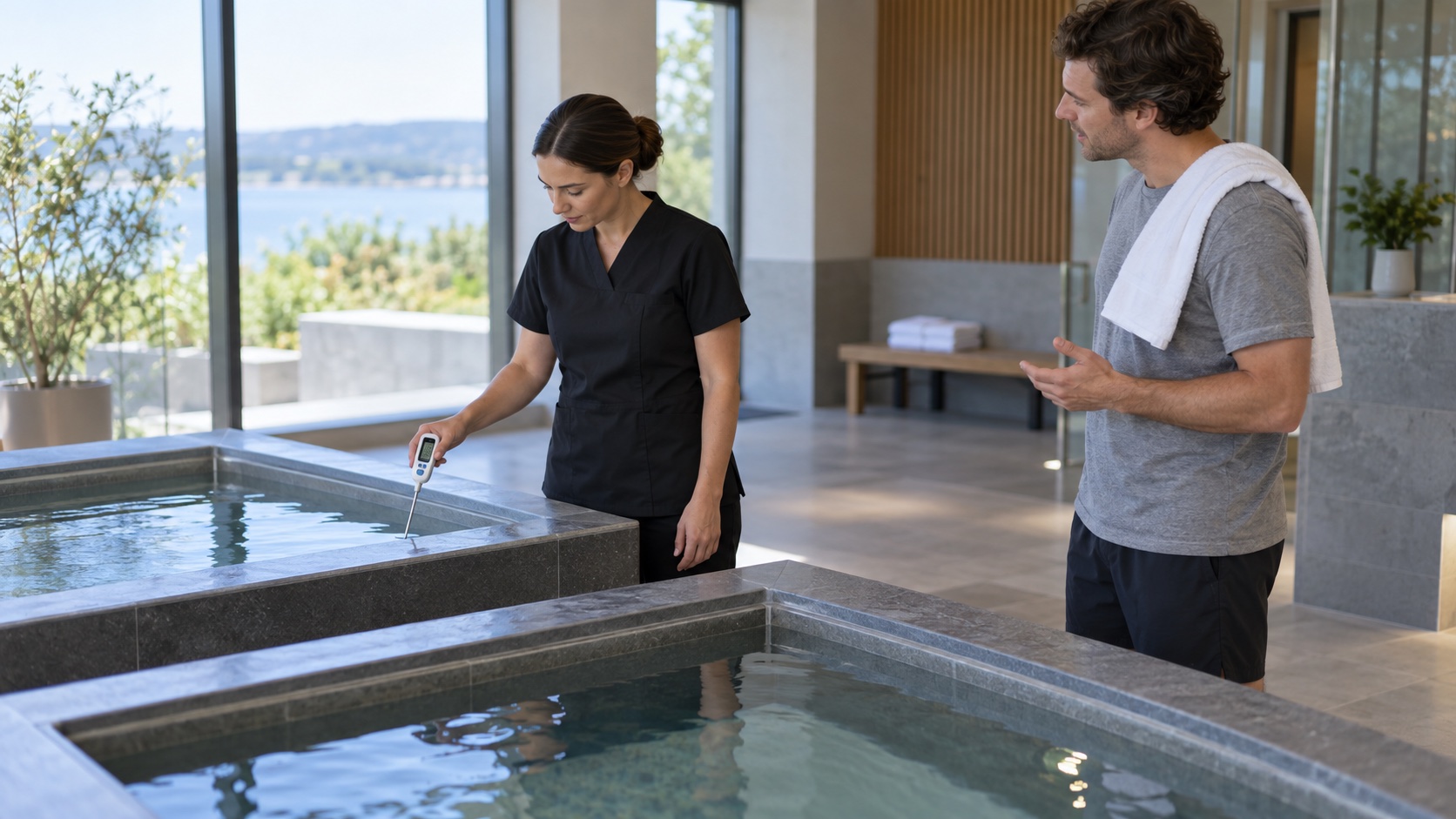
The pattern is simple and old: a hot phase long enough to make you sweat, a cold phase brief enough to be a shock rather than a chill, then a rest, repeated two or three times, finishing warm or neutral. In Finnish sauna culture the rhythm is sauna, cold plunge or snow, rest — often with a drink of water — and back in. The parent topic's version runs 10–15 minutes hot, 1–2 minutes cold, and a 5-minute rest per lap. The claimed mechanism is the alternating squeeze: skin vessels open wide in heat, clamp down in cold, and the rapid switching is said to pump blood, flush waste, and train the vasculature. The claim sounds mechanical enough to be true, which is precisely why it deserves scrutiny.
The tradition deserves a sentence of respect before the evidence takes over. Finnish sauna culture has cycled heat and cold for centuries, and the Eastern European banya tradition pairs hot rooms with cold plunges the same way. A practice that survives centuries earns attention; it does not earn a pass on measurement. Those are two different claims, and the rest of this page is about the second one.
Product picks are generic categories, not brands. We may earn a commission on Amazon or iHerb purchases at no cost to you — this never changes our evidence conclusions. Full disclosure
Smart band or smartwatch
Can make activity, exercise, and routine patterns easier to notice over time.
⚠️ Step, heart-rate, and sleep estimates can be inaccurate and may encourage unhelpful over-monitoring; consumer readings are not medical diagnoses.
Check price on Amazon →The Claims, Mapped to the Evidence
The table reads each claim against the studies, and the honest pattern is that every claim is weaker than its marketing — sometimes usefully so, sometimes terminally.
| Claimed benefit | What the studies actually show | Read |
|---|---|---|
| 🧊 Faster recovery from soreness | Small, short-term trials, mixed results; the Cochrane review of cold-water immersion found limited evidence of a modest effect on muscle soreness, and contrast variants were studied far less than plain cold (Bleakley et al., 2012) | Mixed |
| 😌 Feeling recovered, sooner | Athletes consistently rate themselves more recovered after water-immersion recovery, contrast included — the most reproducible finding in the field (Versey et al., 2013) | Reproducible |
| 🫀 Circulation and blood pressure | Acute vessel dilation and constriction are measurable, but studies of lasting cardiovascular benefit from the cycling itself are essentially absent | Limited |
| ⏳ Longevity and health outcomes | No data. The mortality-grade evidence in this pillar belongs to heat alone, not to the hot-cold combination | No data |
Why the "Vascular Pump" Story Falls Short
The intuitive case for contrast therapy goes like this: heat opens the vessels, cold slams them shut, and the repeated squeeze pumps blood through tired muscles. It is a satisfying image, and the instruments do not support it. When researchers measured muscle temperature inside the gastrocnemius during contrast baths, the hot-cold cycling produced no meaningful fluctuation in deep muscle temperature at all (Higgins & Kaminski, 1998). Skin blood flow swings dramatically; a few centimeters down, almost nothing moves. The hydrostatic pressure of simply being immersed in water may matter more than the temperature swing itself — compression from outside, not pumping from within — which would explain why athletes feel better after plain water immersion too (Wilcock et al., Sports Medicine, 2006). None of this makes contrast therapy useless; it makes the popular mechanism mostly story. The honest reading is that the cycle is a gentle cardiovascular stimulus — a vessel-opening, vessel- closing drill — with plausible but unmeasured long-term effects, wrapped in a tradition that feels good.
🤔 Recovered feelings are still real
"It just feels like it works" is routinely dismissed, and here it should not be. Perceived recovery predicts willingness to train again, and a recovery ritual you believe in is a recovery ritual you keep. The mistake is the upgrade: feeling recovered after contrast cycling is not evidence that the cycling improved your long-term health, and it is not a reason to skip sleep, food, or actual rest days. Enjoy the ritual; keep the ledger honest. That distinction — felt benefit versus measured outcome — is the whole lesson of this page.
The Real Safety Notes of Cycling
Contrast therapy is a cardiovascular drill, and the risks are the same ones the rest of this series maps — just sequenced faster. Each hot phase ends in the post-sauna blood-pressure dip the sauna safety page describes; each cold entry spikes pressure and heart rate within seconds (Tipton et al., Experimental Physiology, 2017). Cycling between the two means the system swings both directions in the space of minutes. For a healthy, hydrated adult that is the point of the exercise. For anyone with uncontrolled blood pressure, unstable cardiac disease, or a history of fainting, it is a reason to read the medical screen page before trying it — and the practical rules are not optional: hydrate through the session (the hydration page runs the math), never enter cold water alone, never after alcohol, and never rush the transitions. The Finnish pattern's built-in rest lap is not decoration; it is the safety margin.
If You Want to Try It
- 🔥 Start with the hot phase you already own. If you have not completed the first-month sauna plan, that is the prerequisite — contrast cycling assumes both ends of the cycle are individually comfortable.
- 🧊 Keep the cold phase brief. One to two minutes is the tradition and the sensible range; the goal is the shock, not the chill. Use the cold plan's breathing rule on every entry.
- 😌 Rest laps are mandatory. Five minutes of sitting between cycles lets blood pressure return before the next swing; two or three laps total is plenty.
- 💧 Finish warm or neutral, and drink. Ending a contrast session with a long cold soak leaves you chilled and shivering; the tradition finishes warm, then rehydrates.
- 📉 Watch the markers. If recovery signals turn negative — sleep worse, resting heart rate up — the cycling is a stressor without a recovery side, and the dose topic's answer is to step back a rung.
- 📝 Expect a learning curve. The first cycle often feels worse than a plain sauna; the sequence usually clicks by the third or fourth session. If it never clicks, the evidence does not require you to keep it.
Questions, Answered Briefly
- 🥇 Does contrast beat sauna alone? No trial answers this. The mortality-grade evidence belongs to heat alone; contrast is an enjoyment upgrade, not a requirement — the parent topic says exactly this.
- 💪 Is it good for muscle growth? The cold phases carry the same caution as any post-lifting cold exposure: immersion soon after resistance training may blunt the muscle-building signal, so keep contrast sessions away from the hours after lifting, as the cold-after-training page details.
- 🌙 Morning or evening? The arousal from cold makes morning a natural fit; evening sessions should finish warm and end a couple of hours before bed, per the parent topic's timing rules.
- 🧪 What about DOMS specifically? The Cochrane review of cold-water immersion found limited, low-quality evidence of a modest effect on delayed soreness — real enough to keep studying, weak enough that contrast should not be your only recovery tool.
- 🛁 Shower version? A hot-to-cold shower cycling is a fine entry point and the same pattern at lower intensity — the same transitions, the same rest between, the same finish-warm rule.
The Bottom Line
- The tradition is old; the evidence is young and thin — small sports-science trials, no outcome data, and no standard protocol to test.
- The best-supported claim is feeling recovered — reproducible across studies, genuinely useful for adherence, and not the same thing as a health outcome.
- The "vascular pump" mechanism is mostly story — deep muscle temperature barely moves during contrast baths, and simple immersion may do much of the work.
- Treat it as an enjoyable upgrade, not a requirement — earn both ends of the cycle first, respect the pressure swings, and let the markers decide the dose.
Related Topics
- Bleakley C, McDonough S, Gardner E, Baxter GD, Hopkins JT, Davison GW, "Cold-water immersion (cryotherapy) for preventing and treating muscle soreness after exercise," Cochrane Database of Systematic Reviews (2012)
- Versey NG, Halson SL, Dawson BT, "Water immersion recovery for athletes: effect on exercise performance and practical recommendations," Sports Medicine (2013)
- Higgins D, Kaminski TW, "Contrast therapy does not cause fluctuations in human gastrocnemius intramuscular temperature," Journal of Athletic Training (1998)
- Wilcock IM, Cronin JB, Hing WA, "Physiological response to water immersion: a method for sport recovery?" Sports Medicine (2006)
- Tipton MJ, Collier N, Massey H, Corbett J, Harper M, "Cold water immersion: kill or cure?" Experimental Physiology (2017)