Spices as Hormetins
A spice is a plant's chemical defense concentrated — which makes the spice rack a natural test of the plant-hormesis idea at its strongest dose. This page reads the dose-response honestly, spice by spice: where the human evidence is genuinely good, where it is a measurement artifact, and why the food version keeps winning over the pill version.
What the evidence supports
- High-concentration topical capsaicin has strong trial support for specific neuropathic pain.
- Near-daily chili consumption was associated with meaningfully lower mortality in a half-million-person cohort.
- Ginger has consistent, modest effects on nausea and small effects on osteoarthritis pain.
What remains uncertain
- Curcumin's literature is heavily contaminated by assay-interference artifacts; convincing human trials are lacking.
- The mortality association with chili comes from one cohort culture and cannot separate chili from the rest of the meal.
- Very high chronic chili intake has been associated with higher gastric cancer risk in some Asian cohorts — dose cuts both ways.
Evidence last reviewed: August 15, 2026. Conclusions may change as new research is published.
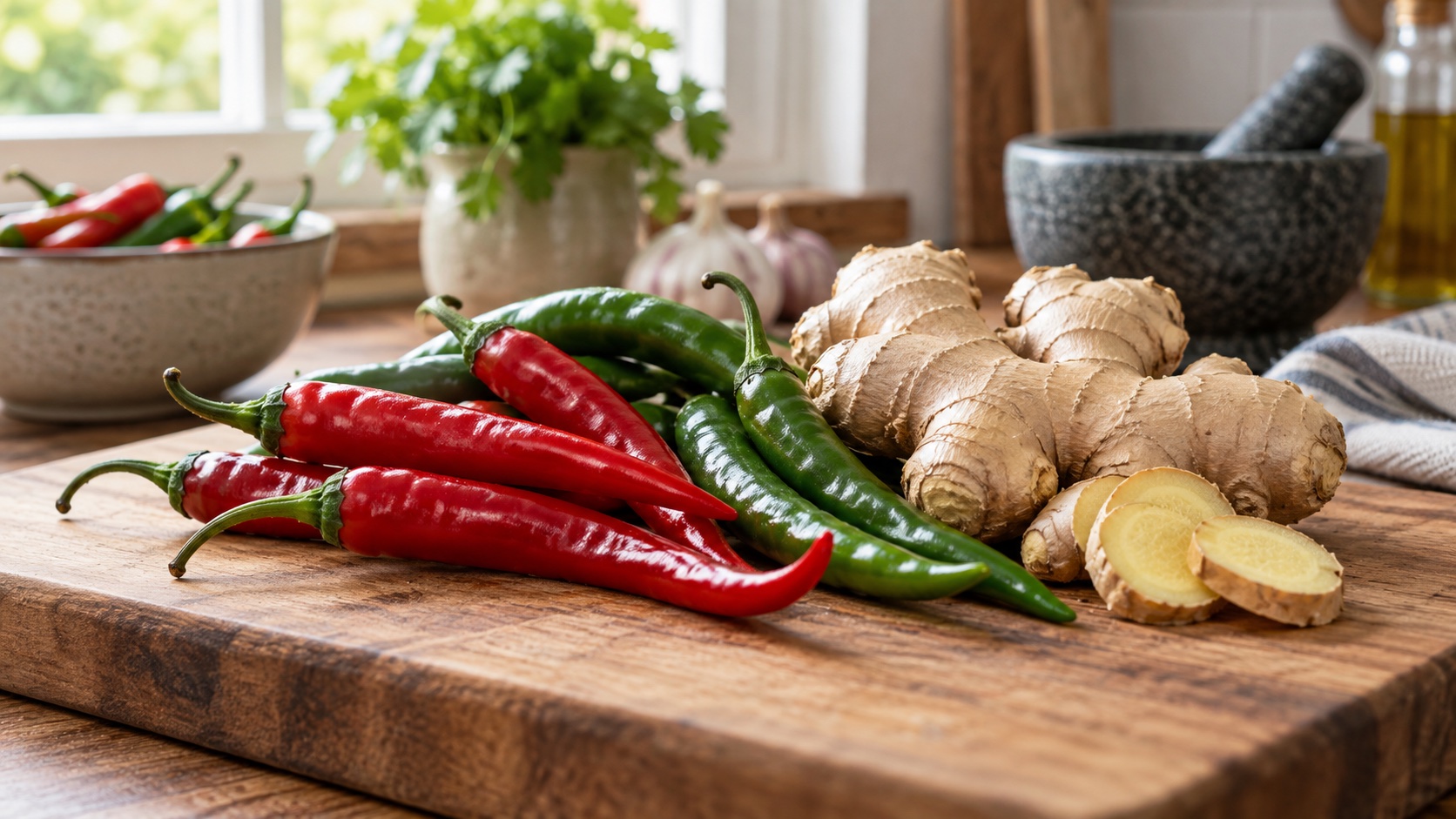
Why Spices Belong in a Hormesis Topic
The compounds that make spices interesting — capsaicin's burn, ginger's pungency, curcumin's yellow — are plant defenses against insects and microbes, concentrated in the parts of the plant most worth protecting. Eating them is a mild chemical provocation, and the body responds with adaptation: that is the definition of a hormetin, and the parent topic, The Vegetarian Diet & Plant Hormesis, situates spices inside its wider plant-stress story. What distinguishes the spice shelf is dose: nobody eats a pound of black pepper, but a single hot chili delivers an acute physiological event — pain signaling, sweating, endorphin release. That intensity makes spices the hormesis idea's sharpest test, and the results are instructive precisely because they are uneven.
Product picks are generic categories, not brands. We may earn a commission on Amazon or iHerb purchases at no cost to you — this never changes our evidence conclusions. Full disclosure
Culinary turmeric, ginger, and chili
Culinary spices for pages that explicitly recommend cooking with whole-food spice forms.
⚠️ GI tolerance and medication context matter; culinary amounts are not equivalent to extracts or supplements.
Check price on Amazon →Capsaicin: The Pain Signal That Protects
Capsaicin works by a receptor that scientists would have invented if plants had not: TRPV1, the heat-and-pain channel characterized by Caterina and colleagues in Nature (1997), which detects both actual heat and the chemical "burn" of chili. The body's response to repeated, controlled activation is desensitization — the channel runs down and pain signals quiet — which is the mechanism behind the strongest clinical result in this whole topic: high-concentration capsaicin patches for neuropathic pain, supported by Cochrane reviews (Derry et al., 2017). Note the dose logic: this is not eat-more-chili medicine, it is a concentrated topical intervention under clinical supervision — a ⚠️ clinician-territory use, not a kitchen protocol.
At the food level, the most interesting data come from China: in a cohort of nearly half a million adults followed for about seven years, people who ate spicy food six or seven days a week had roughly 14% lower total mortality than those who ate it less than once a week (Lv et al., BMJ, 2015). The usual cautions apply in full force: one culture, one observational dataset, and chili eaters differ from abstainers in ways adjustment never fully captures. The association is real; its causal share is unknown. The hormetic dose topic explains why this kind of cohort curve invites both enthusiasm and restraint. One more capsaicin claim deserves its quiet burial here: the "fat-burning" narrative. Short trials do show capsaicinoids nudging energy expenditure upward, but the summed effects are small, transient, and nowhere near a weight-management strategy — the sort of statistically significant, practically negligible finding this site tries to label honestly.
Curcumin: The Cautionary Tale
Turmeric's active compound is the most-studied spice molecule in history and the field's clearest cautionary tale. The turning point was Nelson and colleagues' 2017 analysis in the Journal of Medicinal Chemistry, which documented that curcumin is a classic assay-interference compound: it fluoresces, chelates metals, and destabilizes membranes, so it produces impressive-looking "activity" in the test systems used for early screening — results that vanish when those artifacts are controlled for. Human trials have compounded the problem: absorption is poor, metabolism is fast, and the formulations that fix absorption still fail to separate from placebo on hard outcomes. The practical reading, developed further on the polyphenol families page: turmeric as a food is fine and pleasant; curcumin as a supplement is a large industry resting on a small evidence base, and the big five supplements page explains why it does not make that short list.
Ginger: The Solid Middle
Ginger sits between capsaicin's real results and curcumin's artifacts — unglamorous, modest, and reasonably consistent. The two best-supported uses: nausea, where a systematic review and meta-analysis found ginger reduced pregnancy-related nausea (Viljoen et al., Nutrition Journal, 2014), and osteoarthritis pain, where a meta-analysis of randomized trials found small but real improvements in pain and disability versus placebo (Bartels et al., Osteoarthritis and Cartilage, 2015). The honest sizes matter: these are "modest and consistent" effects, the kind that make ginger a reasonable kitchen adjunct and a poor substitute for the first-line treatments the medical literature actually recommends.
Cinnamon, Garlic, and the Rest of the Rack
Three more spice-rack regulars deserve honest placement, because they show up constantly in supplement marketing:
- 🥄 Cinnamon and blood glucose. Meta-analyses of small, short trials (Allen et al., Annals of Family Medicine, 2013) found modest reductions in fasting glucose with cinnamon supplementation — statistically real but small, heterogeneous, and far short of what glucose-lowering medication achieves. It is a garnish on glucose management, not a treatment, and ⚠️ anything resembling diabetes care belongs with a clinician.
- 🧄 Garlic and blood pressure. The allicin chemistry the parent topic introduces has modest, reproducible blood-pressure effects in trials of garlic preparations — useful context, since alliums are a daily food in most of the diets this topic series recommends.
- ⚫ Black pepper and absorption. Piperine, black pepper's pungent compound, is added to turmeric extracts to force absorption — which turns one problem (curcumin's poor bioavailability) into another (more compound circulating with no better outcomes). Piperine also inhibits enzymes that clear common medications, so combination products deserve real caution rather than casual use.
The Dose-Response, Honestly Read
| Spice | Claim | What the dose-response actually shows | Verdict |
|---|---|---|---|
| 🌶️ Capsaicin | Longevity from spicy food | Lower mortality with frequent use in one large cohort; the causal share is unknown | Moderate |
| 🫚 Ginger | Nausea relief | Consistent modest effect in pregnancy-related nausea trials | Good |
| 🟡 Turmeric | Anti-inflammatory benefits from extracts | Artifact-heavy literature; extracts fail to beat placebo on hard endpoints | Weak |
| 🔥 High-dose chili | Harmless at any dose | Some Asian cohorts associate very high chronic intake with gastric cancer risk | Caution |
The dose-response pattern across all three spices is the classic hormetic shape the dose topic documents: low-to-moderate, intermittent exposure provokes adaptation; chronic extreme exposure slides into irritation. For chili specifically, the honest reading is that the protective association and the gastric-cancer caution signal both sit in observational data from different populations — enough to justify "spices as food, in reasonable amounts," and not enough to justify anything stronger.
⚖️ Food yes, pills no
The audit rule from the polyphenol families page applies with extra force here: spice compounds earned their effects inside whole foods — with fiber, matrix, and culinary context — and the evidence repeatedly collapses when they are isolated into extracts. Cook with ginger and turmeric freely, enjoy chili at a level your gut tolerates, and treat concentrated spice supplements as an industry looking for evidence rather than evidence looking for consumers.
Questions, Answered Briefly
- 🌶️ Should I eat chili every day? The cohort data associate frequent chili with lower mortality, but one observational dataset from one food culture is not a prescription. If you enjoy it and tolerate it, fine; forcing it is not evidence-based.
- 💊 Is a curcumin pill worth it? The trial record says no — the promising early signals trace largely to assay artifacts. Use turmeric in food and keep your money.
- 🫚 Ginger tea or ginger supplement? For nausea, either appears to work at food-level doses. For osteoarthritis, the effect is real but small — expectations should match.
- 🥵 Can spicy food be harmful? At very high chronic intake, some cohorts show elevated gastric cancer risk. Moderation — the hormetic dose — is the reading that fits all the data at once.
- 🔥 Does chili "boost metabolism"? Capsaicinoids raise energy expenditure a little in short trials, and the summed effect is small — nowhere near a weight-management strategy. Enjoy the food; ignore the fat-burner framing.
The Bottom Line
- Spices are hormesis in concentrated form — plant-defense compounds at doses that provoke a real physiological response.
- The evidence is sharply uneven — topical capsaicin and ginger for nausea clear the bar; curcumin extracts do not.
- Dose cuts both ways — frequent moderate chili associates with lower mortality in one cohort; extreme intake associates with harm in others.
- Keep spices in food — the whole-food context is where every one of these compounds earned its evidence.
Related Topics
- Lv et al., "Consumption of spicy foods and total and cause specific mortality: population based cohort study," BMJ (2015)
- Caterina et al., "The capsaicin receptor: a heat-activated ion channel in the pain pathway," Nature (1997)
- Derry et al., "Topical capsaicin (high concentration) for chronic neuropathic pain in adults," Cochrane Database of Systematic Reviews (2017)
- Nelson et al., "The essential medicinal chemistry of curcumin," Journal of Medicinal Chemistry (2017)
- Allen et al., "Cinnamon use in type 2 diabetes: an updated systematic review and meta-analysis," Annals of Family Medicine (2013)
- Viljoen et al., "A systematic review and meta-analysis of the effect and safety of ginger in the treatment of pregnancy-associated nausea and vomiting," Nutrition Journal (2014)
- Bartels et al., "Efficacy and safety of ginger in osteoarthritis patients: a meta-analysis of randomized placebo-controlled trials," Osteoarthritis and Cartilage (2015)