The Cruciferous Case
Of everything the plant-hormesis idea promises, one compound delivers on it most completely: sulforaphane, from broccoli and its cruciferous relatives. This page follows the full story — the chemistry that makes it unusual, the human trials that set it apart, the dose that actually works, and the places where even this strongest story runs out of road.
What the evidence supports
- Sulforaphane activates the Nrf2 pathway — the cell's antioxidant-defense switch — in human trials with a mapped molecular mechanism.
- Sprout preparations measurably increased detoxification of air pollutants and aflatoxin in randomized trials.
- In one controlled trial in type 2 diabetes, sulforaphane modestly reduced fasting glucose.
What remains uncertain
- No trial has shown sulforaphane reduces cancer, cardiovascular events, or mortality — the biomarker changes are real, the endpoint evidence is absent.
- Nrf2 activation is not unambiguously good: some cancers hijack the pathway for their own protection.
- How much of the benefit comes from sulforaphane versus the rest of the vegetable remains unclear.
Evidence last reviewed: August 15, 2026. Conclusions may change as new research is published.
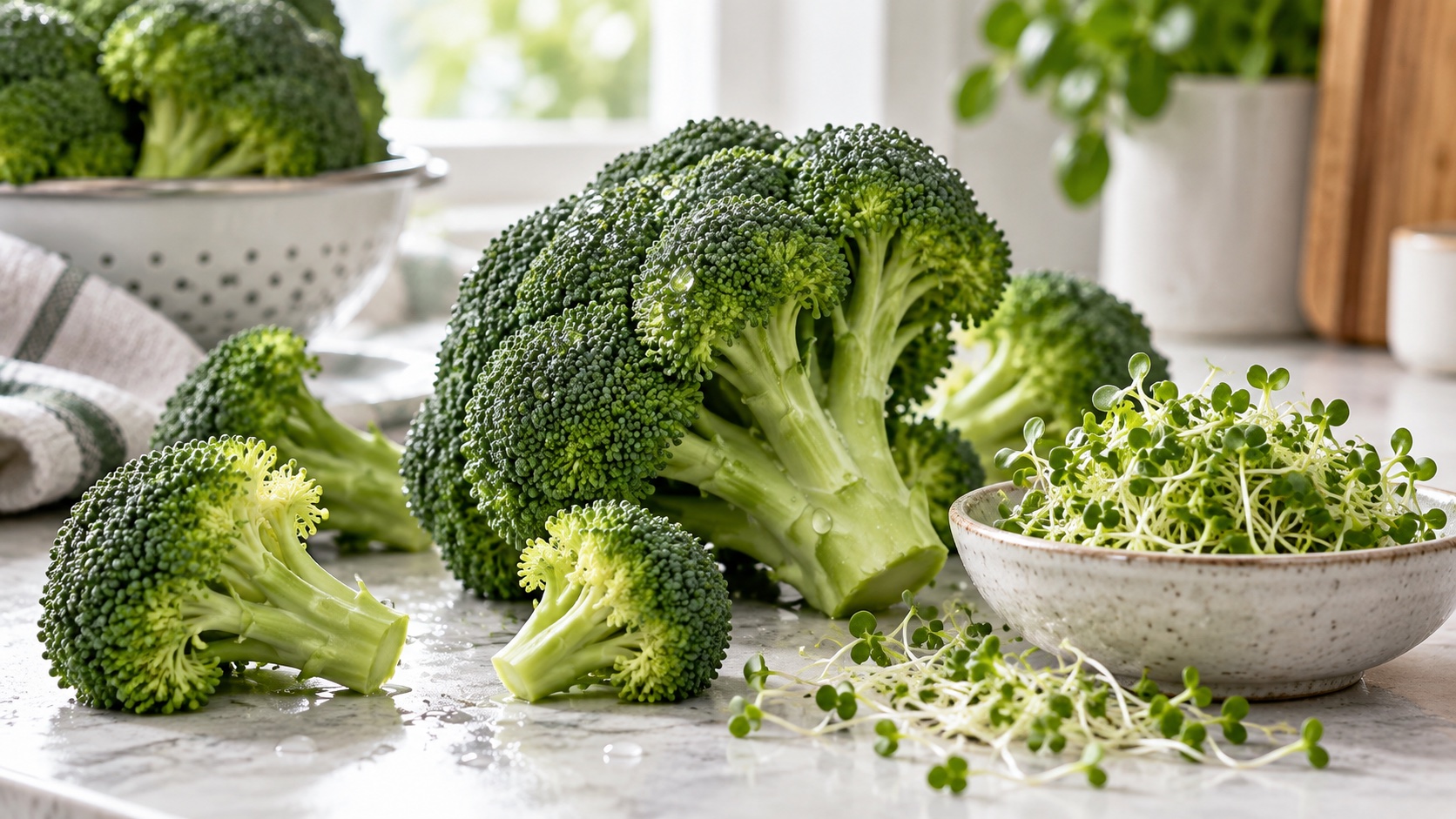
Why This One Is Different
Most polyphenols enter the body as vague hopefuls — absorbed poorly, metabolized fast, and acting on pathways that are hard to name precisely. Sulforaphane is the exception at every step. Its precursor, glucoraphanin, sits inert in cruciferous tissue alongside an enzyme called myrosinase; when the plant is crushed or chewed, the two mix and sulforaphane forms on the spot — a two-part chemical weapon that the plant keeps disassembled until damage occurs. In our cells, sulforaphane modifies cysteine residues on Keap1, the protein that holds the Nrf2 transcription factor inactive, releasing Nrf2 to switch on dozens of protective genes. That mechanism was worked out at the molecular level — Keap1 was characterized by Itoh and colleagues in Genes & Development (1999) — which gives this story something most plant compounds lack: a map, not just an association. It also arrived through a deliberate search rather than accident: Talalay's laboratory systematically screened edible plants for compounds that induce protective enzymes, found the crucifers' glucosinolates, and then located the richest source in a food most people had never considered eating — the three-day-old sprout. That is how this topic earned its unusually solid footing: the discovery path, the mechanism, and the trials all happened in plain view. The xenohormesis page explains why a mapped mechanism matters to the whole theory's credibility.
Product picks are generic categories, not brands. We may earn a commission on Amazon or iHerb purchases at no cost to you — this never changes our evidence conclusions. Full disclosure
Broccoli sprouting seeds
Makes it practical to grow broccoli sprouts where an article specifically teaches that food preparation method.
⚠️ Raw sprouts can carry foodborne-illness risk; pregnancy, immunocompromise, older age, and other higher-risk contexts require the article’s cooked alternative or individualized food-safety guidance.
Check price on Amazon →The Sprout Discovery
The other reason sulforaphane left the pack came from a 1997 finding by Fahey, Zhang and Talalay at Johns Hopkins (PNAS): the compound is not evenly distributed in the plant. Three-day-old broccoli sprouts concentrate glucoraphanin at 10 to 100 times the level of mature broccoli — one of the largest known differences between two edible forms of the same plant. That discovery converted a "eat your vegetables" platitude into a measurable dose question: a small handful of sprouts delivers what pounds of mature florets would. The relative densities, illustrated below, are the practical heart of this topic.
The Human Trials, One by One
| Trial | Setting | Finding | Verdict |
|---|---|---|---|
| 🧪 Qidong aflatoxin trial | Residents of a region with high aflatoxin exposure (China) | Sprout beverage reduced urinary aflatoxin-DNA adducts, a marker of toxin damage | Good |
| 🏭 Air-pollution trial | Adults exposed to airborne benzene and acrolein | Rapid, sustained rise in excretion of detoxified pollutants | Good |
| 🩸 Type 2 diabetes trial | Obese adults with dysregulated type 2 diabetes | Modest reduction in fasting glucose versus placebo over 12 weeks | Moderate |
| 🎗️ Cancer-prevention trials | Preclinical and early-phase human work | Promising biomarker shifts; no trial has shown fewer cancers | Early |
The pattern is worth stating plainly: the strongest results are mechanism results — faster detoxification of real carcinogens (aflatoxin, benzene, acrolein) in randomized, controlled human trials by Kensler, Egner and colleagues. That is a genuine achievement, and it is not the same as proof of fewer diseases. The leap from "your cells clear toxins faster" to "you live longer" is precisely the leap this topic has not yet made, and the honest reader should hold both facts at once.
What Nrf2 Activation Actually Does
The reason the detoxification trials are believable is that they measure exactly what the pathway does. Under routine conditions, Keap1 marks Nrf2 for continuous degradation, keeping defenses at idle. When sulforaphane arrives, it reacts with specific Keap1 cysteines, Nrf2 accumulates, and the cell upgrades an entire battery: glutathione synthesis, quinone reductase, heme oxygenase, and the enzymes that conjugate and export toxins. This is hormesis in its textbook form — a mild chemical stress that prompts a defensive upgrade bigger than the stress itself, which is why the hormetic dose topic uses sulforaphane as a worked example. It also explains the two-part chemistry's elegance: the plant stores the ingredients apart so the "stress" is only released when the plant itself is damaged — the same logic the parent topic, The Vegetarian Diet & Plant Hormesis, describes across all stressed plants.
🧪 The chop-and-wait chemistry
Sulforaphane only forms when glucoraphanin meets myrosinase — and heat destroys the enzyme. The evidence-based kitchen protocol: chop or crush the crucifer, let it rest about 40 minutes while the reaction runs, then cook briefly if you like. For pre-cooked or frozen crucifers, adding a pinch of mustard seed powder (a myrosinase donor) restores much of the lost conversion. None of this is folk wisdom; it follows directly from the enzyme-kinetics studies that built the literature.
Sprouting at Home, Honestly
Sprouts are easy to grow and the economics are unbeatable — a tablespoon of seed yields days of sprouts for pennies. The method that mirrors the research: soak seeds overnight, rinse twice daily in a jar, harvest around day three when glucoraphanin peaks, and refrigerate. Two honest cautions belong here. First, sprouting conditions that suit the plant also suit microbes: raw sprouts have been repeatedly linked to foodborne-illness outbreaks, which is why public-health agencies advise caution for people with weakened immunity, pregnancy, or very young or old age. Rinsing hygiene and refrigeration are not optional details. Second, store-bought sprout labels rarely state variety or age, so glucoraphanin content varies far more than the packaging suggests — one reason the trials used standardized seed lots and why home sprouting from a known seed is, if anything, the more consistent route. For most people a small daily handful is safe, cheap, and among the better-evidenced habits this site covers; for a few, the food-safety caveat is the deciding factor.
Where the Story Weakens
Even the strongest plant-hormesis case has three honest soft spots:
- 🎗️ No hard endpoints. Detoxification markers are surrogates. No randomized trial has shown sulforaphane prevents cancer or extends life, and supplement sellers routinely blur that line.
- ⚖️ Nrf2 cuts both ways. The same protective switch can be co-opted: some established tumors show constitutively active Nrf2 that shields them from chemotherapy. For prevention this is mostly theoretical; it is a reason for humility, not panic.
- 🥦 The dose travels badly. Glucoraphanin content varies enormously by variety, seed lot, and sprouting conditions, and supplement labels rarely match what they contain. Whole sprouts are the more reproducible bet — a 30–60 gram daily handful sits in the range the trials actually used.
Questions, Answered Briefly
- 🌱 Sprouts or supplements? Sprouts. They are the form the trials used, they carry fiber and the rest of the vegetable's chemistry, and they sidestep the label-accuracy problem that plagues sulforaphane pills.
- 🍳 Does cooking destroy it? Boiling does, if you skip the rest step — the myrosinase dies before the reaction runs. Chop, wait about 40 minutes, then cook briefly: the sulforaphane itself tolerates light heat.
- 🥬 Do kale and cabbage count? They deliver the same chemistry at a fraction of the density — useful variety, weak substitutes for the sprout-level dose if that is what you are after.
- 💊 Should everyone eat sprouts daily? A small daily handful is cheap, safe for nearly everyone, and among the most evidence-backed food habits on this site. It is also optional: the evidence supports benefit, not obligation.
- 🧫 Are sprouts risky? For most healthy adults, no — with normal rinsing and refrigeration. For people who are pregnant, very young, elderly, or immunocompromised, the outbreak record justifies cooking sprouts instead, which trades some sulforaphane for meaningful safety.
The Bottom Line
- Sulforaphane is the plant-hormesis story with a map — a two-part chemistry, a characterized target (Keap1-Nrf2), and human trials showing real pathway activation.
- Broccoli sprouts solve the dose problem — 10–100× the glucoraphanin of mature broccoli in a small daily handful.
- The trials show faster detoxification, not longer life — mechanism results are strong; hard clinical endpoints are still absent.
- Chop, wait 40 minutes, then cook — the kitchen step that turns an ordinary crucifer into an actual sulforaphane source.
Related Topics
- Fahey, Zhang & Talalay, "Broccoli sprouts: an exceptionally rich source of inducers of enzymes that protect against chemical carcinogens," Proceedings of the National Academy of Sciences (1997)
- Itoh et al., "Keap1 represses nuclear activation of antioxidant responsive elements by Nrf2 through binding to the amino-terminal Neh2 domain," Genes & Development (1999)
- Kensler et al., "Effects of glucosinolate-rich broccoli sprouts on urinary levels of aflatoxin-DNA adducts in a randomized clinical trial in Qidong," Cancer Epidemiology, Biomarkers & Prevention (2005)
- Egner et al., "Rapid and sustainable detoxication of airborne pollutants by broccoli sprout beverage: results of a randomized clinical trial in China," Cancer Prevention Research (2014)
- Axelsson et al., "Sulforaphane reduces hepatic glucose production and improves glucose control in patients with type 2 diabetes," Science Translational Medicine (2017)
- Yagishita, Fahey, Dinkova-Kostova & Kensler, "Broccoli or sulforaphane: is it the source or dose that matters?" Molecules (2019)