Awe & Nature
This series has worked through the attendance data, the active ingredient, the physiology, and the ritual layer. The final page covers the option for people who want the transcendence without the temple: awe, the emotion of encountering something vast, and nature, its most reliable generator. The evidence is unusually concrete for a feeling — it includes an inflammatory marker — and the practical version is embarrassingly simple: go outside, weekly, and look at something bigger than yourself.
What the evidence supports
- Awe — the sense of vastness that reshapes your mental frame — associates with lower levels of the inflammatory marker IL-6 in healthy adults.
- Time in nature is the most reliable everyday awe trigger, and roughly 120 minutes per week is the threshold where self-reported health and wellbeing rise in large population samples.
- Awe predicts a "small self" — reduced self-focus, more generosity, more collective engagement — in experimental work.
What remains uncertain
- The inflammation finding is cross-sectional — it cannot yet distinguish awe lowering inflammation from healthier people feeling more awe.
- "Spiritual but not religious" outcomes are under-measured; most cohort data on spirituality still flows through attendance questions.
- Whether an awe habit changes hard longevity endpoints is unmeasured — the pathway is plausible, the proof is pending.
Evidence last reviewed: August 15, 2026. Conclusions may change as new research is published.
Awe, Defined Operationally
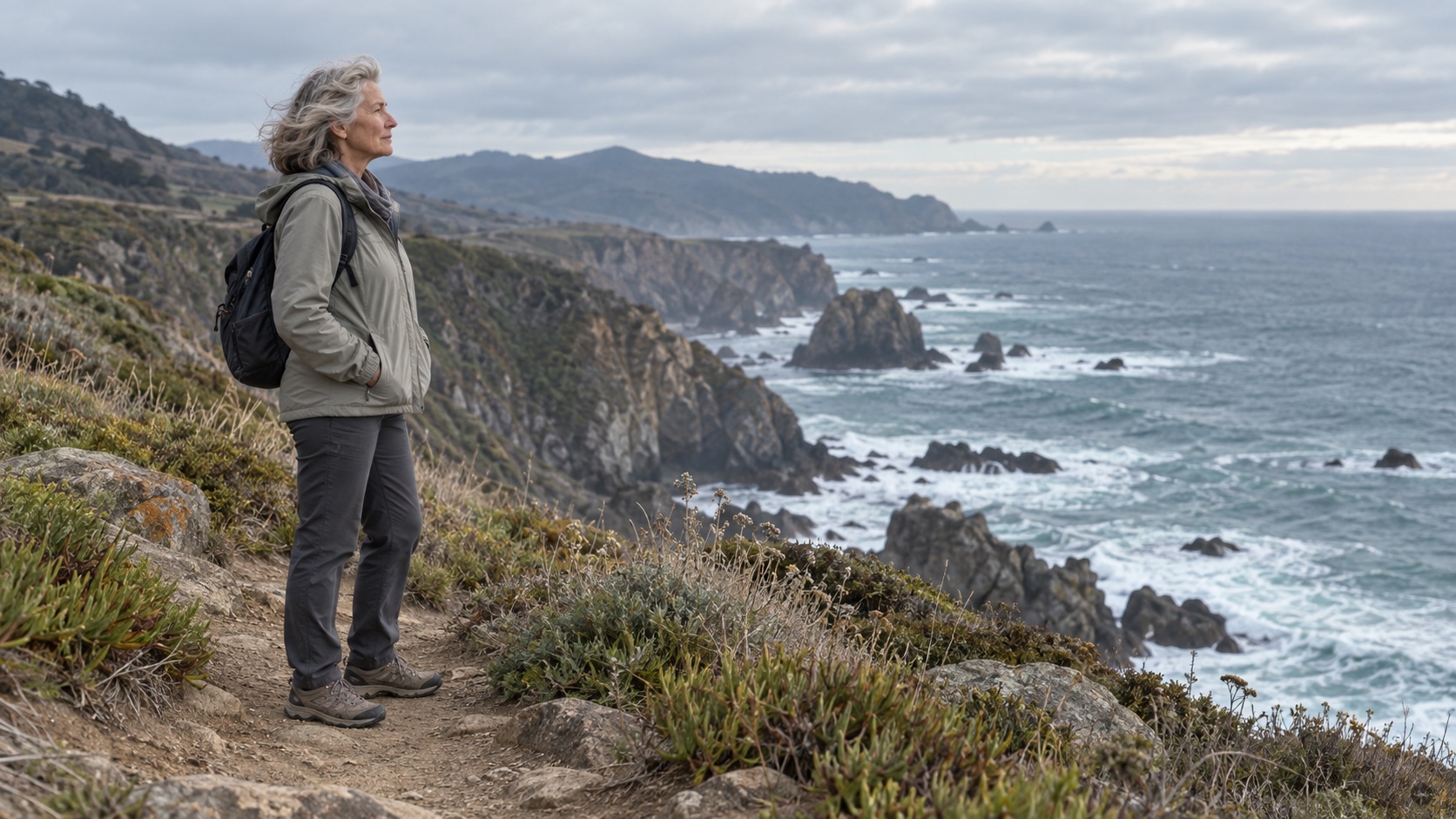
Researchers define awe by two features: perceived vastness — something larger than your usual frame, physically or conceptually — and accommodation, the need to update your mental models to take it in. A coastline, a cathedral, a symphony, a birth, a proof, a night sky: all vast, all demanding accommodation. The definition matters because it makes awe measurable — people can report it in diaries, and laboratories can induce it with videos of the planet from space. The Keltner laboratory's work on the "small self" is the core finding: awe shrinks the felt size of the self relative to the whole, which in turn predicts generosity (Piff et al., Journal of Personality and Social Psychology, 2015) and collective engagement (Bai et al., JPSP, 2017). Awe is, in effect, the opposite of rumination: attention outward, self-concern down. Diary studies find people experience awe a few times a week on average — which means the dose is already available; the question is whether you schedule it.
Product picks are generic categories, not brands. We may earn a commission on Amazon or iHerb purchases at no cost to you — this never changes our evidence conclusions. Full disclosure
Comfortable walking shoes
May improve comfort and consistency for walking-based activity.
⚠️ Footwear cannot correct every pain problem; persistent foot, knee, or hip pain warrants appropriate evaluation.
Check price on Amazon →The Inflammation Finding, In Depth
The most striking number in this literature comes from a study of positive emotions and inflammation (Stellar et al., Emotion, 2015). Among seven positive emotions measured — amusement, compassion, contentment, joy, love, pride, and awe — only awe predicted lower levels of interleukin-6 (IL-6), a cytokine the body's stress and inflammation biology uses as a general alarm. The association was modest, and the design was cross-sectional, so the causal direction is open: awe may downshift inflammation, or people with lower inflammation may simply have more capacity for wonder. The parent topic holds the headline version of this chart; the deeper read is that the emotion's specificity — awe, not joy or love — is what makes it interesting, because it suggests the active ingredient is the self-shrinking, not the pleasantness. That same ingredient appears in the physiology of contemplative practice and in the humility traditions of every faith — which is why awe is the bridge between the religious and secular versions of this entire topic.
Nature as the Reliable Generator
Why nature? Because it is the one awe source that is vast, available, and free of entry requirements. The population-level evidence: an analysis of nearly 20,000 adults in England found that self-reported health and wellbeing rose among people spending 120 minutes or more per week in natural settings — and notably, not among those spending less; the association plateaued around 200 to 300 minutes (White et al., Scientific Reports, 2019). The mechanism-level evidence: a 90-minute walk in a natural setting reduced rumination and activity in a brain region tied to repetitive negative thought, relative to an urban walk (Bratman et al., PNAS, 2015). And the awe-specific evidence: nature experiences — white-water rafting among veterans and at-risk youth — produced measurable awe and reduced post-traumatic stress symptoms (Anderson, Monroy & Keltner, Emotion, 2018). The honest frame: nature is not medicine with a dose label, but it is the most reliable everyday route into the state this page is about — which is exactly how the Beyond Human Bonds topic treats it, as a relationship channel that the longevity framework should count alongside the human ones.
The Spirituality-Without-Religion Route
Here is where the series lands its practical point. The active-ingredient page showed the health channels are community, rhythm, and self-regulation — none of which require doctrine. This page adds the fourth channel: vastness, encountered regularly, which shrinks the self and its rumination. That combination — belonging, rhythm, regulation, and awe — is a complete secular spirituality, and it is assembled from parts the evidence supports individually. The Beyond Human Bonds topic is its natural home in the Relationships pillar: connection to the non-human world, from pets to landscapes, carries measurable psychological weight, and awe is the emotional signature of that connection at its widest aperture. The honest limitation, stated once more: "spiritual but not religious" outcomes are thinner in the cohort data than attendance outcomes, because cohorts rarely ask the question well. The respectful synthesis — the one the parent topic also reaches — is that both routes draw on the same four channels, and the choice of package is a matter of what is already yours.
🌌 Awe needs no pew
Nothing in the awe literature requires belief, membership, or cost. A night sky, a ridgeline, a coastline, a forest in rain — the generators are public goods, and the physiology they set off does not check anything at the door. The flip side deserves equal respect: the same literature finds awe inside cathedrals, mosques, and ceremonies too, and for people whose package is faith, the data describe the same channel working through their tradition. Awe is the one ingredient in this topic that every human can take at full dose, and the site's position is simply: schedule it.
Awe Sources, Audited
| Awe source | What the evidence shows | Read |
|---|---|---|
| 🏔️ Nature & the sky | Most common diary trigger; 120+ weekly minutes associated with better health and wellbeing; nature walks reduce rumination | Strong |
| 💛 Moral beauty — kindness witnessed | Frequent diary trigger; experimental induction produces the small-self effect | Moderate |
| 🎻 Art & music | Reliable in laboratory inductions; population-level data thinner | Moderate |
| 🏟️ Collective effervescence — concerts, ceremonies | Shared awe strengthens bonding and prosociality in field studies (Xygalatas et al. 2013) | Moderate |
| 🖥️ Digital vastness — space imagery, VR | Early work shows VR nature can induce awe; durability and real-world translation unclear | Promising |
A Practical Awe Habit
The translation to a habit is deliberately minimal — awe resists optimization, and the research suggests frequency beats intensity:
- 🌲 The weekly two-hour block. One natural setting, two hours, most weeks — the 120-minute threshold from the population data. The walking topic supplies the dose-response for the legs; this page supplies the reason to look up.
- 🌌 One vast encounter. A night sky, a horizon, a big body of water — something that reliably out-scales the self, on a schedule rather than by accident.
- 💛 One witnessed kindness. The moral-beauty trigger is available anywhere humans are — noticing it deliberately counts as practice.
- 📵 Notice, do not capture. The diary research measures experience, not documentation; the phone-in-pocket version of an awe walk appears to deliver more of the state than the phone-up version. The downshift topic owns the unplugged mechanics.
- 🕯️ Stack it with the rhythm. Awe slots naturally into the weekly ritual this series described — the Sunday hike is a liturgy with a view.
Questions, Answered Briefly
- 🤔 Is awe a replacement for religion? Not in any claim this site makes. The evidence supports awe as one transferable channel among several — belonging, rhythm, regulation — that religion bundles. Whether that bundle satisfies what religion satisfies is a personal question, not an epidemiological one.
- ⏱️ Does a screen count? Partly. Virtual nature induces measurable awe in the lab, but the population thresholds were measured with real exposure, and the rumination-reduction finding came from real walks. Treat screens as a bridge, not the destination.
- 🧪 Should I track my IL-6? No — that is not how this evidence is meant to be used. The cytokine finding describes a research pathway, not a consumer metric. The behavior (weekly vastness) is the point; the biomarker is the scientist's business.
- 🏙️ I live in a city with no nature. Urban parks, botanical gardens, planetariums, big architecture, and the moral-beauty trigger all produce the state. The evidence favors dose over purity — the Beyond Human Bonds topic covers the non-wild versions.
The Bottom Line
- Awe is the transferable core — vastness that shrinks the self is the channel religious and secular practice share, and it is measurable down to an inflammatory marker.
- Nature is the reliable generator — roughly 120 minutes weekly marks the threshold where self-reported health and wellbeing rise in large samples.
- The small self does the work — awe reduces self-focus and rumination, predicts generosity, and stands alone among seven positive emotions in its association with lower IL-6.
- Spirituality without religion is available — belonging, rhythm, regulation, and awe assemble into a complete secular package, with the honest caveat that the cohort data on the secular route remain thinner.
Related Topics
- Stellar et al., "Positive affect and markers of inflammation: discrete positive emotions predict lower levels of inflammatory cytokines," Emotion (2015)
- Piff, Dietze, Feinberg, Stancato & Keltner, "Awe, the small self, and prosocial behavior," Journal of Personality and Social Psychology (2015)
- Bai et al., "Awe, the diminished self, and collective engagement," Journal of Personality and Social Psychology (2017)
- Anderson, Monroy & Keltner, "Awe in nature heals: evidence from military veterans, at-risk youth, and college students," Emotion (2018)
- White et al., "Spending at least 120 minutes a week in nature is associated with good health and wellbeing," Scientific Reports (2019)
- Bratman et al., "Nature experience reduces rumination and subgenual prefrontal cortex activation," PNAS (2015)
- Keltner, Awe: The New Science of Everyday Wonder (2023)