Light is the master signal
Your circadian clock cares about one input above all others: light. This page covers the pathway — from photons to a cluster of neurons behind your eyes — and why the practical rule that follows is lopsided: ten minutes of morning sun does more for your rhythm than an hour of carefully dimmed evening light. Get the lux, the timing, and the biology right, and most other sleep advice gets easier.
What the evidence supports
- A dedicated light-sensing pathway (melanopsin cells in the retina) drives circadian entrainment — shown in controlled laboratory studies (Science, 2002).
- Morning bright light reliably advances the clock and improves sleep timing, including in clinical trials of light therapy.
- Evening light suppresses melatonin and delays the rhythm; the dose-response relationship is well characterized.
What remains uncertain
- The ideal daily light "dose" for long-term health is not defined; most research covers weeks, not years.
- Individual sensitivity varies — age, genetics, and light history all change the response.
- Whether morning light's benefits flow mostly through sleep timing or also through direct metabolic effects is still being worked out.
Evidence last reviewed: August 15, 2026. Conclusions may change as new research is published.
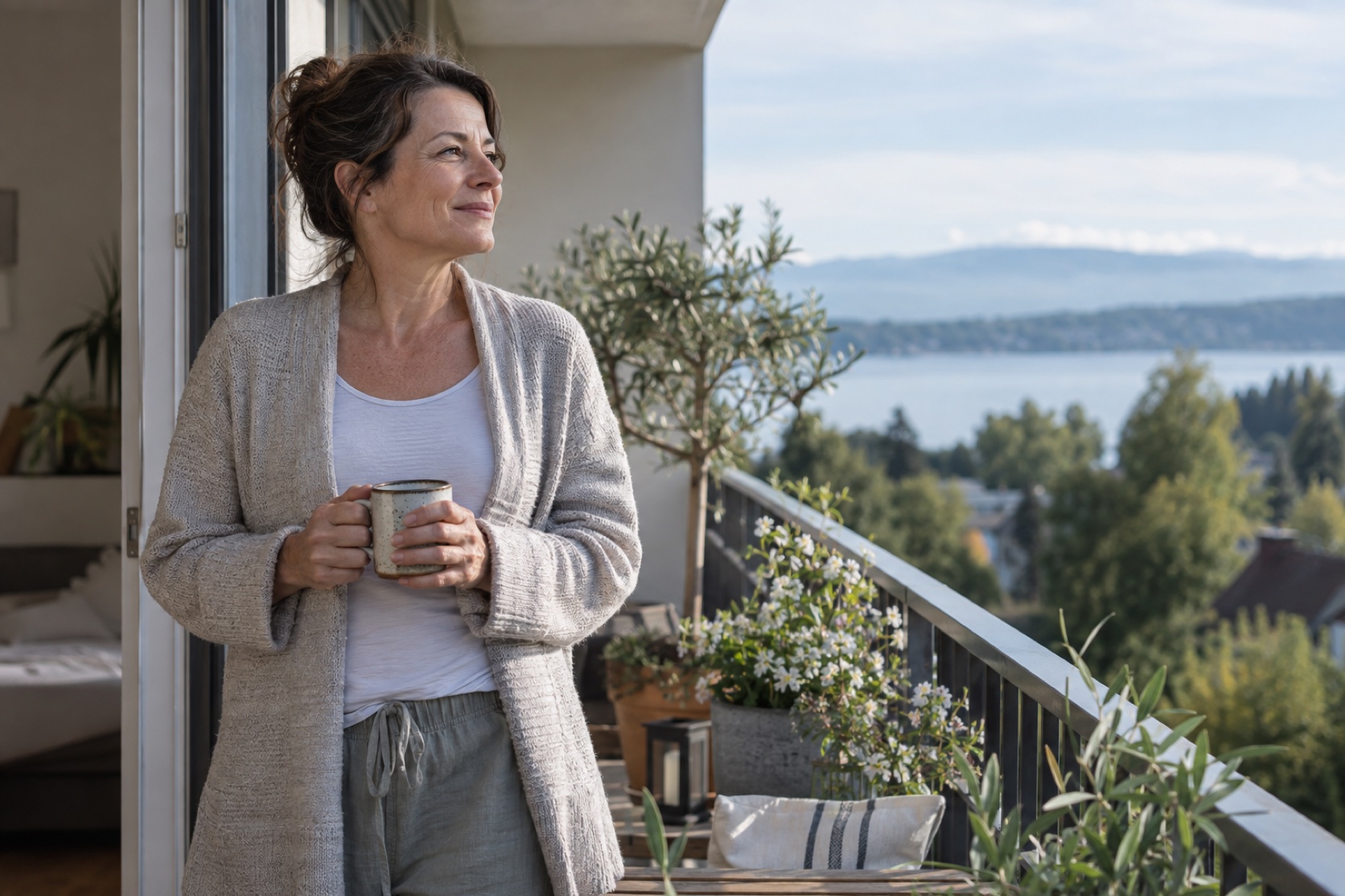
The Signal Your Clock Evolved Around
The circadian system described on the parent topic page — the suprachiasmatic nucleus and its network of peripheral clocks — evolved under a sky, not a ceiling. For virtually all of human history, the light-dark cycle was the dominant environmental rhythm, and it is still the input your clock trusts most. Electric light changed the environment in about a century; your biology hasn't caught up.
The practical consequences are everywhere in the modern day. A well-lit office feels bright, but to your circadian system it is twilight — hundreds of times dimmer than a cloudy sky. A phone at arm's length delivers a few dozen lux; an overcast morning delivers thousands. Understanding the scale gap is the first step to using light deliberately instead of accidentally.
Product picks are generic categories, not brands. We may earn a commission on Amazon or iHerb purchases at no cost to you — this never changes our evidence conclusions. Full disclosure
Warm, dimmable bedside light
Makes a lower-light evening routine easier to follow.
⚠️ None expected; avoid treating a bulb choice as a cure for insomnia.
Check price on Amazon →Your Eye Has Two Jobs: Seeing, and Telling Time
Vision runs on rods and cones. Timekeeping runs on a separate, smaller population of retinal neurons: intrinsically photosensitive retinal ganglion cells (ipRGCs). These cells — roughly 1% of retinal ganglion cells — express a photopigment called melanopsin, first identified in the inner retina (Journal of Neuroscience, 2000) and shown in 2002 to be the sensor that keeps the circadian clock running (Science, 2002). Mice engineered to lose all rods and cones could not see, but their clocks still entrained to light; mice without melanopsin could see normally but lost proper clock responses.
- 👁️ It senses brightness, not images. Melanopsin peaks around 480 nanometers — the blue-green band of sky light. Blue-enriched light therefore carries more clock signal per lux.
- ⏳ It integrates over minutes. ipRGCs respond slowly and stay on while light lasts — the retina is effectively counting photons over time, which is why duration and intensity trade off against each other.
- 🧭 It wires straight to the master clock. ipRGCs project directly to the suprachiasmatic nucleus and also to brain regions governing alertness and mood — a second route by which light wakes you up (Sleep Medicine Reviews, 2007).
The Lux Ladder: Numbers That Matter
Lux is simply light intensity per area. The useful frame is the range of everyday environments, because most people dramatically underestimate how far indoors falls below outdoors.
The bars compress an uncomfortable truth: stepping outside on a gray day moves you up one or two orders of magnitude in light dose, and full sun is another step beyond that. Your evening "bright" living room sits near the bottom of the ladder.
Why Timing Beats Total Dose
The same photons get different answers depending on the hour. Chronobiologists map this as a phase response curve: light in the morning advances the clock (you wake earlier the next day), light late at night delays it (you wake later), and midday light shifts phase little while still boosting alertness and mood.
Direction matters because your internal day is not exactly 24 hours — in forced-routine studies it runs about 24.2 hours (Science, 1999). Left alone, the clock drifts later every day. Morning light is the daily correction that holds it on schedule, and strong morning exposure can reset the pacemaker by hours, not minutes, in controlled experiments (Science, 1989). This is the asymmetry in this page's premise: evening dimness, however meticulous, cannot produce an advance. It can only avoid making the delay worse. Ten minutes under a 10,000-lux morning sky delivers orders of magnitude more photons than an hour under 100-lux lamps — and they arrive at the one phase where light actively pulls your clock earlier.
💡 The indoor trap
Indoor life is a permanent biological twilight. A bright office (~500 lux) is dimmer than a cloudy sky (~1,000–10,000 lux), and most homes run 100–300 lux in the evening. If your only outdoor exposure is the walk to the car, your clock is being asked to hold a schedule on a signal it can barely see. This is a light dose problem, not a motivation problem — and it's why the wake-time anchor protocol puts outdoor light first.
What Light Does at the Wrong Time
Evening light's problem is melatonin. Bright light at night suppresses the pineal gland's melatonin output — demonstrated in humans as early as 1980 (Science), and since refined: the dose-response is steep at low intensities, and hours of ordinary indoor light measurably blunt the evening rise. In a controlled comparison, reading a light-emitting e-reader for several hours before bed suppressed evening melatonin by roughly half and delayed its onset by more than an hour relative to a printed book (PNAS, 2015). The sleep sabotage topic covers the screen-side of this story in more depth.
The cleanest demonstration that light timing drives real-world sleep timing comes from the outdoors itself: after a week of camping with no electric light, participants' melatonin onset moved about two hours earlier and wake times followed — without any other intervention (Current Biology, 2013). The light-dark cycle alone did the work.
One nuance worth keeping straight: wavelength matters, but brightness dominates. Melanopsin's blue-green peak means a blue-enriched screen packs more clock signal per lux than a warm one — yet a dim blue screen (~40 lux) is still a rounding error next to a cloudy sky (thousands of lux). In practice, "dim it down" beats "turn it orange" as a rule: amber night modes help most once brightness is already low.
The Daily Light Prescription
| When | Dose that works | What it does |
|---|---|---|
| 🌅 Within an hour of waking | 10–20 min outdoors (20–30 min if heavily overcast) | Advances the clock, fires the cortisol rise, sets melatonin's timer for the evening |
| ☀️ Midday | Any outdoor time; 30+ min ideal | Reinforces the day signal; boosts alertness and mood |
| 🌇 Evening | Dim, warm, below-eye-level light; screens down | Protects the melatonin rise; prevents further delay |
| 💡 Dark winter mornings | 10,000-lux light box, 20–30 min after waking | Clinically studied dose for seasonal low mood and winter energy (American Journal of Psychiatry, 2005) |
- 🕶️ Skip dark lenses in the first hour. Sunglasses cut the very photons your clock needs. (Eye conditions that require protection are a different story — follow your eye doctor's advice.)
- 🪟 Window glass weakens the signal. It filters some of the blue-green band melanopsin responds to. A short walk beats standing at the window.
- 📉 Dim in the last 1–2 hours, not all evening. Your clock tolerates normal evening light until late; the sensitive window is the final stretch before bed.
⚠️ Bright-light therapy is a real treatment with real cautions: it can destabilize mood in bipolar disorder and requires care with retinal disease and photosensitizing medications. If any of those apply, involve a clinician rather than self-dosing. And no protocol on this site involves looking at the sun directly — brightness works just fine when the light is ambient.
Questions, Answered Briefly
- 🪟 Is a bright window enough? Window glass filters some of the blue-green band melanopsin reads, and glass-side light is already dimmer than open sky. Better than nothing; outdoors is the real dose.
- 🔵 Do blue-blocking glasses fix evening light? They trim one slice of the signal, but brightness remains the dominant factor — dim lamps and screens-down do more, as the saboteurs topic covers.
- ❄️ What about winter? At high latitudes, a 10,000-lux light box for 20–30 minutes after waking is the clinically studied substitute for scarce sun (American Journal of Psychiatry, 2005).
The Bottom Line
- Light is the master signal — a dedicated melanopsin pathway wires your retina to your clock, tuned to sky light around 480 nanometers.
- Timing sets the direction. Morning light advances your clock and corrects its natural drift; late-night light delays it. No amount of evening dimness can substitute for the morning dose.
- Scale beats effort. Outdoors is 100–1,000× brighter than indoors — ten minutes outside delivers more clock signal than an hour of indoor brightening.
- Protect the evening. Dim and warm the last 1–2 hours before bed, and let morning light do the heavy lifting.
Related Topics
- Berson, Dunn & Takao, "Phototransduction by retinal ganglion cells that set the circadian clock," Science (2002)
- Hattar et al., "Melanopsin-containing retinal ganglion cells: architecture, projections, and intrinsic photosensitivity," Science (2002)
- Provencio et al., "A novel human opsin in the inner retina," Journal of Neuroscience (2000)
- Lewy et al., "Light suppresses melatonin secretion in humans," Science (1980)
- Czeisler et al., "Stability, precision, and near-24-hour period of the human circadian pacemaker," Science (1999)
- Czeisler et al., "Bright light induction of strong (type 0) resetting of the human circadian pacemaker," Science (1989)
- Wright et al., "Entrainment of the human circadian clock to the natural light-dark cycle," Current Biology (2013)
- Chang et al., "Evening use of light-emitting eReaders negatively affects sleep, circadian timing, and next-morning alertness," PNAS (2015)
- Golden et al., "The efficacy of light therapy in the treatment of mood disorders: a review and meta-analysis of the evidence," American Journal of Psychiatry (2005)
- Cajochen, "Alerting effects of light," Sleep Medicine Reviews (2007)