Community & Faith: Lessons From Blue Zones
Every population on Earth that lives measurably longer than its neighbors has one feature in common: belonging. From Okinawan moais to Adventist congregations, the evidence converges on a finding that survives translation into secular life — you don't need a church, but you need a we.
What the evidence supports
- Regular religious-service attendance associates with lower mortality in large cohorts — the effect is substantial and consistent.
- The benefit appears to travel with social participation and purpose, not doctrine — secular forms of regular gathering show similar patterns.
- Blue Zone populations (Okinawa, Sardinia, Loma Linda) share dense, multigenerational community structures.
What remains uncertain
- Selection (healthier people attend more) explains an unknown share of the attendance effect.
- Blue Zone claims rest on demographic and observational data of variable quality — treat the narratives as illustrations, not proof.
- Which community features (ritual? identity? support?) carry the benefit is not well isolated.
Evidence last reviewed: August 13, 2026. Conclusions may change as new research is published.
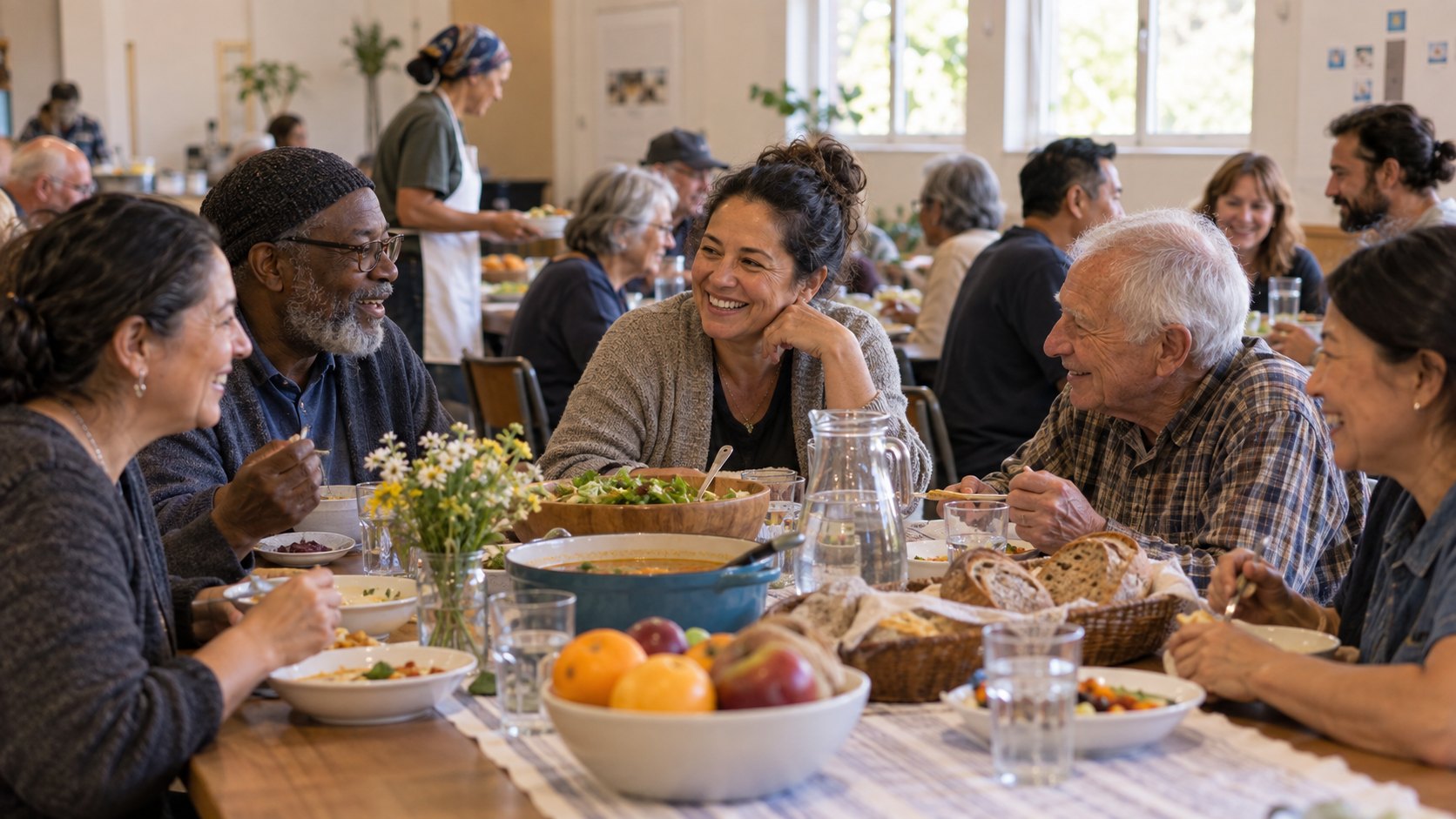
The Attendance Finding
The most striking number in this literature comes from studies of religious-service attendance: adults who attend weekly show mortality reductions in the range of 25–35% over follow-up in large cohorts — an effect size that rivals exercise and dwarfs most dietary findings. The Adventist Health Studies in Loma Linda, California (a certified Blue Zone) find regular churchgoers living several years longer on average — for men, the gap approaches a decade in some analyses. The honest caveats: attendance studies are observational, attendance correlates with healthier behavior and social resources, and the "religious" part of the effect may be separable from the "community" part — the secular experiments (choirs, volunteer corps, community organizations) show the same direction with similar mechanisms. The finding isn't about theology; it's about weekly, scheduled, multigenerational belonging.
What the Blue Zones Actually Share
The Blue Zones — Okinawa, Sardinia, Ikaria, Nicoya, Loma Linda — are often marketed as diet stories (beans! wine! hills!). The demographic reality is more structural: every one of them is a community story. Okinawa's moai — small lifelong mutual-aid groups formed in childhood — is the clearest example: the same five or six people, meeting regularly, sharing money, problems, and life, for seventy years. Sardinian villages concentrate centenarians where multigenerational households and daily piazza sociality persist. The features worth extracting, because they're replicable: lifelong membership in a small group, regular face-to-face rhythm, mutual obligation, and elders embedded in the group rather than warehoused apart. None of it requires geography or faith — it requires showing up to the same people for decades.
The Third Place, Eulogized
Sociologist Ray Oldenburg's term deserves revival: the third place — the social venue that is neither home nor work, where you're neither employee nor family, and where conversation is the main activity. Historically: the pub, the church, the café, the barbershop, the piazza. Their defining features are exactly what modern life removed: free or cheap, walkable, no appointment needed, regulars you recognize, conversation as the point. Oldenburg's argument, now vindicated by the loneliness data: when third places disappear, the weak-tie cloud disappears with them — and the strong ties, starved of the casual infrastructure that feeds them, thin out a generation later. The longevity translation: your third place is a health asset, and if you don't have one, the tribe-building topic's containers are the modern reconstruction — same features, different names.
The Mechanisms: Why Belonging Works
The community effect is the previous topics' biology at scale: buffering (a group spreads shocks — the moai that absorbs a job loss or a funeral), health monitoring (groups notice when you're fading, the same mechanism as the marriage topic's spouse effect), purpose (roles and obligations — the Purpose pillar's raw material), rhythm (the weekly container, same as the tribe-building topic's core principle), and identity (being part of a "we" — which measurably reduces the threat-state physiology from the biology topic). The deepest point: community is long-duration infrastructure. A moai doesn't help you on week one; it's the compounding of seventy years of showing up. The longevity benefit of belonging is mostly the longevity benefit of never drifting — of having a group that would notice the drift.
Diet or Community? The Blue Zone Caveat
An honesty section, because the Blue Zone story gets marketed selectively: the original claims about extraordinary centenarian densities in these five regions have faced genuine criticism — age-exaggeration and incomplete vital records in some zones may inflate the numbers. The diet-and-wine narrative that became a bestseller is the weakest-supported part of the story. What survives the criticism robustly is the structural observation: these populations are densely connected — multigenerational households, lifelong small groups, elders embedded in daily life. Read carefully, the Blue Zones aren't evidence for eating more beans; they're evidence for never drifting from your people. That lesson stands even if the centenarian counts are exaggerated — because the mortality data on belonging (the attendance findings above) comes from entirely separate, rigorous cohort studies.
Multigenerational Contact
One Blue Zone feature deserves specific attention because modern life has nearly eliminated it: regular contact across generations. In the long-lived populations, grandparents live with or beside grandchildren, elders have daily roles, and the old are witnesses rather than warehouse residents. The health evidence runs in both directions: older adults with active family and community roles show better cognitive and physical outcomes, and children with regular grandparent contact show measurable socioemotional benefits. The modern family — scattered across time zones, connected by video calls — is a weakened version of the multigenerational structure that carried most of human history. The practical compensations: intergenerational containers exist (choirs, volunteer programs, community gardens, the classic "adopt a grandparent" schemes) and the tribe-building topic's principle applies — the structure matters more than the blood relation.
Community Questions, Answered Briefly
- I'm not religious — what's my moai? Any lifelong small group with mutual obligation: a book club that outlives its first decade, a volunteer crew, a music ensemble, a recurring neighborhood project. The features matter, not the label.
- Does community require a big city? The evidence runs the other way: small towns and tight neighborhoods produce more belonging per capita than dense anonymity. What matters is repetition, not population.
- How does belonging connect to purpose? Community is where roles live — the Purpose pillar's entire raw material. Being needed is the bridge between this pillar and the next.
🧭 The secular translation
For readers for whom organized religion isn't the answer, the evidence supports a clean translation: the active ingredient is weekly scheduled belonging with people who'd notice your absence. Choirs and community orchestras, volunteer fire brigades and food banks, sports clubs with real seasons, alumni and service organizations, book clubs that survive their third year — any container with ritual, rhythm, and mutual obligation. The research question isn't "do you believe?" — it's "who notices when you don't show up?"
The DIY Moai
The Okinawan moai — the same small group for seventy years — is the most imitated structure in longevity circles, so a practical template belongs here. The working formula, reconstructed from the successful secular versions: four to eight people, a fixed rhythm (monthly minimum, weekly ideal), a shared activity that forces conversation (a meal, a walk, a project — not a meeting), an explicit mutual-obligation norm (the rides, the moving help, the hospital visits are the point, not a favor), and a no-quit rule for the first year — moais survive because quitting is structurally awkward, and the awkwardness is the design. The failure modes are equally instructive: groups dissolve when they're interest-only (hobbies change, the group dies with them), when they're too large (obligation diffuses), or when they never move past pleasantries to the obligations. A moai that survives its first crisis — a death, a divorce, a diagnosis — has become the real thing.
The Bottom Line
- Belonging is a longevity feature — attendance effects rival the best-documented habits in medicine.
- The active ingredient is structure, not doctrine: weekly rhythm, mutual obligation, multigenerational range.
- The Blue Zones are community stories — the moai pattern is replicable anywhere.
- The secular version works: find your weekly container and let the decades compound.
Go Deeper: Subtopics
- 🔎 Belonging as a health variable — attendance, not belief: the mortality evidence for community participation. Read it →
- 🔎 Blue Zones' social architecture — moais, church, and the multigenerational household: what transfers. Read it →
- 🔎 Secular belonging — volunteering, clubs, and gyms: the non-religious versions of the same mechanism. Read it →
- 🔎 Faith & coping — the prayer/meditation physiology overlap (links Purpose pillar's religion topic). Read it →
- 🔎 Designing for belonging — walkable neighborhoods, third places, and the built-environment evidence. Read it →
Related Topics
- Li et al., "Association of religious service attendance with mortality among women," JAMA Internal Medicine (2016)
- Fraser & Shavlik, "Ten years of life: is it a matter of choice?" Archives of Internal Medicine (2001)
- Buettner & Skemp, "Blue Zones: lessons from the world's longest lived," American Journal of Lifestyle Medicine (2016)
- Willcox et al., "The Okinawan moai and social networks of the long-lived," The Journals of Gerontology (2015)
- VanderWeele et al., "Religious service attendance and mortality," American Journal of Epidemiology (2017)