Learning as Social Glue
A class buys two things with one attendance: the skill you signed up for and a network you didn't. The evidence says both halves matter — social connection ranks alongside smoking and inactivity in mortality data, and group-based learning adds accountability that solo practice can't manufacture. This page covers the double benefit honestly: what the connection science shows, what the group-learning trials actually measured, and how to choose a format you'll keep showing up to.
What the evidence supports
- Stronger social relationships predict better survival across 148 studies — an effect comparable in size to well-known risk factors.
- Older adults who belong to more social groups show measurably better cognitive trajectories.
- Community singing improved mental-health-related quality of life in older adults in a randomized trial — a modest, real effect.
What remains uncertain
- Whether groups add cognitive benefit beyond the skill itself is unproven — the Synapse Project's social-only arm gained no memory benefit.
- Self-selection runs through every cohort: joiners differ from non-joiners in ways that exaggerate the apparent effect.
- Which group formats beat which — choir vs class vs club — has never been tested head-to-head.
Evidence last reviewed: August 15, 2026. Conclusions may change as new research is published.
The Double Benefit
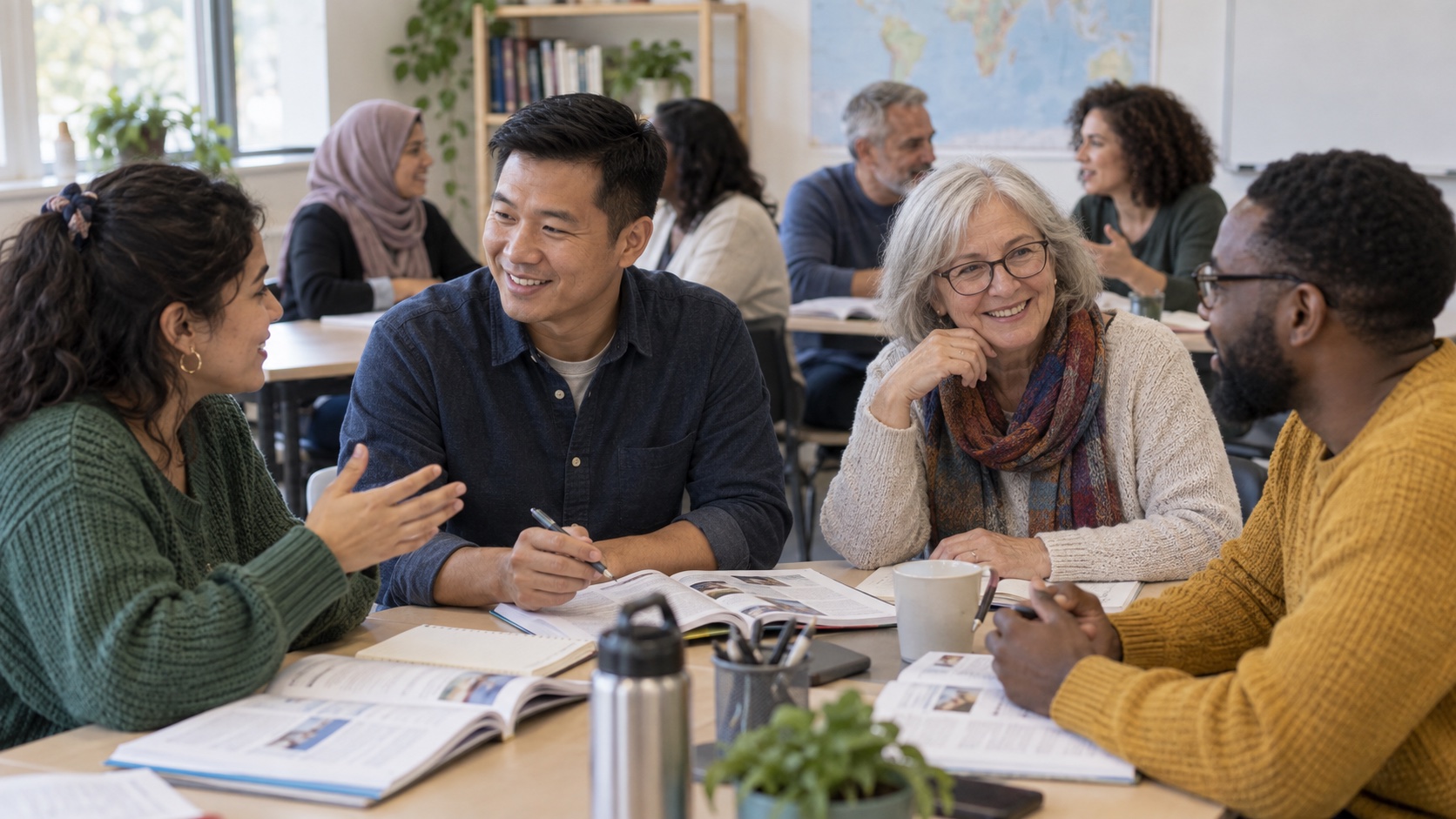
Skill learning and social connection are usually sold as separate longevity strategies — one in the cognitive column, one in the relationships column. A class collapses the columns: the same Tuesday evening delivers practice (the cognitive half) and people (the social half), each reinforcing the other. The social half is not decoration. Holt-Lunstad's meta-analysis of 148 studies found that stronger social relationships were associated with a roughly 50% increase in the odds of survival over follow-up — an association in the same league as quitting smoking or taking up exercise (Holt-Lunstad et al., PLoS Medicine, 2010). The loneliness topic owns that literature in depth; this page borrows it for one purpose — to argue that when you're choosing how to learn, the format that adds people is not a nicety. It's a second intervention, bundled free.
Why Groups Seem to Protect the Brain
The connection-cognition link has its own literature, and it's longitudinal. In the Kungsholmen Project, older adults with limited social networks showed meaningfully higher dementia incidence over three years than those with rich networks (Fratiglioni et al., The Lancet, 2000). More recent work points at a mechanism with a name: social identity. Across cohorts, older adults who belonged to more groups — clubs, classes, choirs, teams — showed better memory trajectories, and the effect tracked the number of memberships, not just the hours of contact (Haslam et al., Social Science & Medicine, 2014). The proposed logic: group memberships give life structure, roles, cognitive demand, and reasons to leave the house — a bundle that no solo app replicates. None of this proves a class prevents dementia; it shows the social scaffold and the cognitive scaffold are load-bearing on each other.
What the Choir Data Actually Show
The group-learning intervention with the most trial-grade evidence is community singing. In the SING trial, older adults randomized to community singing groups reported better mental-health-related quality of life than waitlist controls, with the gains still present at six months (Coulton et al., British Journal of Psychiatry, 2015). The honest reading: the effects were real but modest — mood and quality of life, not memory scores — and the comparison was against no treatment, which flatters any social activity. What the trial does establish is the practical claim: a structured weekly group that demands participation (you can't lip-sync choir attendance) is deliverable, durable, and measurably good for well-being. Choirs are not magical; they're a well-tested template for what a good group format looks like — fixed schedule, shared progress, a public product, and low barriers to entry.
Format Matters
Not all "social learning" is equal. The Synapse Project's social-only condition — pleasant group activities with no demanding skill — produced no memory gains, which is the sharpest evidence that the demand and the group must travel together (Park et al., Psychological Science, 2014). Format by format:
| Format | What it delivers | Evidence | Verdict |
|---|---|---|---|
| 🏫 In-person class (language, craft, instrument) | Structured difficulty plus a cohort that notices your absence | Good | The reference format — demand and group in one room |
| 🎤 Choir or ensemble | Shared performance goal; attendance is part of the product | Good | Trial evidence for well-being; the skill is the glue, not the point |
| 📚 Book club or discussion group | Cognitive demand plus conversation, low equipment cost | Moderate | Demand varies with the reading; pick a group that argues, not one that nibbles |
| 💻 Online synchronous class | Real cohort, no commute — best access for mobility-limited learners | Moderate | Needs deliberate after-class contact; the camera-off crowd gets the skill, not the glue |
| 📱 Solo app plus online forum | Skill only; the forum is ambient, not accountable | Weak | Fine as the 15-minute loop's container, not as the social strategy |
The Network Multiplier
One class begets more than its curriculum. The people in a course share an interest, which makes them unusually good sources of what's next — the next class, the better teacher, the festival, the club. Social network research calls these weak ties, and they are the channels through which new opportunities mostly travel; the weak-ties topic covers the mechanism. The practical consequence: the return on a class compounds through invitations. Year one is a Spanish class; year three is a travel group, a cooking cohort, and a standing Tuesday. Each link raises the odds of the next, which is why the first class is worth disproportionate effort — it seeds the network that seeds the rest.
Joining When Joining Is Hard
For the shy, the newly retired, or the out-of-practice joiner, the double benefit requires crossing a threshold. Some evidence-tested shortcuts:
- 👫 Borrow an anchor. Sign up with one person; the social-accountability pattern from the Habit Formation protocol turns a friend into an attendance mechanism.
- 📅 Commit to the calendar, not the vibe. Decide on a fixed number of sessions (say six) before the first one — judging a group by session one is judging before the group has formed.
- 🔨 Choose a product-producing skill. Classes with a visible output (a quilt, a song, a dish) give the socially awkward a thing to talk about — the artifact carries the conversation.
- 🌍 Try intergenerational. Mixed-age classes reduce the performance anxiety some older beginners feel, and the research on purposeful hobbies suggests teaching-shaped roles add their own benefit.
Questions, Answered Briefly
- 🤫 I'm shy. Is the social benefit closed to me? No — product-producing classes give introverts an artifact to discuss, which shifts attention from the person to the work. Many quiet joiners report that structure, not charisma, is what keeps them returning.
- 💻 Do online classes count? For the skill, yes; for the glue, partially. Synchronous formats with cameras on and a cohort that recurs deliver most of the benefit; add a deliberate ritual (shared note thread, after-class coffee call) to close the gap.
- 👵 Is a group with people my own age better? The evidence doesn't rank age mixes. Intergenerational classes add a teaching-shaped role for older members, which the Purpose pillar's research treats as its own benefit — but the strongest predictor is shared interest, not shared birth year.
- 💸 Classes cost money. Are free groups as good? The evidence cares about schedule, demand, and continuity, not tuition. A free reading group that meets weekly beats an expensive course you attend twice — price is not the active ingredient.
- ⚖️ Group or solo — do I have to choose? No, and the strongest combination is both: the daily solo loop supplies spacing and retrieval, while the weekly class supplies demand, correction, and people. Each covers what the other structurally can't.
👥 The group is the retention mechanism
Solo learners drop out quietly — nobody is watching. Group learners are missed, and being missed is a retention technology no app has replicated. The honest caveat from the Synapse comparison: the group magnifies the skill's effect, but it does not replace the skill's demand. Choose the class for the difficulty you want, stay for the people, and let the evidence ranking help pick among activities you'd enjoy with company.
The Bottom Line
- Classes buy two interventions for one attendance — the skill's cognitive demand and a social network whose absence is itself a mortality risk factor.
- The group magnifies, it doesn't replace — the Synapse social-only arm gained no memory benefit; demand and connection must travel together.
- Format shapes the benefit — in-person classes and choirs have the strongest evidence; online formats need deliberate after-class contact to deliver the social half.
- The first class is the seed — weak ties from one course become the invitations to the next, and the network compounds faster than the skill.
Related Topics
- Holt-Lunstad, Smith & Layton, "Social relationships and mortality risk: a meta-analytic review," PLoS Medicine (2010)
- Fratiglioni, Wang, Ericsson, Maytan & Winblad, "Influence of social network on occurrence of dementia: a community-based longitudinal study," The Lancet (2000)
- Haslam, Cruwys & Haslam, "The we's have it: evidence for the distinctive benefits of group engagement in enhancing cognitive health in aging," Social Science & Medicine (2014)
- Coulton et al., "Effectiveness and cost-effectiveness of community singing on mental health-related quality of life of older people: randomised controlled trial," British Journal of Psychiatry (2015)
- Barnes, Mendes de Leon, Wilson, Bienias & Evans, "Social resources and cognitive decline in a population of older African Americans and whites," Neurology (2004)
- Park et al., "The impact of sustained engagement on cognitive function in older adults: the Synapse Project," Psychological Science (2014)