The 15-Minutes-Daily Protocol
The gap between "I should learn something new" and actually doing it is rarely knowledge — it's scheduling. This page builds the minimal loop: a 15-minute daily practice block designed around the learning science from the science page, wired into the habit machinery that keeps it alive. Fifteen minutes is not a magic dose — it's the smallest unit that survives a real life, and run daily, it compounds into a serious annual curriculum.
What the evidence supports
- Distributed practice beats massed practice for long-term retention across dozens of experiments — daily beats weekly for the same total minutes.
- Retrieval practice (self-testing) produces more durable learning than rereading or re-watching.
- Habit formation follows a predictable curve — a median of roughly two months of repetition to automaticity, with wide individual variation.
What remains uncertain
- Fifteen minutes specifically has not been compared against other doses in a trial; it is an engineering choice, not a measured optimum.
- Habit-formation studies come mostly from everyday behaviors like diet and exercise, not skill practice — the transfer is plausible, not demonstrated.
- How much of the benefit of a small daily dose comes from the practice vs from keeping the skill's mental representation alive is unmeasured.
Evidence last reviewed: August 15, 2026. Conclusions may change as new research is published.
Why 15 Minutes
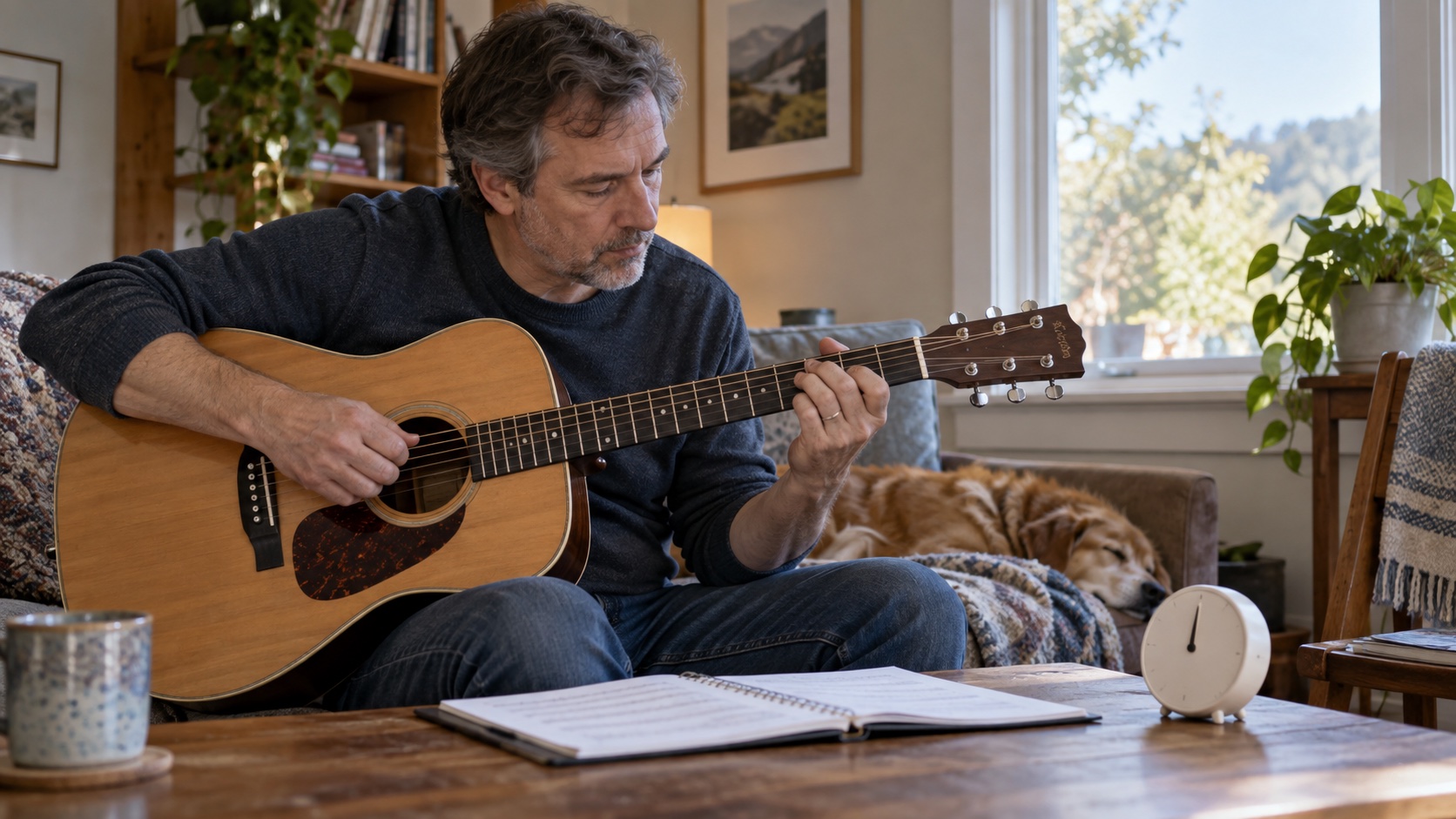
The dose is an engineering decision, not a research finding, so let it be defended on engineering terms. Fifteen minutes is short enough to survive a bad day, long enough to hold one real learning unit — a scale, a phrase, a verb conjugation, one pass at a passage — and small enough that the activation cost never becomes an excuse. Run the arithmetic and the compounding becomes visible: 15 minutes daily is roughly 91 hours a year of deliberate practice, which is more practice than most hobbyists ever log. The learning-science literature adds the second argument: the same 91 hours distributed across 365 days outperforms the same hours compressed into weekly marathons, because spacing is one of the most replicated effects in memory research (Cepeda et al., Psychological Bulletin, 2006). Daily-and-small is not a consolation prize; it is the higher-yield geometry for the same total time.
Product picks are generic categories, not brands. We may earn a commission on Amazon or iHerb purchases at no cost to you — this never changes our evidence conclusions. Full disclosure
Book or skill-learning workbook
Can support sustained reading or structured skill practice.
⚠️ None expected; a product cannot prevent dementia or replace assessment of new cognitive symptoms.
Check price on Amazon →The Loop: Practice, Recall, Correct, Log
Fifteen minutes is the container; the loop is the content. Four moves, in order, every session:
- 🎯 Practice at the edge. Roughly ten minutes aimed just beyond current ability — the deliberate-practice target from the science page. If yesterday's material now feels automatic, raise the difficulty today.
- 🔁 Recall, don't reread. Two minutes closing the book and reconstructing what you practiced — from memory, no peeking. Retrieval practice produces more durable learning than re-studying (Roediger & Karpicke, Psychological Science, 2006).
- ✏️ Correct against the source. One minute comparing your reconstruction with the real thing and marking the gap — the feedback step without which practice is just repetition.
- 📓 Log one line. One minute writing what you did and where it snagged. Tomorrow's session starts from the snag. The logging habit is the review-system pattern from the Habit Formation protocol, shrunk to a sentence.
The Learning Science Inside the Loop
Each move in the loop maps to a specific, well-replicated finding — the loop is the literature wearing work clothes:
- 📅 Spacing. Distributed sessions beat massed ones for retention (Cepeda et al., 2006); daily practice is spacing at its densest legal setting.
- 🃏 Interleaving. Mixing related material (two scales, not one; verbs mixed with nouns) slows practice but deepens it — a technique rated among the most useful in the Dunlosky et al. review of learning techniques (2013).
- 🥵 Desirable difficulty. Learning that feels slightly harder at the moment tends to last longer — the reason the edge, not the comfort zone, is the target.
- 🛏️ Sleep seals the session. Memory consolidation happens during sleep; the Sleep pillar owns the biology, and a daily loop conveniently avoids the midnight-cram trap.
The Habit Machinery
The loop works when it runs; the habit machinery is what makes it run. Three pieces of the Habit Formation protocol do the heavy lifting here:
- 📌 Implementation intentions. "After I finish my coffee, I will practice at the table for 15 minutes" outperforms "I'll practice more" — the if-then format is among the strongest single techniques in the habit literature (Gollwitzer & Sheeran, 2006).
- 🏠 Environment design. The instrument out of its case, the app on the home screen, the notebook open — environment design removes the friction that kills small habits.
- ✌️ The two-day rule. Miss one day, shrug. Never miss two — the two-day rule keeps a missed session from becoming an abandoned habit. Expect the median habit to take roughly two months to feel automatic (Lally et al., 2010) and treat that entire period as the project.
A Real Week in the Loop
One concrete week, using the 15-minute block. Adjust the skill references to whatever you're learning; the cadence is the point:
| Day | Block | What happens | Why it's there |
|---|---|---|---|
| 🗓️ Monday | Practice | 15 minutes at the edge: new material, full difficulty | Fresh start; the week's hardest session while motivation is highest |
| 🗓️ Tuesday | Practice + recall | 10 minutes extending Monday, 5 minutes recalling it cold | Spacing begins; retrieval locks Monday in |
| 🗓️ Wednesday | Practice | 15 minutes at the edge, mixed with Tuesday's material | Interleaving — mixing old and new deepens both |
| 🗓️ Thursday | Practice + recall | 10 minutes new, 5 minutes recalling the whole week so far | Expanding retrieval: recalling older material is the strongest glue |
| 🗓️ Friday | Practice | 15 minutes consolidating the week's hardest moment | The snag from your log gets one focused pass before the weekend |
| 🗓️ Saturday | Review | 10 minutes free recall of the week + one log line; pick next week's edge | Weekly review — the review pattern that turns sessions into a trajectory |
| 🗓️ Sunday | Off | Nothing; sleep normally | Rest and sleep consolidate the week — skipping practice is part of the design |
When to Upgrade, When to Hold
Fifteen minutes is a floor, and the loop scales honestly. If sessions feel easy for two weeks straight, the difficulty is too low — raise the edge before raising the minutes. If you're logging real progress and the block still fits, keep it; there is no measured dose-response that says 30 beats 15 for everyone, and the habit literature repeatedly finds that consistency outranks session length when the two trade off. Physical skills (an instrument, a sport) may want longer blocks for warm-up, but the same loop structure applies — the warm-up is part of the block, not an excuse to skip it. And if weeks of honest daily work produce nothing — no progress, no enjoyment, only dread — that is a quitting decision, not a dose problem: 15 minutes of the wrong skill is still the wrong skill.
Questions, Answered Briefly
- 🤔 Is 15 minutes really enough? For a skill practiced daily, yes — as a floor. The science supports the distribution (daily beats crammed), and the annual arithmetic (about 91 hours) makes the dose real. It is enough to build momentum, not to replace a teacher.
- 📱 Should I use an app? If it removes friction, yes — as the container, not the curriculum. The evidence favors retrieval and difficulty, which most apps provide thinly; pair one with the recall-and-log moves above.
- 🌅 Morning or evening? The evidence is silent; the habit is not. Anchor the block to an existing daily event (coffee, lunch, evening news) and keep the anchor fixed — the implementation-intentions pattern works at any hour.
- 📉 I missed a week. Start over? No. Resume at 60–70% difficulty for a day or two, keep the log, and continue. The streak resets; the skill does not.
- 👥 Can the 15 minutes be a class instead? It can complement one — classes bring structure and social pressure (the social-glue page), while the daily block supplies the spacing classes can't. Use both.
⏱️ A floor, not a ceiling
The protocol's defining property is its smallness — small enough that a genuinely awful Tuesday still fits. On days when 15 minutes feels impossible, do 3: the research on habits says the repetition of the cue matters more than the length of the session. Two minutes of scales beats zero minutes, every time, and protects the chain the two-day rule exists to defend.
The Bottom Line
- Daily-and-small beats weekly-and-large — spacing is among the most replicated findings in memory research, and 15 minutes a day compounds to roughly 91 practice hours a year.
- Run the loop, not just the minutes — practice at the edge, recall from memory, correct against the source, log one line; each move maps to a tested learning principle.
- Borrow the habit machinery — implementation intentions, environment design, and the two-day rule are what convert a plan into months of attendance.
- Treat the dose as adjustable, not sacred — raise difficulty before minutes, shrink to 3 on bad days, and escalate to the quitting page if honest effort meets no progress.
Related Topics
- Cepeda, Pashler, Vul, Wixted & Rohrer, "Distributed practice in verbal recall tasks: a review and quantitative synthesis," Psychological Bulletin (2006)
- Roediger & Karpicke, "Test-enhanced learning: taking memory tests improves long-term retention," Psychological Science (2006)
- Dunlosky, Rawson, Marsh, Nathan & Willingham, "Improving students' learning with effective learning techniques: promising directions from cognitive and educational psychology," Psychological Science in the Public Interest (2013)
- Lally, van Jaarsveld, Potts & Wardle, "How are habits formed: modelling habit formation in the real world," European Journal of Social Psychology (2010)
- Gollwitzer & Sheeran, "Implementation intentions and goal achievement: a meta-analysis of effects and processes," Advances in Experimental Social Psychology (2006)
- B. J. Fogg, Tiny Habits: The Small Changes That Change Everything (Houghton Mifflin Harcourt, 2019)