Learning New Skills After 50
"You can't teach an old dog new tricks" is false — the trials show adults in their 60s, 70s, and 80s gaining measurable cognition from new skills. But the research has a specific recipe: novel, demanding, and sustained. Here's the evidence and the curriculum it implies.
What the evidence supports
- Novel skill learning improves memory and executive measures in 60–80-year-olds (Synapse Project).
- Late-life language and music training produce cognitive gains in randomized trials.
- Bilingualism associates with dementia onset delayed by several years in cohorts.
What remains uncertain
- How long the gains persist after training stops is unclear — maintenance likely requires continued practice.
- Which skills transfer best to general cognition is not established — the "demanding combination" hypothesis needs replication.
- Effect sizes are modest — learning slows decline; it doesn't stop aging.
Evidence last reviewed: August 13, 2026. Conclusions may change as new research is published.
What the Trials Actually Tested
- 🧶 The Synapse Project: older adults randomized to learn digital photography, quilting, or both — demanding, unfamiliar, real-world skills — improved episodic memory over 3 months; the combined condition gained most. Meanwhile, social-only and passive-activity control groups didn't gain cognitively.
- 🗣️ Language trials: late-life language courses produce cognitive gains in trials — and bilingual cohorts show dementia onset delayed by ~4–5 years on average.
- 🎹 Music training: randomized late-life piano training improved auditory processing and working memory — benefits that require continued playing.
- 📚 The common ingredient: every effective intervention taught something genuinely new and progressively harder — the opposite of the familiar-and-comfortable activities the control groups did.
The Curriculum, From the Evidence
- 🗣️ A language — the best-evidenced cognitive skill; apps lower the barrier, but the trials' dose was classes plus practice.
- 🎹 An instrument — the combination of motor + auditory + working memory is among the richest cognitive loads available.
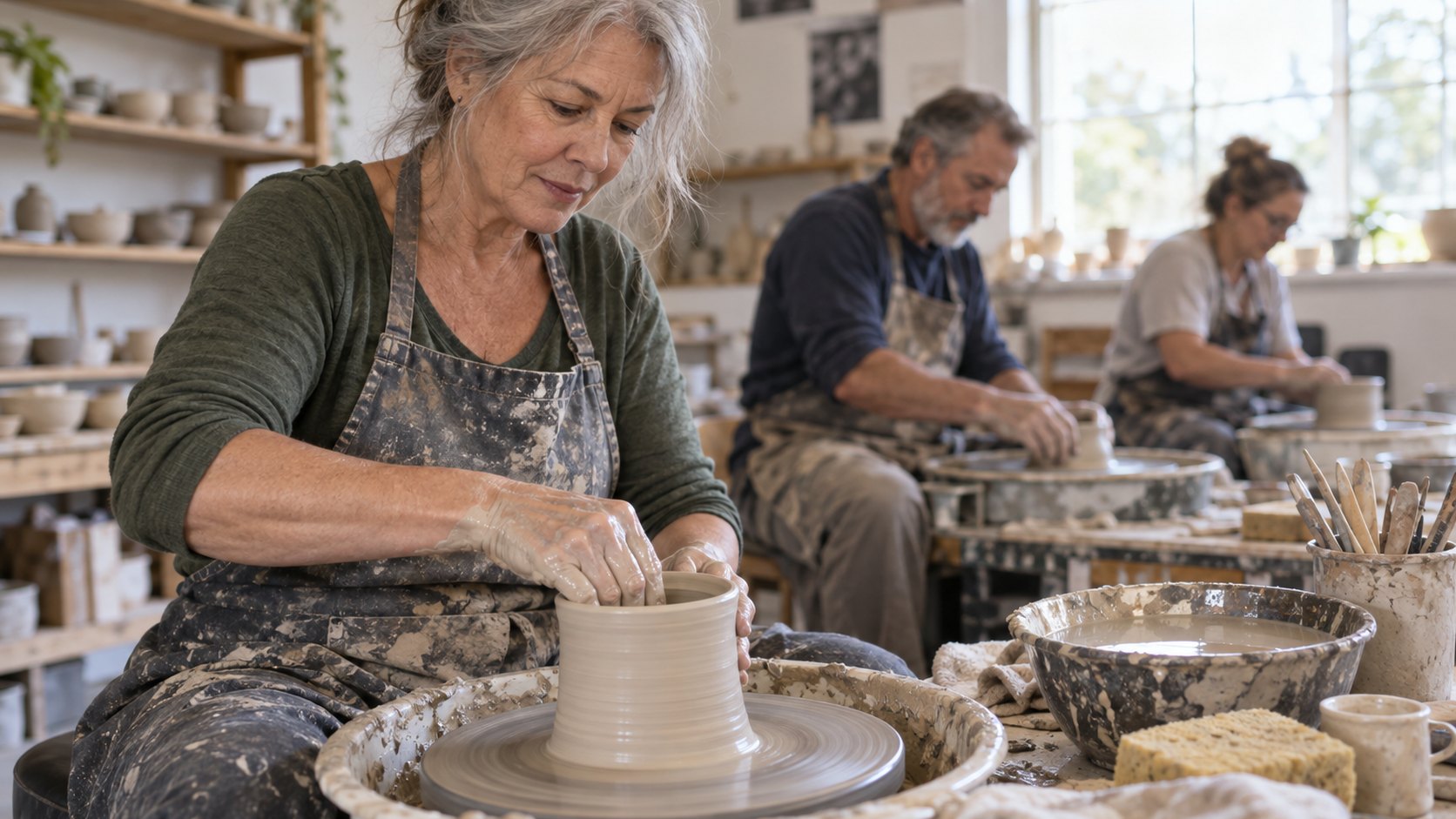
- 🖌️ A craft with progression — photography, quilting, woodwork, drawing: anything with technique levels and visible output.
- 🎯 The dose that worked: 2–3 sessions weekly, 1–2 hours total, for at least 3 months — and ideally indefinitely, because the maintenance literature says the gains track the practice.
⚠️ What won't work
The honest exclusion list: crosswords and sudoku (familiar, narrow — they maintain the specific skill, little else), brain-training apps (the neuroplasticity topic's finding: no meaningful transfer), and passive consumption — documentaries, lectures, podcasts — which are pleasant but don't demand the effort that drives adaptation. The uncomfortable summary: the effective activities are the ones that feel like work. That feeling is the training stimulus.
Learning Questions, Answered Briefly
- I'm already busy — what's the minimum effective dose? The trials used roughly 2–3 sessions weekly; below weekly frequency, gains fade toward maintenance. One genuinely novel skill, twice a week, beats three skills once a month.
- Does an app-based language course count? Yes — the modern trials increasingly use app-supported learning, and the mechanism (novel, progressing, consistent) is identical. Classrooms add social demand, which stacks.
- What if I keep quitting? The habit machinery from the Hobbies topic applies: anchor the sessions to an existing routine, shrink the session until it's un-skippable, and judge at day 90 — quitting usually happens before the habit loop locks.
The Bottom Line
- Late-life learning works — the trials show real memory gains in the 60s–80s.
- Novelty is the active ingredient — familiar-and-easy activities don't count.
- The demanding combination wins — two new skills beat one.
- Pick from the curriculum — language, instrument, or craft — and keep it on the calendar forever.
Go Deeper: Subtopics
- 🔎 The skill-acquisition science at any age — deliberate practice, and how age changes (not ends) learning. Read it →
- 🔎 Which skills pay the most cognitively — languages, instruments, dance: the comparative evidence. Read it →
- 🔎 The 15-minutes-daily protocol — the minimal sustainable learning loop and the habit machinery (links Habit Formation Protocol). Read it →
- 🔎 Quitting well — the exploration-exploitation balance: when to persist and when to switch. Read it →
- 🔎 Learning as social glue — classes and groups: the double benefit of skill + community. Read it →
Related Topics
- Park et al., "The impact of sustained engagement on cognitive function in older adults: the Synapse Project," Psychological Science (2014)
- Bugos et al., "Individualized piano instruction enhances executive functioning and working memory in older adults," Aging & Mental Health (2007)
- Antoniou et al., "Foreign language training as cognitive therapy for age-related cognitive decline," Neuroscience & Biobehavioral Reviews (2013)
- Bialystok et al., "Bilingualism and dementia onset," Neuropsychologia (2007)
- Stine-Morrow et al., "The effects of an engaged lifestyle on cognitive vitality," Psychology and Aging (2008)