Plasticity's Helpers
A learning demand is the spark; the rest of your life decides whether it catches. Sleep consolidates what practice started, exercise fertilizes the machinery that builds it, and social novelty keeps the demand coming. This page assembles the plasticity environment — the three helpers with real evidence, and the limits of everything else.
What the evidence supports
- A year of aerobic exercise increased hippocampal volume in older adults while controls shrank (Erickson et al., PNAS, 2011).
- Sleep is when newly formed memories are consolidated — and deprivation measurably impairs next-day learning (Walker & Stickgold, 2006).
- Socially and cognitively engaging activity associates with lower dementia risk and slower decline in cohorts (Fratiglioni et al., Lancet Neurology, 2004).
What remains uncertain
- The social-activity evidence is observational — people who can engage socially differ in many ways, and reverse causation is possible.
- How the helpers combine (exercise plus sleep plus social) has rarely been tested as a package.
- No supplement has convincing trial evidence as a cognitive enhancer in healthy adults — the ginkgo and nootropic literatures are thin.
Evidence last reviewed: August 15, 2026. Conclusions may change as new research is published.
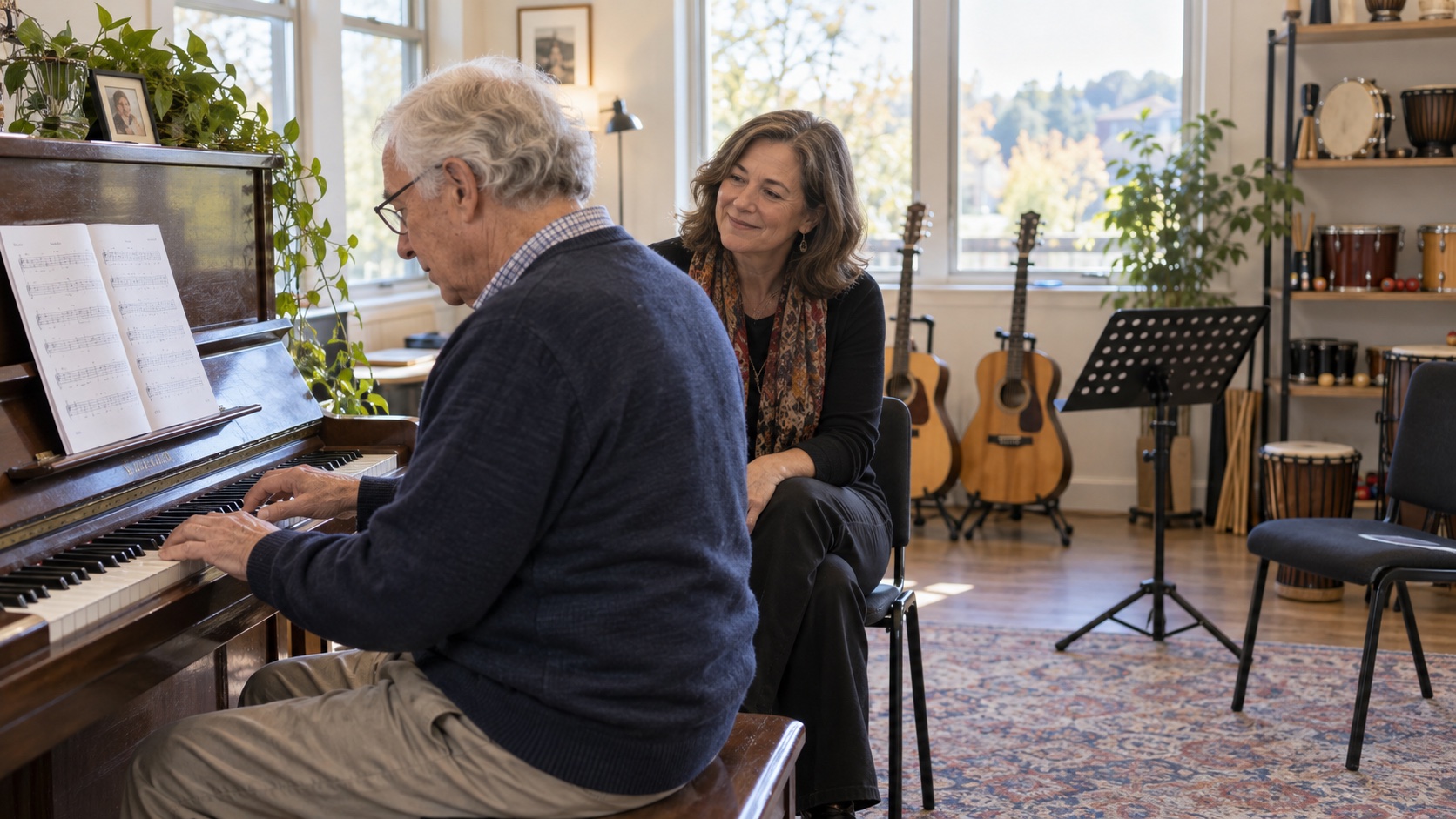
Demand Needs an Environment
The novelty principle supplies the demand; this page supplies the conditions around it. The logic comes straight from the biology in the machinery page: new synapses and myelin are built from resources the body allocates, and the allocation is governed by sleep, movement, and the social world. A brilliantly chosen new skill practiced in a sleep-deprived, sedentary, isolated week is a demand with nowhere to land. The three helpers below are the ones with evidence strong enough to plan around. The environment, not the intention, is what usually separates the person whose new year of learning compounds from the one whose effort evaporates.
Exercise: The Most Replicated Helper
The landmark trial randomized 120 older adults to a year of moderate walking or to stretching controls. The walkers grew their hippocampus by about 2% — reversing a year's worth of typical age-related shrinkage — with gains in memory and serum BDNF, a protein central to synaptic growth; controls lost volume (Erickson et al., PNAS, 2011). Meta-analyses put the finding in context: aerobic exercise reliably increases left hippocampal volume in healthy adults (Firth et al., NeuroImage, 2018), and essentially any exercise mode — aerobic, resistance, or mixed — produces small but consistent cognitive benefits in people over 50 (Northey et al., British Journal of Sports Medicine, 2018). The likely mechanism is the one the animal literature has known for decades: running increases new-neuron formation and growth-factor signaling (van Praag et al., PNAS, 1999). The dose is not exotic — the zone 2 and VO₂ max topics own the prescriptions; the plasticity point is that movement is not just a cardiovascular line item, it is a growth-factor delivery system for the brain.
Sleep: Where the Rewiring Finishes
Practice does not consolidate itself. During sleep, the hippocampus replays the day's activity while the cortex files it — the process that turns fragile, same-day learning into durable skill, and the reason a night of sleep after practice improves performance measurably more than the same hours spent awake (Walker & Stickgold, Annual Review of Psychology, 2006). Sleep deprivation cuts the other way: restricted sleep impairs the consolidation of learned material, so the same practice hour buys less. The sleep pillar owns the full repair science — including the deep-sleep decline that makes older learners need to protect sleep more, not less (see the glymphatic topic for the clearance side). For plasticity specifically, the working rule is blunt: a learning habit without adequate sleep is tuition paid to a school that keeps losing your records.
Social Novelty: Conversation as Cognitive Load
The social helper is the most underrated of the three, because it hides its mechanism. Conversation is a real-time cognitive workout — tracking meaning, tone, and turn-taking, improvising under time pressure — and every new person and situation is, by definition, novel. Cohort evidence is consistent: richer social networks associate with lower dementia risk (Fratiglioni et al., Lancet Neurology, 2004), and social activity in late life associates with slower cognitive decline (James et al., Journal of the International Neuropsychological Society, 2011). The famous leisure-activity study adds the texture: dancing — social, cognitive, and physical at once — carried the strongest association with lower dementia risk among the activities measured (Verghese et al., NEJM, 2003). The conversation topic develops this idea fully, and the loneliness evidence is the inverse: isolation is a demand vacuum. One caution stays in view: these are observational findings, and healthier people socialize more. The mechanism is plausible, the causality is softer than for exercise. Practically, social novelty means roles and people you have not yet learned to predict — a class, a team, a volunteer shift — rather than sheer volume of contact.
The Environment at a Glance
| Helper | What it does for plasticity | Evidence | The dose that counts |
|---|---|---|---|
| 🏃 Exercise | Growth factors (BDNF), hippocampal volume, new-neuron support | Strong | 150+ minutes a week, mixed aerobic and strength |
| 😴 Sleep | Consolidates practice into durable skill; clears metabolic waste | Strong | 7–9 hours, protected consistently |
| 💬 Social novelty | Unscripted cognitive load; novel situations on schedule | Moderate | Regular contact, ideally with new people and activities |
| 💊 Supplements | Claimed enhancers (ginkgo, nootropics) with thin evidence | Weak | None established — spend the money on shoes and sleep |
The Honest Limits
The environment has an out-of-bounds zone worth marking. Ginkgo — the most-studied supplement in this space — did not prevent dementia or cognitive decline in a randomized trial of over 3,000 older adults (DeKosky et al., JAMA, 2008), and the broader nootropic category rests on small, short, often industry-funded studies. The substances topic audits the negative side of the ledger — alcohol, cannabis, and the rest. Stress deserves its own caution: chronically elevated cortisol impairs the same hippocampal machinery the helpers support, which is why the stress pillar belongs in this environment too. The principle throughout: prefer the levers with randomized evidence, and treat the supplement aisle as a hypothesis, not a plan. Caffeine earns an honest footnote: a temporary alertness aid with real effects on wakefulness and no demonstrated role as a plasticity builder — useful for a bad night, never a substitute for the sleep itself.
😴 Without sleep, the lesson never gets filed
Consolidation is the transaction that turns practice into wiring, and it runs overnight. A demanding learning schedule paired with chronic short sleep is the most common way people pay for plasticity they never receive — the demand is real, the deposit never lands. Protect the sleep window with the same seriousness you give the practice window; the sleep protocol is the operating manual.
Assembling the Environment
The helpers are not a to-do list bolted onto learning; they are the multiplier that decides whether a year of effort compounds or evaporates. A minimal, evidence-aligned week around any learning goal looks like this:
- 🎯 Three to four practice sessions on the new skill, at the edge of competence — the demand side, per the novelty principle.
- 🛏️ A fixed sleep anchor of 7–9 hours, protected on practice days especially — consolidation is booked nightly.
- 🏃 Two to three movement sessions totaling 150+ minutes, mixing aerobic and strength — the growth-factor delivery.
- 💬 At least one genuinely social, unscripted engagement a week — a class, a club, a new person — keeping the demand social as well as cognitive.
Each helper earns its place independently, which is the point: the environment works even before the skill is chosen. Set the conditions, and the demand — whatever you pick — has somewhere to land. That is the closing loop of this series, and it connects back to the whole pillar: how the brain ages is largely a story of these conditions eroding, which means it is also a story you can edit. None of the helpers is exotic, and each doubles as a pillar elsewhere on this site — the quiet point being that the plasticity environment is the longevity environment, aimed at the brain.
The Bottom Line
- Exercise is the strongest helper — a year of walking grew hippocampal volume while controls shrank (Erickson et al., 2011).
- Sleep is where practice becomes skill — consolidation runs overnight, and short sleep silently caps what learning can buy.
- Social novelty is real but softer evidence — strong cohorts, plausible mechanism, no randomized proof; conversation is unscripted cognitive load.
- Supplements are the weak corner — even ginkgo failed its big trial; the environment is built from sleep, movement, and people.
Related Topics
- Erickson et al., "Exercise training increases size of hippocampus and improves memory," PNAS (2011)
- Firth et al., "Effect of aerobic exercise on hippocampal volume in humans: a systematic review and meta-analysis," NeuroImage (2018)
- Northey et al., "Exercise interventions for cognitive function in adults older than 50: a systematic review with meta-analysis," British Journal of Sports Medicine (2018)
- Walker & Stickgold, "Sleep, memory, and plasticity," Annual Review of Psychology (2006)
- Fratiglioni et al., "An active and socially integrated lifestyle in late life might protect against dementia," Lancet Neurology (2004)
- James et al., "Late-life social activity and cognitive decline in old age," Journal of the International Neuropsychological Society (2011)
- Verghese et al., "Leisure activities and the risk of dementia in the elderly," New England Journal of Medicine (2003)
- DeKosky et al., "Ginkgo biloba for prevention of dementia: a randomized controlled trial," JAMA (2008)
- van Praag et al., "Running enhances neurogenesis, learning, and long-term potentiation in mice," PNAS (1999)