Plant vs animal protein
Plant and animal proteins are not interchangeable gram for gram — the difference is one amino acid, leucine, and how much of it each source delivers. Plant-based eaters can absolutely maintain and build muscle, but the evidence says they pay a roughly 30% dose penalty unless they plan for it. This page explains the gap, the offset, and the mixing strategies that close it without eating a field of beans.
What the evidence supports
- Plant protein isolates carry less leucine per gram than animal sources — roughly 6–9% vs 9–11% of protein (Amino Acids, 2018).
- At matched doses, plant proteins stimulate less muscle protein synthesis than animal proteins (Journal of Nutrition, 2015).
- With adequate totals and training, plant-based diets support muscle gains comparable to omnivorous ones (Sports Medicine, 2021).
What remains uncertain
- The exact size of the plant "offset" varies by source, age, and whether leucine is added — estimates cluster around 20–40% more protein.
- Long-term trials in older adults comparing plant and animal protein for muscle are scarce.
- Whether plant protein's lower leucine matters at very high total intakes is not fully resolved.
Evidence last reviewed: August 15, 2026. Conclusions may change as new research is published.
The Leucine Gap
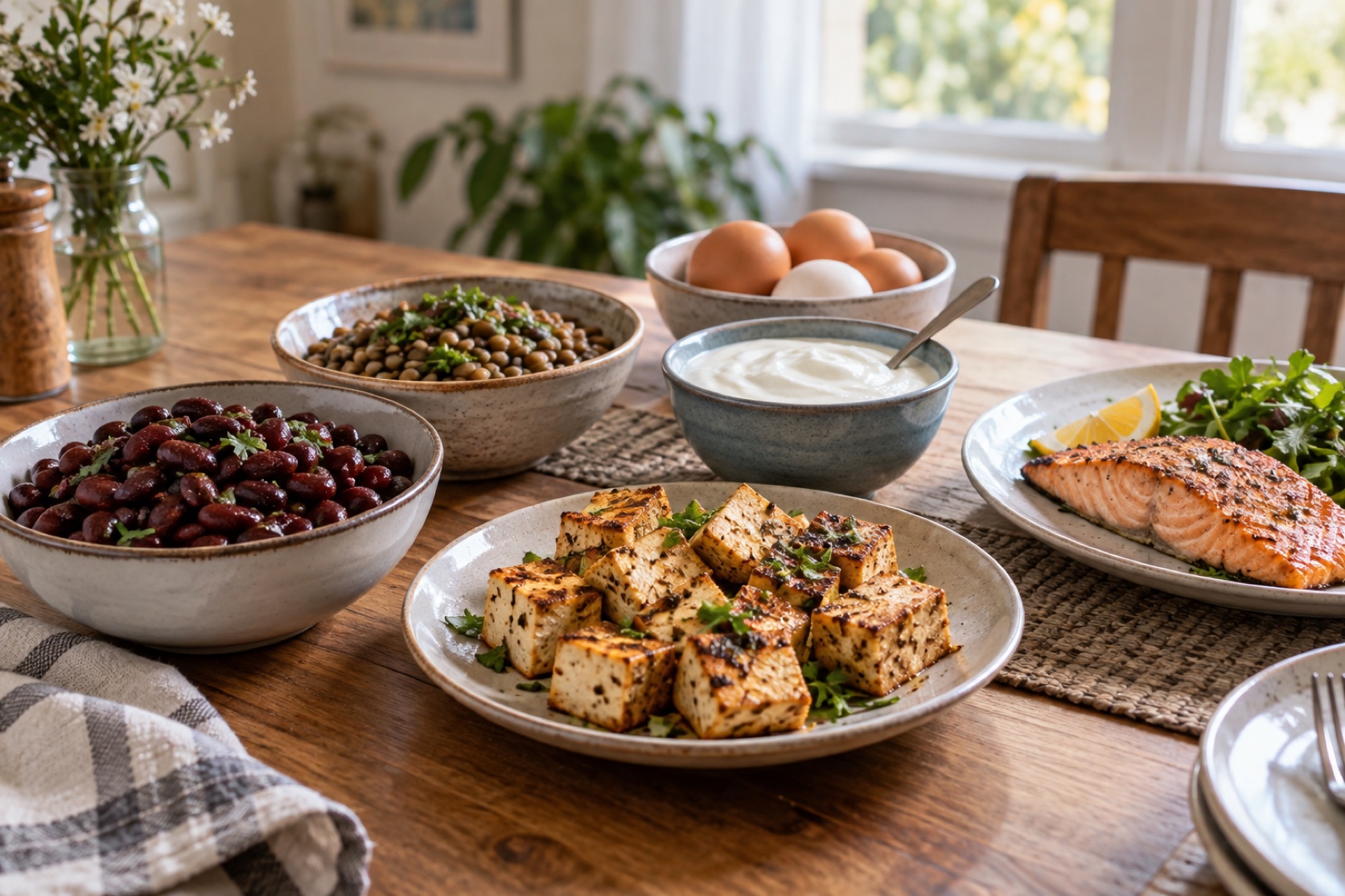
Muscle protein synthesis is triggered when a meal delivers enough leucine — roughly 2.5–3 grams in one sitting — on top of all nine essential amino acids. The parent topic covers the trigger; this page is about what happens when your protein source is a plant. A systematic analysis of commercial isolates (Amino Acids, 2018) found leucine makes up about 11% of whey protein, but only 8–9% of soy and pea and less in wheat and rice. The arithmetic follows: a 25 g scoop of whey carries ~2.7 g of leucine and clears the trigger; a 25 g serving of pea carries ~2.1 g and lands short; 25 g of wheat protein carries under 2 g. It is not that plants lack leucine — it is that you need a larger serving of them to hit the same trigger. Everything else on this page flows from that concentration difference.
Product picks are generic categories, not brands. We may earn a commission on Amazon or iHerb purchases at no cost to you — this never changes our evidence conclusions. Full disclosure
Protein powder
A convenient way to add dietary protein when food intake is insufficient or impractical.
⚠️ May cause digestive symptoms; formulation matters for allergies and intolerances. It does not replace a varied diet.
Check price on Amazon →The ~30% Offset: Where It Comes From
Dose-matched experiments show the gap directly. Soy protein at the same gram dose as whey stimulated less muscle protein synthesis both at rest and after exercise in young men (Journal of Applied Physiology, 2009), and a review of plant-versus-animal feeding trials found the same pattern across sources — wheat, soy, and rice all underperforming animal protein at equal doses (Journal of Nutrition, 2015). The escape hatch is interesting: when researchers added leucine to a suboptimal protein dose, the muscle response was rescued (Journal of Physiology, 2012), and co-ingesting leucine with a plant protein improved muscle protein accretion in older men (Clinical Nutrition, 2013). That pinpoints leucine — not "animal magic" — as the limiting factor. The practical translation: to generate the same anabolic signal from plants, eat roughly 20–40% more plant protein per meal, commonly rounded to ~30%. Applied to the per-meal numbers from the distribution page: where an omnivore needs 30 g, a plant-based eater plans ~40 g, or fortifies the meal toward the leucine trigger.
Quality Scores: DIAAS and Completeness
The second difference is encoded in formal quality scoring. Modern systems (the digestible indispensable amino acid score, or DIAAS, from the FAO's 2013 report) grade proteins on digestibility and essential-amino-acid balance rather than nitrogen alone. Soy scores close to animal proteins; most legumes and grains score lower because they are short on one or two essentials — typically lysine in grains and methionine in legumes. The old "complete protein" pairing wisdom (beans with rice, hummus with bread) exists because each source covers the other's gap. Two modernizations: the pairing does not need to happen at the same meal — the body pools amino acids over roughly 24 hours — and leucine still needs a threshold per meal, which quality scores alone do not guarantee. A perfectly "complete" plant day can still undershoot the trigger at breakfast if the leucine is spread thin.
What the Longer Trials Actually Show
The good news for plant-based eaters arrives when totals are adequate. In an eight-week resistance-training trial, rice protein isolate produced gains in lean mass and strength that were not meaningfully different from whey's (Nutrition Journal, 2013). A larger 12-week trial put habitual vegans and omnivores on protein-matched high-protein diets (~1.6 g/kg) during training: both groups gained comparable lean mass and strength (Sports Medicine, 2021). The pattern across studies: at intakes that clear the leucine trigger each meal, plant protein supports muscle nearly as well as animal protein; the deficit shows up at sub-trigger doses, which is exactly where casual plant-based diets live. Translation: the offset is a dose-and-timing problem, not a fundamental limit — solve the arithmetic and the biology cooperates.
The Volume Problem
Why don't plant-based eaters just eat 40 g per meal? Because plant protein arrives with fiber and water. Hitting 30 g of protein from whole lentils means roughly two cups of cooked lentils — a genuinely filling, slow meal — and 40 g is more than most people want to chew at breakfast. This is not a failure of willpower; it is a food matrix reality. The workarounds, in descending order of practicality:
- 🫛 Soy foods first. Tofu, tempeh, and edamame are concentrated, complete, and leucine-reasonable — far easier to hit 30 g with than whole beans.
- 🥤 Blends and powders. A pea-plus-rice blend closes the lysine gap and delivers leucine at close-to-whey density — the pragmatic breakfast fix (the powder page covers quality and third-party testing).
- 🍚 Legume-plus-grain pairings. Still the backbone of lunch and dinner: lentils with rice, beans with tortillas, chickpeas with couscous — pairing completes the amino-acid profile across the day.
- 🧮 Slightly higher total target. Aim at ~1.6 g/kg rather than 1.2, matching the band page's upper end — the total helps cover per-meal shortfalls without perfect precision.
| Source | Typical serving | Protein | Approx. leucine | Practical note |
|---|---|---|---|---|
| 🥛 Whey scoop (reference) | 25 g powder | ~20–25 g | ~2.5–2.7 g | Clears the trigger alone |
| 🫛 Tofu / tempeh | 150 g | ~12–25 g | ~1.3–2.0 g | Pair with grains or add volume |
| 🫘 Lentils, cooked | 1 cup | ~18 g | ~1.2 g | Filling; combine with rice |
| 🟢 Edamame | 1 cup | ~18 g | ~1.4 g | Concentrated soy; snack-friendly |
| 🥣 Pea + rice blend | 1 scoop | ~20–25 g | ~2.0–2.3 g | Near whey; convenient breakfast |
🫛 The two-sentence plant playbook
Target ~1.6 g/kg daily, anchor every meal on soy or a pea-rice blend to clear the leucine trigger, and pair legumes with grains across the day. If a meal falls short, adding a little more total — not perfection — is the fix. Also consider creatine monohydrate, which plant-based diets deliver almost none of: the supplements topic scores it honestly.
Plant Protein's Longevity Dividend
The comparison cuts both ways. When a large cohort study separated animal from plant protein, higher plant protein intake was associated with lower all-cause and cardiovascular mortality, while animal protein showed the opposite association (JAMA Internal Medicine, 2016) — though such observational splits are heavily confounded by who eats what and how they otherwise live. The mechanistic story is plausible regardless: plant proteins arrive bundled with fiber, polyphenols, and less saturated fat, feeding both the hormetic benefits of plant-heavy diets and the gut microbiota. So the honest framing is not "which protein wins" but which total package: animal protein is the more concentrated muscle signal; plant protein is the better longevity bundle — and a mixed pattern (plant-dominant, with some animal or fortified plant protein) captures most of both. The gut topic owns the microbiota half of that trade.
Questions, Answered Briefly
- 🍱 Do I need to combine proteins at every meal? No. Variety across the day is enough — the body pools amino acids over about 24 hours. Only leucine needs to clear its threshold at each individual meal.
- 👨 Does soy lower testosterone? Controlled trials in men find no meaningful effect of soy foods or isolates on testosterone. The men's health topic covers the hormone decline that is real — and it is not caused by tofu.
- 🥤 Is pea protein as good as whey? At equal leucine (i.e., a slightly larger pea dose or a pea-rice blend), the muscle response is close; the eight-week rice-vs-whey trial found no meaningful difference in outcomes (Nutrition Journal, 2013).
- 🌾 What about quinoa and hemp? Quinoa is complete but low-density; hemp is modest in leucine. Both are fine contributors — just don't count on them to clear the per-meal trigger alone.
The Bottom Line
- The difference is leucine concentration. Whey carries ~11% leucine; soy and pea ~8–9%; wheat less. Equal grams are not equal signals (Amino Acids, 2018).
- Plan for a ~30% offset. Where an omnivore eats 30 g per meal, a plant-based eater plans ~40 g — or fortifies with leucine-rich soy, blends, or added leucine.
- The offset is solvable arithmetic, not a ceiling. With ~1.6 g/kg and training, plant-based eaters gain muscle comparably to omnivores (Sports Medicine, 2021).
- Play both sides deliberately. Animal protein is the concentrated signal; plant protein is the longevity bundle — a plant-dominant mix with strategic animal or fortified sources captures most of each.
Related Topics
- Gorissen et al., "Protein content and amino acid composition of commercially available plant-based protein isolates," Amino Acids (2018)
- van Vliet, Burd & van Loon, "The skeletal muscle anabolic response to plant- versus animal-based protein consumption," The Journal of Nutrition (2015)
- Tang et al., "Ingestion of whey hydrolysate, casein, or soy protein isolate: effects on mixed muscle protein synthesis at rest and following resistance exercise in young men," Journal of Applied Physiology (2009)
- Churchward-Venne et al., "Supplementation of a suboptimal protein dose with leucine or essential amino acids: effects on myofibrillar protein synthesis at rest and following resistance exercise in men," The Journal of Physiology (2012)
- Joy et al., "The effects of 8 weeks of whey or rice protein supplementation on body composition and exercise performance," Nutrition Journal (2013)
- Hevia-Larraín et al., "High-protein plant-based diet versus a protein-matched omnivorous diet to support resistance training adaptations: a comparison between habitual vegans and omnivores," Sports Medicine (2021)
- Song et al., "Association of animal and plant protein intake with all-cause and cause-specific mortality," JAMA Internal Medicine (2016)
- FAO, "Dietary protein quality evaluation in human nutrition," FAO Food and Nutrition Paper 92 (2013)