Physical vs Creative vs Social Hobbies
Most hobby advice asks "which one?" — the wrong question, because the evidence doesn't care much what the activity is. It cares which family it belongs to, because each family moves a different part of the survival machinery. This page sorts the research into three families, shows what each one buys, and makes the case that a durable leisure life holds one of each.
What the evidence supports
- Physical hobbies carry the largest and cleanest mortality literature — pooled cohorts of hundreds of thousands of adults.
- Social hobbies rest on one of the most replicated findings in epidemiology: relationship quantity and quality predict survival.
- Creative hobbies show associations with lower depression risk and, for receptive arts, lower mortality; active making has a thinner but growing evidence base.
What remains uncertain
- No study has randomized people to "one of each" and compared outcomes — the portfolio idea is inference, not a finding.
- Family boundaries blur: dance is physical and social, choir is creative and social, and most hobbies bundle mechanisms.
- Whether the three families are additive, redundant, or synergistic is unknown.
Evidence last reviewed: August 15, 2026. Conclusions may change as new research is published.
The Three Families
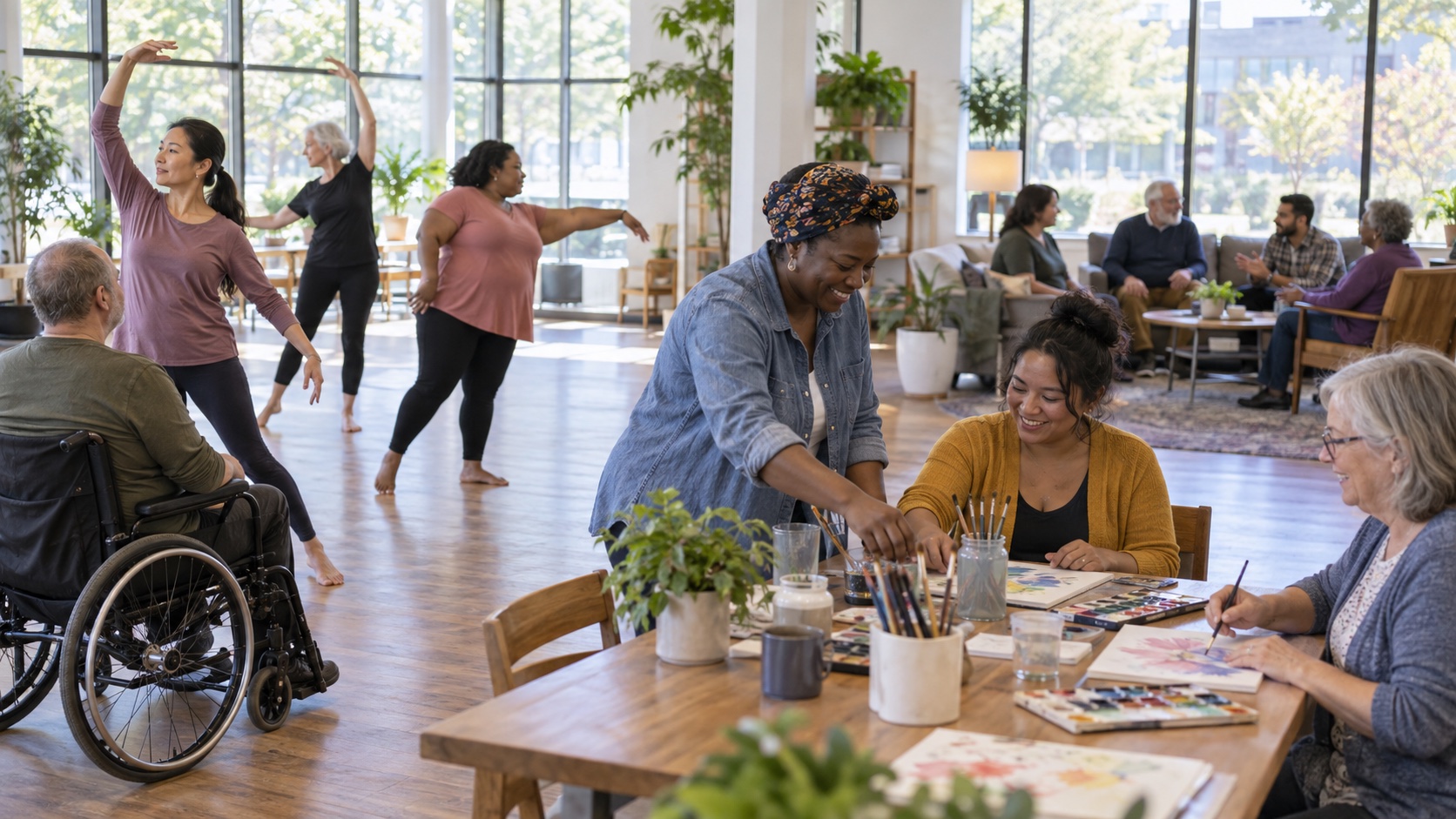
Strip the labels off any hobby and three ingredients remain: the body moves, the mind makes something, or people share it. Those are the families, and the research treats them almost independently — exercise epidemiologists study the first, social epidemiologists the second, and an emerging arts-and-health field the third. The cohort numbers page showed that engagement of any kind tracks with survival; this page is about which family moves which outcome, and why the families are complements rather than substitutes.
- 🏃 Physical: movement with a game, a goal, or a place attached — tennis, hiking, gardening, dance, swimming.
- 🤝 Social: doing something alongside others — choir, board-game clubs, team sports, volunteering, walking groups.
- 🎨 Creative: making or receiving art — music, painting, writing, craft, photography, museums, theatre.
- 🧩 The overlap: most real hobbies score in two or even three families at once, and the overlap is where the compounding happens.
A useful way to read the parent Hobbies & Habits topic is through this lens: the habit machinery builds the schedule, and the families decide what the schedule contains. Choose only one family and you leave two channels idle.
Product picks are generic categories, not brands. We may earn a commission on Amazon or iHerb purchases at no cost to you — this never changes our evidence conclusions. Full disclosure
Comfortable walking shoes
May improve comfort and consistency for walking-based activity.
⚠️ Footwear cannot correct every pain problem; persistent foot, knee, or hip pain warrants appropriate evaluation.
Check price on Amazon →The Physical Family
Physical hobbies have the deepest evidence by a wide margin, because researchers have spent decades measuring leisure-time activity in MET-hours and matching it to death records. The headline: adults doing 22.5 to 40 MET-hours per week of leisure-time activity show about a 39% lower mortality rate than inactive adults in pooled cohorts of over 660,000 people (Arem et al., JAMA Internal Medicine, 2015). The number belongs to the cohort evidence page; the hobby-relevant insight here is narrower and more practical: activity that is also play persists longer.
Sports and games survive where gym routines die, because they bundle challenge, company, and fun into the same hour. Gardening is the quiet star of this family — a meta-analysis of the gardening literature found consistent associations with lower depression and anxiety, better well-being, and reduced BMI across a wide range of studies (Soga et al., Preventive Medicine Reports, 2017). For anyone who finds scheduled exercise joyless, a physical hobby is not a consolation prize; it is the same dose wearing a better costume. The 3-2-1 training topic explains how sports slot into a formal training week without wrecking recovery.
The Social Family
The social family rests on the most replicated relationship in behavioral epidemiology. A meta-analysis of 148 studies covering 308,849 participants found that people with stronger social relationships had a 50% increased likelihood of survival over follow-up periods averaging seven and a half years — an effect size on par with quitting smoking and larger than most things people take pills for (Holt-Lunstad et al., PLOS Medicine, 2010). Hobbies are one of the few legitimate ways adults manufacture that exposure: a weekly game night is a friendship maintenance system disguised as a pastime.
The mechanism stack is unusually concrete. Companions buffer stress in ways that show up in cortisol and blood pressure; accountability partners keep you showing up; and group identity — being "one of the Tuesday runners" — is a durable source of the daily meaning the small-purpose topic describes. The deeper account of how to build and sustain these groups lives in the building-your-tribe topic; for hobby purposes, the rule is simple: if an activity can be done with people, doing it with people upgrades it.
The Creative Family
The creative family has the youngest evidence base and, so far, the most encouraging one. The ELSA arts analysis — roughly 6,700 adults followed for 14 years — found frequent receptive arts engagement associated with about 31% lower mortality (Fancourt & Steptoe, BMJ, 2019), and the same research group found cultural engagement associated with a meaningfully lower risk of incident depression in older adults (Fancourt & Steptoe, British Journal of Psychiatry, 2018). Active making has less survival data but its own landmark: in the creativity-and-aging study, older adults randomized to weekly professionally led cultural programs — chorale groups were the flagship — showed better physical health, morale, and activity than controls over two years (Cohen et al., The Gerontologist, 2006).
What makes the creative family interesting for longevity is not the physiology — it is the mastery. Making things feeds the challenge-skill loop directly, which is why craft hobbies are among the most reliable generators of the state the flow page dissects. A person who is learning a new piece, a new technique, or a new project has a reason to concentrate, and concentration is the point of leisure most adults have forgotten how to pay for.
Why One of Each
The case for a portfolio is that the three families move different outcomes through different mechanisms: physical hobbies move cardiovascular and metabolic risk, social hobbies move the stress-and-survival machinery, creative hobbies move mood and cognition. The chart below puts the headline number from each family side by side — with the warning that they come from different studies, different populations, and different outcome definitions, so the bars are magnitudes to sense, not a horse race.
| Family | What it looks like | What it moves most | Evidence grade |
|---|---|---|---|
| 🏃 Physical | Tennis, hiking, gardening, dance, swimming, cycling | Mortality, cardiovascular and metabolic risk, function | Strong |
| 🤝 Social | Choir, game clubs, team sports, volunteering, walking groups | Survival odds, depression risk, functional disability | Strong |
| 🎨 Creative | Music, painting, writing, craft, photography, museums | Depression risk, well-being, mortality (receptive arts) | Moderate |
| 🧩 Combo | Dance class, community choir, club sport — two or three families at once | Several outcomes through one calendar slot | High value |
Building the Portfolio Without Overloading
"One of each" is a compass, not a shopping list — three new hobbies started in the same month is how the over-commitment trap begins. The sane build order is one family at a time, installed the way the habit formation protocol installs anything: pick the family you are missing, run the 4-week trial, and only then consider the next slot.
- 🎯 Fill the gap first. Desk worker with a gym habit? You are missing creative, not physical. Retired and often alone? Social is the gap. Build what is absent.
- 🧩 Prefer overlap when possible. A dance class scores physical plus social; a community choir scores creative plus social. Overlaps give you two families for one commitment.
- ⏳ One new family per season. Three trials a year covers the full portfolio without a single week of over-commitment.
- 📉 A family can retire. If the body forces the physical hobby out, that is a replacement decision, not a portfolio collapse — swap within the family, keep the other two.
🧩 A portfolio, not a to-do list
The point of one of each is resilience: when one family is unavailable — injury pauses the physical hobby, a move scatters the social one — the other two hold the structure. But a portfolio you resent is worse than a single hobby you love. Two families done well beats three done resentfully, every time. Start with one, and let the evidence of your own calendar decide whether a second earns its slot.
Questions, Answered Briefly
- 🏃 Does my gym workout count as the physical hobby? Physiologically yes — the dose-response doesn't care about the costume. But if training feels like work and you skip it when tired, a play-flavored physical hobby is worth adding anyway: it is the one that survives life.
- 🖥️ Do online communities count as social? Partially. Weak ties and text interaction carry some benefit, but the strongest evidence involves real-time, in-person, or voice interaction. A Discord server is a start, not a substitute.
- 🎨 Is consuming art a creative hobby? The receptive arts — museums, concerts, theatre — carry their own evidence for mortality and depression, so yes, attendance counts. It just doesn't build the mastery loop that making does.
- 🧩 Can one hobby really cover all three? A competitive team sport with a skill component — doubles tennis, a dance troupe — comes close. If you have one such hobby and it is durable, you may already have your portfolio. Most people don't, which is why the gap-first logic works.
The Bottom Line
- Hobbies sort into three families — physical, social, and creative — each with its own evidence base and its own mechanisms.
- Each family moves different outcomes — physical moves metabolic and cardiovascular risk, social moves survival odds and mood, creative moves depression risk and mastery.
- One of each is a resilience portfolio — when one family is unavailable, the other two hold the structure.
- Build it one family at a time — fill the missing gap first, prefer overlapping activities, and let a trial decide before the calendar does.
Related Topics
- Holt-Lunstad et al., "Social relationships and mortality risk: a meta-analytic review," PLOS Medicine (2010)
- Arem et al., "Leisure time physical activity and mortality: a detailed pooled analysis," JAMA Internal Medicine (2015)
- Fancourt & Steptoe, "The art of life and death: 14 year follow-up analyses of associations between arts engagement and mortality in the English Longitudinal Study of Ageing," BMJ (2019)
- Fancourt & Steptoe, "Cultural engagement and incident depression in older adults: evidence from the English Longitudinal Study of Ageing," British Journal of Psychiatry (2018)
- Cohen et al., "The impact of professionally conducted cultural programs on the physical health, mental health, and social functioning of older adults," The Gerontologist (2006)
- Soga et al., "Gardening is beneficial for health: a meta-analysis," Preventive Medicine Reports (2017)